On this page
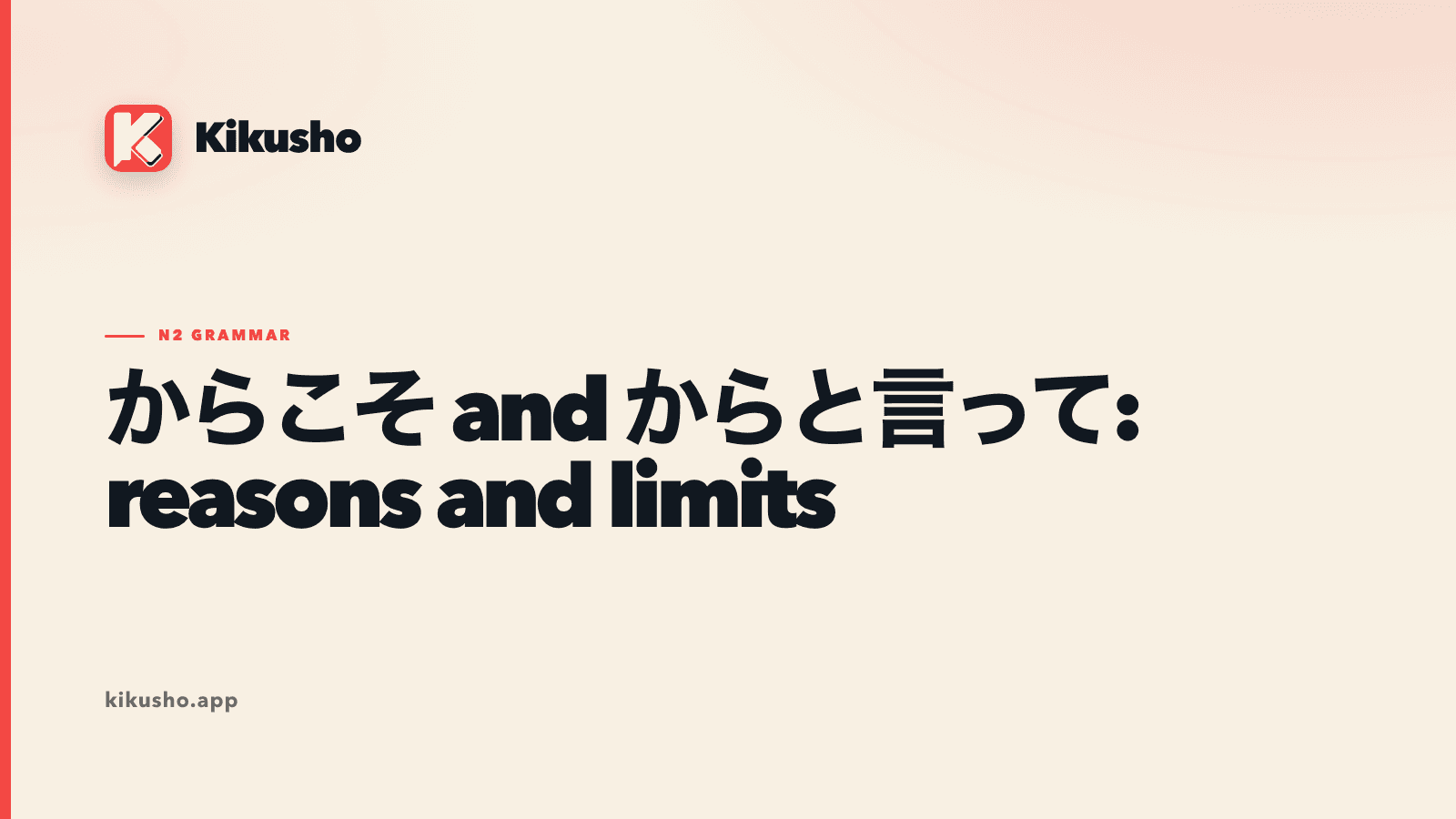
Use AからこそB when you affirm A as the special or decisive reason for B: “precisely because A, B.” Use Aからと言ってB when you reject an inference or permission based on A: “just because A, it does not follow that B.”
The contrast becomes clear when the same reason appears in both frames:
親しいからこそ、本当のことを言う。
したしいからこそ、ほんとうのことをいう。
Precisely because we are close, I tell you the truth.
親しいからと言って、何を言ってもいいわけではない。
したしいからといって、なにをいってもいいわけではない。
Just because we are close does not mean it is acceptable to say anything.
The first speaker confirms the link between closeness and honesty. The second speaker limits what closeness can justify.
Two moves that begin with a reason
Both patterns begin with causal から, but the material after it changes the argument.
| Pattern | Speaker's move | Useful English cue |
|---|---|---|
| AからこそB | selects A as the especially important cause of B | precisely because A; it is because A that B |
| Aからと言ってB | rejects A as sufficient proof or justification for B | just because A does not mean B |
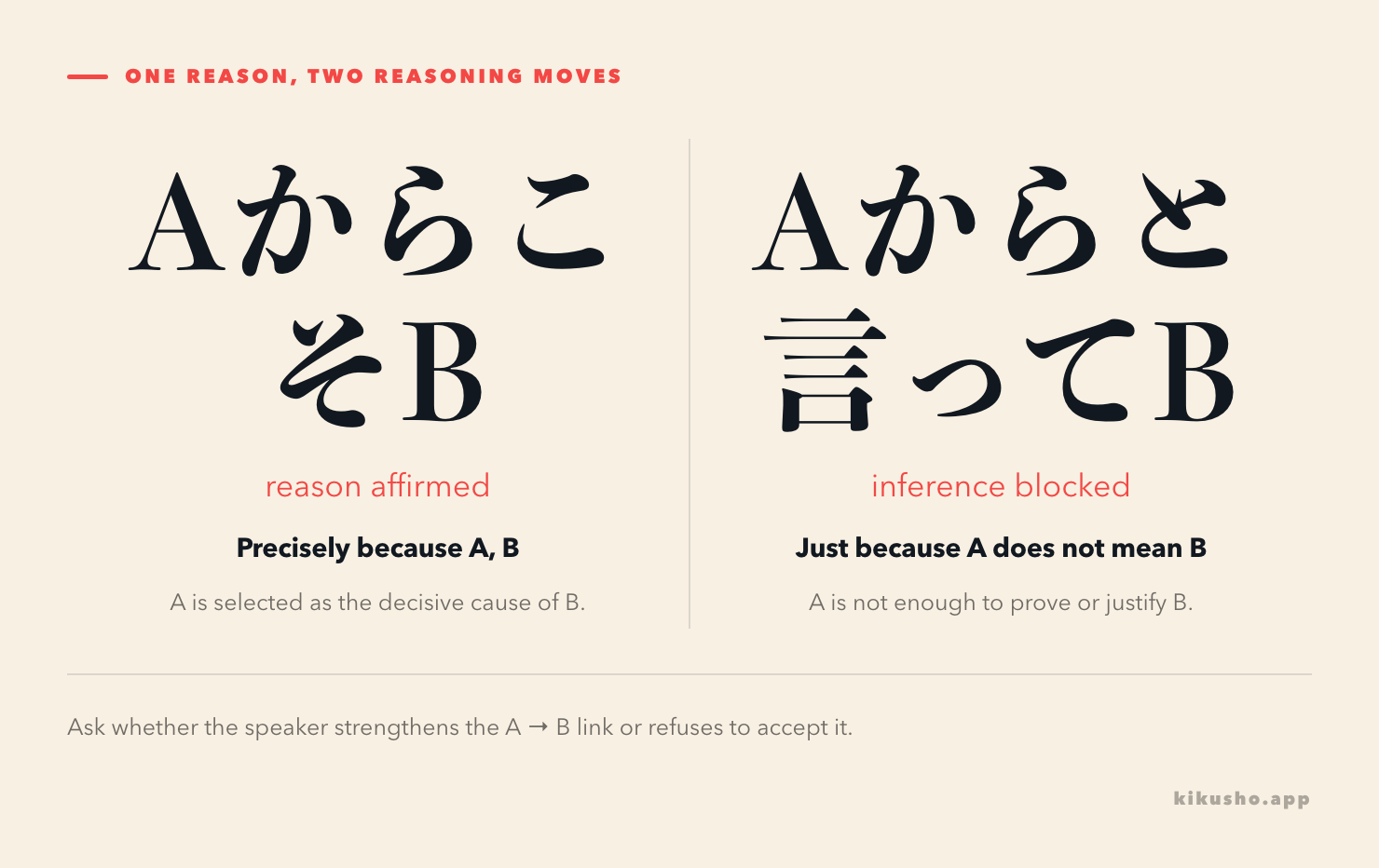
Do not choose by whether A sounds positive or negative. Choose by what the speaker does with the A → B link. からこそ strengthens it. からと言って says that the link is too weak, too broad or unacceptable.
からこそ singles out the decisive reason
からこそ is causal から followed by emphatic こそ. It does more than give a cause: it presents that cause as the one that especially explains the result.
失敗したからこそ、準備の大切さが分かった。
しっぱいしたからこそ、じゅんびのたいせつさがわかった。
It was precisely because I failed that I understood the importance of preparation.
Failure usually seems undesirable, yet the speaker selects it as the source of later understanding. This reversal makes からこそ natural. The form also works without a surprising result:
毎日練習したからこそ、自信を持って演奏できた。
まいにちれんしゅうしたからこそ、じしんをもってえんそうできた。
It was precisely because I practised every day that I could perform confidently.
The Japan Foundation describes からこそ as highlighting a reason subjectively and notes that のだ/んだ often follows the result. That explanatory ending is natural, but it is not required:
相手を信頼しているからこそ、任せたんです。
あいてをしんらいしているからこそ、まかせたんです。
It is precisely because I trust them that I left it to them.
Plain から would simply report the reason. Adding こそ asks the listener to recognize this reason as decisive, perhaps in answer to a misunderstanding. If there is no contrast, defence or special emphasis, plain から is usually enough.
からと言って blocks an inference
In Aからと言ってB, と言って frames a possible line of reasoning based on A. The speaker then denies, restricts or criticizes B.
日本に長く住んでいるからと言って、日本語が完璧だとは限らない。
にほんにながくすんでいるからといって、にほんごがかんぺきだとはかぎらない。
Living in Japan for a long time does not necessarily mean that one's Japanese is perfect.
The sentence does not deny the residence. It rejects the proposed conclusion that long residence guarantees perfect Japanese. Common continuations make this rejection explicit:
- 〜とは限らない: the conclusion is not guaranteed.
- 〜わけではない: that interpretation does not follow.
- 〜とは言えない: the speaker cannot make that claim.
- 〜てはいけない/〜べきではない: A does not justify an action.
安いからと言って、必要のない物まで買うべきではない。
やすいからといって、ひつようのないものまでかうべきではない。
Just because something is cheap, you should not buy things you do not need.
忙しいからと言って、連絡しなくていいわけではない。
いそがしいからといって、れんらくしなくていいわけではない。
Being busy does not mean that it is fine not to contact anyone.
A National Institute for Japanese Language and Linguistics analysis describes this function as denying an inference. It also shows why an explicitly negative ending is common but not obligatory. A criticism, doubt or undesirable consequence can do the rejecting:
雨だからと言って、予定をすぐ変えるのは早い。
あめだからといって、よていをすぐかえるのははやい。
It is premature to change the plan immediately just because it is raining.
早い is grammatically affirmative, but the judgement is negative: rain alone does not warrant the decision.
Attach both patterns to the same forms
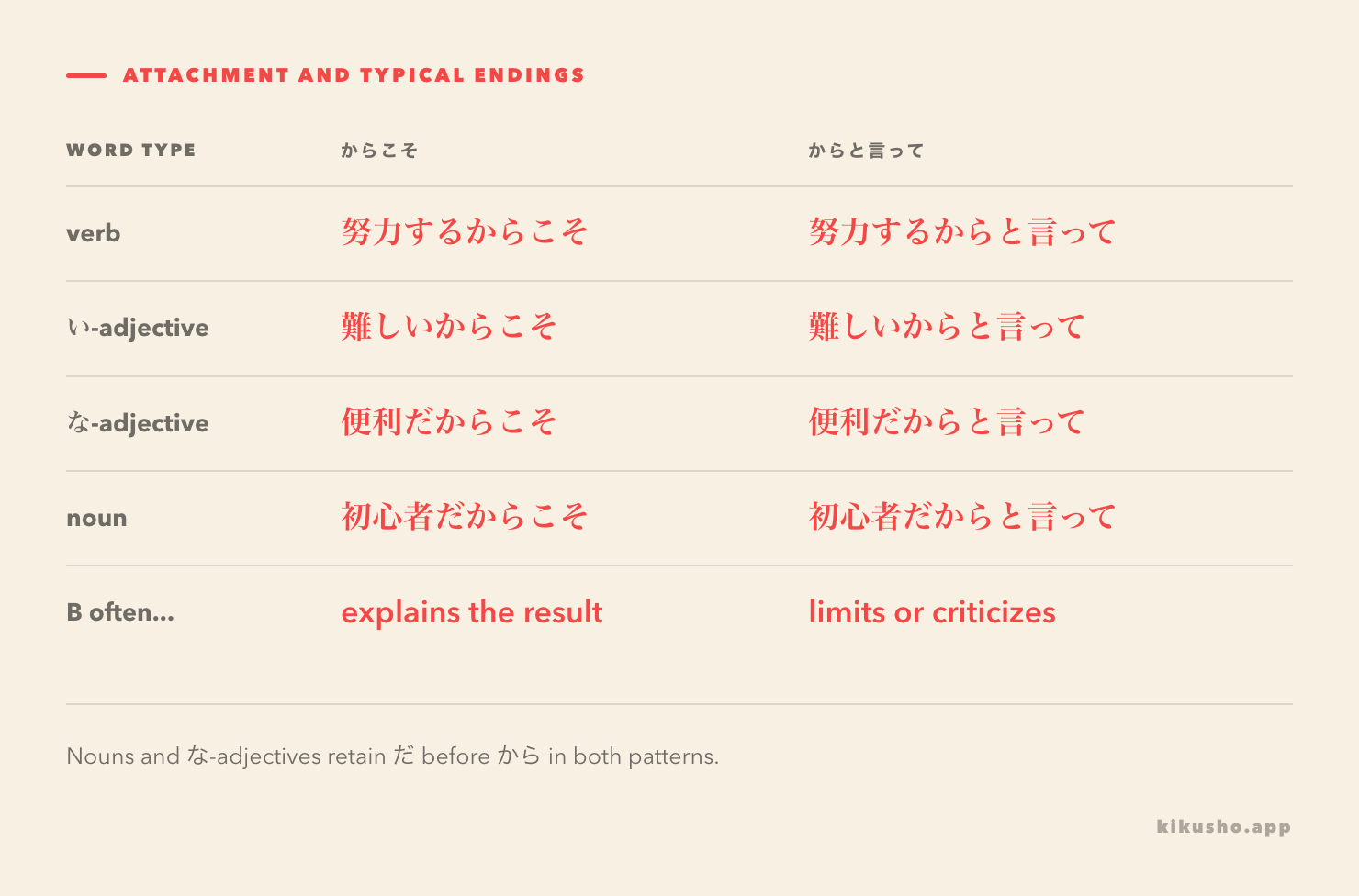
Verbs and い-adjectives use their plain forms. Nouns and な-adjectives retain だ before から.
| Word before the pattern | With からこそ | With からと言って |
|---|---|---|
| verb | 努力するからこそ | 努力するからと言って |
| い-adjective | 難しいからこそ | 難しいからと言って |
| な-adjective | 便利だからこそ | 便利だからと言って |
| noun | 初心者だからこそ | 初心者だからと言って |
The noun contrast is worth memorizing as a pair:
初心者だからこそ、基本を丁寧に学ぶべきだ。
しょしんしゃだからこそ、きほんをていねいにまなぶべきだ。
Precisely because you are a beginner, you should learn the basics carefully.
初心者だからと言って、簡単な問題だけを選ぶ必要はない。
しょしんしゃだからといって、かんたんなもんだいだけをえらぶひつようはない。
Just because you are a beginner, you do not need to choose only easy problems.
Sentence-initial だからこそ and だからと言って refer back to a reason already stated. だからこそ、挑戦したい means “That is precisely why I want to try.” だからと言って、諦める必要はない means “Even so, that does not mean we need to give up.”
Test whether B is being supported or restrained
Imagine a difficult project. One speaker says:
難しいからこそ、挑戦する価値がある。
むずかしいからこそ、ちょうせんするかちがある。
Precisely because it is difficult, it is worth attempting.
Difficulty directly supports the value of the challenge. Another speaker says:
難しいからと言って、最初から諦める必要はない。
むずかしいからといって、さいしょからあきらめるひつようはない。
Just because it is difficult, there is no need to give up from the start.
Now difficulty could lead someone to give up, and the speaker blocks that response. The situation and reason have not changed. The direction of the argument has.
This is also why からと言って is more specific than a general “although.” It does not merely put two unexpected facts together. It presents A as a possible basis for B and refuses to accept that reasoning.
Keep neighboring patterns separate
からこそ and からには both make causal から emphatic, but their focus differs. AからこそB puts weight on A as the special reason. AからにはB accepts A as a commitment or settled situation and puts weight on the resolve, duty or consequence in B:
留学するからこそ、現地でしかできない経験をしたい。
Precisely because I am studying abroad, I want experiences available only there.
留学するからには、できるだけ現地の言葉を使いたい。
Since I have decided to study abroad, I intend to use the local language as much as possible.
The からには comparison with 以上は and 上は develops that commitment pattern. Plain noun-focused こそ and condition-focused てこそ are also separate from the causal unit からこそ; review the underlying focus with こそ and さえ.
For からと言って, the following expression tells you how the inference is limited. The に違いない and とは限らない comparison explains why とは限らない removes a guarantee rather than proving the opposite.
Kikusho's September 2026 inventory places both target rows in N2. JLPT Sensei also lists からこそ and からと言って at N2, while Bunpro currently places からこそ at N3. The Japan Foundation teaching resource independently confirms its reason-emphasis function. These labels are editorial study guidance because the JLPT does not publish an exhaustive grammar list.
When saving either pattern in Kikusho, keep both A and B. A card containing only からこそ = precisely because loses the result that makes the reason decisive. A card containing only からと言って = just because loses the inference being rejected. The complete A → B relation is what you need to recall.
Practice: affirm the reason or limit the conclusion
Answer all six original questions before opening the shared solution block.
Question 1
You want to say, “It is precisely because we disagree that discussion is necessary.” Select the completion that marks the reason as decisive.
意見が違う( )、話し合う必要がある。
A. からこそ
B. からと言って
C. とは限らない
D. に違いない
Question 2
Choose the sentence that means “Just because it is convenient does not mean it is always safe.”
A. 便利だからこそ、いつも安全だ。
B. 便利だからと言って、いつも安全だとは限らない。
C. 便利からと言って、いつも安全ではない。
D. 便利こそ、いつも安全だとは限らない。
Question 3
Complete the noun attachment with 学生 and からこそ.
________、間違いを恐れずに質問してほしい。
“Precisely because you are a student, I want you to ask questions without fearing mistakes.”
Question 4
What reasoning does this sentence express?
経験があるからと言って、その方法が必ず正しいとは言えない。
A. Experience proves the method correct.
B. The person has no experience.
C. Experience alone is insufficient to guarantee that the method is correct.
D. The method is certainly wrong.
Question 5
Compose one sentence with からと言って that says: “Just because you failed once, you should not give up.” Use 一度失敗した, 諦める, and べきではない.
Question 6
Complete the two blanks, then explain the contrast.
この仕事は簡単ではない。しかし、難しい( ① )、学ぶことが多い。難しい( ② )、自分には無理だと決めつけてはいけない。
A. ①からこそ/②からと言って
B. ①からと言って/②からこそ
C. ①とは限らない/②に違いない
D. ①からには/②こそ
Before revealing the reasoning, check whether each choice strengthens the link from A to B or prevents that link from going too far.
Answers and explanations
Answer 1. A, からこそ. The disagreement is selected as the decisive reason that discussion is necessary. からと言って would require B to resist a conclusion based on the disagreement.
Answer 2. B. 便利だからと言って correctly retains だ after the な-adjective, and いつも安全だとは限らない removes the guarantee. C omits required だ; A affirms safety instead of limiting the inference; D does not build the causal frame.
Answer 3. 学生だからこそ. A noun retains だ before からこそ: 学生だからこそ、間違いを恐れずに質問してほしい。 The speaker treats being a student as the particular reason for encouraging questions.
Answer 4. C. The sentence accepts that the person has experience but rejects the inference that experience makes the method necessarily correct. It does not claim that the method is wrong, so D is too strong.
Answer 5. One natural answer is 一度失敗したからと言って、諦めるべきではない。 The failure is real, but the speaker denies that it justifies giving up. Other word orders are possible if they preserve that relation.
Answer 6. A. 難しいからこそ、学ぶことが多い affirms difficulty as the reason for rich learning. 難しいからと言って、自分には無理だと決めつけてはいけない blocks the conclusion that difficulty proves personal inability. The repeated reason supports B in the first sentence and is prevented from justifying B in the second.
Common questions
What is the difference between からこそ and からと言って?
AからこそB presents A as precisely the important reason for B. Aからと言ってB rejects or criticizes the inference from A to B: just because A, B does not necessarily follow and is not automatically justified.
Must からと言って end with とは限らない?
No. It often precedes とは限らない, わけではない or とは言えない, but a warning, prohibition or negative evaluation can also reject the inference.
How do nouns and な-adjectives attach to these patterns?
Retain だ before both patterns: 学生だからこそ and 学生だからと言って; 静かだからこそ and 静かだからと言って. Verbs and い-adjectives use their plain forms before から.
Is からこそ the same as plain から?
Both introduce a reason, but こそ selects that reason as especially decisive, often against another expectation. Use plain から when no such emphasis is needed.