On this page
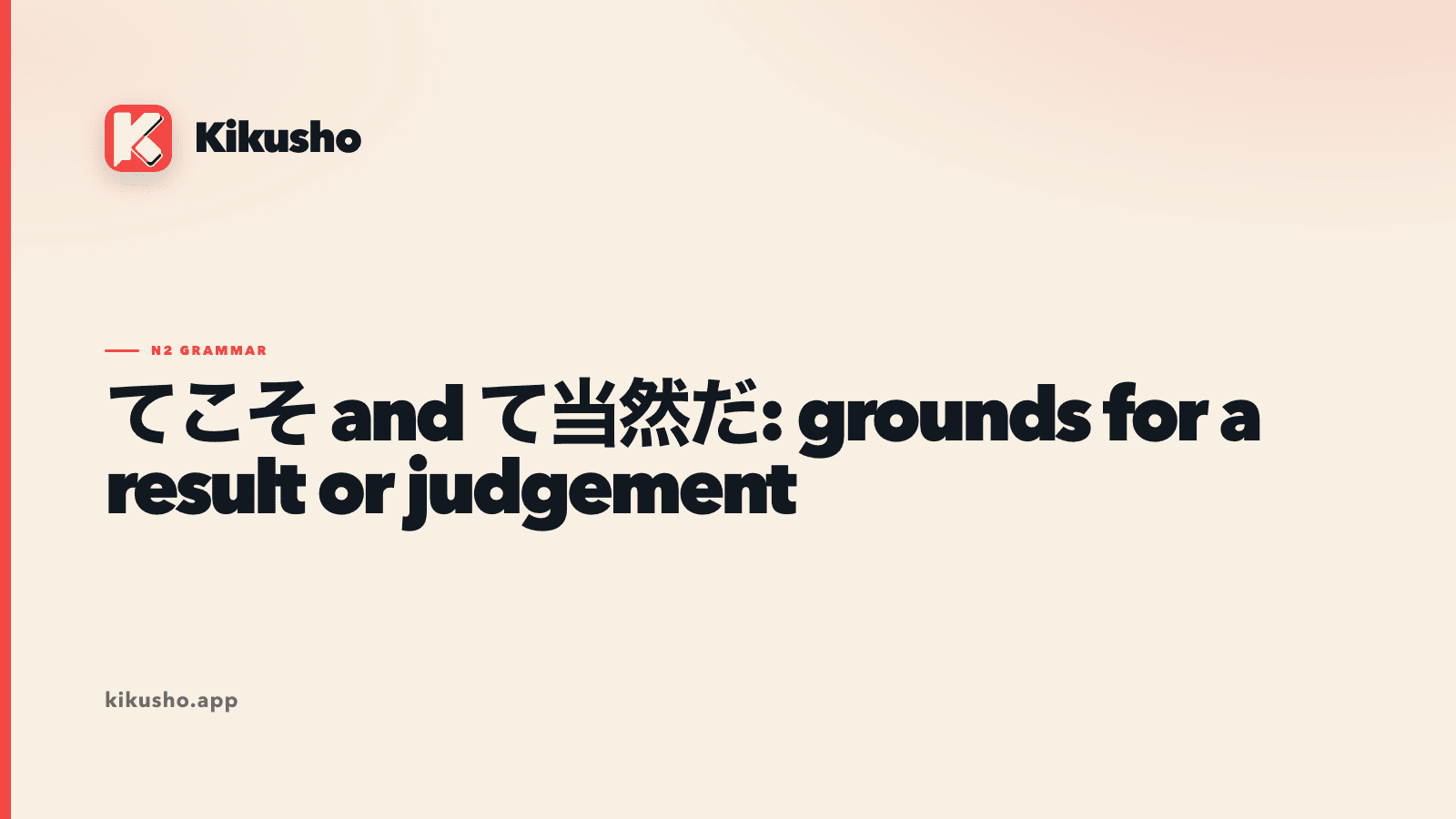
Use AてこそB when A is the condition that gives B its value or makes B possible: 努力してこそ、実力が伸びる means “Only through effort does your ability improve.” Use Aて当然だ when A itself is the expected result: 十分に練習したのだから、合格して当然だ means “Given all that practice, passing is only natural.”
This lesson covers inventory items g-9cd231ce8dd6, ~てこそ, and g-fdb7a0368ef3, ~て当然だ. Bunpro and JLPT Sensei place both at N2, but the JLPT does not publish an exhaustive grammar syllabus. The useful distinction is the direction of the judgement: てこそ points forward to B, while て当然だ looks at A and calls it unsurprising.
One form supplies the ground; the other evaluates the outcome
The identical て attachment can make the two expressions look closer than they are.
| Pattern | What the speaker asserts | Example | Natural reading |
|---|---|---|---|
| AてこそB | B depends on A | 話し合ってこそ、解決できる | Only by discussing it can we solve it |
| Aて当然だ | A is expected in context | あれだけ話し合えば、解決して当然だ | With that much discussion, solving it is only natural |
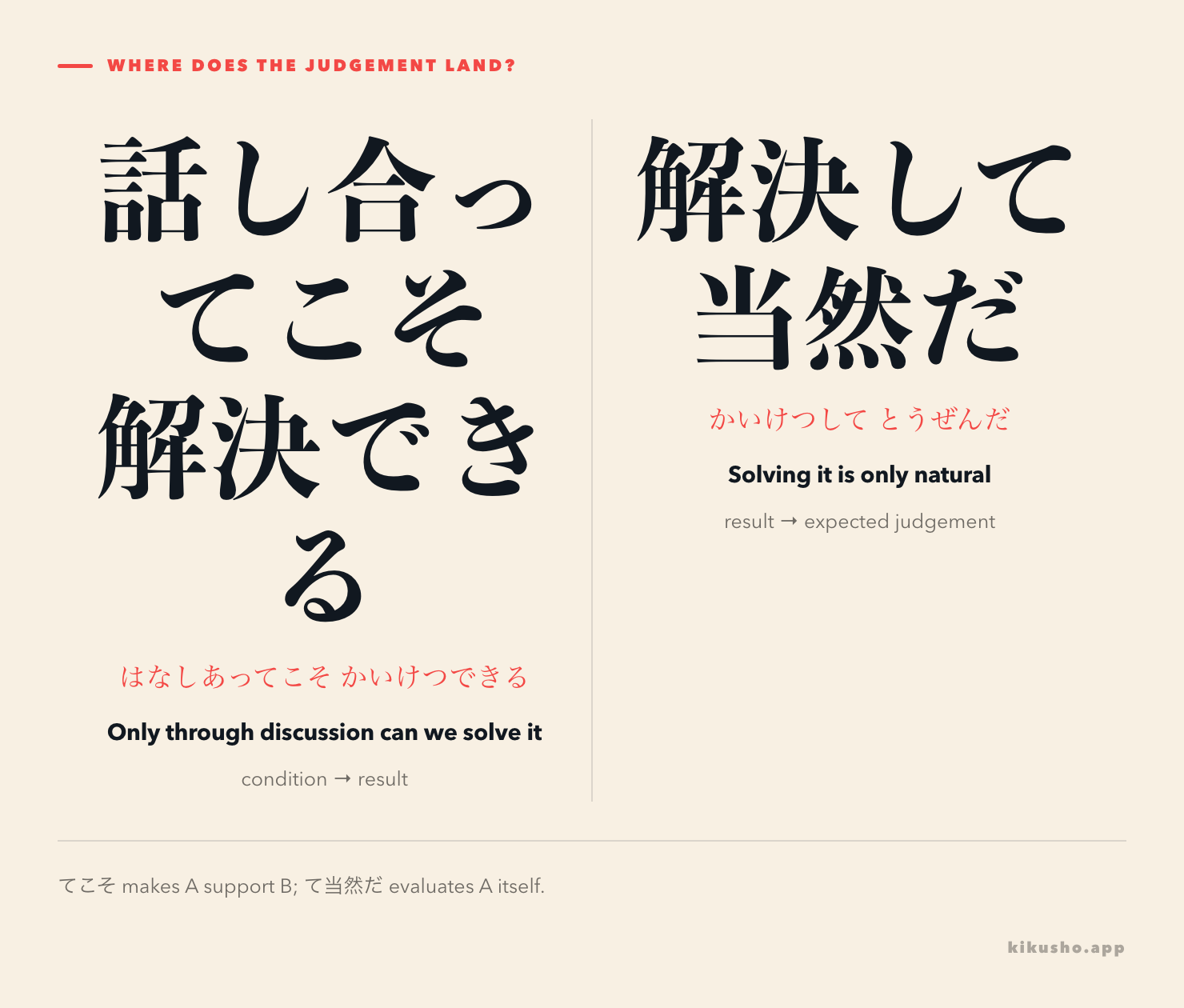
In the first sentence, 話し合う is the route to a separate result, 解決できる. In the second, 解決する receives the judgement 当然だ. Ask where the evaluation lands. If the following clause needs A in order to become true, choose てこそ. If the speaker calls A itself obvious or predictable, choose て当然だ.
~てこそ makes A indispensable to B
Attach こそ to a verb's て-form.
| Dictionary form | て-form | ~てこそ |
|---|---|---|
| 学ぶ | 学んで | 学んでこそ |
| 働く | 働いて | 働いてこそ |
| 経験する | 経験して | 経験してこそ |
| なる | なって | なってこそ |
自分で経験してこそ、本当の難しさが分かる。
じぶんで けいけんしてこそ、ほんとうの むずかしさが わかる。
Only by experiencing it yourself can you understand the real difficulty.
お互いを尊重してこそ、信頼関係が生まれる。
おたがいを そんちょうしてこそ、しんらいかんけいが うまれる。
Only through mutual respect can a relationship of trust develop.
社会に出てこそ、学べることもある。
しゃかいに でてこそ、まなべる ことも ある。
Some things can be learned only after entering working life.
The clause after てこそ often expresses value, possibility, understanding or a meaningful result. Kotobank defines てこそ as て plus the focus particle こそ and says it strengthens the relation between the preceding and following predicates. Bunpro's N2 explanation makes that dependence explicit: B relies on A, yielding readings such as “only if,” “only by” or “unless.”
The construction does more than place A earlier in time. 日本に来てから、日本語を勉強した merely sequences arrival and study. 日本に来てこそ分かることがある claims that coming to Japan is the condition for a certain understanding. The speaker is choosing A as the decisive ground.
For a noun or な-adjective state, a clear modern pattern uses であってこそ: 健康であってこそ、仕事に集中できる, “Only when one is healthy can one concentrate on work.” The あって supplies the て-form that carries こそ.
~て当然だ labels something natural or deserved
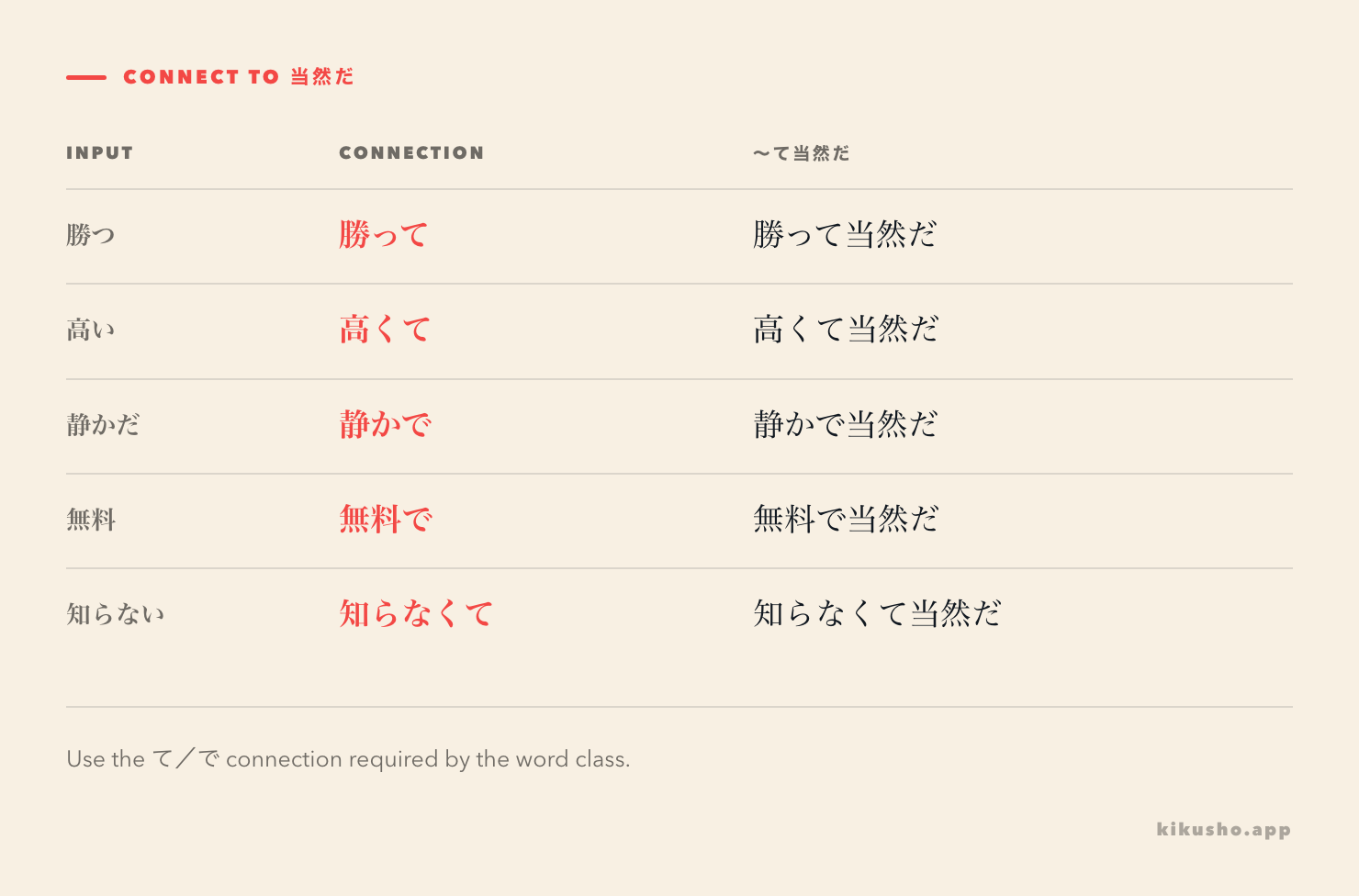
当然(とうぜん) means that something follows as a matter of course. Attach it to the connecting form of the event or quality being judged.
| Input | Connection | Result |
|---|---|---|
| verb: 勝つ | 勝って | 勝って当然だ |
| い-adjective: 高い | 高くて | 高くて当然だ |
| な-adjective: 静かだ | 静かで | 静かで当然だ |
| noun: 無料 | 無料で | 無料で当然だ |
| negative verb: 知らない | 知らなくて | 知らなくて当然だ |
毎日練習したのだから、上手になって当然だ。
まいにち れんしゅうしたのだから、じょうずに なって とうぜんだ。
Since you practised every day, it is only natural that you improved.
この材料なら、値段が高くて当然だ。
この ざいりょうなら、ねだんが たかくて とうぜんだ。
With these materials, it is natural for the price to be high.
初めて聞く話だから、彼が知らなくて当然だ。
はじめて きく はなしだから、かれが しらなくて とうぜんだ。
Since this is the first time the matter has come up, it is natural that he does not know.
Bunpro describes て当然だ as a standard but fairly strong expression for what the speaker regards as an obvious fact. Japanese with Kanako independently gives the same expected-result meaning and documents verb, い-adjective and な-adjective connections.
That strength matters with people. 謝って当然だ can mean “Of course they should apologize” or “It is only right that they apologize.” It presents the speaker's standard as self-evident and can sound critical. When you mean “I understand why they reacted that way,” ~のももっともだ may show more explicit recognition of the person's grounds. The もっともだ and 当然だ comparison develops that stance difference.
Use 当然です for a polite ending, but politeness does not remove the strong evaluation: 返金されて当然です still says that a refund is the proper, expected result.
Keep cause, condition and evaluation separate
Several patterns can be translated with “only,” “because” or “natural,” but they organize the sentence differently.
| Pattern | Main question | Example |
|---|---|---|
| AてこそB | What condition makes B possible or meaningful? | 挑戦してこそ成長できる |
| AからこそB | What exact reason explains B? | 難しいからこそ挑戦する |
| Aて初めてB | What new result appeared after A? | 失敗して初めて気づいた |
| Aて当然だ | Which result is expected or deserved? | 準備不足なら失敗して当然だ |
てこそ often expresses a general principle: taking on challenges is what enables growth. て初めて commonly reports the boundary after which a new realization or event occurred. The prerequisite lesson contrasts that hindsight with a step that must be completed first.
からこそ places focus on an explicit reason and accepts more clause types. てこそ uses the て-form and presents A as the condition that allows B. The からこそ comparison also separates a strongly focused reason from からといって, which rejects an overgeneralized conclusion.
A reliable editing test is to write the two questions beside the sentence. “Only by doing what does B become true?” points to てこそ. “Which event or state is unsurprising here?” points to て当然だ. If neither question matches, an ordinary て, から, or another construction may be better.
When you capture a sentence in Kikusho, keep both sides of てこそ: saving only 努力してこそ removes the result that depends on the effort. For て当然だ, keep the reason as well as the judgement, such as 毎日練習したのだから、上手になって当然だ. The surrounding clause turns a memorable ending into a testable relationship during offline review.
Practice: follow the direction of the judgement
Complete Questions 1–7 before revealing the shared solution panel.
Question 1 — grammar choice. Complete the principle: 互いに協力して__、大きな目標を達成できる。
- ア. 当然だ
- イ. こそ
- ウ. もっともだ
- エ. からでないと
Question 2 — grammar choice. The speaker says a result is predictable: あれほど準備したのだから、成功して__。
- ア. こそだ
- イ. 初めてだ
- ウ. 当然だ
- エ. からこそだ
Question 3 — attachment. Which sentence correctly says “With such high-quality materials, it is natural for the price to be high”?
- ア. この品質なら、値段が高いて当然だ。
- イ. この品質なら、値段が高くて当然だ。
- ウ. この品質なら、値段が高いで当然だ。
- エ. この品質なら、値段が高くこそ当然だ。
Question 4 — meaning contrast. Match each sentence to its claim.
A. 自分で考えてこそ、答えが見つかる。
B. 十分考えたのだから、答えが見つかって当然だ。
- Finding the answer is treated as the expected outcome.
- Thinking for oneself is treated as the condition for finding the answer.
Question 5 — sentence composition. Say “Only through making mistakes can we learn” using 失敗する, 学ぶ and ~てこそ.
Question 6 — text grammar. A manager says the team ignored every warning, so criticism is deserved. Complete: 何度も警告を無視したのだから、批判されて__。
- ア. こそ
- イ. 当然だ
- ウ. 初めて
- エ. からでないと
Question 7 — connected text. Choose the best continuation: 知識を得るだけでは足りない。実際に使ってみてこそ、__。
- ア. 身につく
- イ. 身について当然だ
- ウ. 身につかなくて当然だ
- エ. 使ってはならない
Answers and explanations
Answer 1. イ, こそ. 協力してこそ、達成できる presents cooperation as the indispensable condition for achievement. 当然だ would evaluate the cooperation itself and would not connect naturally to the following result clause.
Answer 2. ウ, 当然だ. The extensive preparation supplies the reason for treating success as expected. 成功して当然だ evaluates the result; 成功してこそ would need a following clause that depends on success.
Answer 3. イ, 値段が高くて当然だ. An い-adjective changes final い to くて before 当然だ. The other options use a verb or な-adjective connection where the い-adjective form is required.
Answer 4. A–2; B–1. In A, 考えてこそ makes independent thought the condition for finding the answer. In B, 見つかって当然だ judges finding it to be the predictable result of enough thought.
Answer 5. 失敗してこそ、学べる。 失敗する → 失敗して takes こそ, and 学べる states the possibility that depends on making mistakes. 失敗して当然だ would instead call failure expected.
Answer 6. イ, 当然だ. Ignoring repeated warnings is presented as grounds for deserved criticism. 批判されて当然だ evaluates the passive event itself as only natural.
Answer 7. ア, 身につく. The passage rejects passive reading and makes actual use the condition for knowledge to stick. てこそ already marks that condition; the following clause supplies its result.
Why both patterns belong in an N2 comparison
JLPT Sensei and Bunpro place both forms at N2, and the Japanese-teacher pages found for the exact query use the same level. Some courses introduce てこそ beside N3 て初めて, so teaching order can differ even when the relationship being tested is the same. The official exam does not settle that boundary with a public item list.
OpenAI Codex reviewed the saved lesson's attachments, readings, translations, register claims and seven answer keys against the cited sources. The reviewer was an AI agent, and no human language review is claimed.
Common questions
What is the difference between ~てこそ and ~て当然だ?
AてこそB presents A as the indispensable condition or ground for B: only by doing A does B become true. Aて当然だ evaluates A itself as natural, expected or deserved in the circumstances.
How do you form ~てこそ?
Attach こそ to a verb's て-form: 学ぶ → 学んでこそ and 努力する → 努力してこそ. The following clause states the result, value or judgement that depends on A.
Can adjectives and nouns be used before ~て当然だ?
Yes. Use the connecting form: 安い → 安くて当然だ, 静かだ → 静かで当然だ, and 無料 → 無料で当然だ. Verbs use the ordinary て-form, as in 勝って当然だ.
Are ~てこそ and ~て当然だ officially JLPT N2 grammar?
JLPT Sensei and Bunpro list both at N2, matching this curriculum. The JLPT does not publish an exhaustive grammar list, so these are study estimates rather than official item-by-item assignments.