On this page
Use N + こそあれ to admit that a state exists, V-stem + こそすれ to allow one direction while rejecting its opposite, and Xこそ…が/けれど to acknowledge a focused fact before qualifying it. The second clause tells you whether the sentence merely concedes A, excludes an alternative, or adds a limitation.
多少の違いこそあれ、基本方針は同じだ。需要は増えこそすれ、減ることはない。計画に参加こそしたが、発言はしなかった。
たしょうの ちがい こそあれ、きほんほうしんは おなじだ。じゅようは ふえこそすれ、へる ことは ない。けいかくに さんかこそ したが、はつげんは しなかった。
Although there are some differences, the basic policy is the same. Demand will only increase, never decrease. I did participate in the project, but I did not speak.
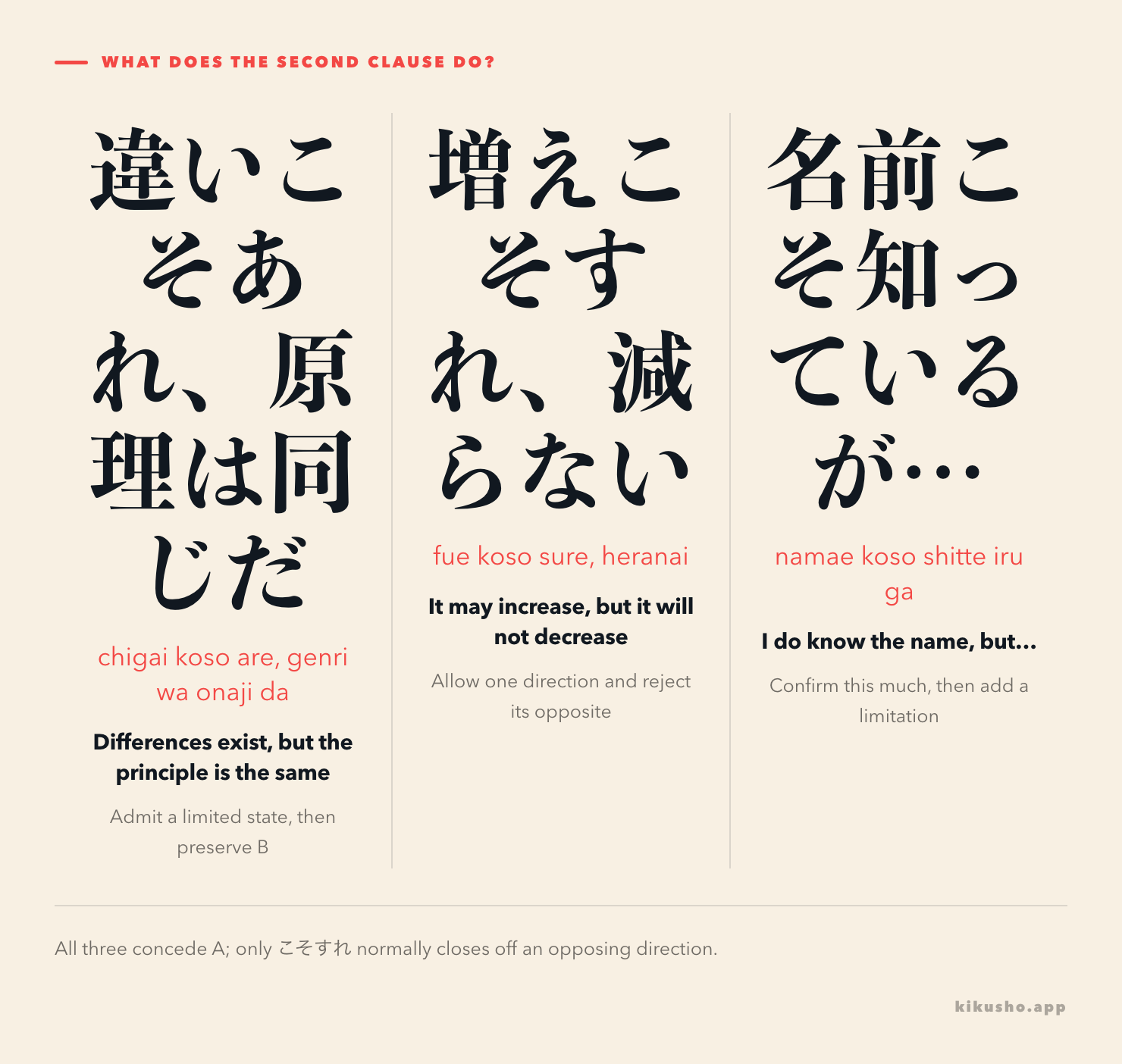
The three sentences all use emphatic こそ inside a concession. Their logic differs. The first allows a limited exception. The second draws a one-way line between increase and decrease. The third confirms one fact while showing how far that fact went.
This lesson reviews g-8310f407293c, こそあれ; g-c5f5e9b8efef, こそすれ; and g-723af552b0ba, こそ~が/けれど. The Kikusho inventory and JLPT Sensei place all three at N1 with no recorded level disagreement. That is a sequencing judgment from study references: the JLPT publishes no complete itemized grammar list.
Ask what A contributes to the argument
| Form | What comes before it | What the second clause does |
|---|---|---|
| N + こそあれ、B | an existing difference, difficulty, doubt, or state | says B still holds despite A |
| V-stem + こそすれ、B | an action or direction | excludes the opposite action or direction |
| X + こそ + predicate + が/けれど、B | the exact element being acknowledged | adds a limit, contrast, or more important point |
The first test is attachment: a noun expressing something that exists favors こそあれ, while an inflecting action favors こそすれ. The second test is argumentative. If B says “A may exist, but the main claim survives,” choose こそあれ. If B means “A can happen, but its opposite will not,” choose こそすれ. If the sentence simply confirms a focused fact and then narrows it, build the predicate normally and put が or けれど after it.
こそあれ admits A without surrendering B
The compact frame is N + こそあれ、B. A names a real but limited condition. B then supplies the sentence's main claim.
細かな問題こそあれ、新しいシステムは安定して動いている。
こまかな もんだい こそあれ、あたらしい システムは あんていして うごいている。
Although there are minor problems, the new system is running reliably.
不安こそあれ、計画を中止するほどの危険はない。
ふあん こそあれ、けいかくを ちゅうしするほどの きけんは ない。
Although there is some anxiety, there is not enough danger to cancel the plan.
The first B is affirmative; the second is negative. Both are natural because こそあれ itself has already conceded the existence of A. 日本語教師のネタ帳's analysis of advanced こそ explicitly gives both kinds of continuation. That matters because some teaching pages describe a following negative as compulsory. It is typical when the writer rejects a larger conclusion, but it is not required for every こそあれ sentence.
Nouns that naturally describe an existing circumstance fit well: 違い, 問題, 苦労, 不安, 反対意見, and 改善の余地. A noun predicate can also appear as N + でこそあれ:
彼は新人でこそあれ、必要な知識は身につけている。
かれは しんじんで こそあれ、ひつような ちしきは みにつけている。
Although he is a newcomer, he has acquired the necessary knowledge.
This is formal writing. In everyday speech, 細かな問題はあるけれど and 新人ではあるけれど usually carry the idea without the ceremonial weight.
こそすれ points firmly in one direction
Attach こそすれ to the ます-stem of an ordinary verb: 増える → 増えこそすれ, 減る → 減りこそすれ, 悪化する → 悪化しこそすれ. Verbal nouns often appear directly before it in established sentences, as in 感謝こそすれ and 心配こそすれ.
このままでは負担は増えこそすれ、軽くなることはない。
このままでは ふたんは ふえこそすれ、かるくなる ことは ない。
At this rate, the burden will only increase; it will not become lighter.
支えてくれた人々には感謝こそすれ、恨む理由などない。
ささえてくれた ひとびとには かんしゃこそすれ、うらむ りゆうなど ない。
I feel only gratitude toward the people who supported me; I have no reason to resent them.
Here B does more than qualify A. It closes off the contrary path: increase, not decrease; gratitude, not resentment. PassJapanese and Nihongo to Japan both document this strong opposite-denial pattern and its literary register. Their shared claim is safest for こそすれ. Do not transfer it into a blanket rule that every こそあれ continuation must be negative.
The opposite may be rejected without the word ない immediately after it. 体力は衰えこそすれ、気力は若いころのままだ still contrasts decline in one domain with its absence in another. What matters is the direction of the reasoning, not a mechanical search for a negative ending.
こそ~が acknowledges exactly this much
In this wider frame, こそ focuses an element inside an ordinary predicate, then が or けれど introduces the limitation. The sentence says, “A is certainly true, but B also matters.”
その店の名前こそ知っているが、行ったことはない。
その みせの なまえこそ しっているが、いった ことは ない。
I do know the name of the shop, but I have never been there.
会議には参加こそしたが、意見は述べなかった。
かいぎには さんかこそ したが、いけんは のべなかった。
I did attend the meeting, but I did not express an opinion.
部屋は広くこそあるけれど、駅から遠い。
へやは ひろくこそ あるけれど、えきから とおい。
The room is certainly spacious, but it is far from the station.
J-nihongo's こそ~が/けれど lesson describes this as strongly acknowledging the first point before adding a restriction, contrast, or deficiency. にほんご部 likewise treats B as the weightier point in the writer's argument.
The form changes with the focused material:
| Focused material | Pattern | Example |
|---|---|---|
| noun inside a clause | N + こそ + predicate + が | 名前こそ知っているが |
| verbal noun or verb stem | stem + こそ + する + が | 参加こそしたが/話しこそしたが |
| い-adjective | Aく + こそある + が | 小さくこそあるが |
| な-adjective | stem + でこそある + が | 静かでこそあるが |
| noun predicate | N + でこそある + が | 新人でこそあるが |
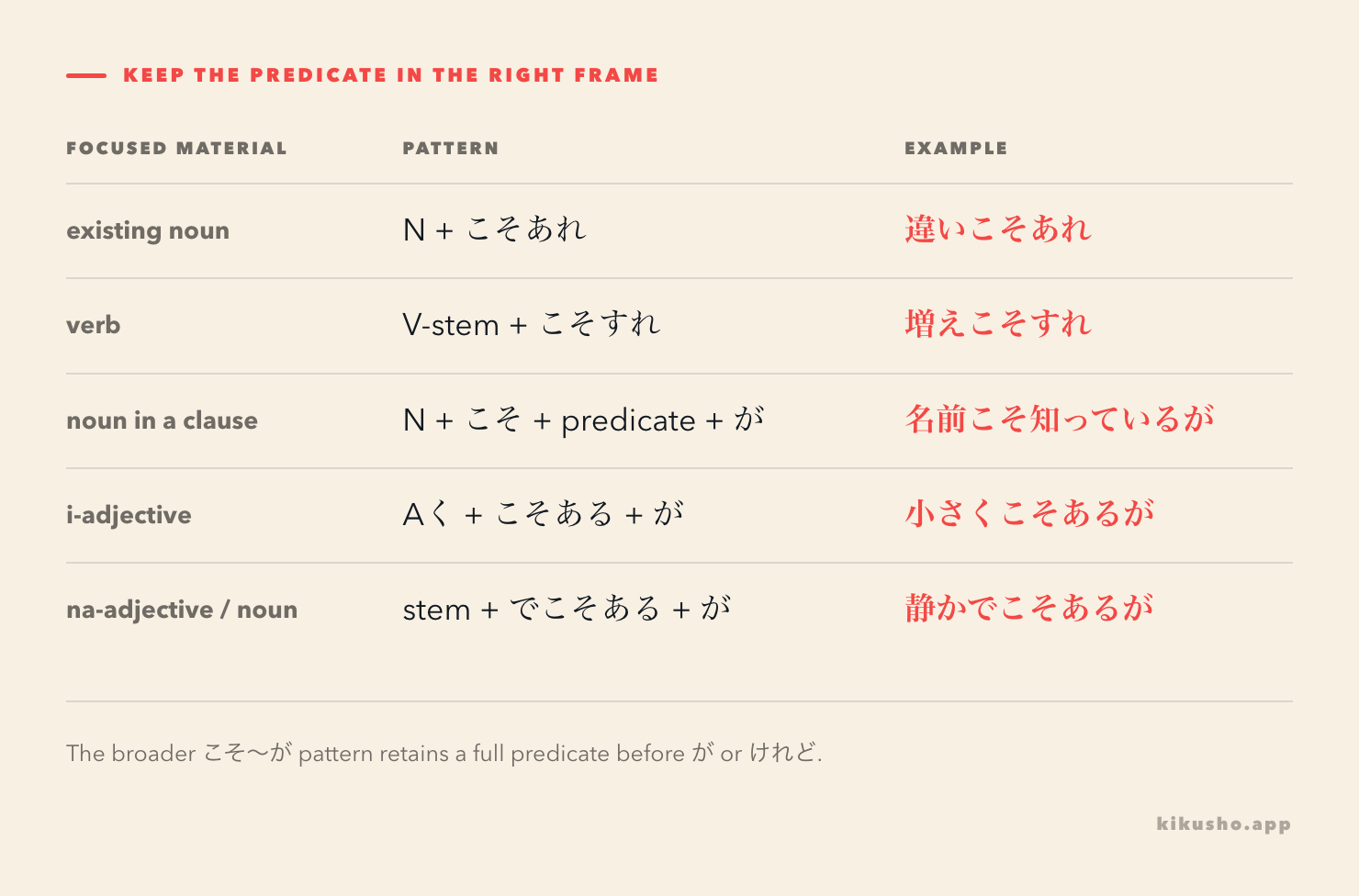
Do not reduce this to N + こそ + が. The が belongs after the predicate: 名前こそ知っているが, not 名前こそが知っている. The sequence こそが can occur in an unrelated focus sentence such as 彼こそが責任者だ, where が marks the focused subject and no concessive second clause follows.
The boundaries overlap, but the strongest claim changes
問題こそあれ、運用は続けられる and 問題こそあるが、運用は続けられる are close. Both concede problems and keep the main judgment. The first uses a compact, weighty concessive formula. The second builds ある as a full predicate and uses the broader こそ~が frame.
増えこそすれ、減ることはない is less interchangeable. It presents increase and decrease as opposite directions and closes one of them. Replacing it with 増えてはいるが would merely acknowledge an increase before a contrast; it would lose the categorical “never decrease” force.
This family grows from the focus particle taught in the こそ and さえ comparison. Simple これこそ本物だ selects “this” as the real thing. The N1 constructions add an adversative relationship across two clauses. They also differ from にせよ and にしろ, which make a following conclusion hold even if one case is granted or whichever of two alternatives applies.
In Kikusho, capture both halves of the sentence. 増えこそすれ alone preserves the attachment but loses the excluded direction. A card with 増えこそすれ、減ることはない makes the opposition retrievable. For こそ~が, keep the full predicate before the conjunction so that 名前こそ知っているが does not collapse into the unrelated subject focus 彼こそが.
Practice: follow the argument into the second clause
Question 1 · existence. Complete the formal concession: 小さな違い__、二つの方法の原理は同じだ。
① こそすれ
② こそあれ
③ こそが
④ でこそすれ
Question 2 · one-way change. Which sentence most clearly means that costs may rise but will never fall?
① 費用は上がりこそすれ、下がることはない。
② 費用こそ上がるが、計算した。
③ 費用は上がるこそあれ、下がらない。
④ 費用こそが上がり、下がることはない。
Question 3 · adjective attachment. Complete: この機械は小さ__、性能は高い。
① いこそあれが
② くこそあるが
③ さこそすれ
④ くこそすれが
Question 4 · text grammar. Read 多少の不便こそあれ、この町は住みやすい. Is the second clause ungrammatical because it is affirmative, or does it state the main judgment that survives the conceded inconvenience?
Question 5 · repair. Correct the attachment in 人口は減るこそすれ、増えることはない.
Question 6 · sentence composition. Use 感謝, こそすれ, 恨む, and 理由はない to say that you feel gratitude and have no reason to resent someone.
Question 7 · compare the claims. Explain why 名前こそ知っているが、会ったことはない uses the wider こそ~が frame rather than the strongly directional こそすれ pattern.
Answers and explanations
Reasoning 1
② こそあれ. 違い is a noun naming something that exists. The second clause says that the shared principle remains despite that limited difference.
Reasoning 2
①. 上がり is the ます-stem of 上がる, and the second clause explicitly rejects the opposite direction 下がる. The other choices break the attachment or create a different focus structure.
Reasoning 3
② くこそあるが. An i-adjective changes to its adverbial く form before こそあるが: 小さくこそあるが. The full predicate remains visible in the wider concessive frame.
Reasoning 4
The affirmative second clause is grammatical. こそあれ concedes that some inconvenience exists; この町は住みやすい gives the main evaluation that remains true. A negative B is common, especially when rejecting an exaggerated conclusion, but is not compulsory here.
Reasoning 5
人口は減りこそすれ、増えることはない。 Attach こそすれ to the ます-stem 減り, not to the dictionary form 減る.
Reasoning 6
その人には感謝こそすれ、恨む理由はない。 The first half presents gratitude as the only admitted stance; the second excludes resentment.
Reasoning 7
The speaker confirms a limited fact, knowing the name, then adds the boundary of that knowledge, never having met the person. The two clauses are not opposite directions such as increasing versus decreasing. こそ~が can acknowledge exactly this much before adding a limitation, while こそすれ would imply a stronger exclusion of an opposing action or tendency.
This lesson was checked for noun, verb, adjective, and predicate attachment; affirmative and negative continuations after こそあれ; the directional force of こそすれ; the distinct こそが subject-focus boundary; register; and all seven exercise answers. AI-assisted editorial review was used, with no claim of human language review.
Common questions
What is the difference between こそあれ and こそすれ?
こそあれ usually follows a noun and concedes that a state or issue exists. こそすれ follows a verb stem or verbal noun and normally presents one action or direction while strongly excluding its opposite.
Must the clause after こそあれ be negative?
No. It may deny a larger problem, but it can also make an affirmative main claim, as in 苦労こそあれ、この仕事にはやりがいがある.
What does こそ~が mean?
It strongly acknowledges the focused fact before が or けれど introduces a limitation, contrast, or more important second point.
Are these expressions common in conversation?
They are formal and characteristic of careful writing, speeches, and argument. Ordinary conversation usually uses あるけれど, するけれど, or a simpler が construction.