On this page
ことごとく distributes one result across every member of a set; まるっきり says a state or difference is complete; およそ either gives a rough quantity, frames a general claim or makes a negative judgment total. The English gloss “completely” can fit all three in some translations, but the sentence is measuring a different thing each time.
応募した案はことごとく却下された。
おうぼした あんは ことごとく きゃっかされた。
Every proposal we submitted was rejected.
最終案は最初の案とまるっきり違う。
さいしゅうあんは さいしょの あんと まるっきり ちがう。
The final proposal is completely different from the first.
完成までにはおよそ三か月かかる。
かんせいまでには およそ さんかげつ かかる。
Completion will take approximately three months.
The first sentence checks proposals one by one. The second evaluates the degree of difference between two proposals. The third leaves a margin around a number.
This lesson verifies inventory items g-7fcba724ee3a, ことごとく; g-24e063ecf93f, まるっきり; and g-73ea2b2ad9b5, およそ. コトバンク on ことごとく defines it as covering all the things under discussion without remainder. Its まるっきり entry treats the form as an intensified まるきり and notes its frequent partnership with negative expressions. The およそ entry records the estimate, generalizing and emphatic-negative senses. Japanesetest4you and the three assigned JLPT Sensei pages place these adverbs with N1 study material. Kikusho uses that study order without presenting it as an official itemized syllabus.
Ask what the sentence ranges over
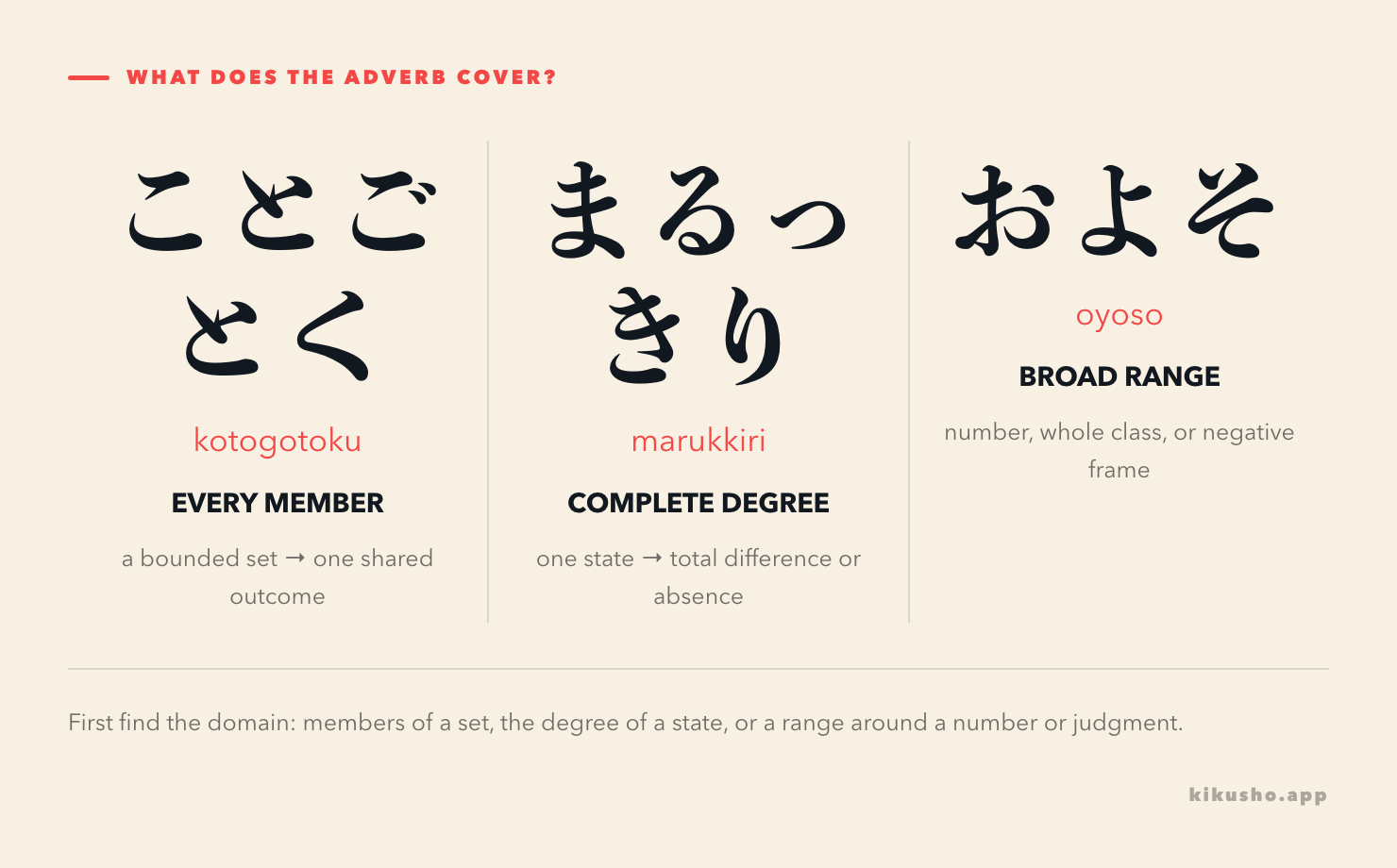
Use one diagnostic before translating:
| Form | What is being ranged over? | Core result | Typical cue |
|---|---|---|---|
| ことごとく | the members or events in a bounded set | every one, without exception | 複数の案、予想、試み |
| まるっきり | the degree of one state, contrast or absence | completely, utterly | 違う、別、分からない |
| およそ | a numerical neighborhood, a whole class, or every reasonable standard | about; generally; not remotely | number, topic statement, negative predicate |
Suppose a company tested five prototypes.
五つの試作品はことごとく壊れた。
いつつの しさくひんは ことごとく こわれた。
Every one of the five prototypes broke.
The outcome applies to all five. Now focus on one prototype:
改良前とはまるっきり別の製品になった。
かいりょうまえとは まるっきり べつの せいひんに なった。
It became a completely different product from the pre-improvement version.
There is one product under discussion, and the perceived difference is total. Finally, estimate the test duration:
試験にはおよそ五時間かかった。
しけんには およそ ごじかん かかった。
The test took about five hours.
No item is being exhausted and no property is being pushed to one hundred percent. The number is deliberately approximate.
ことごとく leaves no member outside the outcome
ことごとく is an adverb. It does not attach by conjugation; it sits before the predicate whose scope covers the relevant set.
台風で沿岸の道路はことごとく通行止めになった。
たいふうで えんがんの どうろは ことごとく つうこうどめに なった。
Because of the typhoon, every coastal road was closed.
彼の予想はことごとく外れた。
かれの よそうは ことごとく はずれた。
Every one of his predictions was wrong.
参加した候補者はことごとく一次審査を通過した。
さんかした こうほしゃは ことごとく いちじしんさを つうかした。
Every candidate who took part passed the first screening.
Negative or disappointing outcomes are common because a series of failures, rejections or destroyed objects is rhetorically striking. Negativity is a tendency, not a grammatical requirement. The third example has a successful outcome and still exhausts the relevant questions.
The form sounds stronger and more literary than ordinary 全部 or みんな. It is at home in reports, narration and forceful summaries. Its spelling 悉く appears in print, but kana ことごとく is common and easier to read.
A singular subject needs an internal plurality to support the form. 彼の提案はことごとく却下された naturally suggests several proposals or several occasions. If there was exactly one proposal and one decision, 完全に却下された or simply 却下された fits better.
まるっきり fills the degree scale
まるっきり also behaves adverbially, but it measures completeness rather than membership.
説明を聞いても、仕組みがまるっきり分からなかった。
せつめいを きいても、しくみが まるっきり わからなかった。
Even after hearing the explanation, I did not understand the mechanism at all.
写真と実物では色がまるっきり違う。
しゃしんと じつぶつでは いろが まるっきり ちがう。
The color is completely different in the photograph and in person.
十年ぶりに会った彼は、まるっきり別人だった。
じゅうねんぶりに あった かれは、まるっきり べつじんだった。
When I met him after ten years, he seemed like a completely different person.
The first example contains grammatical negation. The other two do not, yet 違う and 別人だ describe total contrast. This is why “まるっきり always requires ない” is too narrow. A better rule is that it strongly favors predicates that can be understood as complete nonidentity, absence, failure or separation from an expectation.
The form is an emphatic version of まるきり. It feels more conversational and expressive than neutral 全く in many contexts. In a formal report, 全く異なる is often the quieter choice; in a personal reaction, まるっきり違う readily conveys surprise or criticism.
Compare the two target adverbs with the same noun:
三つの予測はことごとく外れた。
All three forecasts were wrong.
現実は予測とまるっきり違った。
Reality was completely different from the forecast.
The first makes three separate checks. The second places 現実 and 予測 at opposite ends of a similarity scale.
およそ has three routes through one broad viewpoint
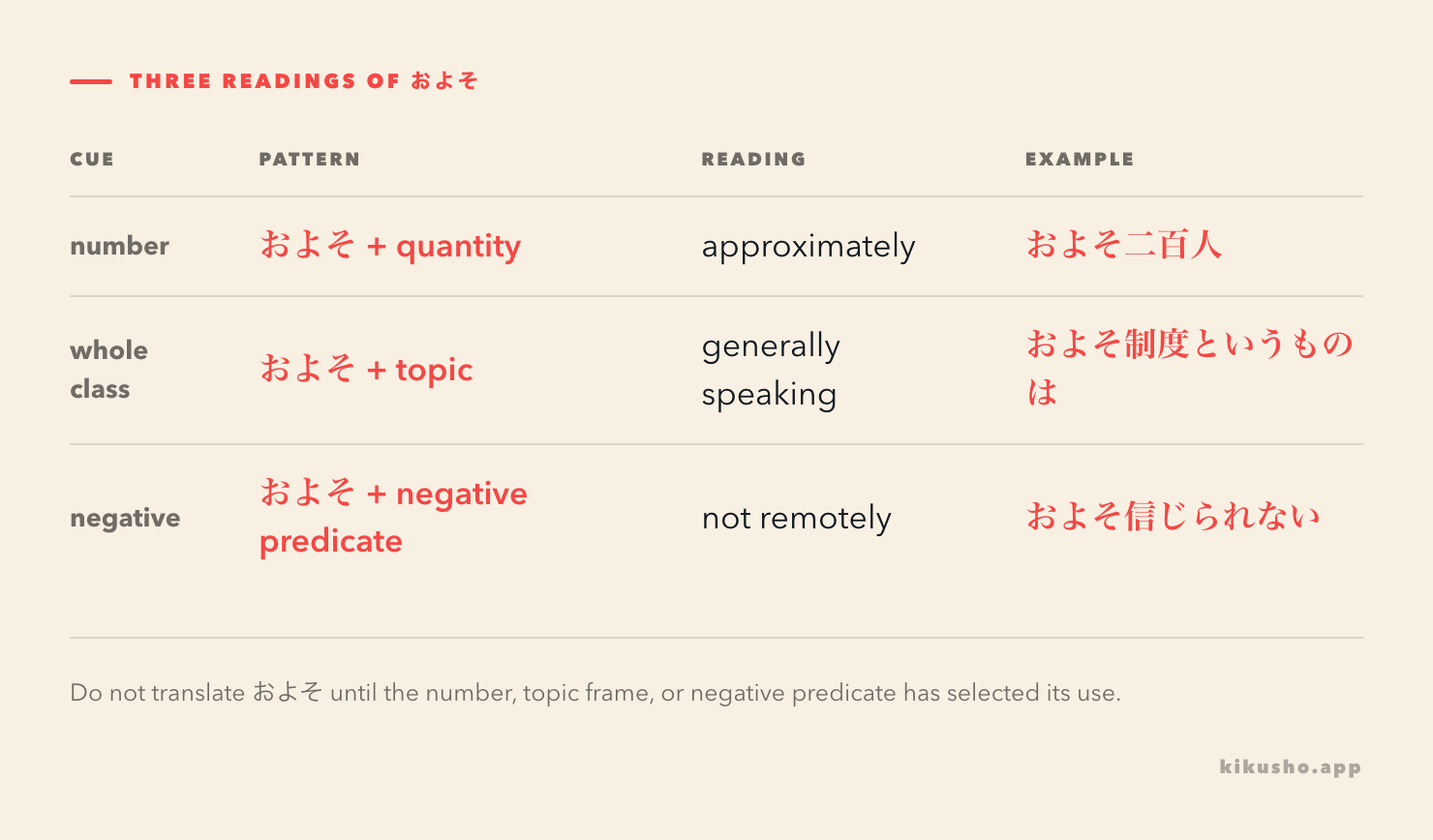
The ordinary quantitative use comes before a number or measurable amount:
駅から会場まではおよそ二キロある。
えきから かいじょうまでは およそ にキロ ある。
It is approximately two kilometers from the station to the venue.
調査にはおよそ千人が参加した。
ちょうさには およそ せんにんが さんかした。
About one thousand people took part in the survey.
Here およそ overlaps with 約, although 約 attaches directly before the number and is compact in formal data: 約千人. およそ sounds like an adverbial estimate supplied by the writer or speaker.
The generalizing use opens the lens to a class or topic:
およそ制度というものは、運用しながら改善する必要がある。
およそ せいどという ものは、うんようしながら かいぜんする ひつようが ある。
Generally speaking, institutions need improvement as they are put into operation.
This およそ means “speaking generally” or “as for such things in general.” It is formal and rhetorical. Everyday conversation is more likely to use 一般に, だいたい or a topic without an overt generalizer.
With a negative or negatively oriented predicate, the same broad lens produces an emphatic denial:
その説明はおよそ説得力がない。
その せつめいは およそ せっとくりょくが ない。
That explanation is not remotely persuasive.
この数字は現状を示すものとはおよそ言いがたい。
この すうじは げんじょうを しめす ものとは およそ いいがたい。
These figures can hardly be said to represent the current situation by any reasonable measure.
The negative partner need not be a final ない. 言いがたい, 考えにくい, 無縁だ and ほど遠い can all supply the negative orientation. In this use, translating およそ as “approximately” would reverse the reading strategy. Look to the predicate before deciding.
Overlap appears only after the scope changes
Both ことごとく and まるっきり can intensify a bad result, but they cannot keep the same information structure.
実験はことごとく失敗した。
Natural when 実験 refers to multiple experiments or attempts: every one failed.
実験はまるっきりだめだった。
Possible as an evaluation of one experiment: it was a complete failure. The sentence no longer counts attempts.
The emphatic-negative およそ can approach まるっきり:
彼の説明はまるっきり理解できなかった。
I could not understand his explanation at all.
彼の説明は専門的すぎて、およそ理解できなかった。
His explanation was so technical that I could hardly understand it by any reasonable measure.
Both express a near-zero result. まるっきり sounds like an immediate total-degree judgment. およそ sounds more detached or rhetorical, as though the explanation falls outside the range of what can reasonably be understood.
For a broader map of zero-degree expressions, compare ちっとも, 全く and 少しも~ない. When the verb itself encodes exhausting a resource or domain, the ~尽くす lesson handles that completion inside the predicate rather than with an adverb.
A wrong choice reveals the wrong unit of thought
Three common errors come from chasing a translation instead of finding the scope.
First, do not use ことごとく merely to strengthen one adjective:
✕ この部屋はことごとく暗い。
If the intended meaning is “this room is completely dark,” use まるっきり暗い only in an emphatic context, or the more neutral 完全に暗い. ことごとく would need a plural set such as 建物の部屋はことごとく暗かった, “every room in the building was dark.”
Second, do not let the approximate sense of およそ contaminate its negative frame:
およそ信じられない
This means “utterly unbelievable” or “hardly believable by any reasonable standard,” not “approximately unbelievable.”
Third, do not force まるっきり into a neutral count:
参加者はおよそ二百人だった。
Only およそ supplies an estimate. まるっきり二百人 and ことごとく二百人 do not create a quantity reading.
Practice: members, degree or broad range
Answer all seven prompts before opening the explanation block.
Question 1. Every proposed date was rejected. Choose the natural adverb.
候補に挙げた日程は( )却下された。
Choice A: およそ
Choice B: まるっきり
Choice C: ことごとく
Choice D: 約
Question 2. The new design is completely different from the old one. Fill the gap.
新しいデザインは以前のものと( )違う。
A. まるっきり
B. ことごとく
C. およそ
D. それぞれ
Question 3. Which およそ means “approximately”?
- その案はおよそ現実的ではない。
- 会場にはおよそ八百人が集まった。
- およそ教育というものは時間がかかる。
- 彼の態度は誠実とはおよそ言いがたい。
Question 4. Which sentence uses ことごとく naturally?
- この一枚の紙はことごとく白い。
- 四回の交渉はことごとく不調に終わった。
- 駅まではことごとく二キロだ。
- その二案はことごとく似ていないほど違う。
Question 5. What does およそ contribute here?
およそ研究というものは、一度の失敗で結論を出すべきではない。
A. an exact count
B. a casual complaint
C. a general statement about a class
D. every experiment failed
Question 6. Choose the only sequence that preserves all three scopes.
試した方法は( ① )失敗し、結果も予想とは( ② )違っていた。再調査には( ③ )二週間かかる。
Sequence A: ①ことごとく ②まるっきり ③およそ
Sequence B: ①まるっきり ②およそ ③ことごとく
Sequence C: ①およそ ②ことごとく ③まるっきり
Sequence D: ①ことごとく ②およそ ③まるっきり
Question 7. Write three linked sentences about a product test. Use ことごとく for several samples failing, まるっきり for a result differing from the forecast, and およそ before an estimated repair time.
Answers and explanations
1. Set scope
Choice C: ことごとく. The proposed dates form a bounded set, and rejection reaches every member without exception.
2. Total degree
A. まるっきり. The sentence measures how completely the new design differs from the old one. It does not distribute one outcome across several designs.
3. Numerical estimate
2. A following number, 八百人, selects the approximate sense. Sentences 1 and 4 use emphatic negation; sentence 3 opens a general statement.
4. Exhaustive outcome
2. Four negotiations supply distinct events, and each ended unsuccessfully. The other choices try to use ことごとく for a single property, a quantity estimate or an ill-formed comparison.
5. General viewpoint
C. およそ expands the statement to research in general. There is no approximate number and no negative-polarity reading attached to the adverb itself.
6. Three different domains
Sequence A: ①ことごとく, ②まるっきり, ③およそ. Several methods all fail, the degree of difference is complete, and the two-week duration is an estimate.
7. One possible response
試作品はことごとく耐久試験に失敗した。
結果は予測とまるっきり違っていた。
修理にはおよそ三日かかる見込みだ。
The first sentence distributes failure across the samples. The second measures a total contrast, and the third places an approximate boundary around three days.
Read outward from the predicate
When one of these adverbs appears in a dense N1 sentence, postpone the English gloss. Check the noun phrase for a plural set, then check the predicate for a degree contrast or negative orientation, and finally check for a following number.
That reading order also exposes what a useful review card must preserve. ことごとく needs its set, まるっきり needs its gradable or contrastive predicate, and およそ needs the cue that selects one of its three readings. Keeping only an isolated translation removes the evidence that lets you choose correctly the next time.
Common questions
What is the difference between ことごとく and まるっきり?
ことごとく says every member of a relevant set meets the same outcome, with no exception. まるっきり evaluates one state, resemblance, difference or absence as complete. The first counts across members; the second measures degree.
Does まるっきり always need a negative ending?
No. It often accompanies negative wording, but it also works with affirmative predicates that describe a total contrast or identity, such as まるっきり別人だ and まるっきり違う.
Why can およそ mean both approximately and not at all?
Before a number, およそ marks a rough estimate. In formal general statements it can mean generally speaking, and with a negative or strongly negative predicate it expands the judgment across every reasonable measure, giving the sense not remotely or not at all.
Are ことごとく, まるっきり and およそ official N1 grammar items?
Several study publishers place these adverbs in N1 material, so Kikusho follows that route. The JLPT does not publish an exhaustive official list of individual grammar and vocabulary items, so N1 is a study placement rather than a guaranteed test boundary.