On this page
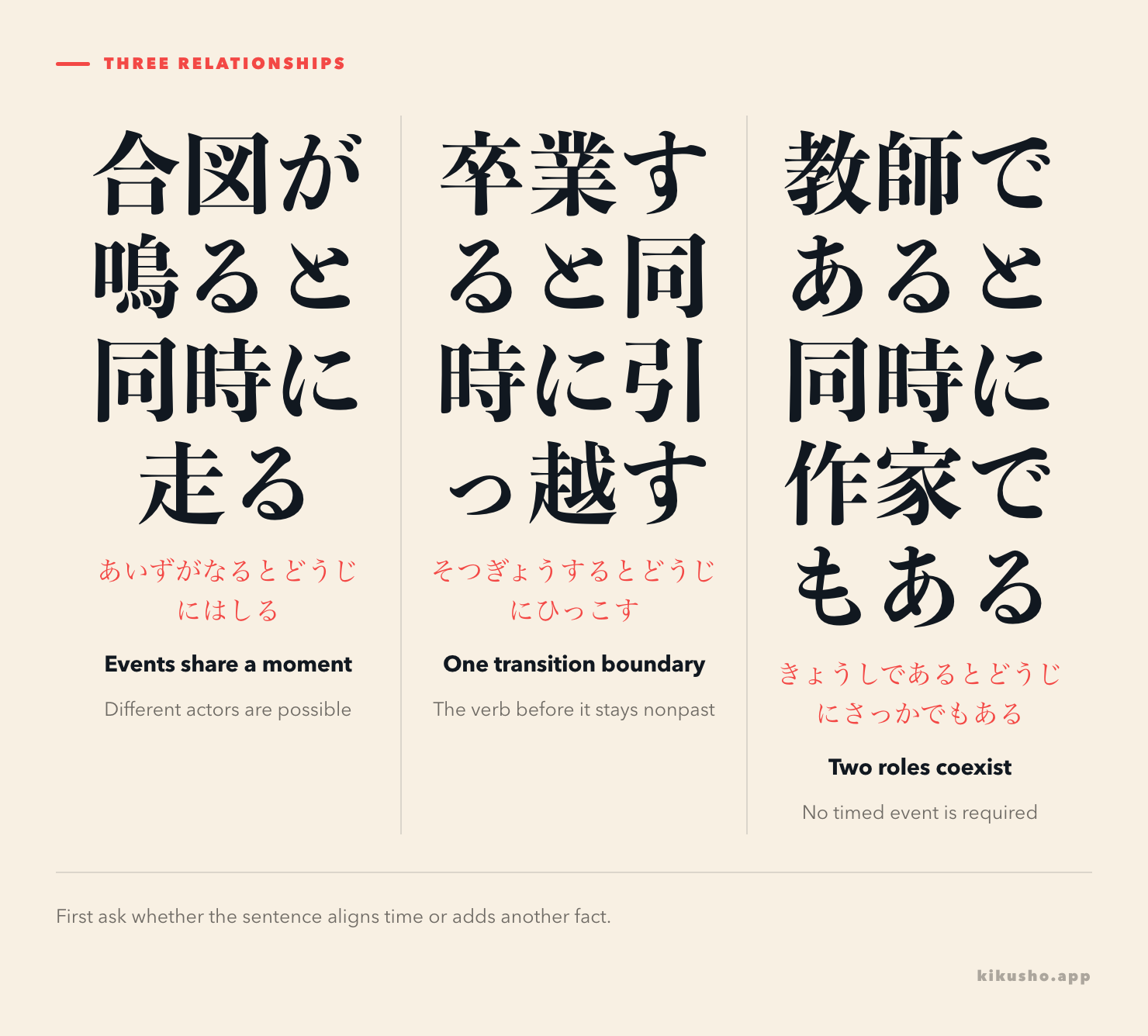
The lift doors open, and the passengers step out at that same moment: ドアが開くと同時に、乗客が降りてきた. と同時に puts two events on one time boundary. It can also align two facts rather than two actions, as in “she is a doctor and a researcher at the same time.”
That second use is why translating the form as only “simultaneously” is too narrow. Sometimes the sentence describes a clock; sometimes it describes a double identity.
と同時に aligns events or coexisting facts
The expression contains 同時(どうじ), “the same time”. Its two central jobs share one idea: A and B both hold together.
| Relationship | Example | Natural reading |
|---|---|---|
| Events coincide | ドアが開くと同時に、乗客が降りてきた。 | As the doors opened, passengers came out. |
| One event follows at the boundary of another | 卒業すると同時に、故郷を離れた。 | Upon graduating, I left my hometown. |
| Two roles or qualities coexist | 彼女は医師であると同時に、研究者でもある。 | She is a doctor as well as a researcher. |
JLPT Sensei's と同時に reference gives “at the same time as”, “while” and “simultaneously”, with both event and dual-activity examples. Bunpro's independent account also includes the “as well as” reading for concurrent roles or functions.
The two sources disagree about placement. JLPT Sensei labels the form N2, while Bunpro places it at N3. Kikusho follows the N2 inventory entry g-4a193d00705e, but treats that level as study guidance. The JLPT FAQ does not provide an exhaustive official grammar list against which either estimate could be certified.
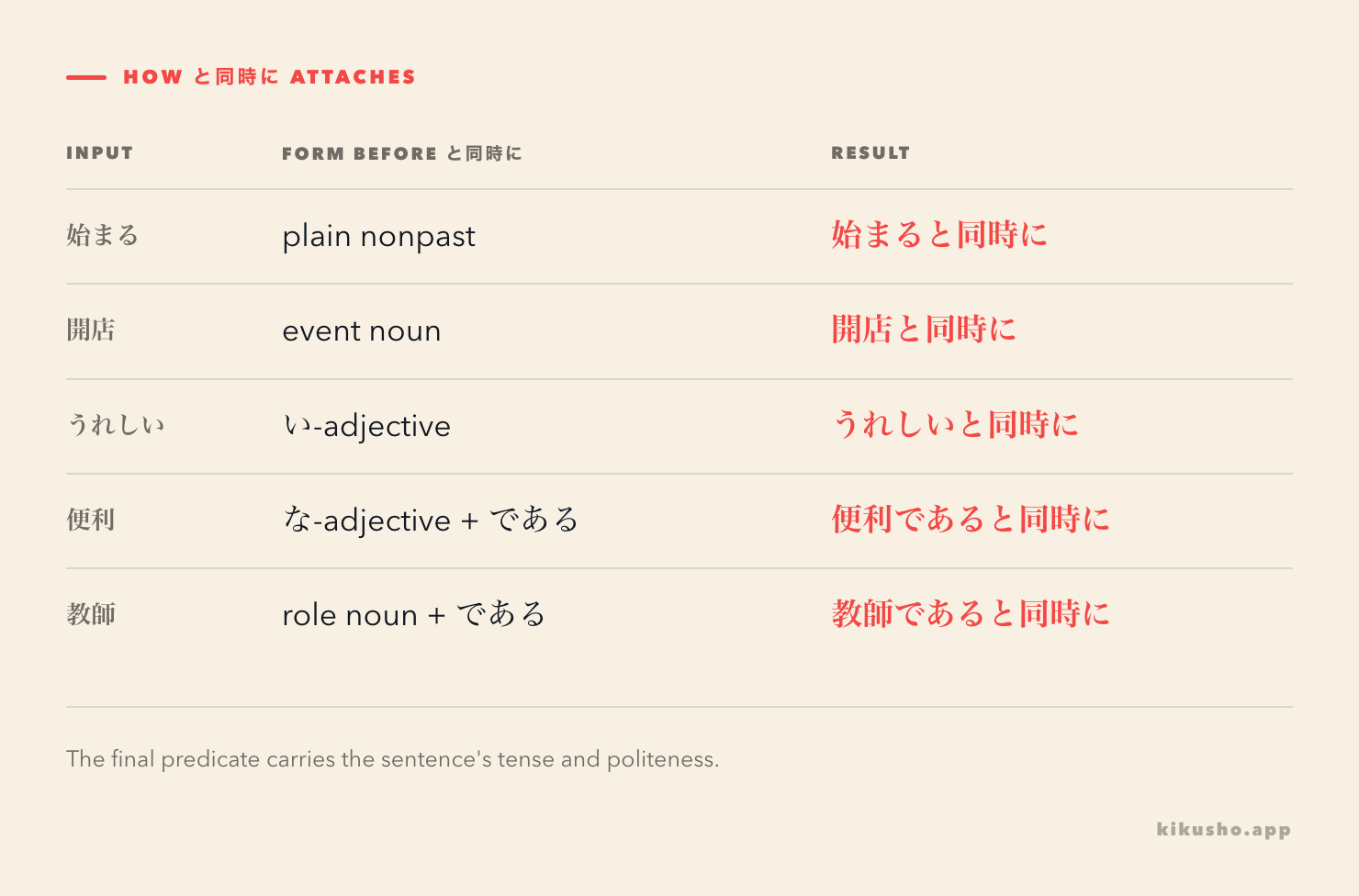
Attach it to the plain nonpast form or to a noun
The usual shapes are:
| What comes before | Pattern | Example |
|---|---|---|
| Verb | plain nonpast + と同時に | 始まると同時に |
| Event noun | noun + と同時に | 開店と同時に |
| い-adjective | adjective + と同時に | うれしいと同時に |
| な-adjective | adjective + であると同時に | 必要であると同時に |
| Noun as a role or status | noun + であると同時に | 教師であると同時に |
The verb before the expression normally stays nonpast even when the whole event happened in the past:
発車すると同時に、雨が降り始めた。
はっしゃするとどうじに、あめがふりはじめた。
The moment the train departed, it began to rain.
The final 降り始めた places the report in the past. 発車したと同時に is not the standard form tested for this construction. The same principle appears in 大学を卒業すると同時に、東京へ引っ越しました: the final predicate carries the sentence's past and politeness.
An event noun can package the same boundary without a verb:
開店と同時に、最初のお客さんが入ってきた。
かいてんとどうじに、さいしょのおきゃくさんがはいってきた。
The first customer came in as soon as the shop opened.
For roles and states, である makes the first fact explicit. The second side often uses も or でもある, which reinforces that both descriptions apply:
この建物は図書館であると同時に、地域の交流の場でもある。
このたてものはとしょかんであるとどうじに、ちいきのこうりゅうのばでもある。
This building is a library and also a place for community exchange.
With a noun, である may be omitted in some sentences. Keeping it in a dual-role example makes the structure easier to see and gives the sentence a formal, expository tone.
Simultaneous can mean overlap or one shared boundary
Two events do not need identical duration. In ドアが開くと同時に、乗客が降りてきた, the opening creates the boundary at which the passengers begin to emerge. In 彼は笑うと同時に、涙を流した, the laughter and tears can overlap for longer.
The expression stays neutral about surprise. It asserts the timing or coordination itself:
合図が鳴ると同時に、二人の選手が走り出した。
あいずがなるとどうじに、ふたりのせんしゅがはしりだした。
The two athletes started running as the signal sounded.
The actor can change across the boundary. The signal sounds; the athletes run. That separates this pattern from the ordinary simultaneous-action use of ~ながら, where one actor typically performs both actions and the final verb carries the main focus.
Compare:
| Sentence | What it presents |
|---|---|
| 音楽を聞きながら、走った。 | One person ran while listening to music. |
| 合図が鳴ると同時に、選手が走り出した。 | One event and another actor's response share a boundary. |
If you need to say that several things were handled in one batch, rather than align A with B, 一度に may be the better expression.
Two facts can be true without being timed events
The dual-fact use often appears in explanations, profiles and formal argument. Nothing begins or ends in the following sentence:
この仕事は難しいと同時に、やりがいもある。
このしごとはむずかしいとどうじに、やりがいもある。
This work is difficult and rewarding at the same time.
The point is two-sidedness. The job has both qualities. An い-adjective attaches directly, so 難しいであると同時に is wrong. A な-adjective uses である:
この方法は便利であると同時に、危険でもある。
このほうほうはべんりであるとどうじに、きけんでもある。
This method is convenient but also dangerous.
English may prefer “but also” when the qualities pull in different directions. Japanese と同時に itself does not mark a concession in the way “although” does; it places both evaluations side by side. In a role sentence, the same structure can show that one person has two responsibilities:
田中さんは監督であると同時に、脚本家でもある。
たなかさんはかんとくであるとどうじに、きゃくほんかでもある。
Tanaka is both a director and a screenwriter.
と同時に, たとたん and とともに choose different viewpoints
Use と同時に when the alignment itself matters. Use verb た-form + とたん(に) when B is presented as a sudden, often unexpected development immediately after A reaches its boundary:
窓を開けると同時に、係員が照明をつけた。
As the window was opened, the attendant switched on the lights.窓を開けたとたんに、強い風が入ってきた。
The moment I opened the window, a strong gust came in.
The first reads as coordinated timing. The second foregrounds the development that followed the opening. The dedicated 最中に and たとたん lesson covers the た-form and sudden-result constraint in detail.
とともに overlaps with と同時に, especially when two related events or facts coexist. It also has meanings that と同時に does not automatically supply: acting together with someone and changing along with a trend. The Japan Foundation's とともに teaching material says that its coexisting-facts use is broadly replaceable by と同時に, while also documenting the companion and linked-change uses. For trends such as values changing with the times, see とともに beside にしたがって.
| Form | Central question |
|---|---|
| A と同時に B | Do A and B share a moment or coexist as facts? |
| A たとたんに B | Did B arise suddenly at A's completed boundary? |
| A とともに B | Does B accompany A, share its course, or change with it? |
Keep the relationship, not just the translation
“At the same time” can point to several Japanese structures. When you save a sentence, keep both sides. Kikusho can turn text you encounter into an editable card with its reading, meaning, register note and example, then schedule it for offline review. On a later review, cover the ending and decide first whether the line contains two clocks, one sudden development or two coexisting facts.
That decision lets you reconstruct the Japanese instead of memorising three English equivalents that blur together.
Practice: identify what is simultaneous
Complete all six items before opening the explanation panel.
Item 1
Choose the standard attachment for “The doors closed as the train departed.”
A. 電車が発車したと同時に、ドアが閉まった。
B. 電車が発車すると同時に、ドアが閉まった。
C. 電車が発車してと同時に、ドアが閉まった。
D. 電車が発車しますと同時に、ドアが閉まった。
Item 2
What relationship does this sentence express?
この部屋は寝室であると同時に、仕事場でもある。
A. The room changed from a bedroom into a workspace.
B. The room is both a bedroom and a workspace.
C. Work began immediately after someone went to bed.
D. The bedroom and workspace are in different buildings.
Item 3
Complete the sentence with the event noun 開店.
____、店の前にいた客が一斉に入ってきた。
Write the full sentence and translate it.
Item 4
Which form best matches an unexpected gust that entered immediately after the speaker opened a window?
A. 窓を開けながら、強い風が入ってきた。
B. 窓を開けると同時に、強い風が入ってきた。
C. 窓を開けたとたんに、強い風が入ってきた。
D. 窓を開店と同時に、強い風が入ってきた。
Item 5
Read the short passage.
会場の時計が十二時を示すと同時に、係員が入口を閉めた。中にいた参加者は、そのまま説明を聞き続けた。
Did the clock and the attendant perform actions with one shared actor? What does と同時に establish here?
Item 6
Choose the correctly formed dual-quality sentence.
A. この計画は大胆だと同時に、現実的でもある。
B. この計画は大胆であると同時に、現実的でもある。
C. この計画は大胆にと同時に、現実的でもある。
D. この計画は大胆だったと同時に、現実的でもある。
Now open the panel and compare the relationship you assigned in each item.
Answers and explanations
Explanation 1
B. 電車が発車すると同時に、ドアが閉まった。 The verb before と同時に takes the plain nonpast form 発車する. The final 閉まった puts the whole report in the past. A uses the た-form required by とたん, while C and D insert forms this construction does not take.
Explanation 2
B. The room is both a bedroom and a workspace. 寝室である states the first role; 仕事場でもある adds the second. The sentence describes two facts that coexist, without asserting a change of use or a sequence in time.
Explanation 3
One model answer is 開店と同時に、店の前にいた客が一斉に入ってきた。 It means “As soon as the shop opened, the customers waiting outside all came in together.” The event noun 開店 attaches directly to と同時に.
Explanation 4
C. 窓を開けたとたんに、強い風が入ってきた。 The prompt presents the gust as an unexpected development at the completion of opening the window. That selects plain past 開けた + とたんに. B is structurally possible Japanese, but it gives a more neutral timing relationship and does not foreground the surprise requested here.
Explanation 5
There is no shared actor. 会場の時計 indicates twelve, while 係員 closes the entrance. と同時に establishes that the two events share the same boundary. Unlike the ordinary two-action use of ながら, this sentence does not require one person to perform both actions.
Explanation 6
B. この計画は大胆であると同時に、現実的でもある。 The な-adjective 大胆 takes である before と同時に, and 現実的でもある supplies the second quality. A uses the casual copula だ where the target pattern calls for である; C invents an adverbial attachment; D changes the first quality to past without a context that supports that time contrast.
Common questions
What does と同時に mean in Japanese?
と同時に means “at the same time as”, “the moment that”, or “as well as”. It can align two events in time or present two roles, qualities or functions as simultaneously true.
What form comes before と同時に?
Use a verb in the plain nonpast form, a noun, an い-adjective, or a noun or な-adjective followed by である. In dual-role sentences, である often makes the first role especially clear, as in 教師であると同時に研究者でもある.
How are と同時に and たとたん different?
と同時に neutrally aligns events and uses a plain nonpast verb. たとたん uses a plain past verb and commonly presents a sudden or unexpected development just after the first event reaches its boundary.
Is と同時に N2 or N3 grammar?
Study guides disagree: JLPT Sensei lists it at N2, while Bunpro lists it at N3. Kikusho keeps it in the N2 sequence and records the disagreement because the JLPT does not publish an exhaustive official grammar list.