On this page
After promising to help with the cleanup, saying 先に帰るわけにはいかない means “I can't very well leave first”: leaving would go against that commitment. わけにはいかない rules an action out because of circumstances, responsibility or propriety, rather than simply reporting that you lack the ability to do it.
わけにはいかない rules out an option, not just an ability
The form taught here is わけにはいかない, read wake ni wa ikanai. It follows a verb phrase and tells the listener that the action is not a viable or acceptable choice in the situation. “Cannot afford to” and “cannot very well” are useful English translations, but the constraint need not involve money.
片づけを手伝うと約束したので、先に帰るわけにはいかない。
かたづけを てつだうと やくそくしたので、さきに かえる わけにはいかない。
“I promised to help with the cleanup, so I can't very well leave first.”
Walking out may be physically possible. The promise makes it an unacceptable course for the speaker. 片づけ(かたづけ) is cleanup, and 手伝う(てつだう) means to help. The context supplies the English “I,” which the Japanese sentence leaves unstated.
Bunpro's explanation of わけにはいかない discusses duty and social pressure, while also allowing contextual constraints on something the speaker wants to do. Do not turn the headline “social impossibility” into a requirement that somebody else must explicitly forbid the action.
Keep the dictionary or negative verb intact before わけ
The two core attachments are dictionary form + わけにはいかない and plain negative + わけにはいかない. They produce opposite action requirements. The verb is not shortened to its ます-stem.
| Verb | Affirmative attachment | Negative attachment |
|---|---|---|
| 休む(やすむ), take time off | 休むわけにはいかない | 休まないわけにはいかない |
| 答える(こたえる), answer | 答えるわけにはいかない | 答えないわけにはいかない |
| する, do | するわけにはいかない | しないわけにはいかない |
| 来る(くる), come | 来るわけにはいかない | 来ないわけにはいかない |
In the last row, 来ない is read こない, so the negative construction begins こないわけ. If negative forms are still uncertain, review ない, ません and their past forms before making the longer pattern.
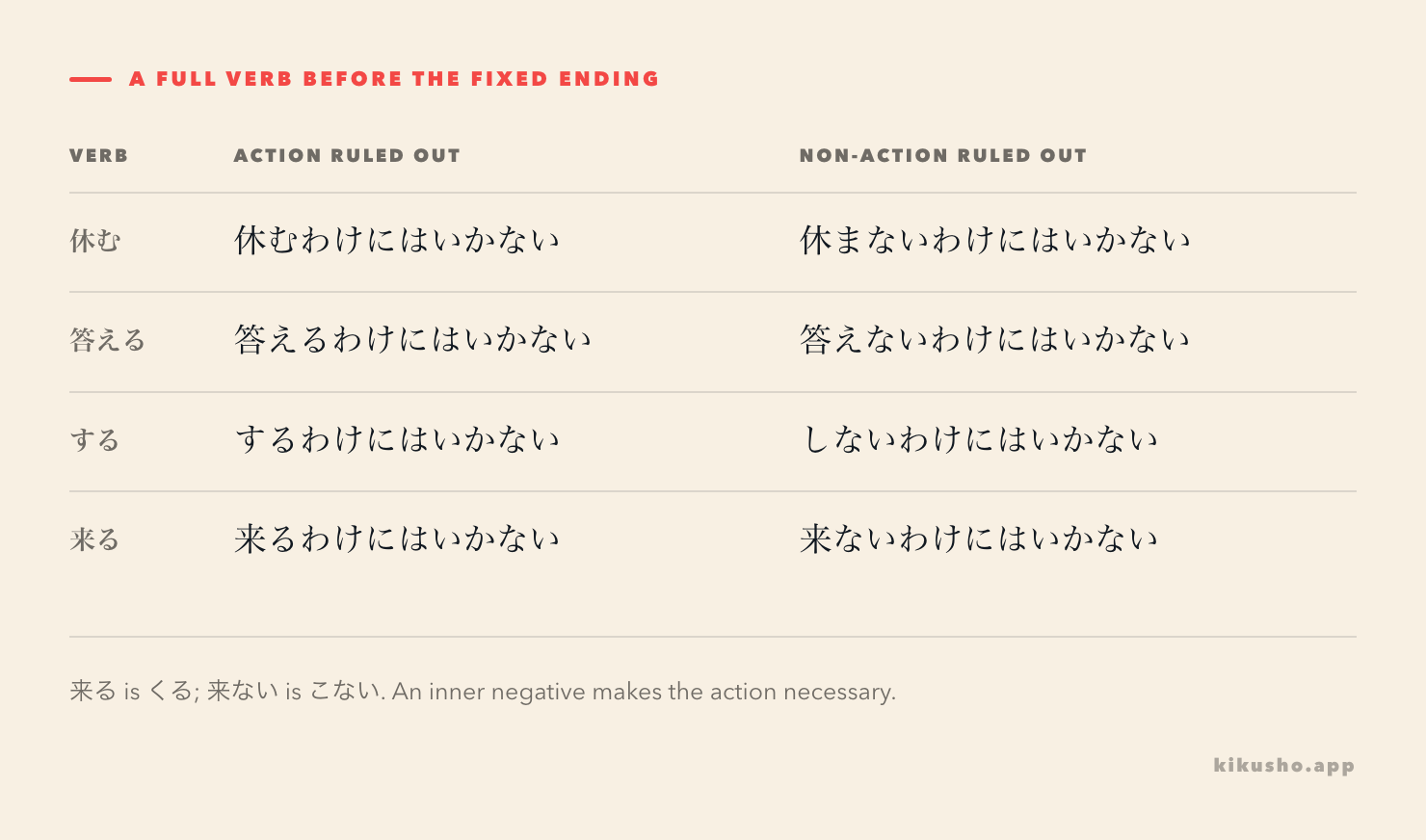
休むわけにはいかない rules out taking time off. 休まないわけにはいかない rules out not taking time off, so taking it becomes necessary. The table gives grammatical forms, not a claim that every situation requires one of these actions. JLPT Sensei's lesson includes both affirmative and negative attachments.
An affirmative verb presents something you cannot reasonably do
A reason clause often tells you what excludes the action: a promise, your role, someone else's interests, or the consequences of proceeding.
まだ内容を確認していないので、返事をするわけにはいかない。
まだ ないようを かくにんしていないので、へんじを する わけにはいかない。
“I haven't checked the content yet, so I can't responsibly give an answer.”
返事(へんじ) is an answer or reply. The speaker could send words, but considers replying before checking inappropriate. The sentence does not identify the precise rule; the reason makes the speaker's position intelligible.
You can also place an ongoing verb phrase before the ending:
受付を担当しているので、ここで寝ているわけにはいかない。
うけつけを たんとうしているので、ここで ねている わけにはいかない。
“I'm on reception duty, so I can't just be sleeping here.”
The restricted situation is 寝ている, being asleep, rather than bare 寝る. Nihongo no Sato's explanation includes dictionary, negative and ている attachments and distinguishes this constraint from inability through lack of skill. Thus “use the dictionary form” is a starting rule for the core pattern, not a ban on a longer verb phrase ending in いる.
A negative verb makes non-action unacceptable
主催者なので、参加者に説明しないわけにはいかない。
しゅさいしゃなので、さんかしゃに せつめいしない わけにはいかない。
“As the organiser, I have to explain to the participants.”
The action is 説明する(せつめいする), explain. 説明しない means not explaining. The outer ending says that this non-action is unavailable to the organiser; the result is an obligation to explain. 主催者(しゅさいしゃ) is the organiser, and 参加者(さんかしゃ) a participant.
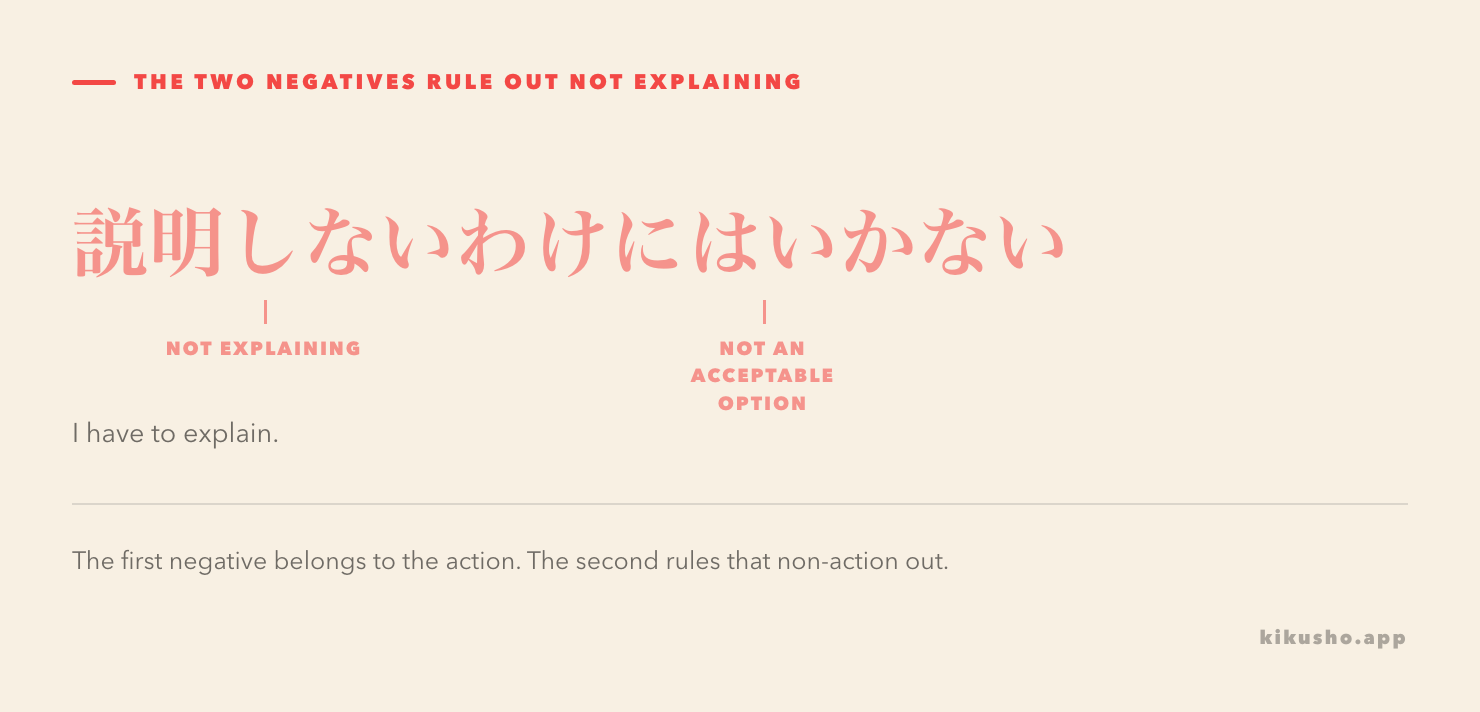
Bunpro's separate ないわけにはいかない page describes this as an extension of the basic construction. The Japan Foundation's discussion of obligation connects it with social expectations, common sense and previous experience.
It can overlap with ざるを得ない and unavoidable action. The emphasis differs: 説明しないわけにはいかない highlights why failing to explain is unacceptable; 説明せざるを得ない presents explanation as the action left when alternatives are unavailable. A real situation may support both descriptions. Do not invent a rigid boundary where every practical constraint belongs to one and every social constraint to the other.
Politeness changes the final ending, not the action form
まだ公開前なので、資料を見せるわけにはいきません。
まだ こうかいまえなので、しりょうを みせる わけにはいきません。
“The materials haven't been released yet, so I can't show them.”
公開前(こうかいまえ) means before public release. わけにはいきません is the polite ending, also listed by Sensei. It keeps the constraint intact while addressing the listener politely. It is not a humble transformation of 見せる.
Keep 見せる, not 見せますわけにはいかない. You can equally make the obligation polite: 説明しないわけにはいきません. That still means having to explain, because the inner negative has not disappeared.
The construction is usable in conversation as well as writing, often to explain a serious constraint. A polite ending does not guarantee that a refusal will be received as considerate: the reason, tone and relationship still matter. It need not describe an involuntary urge or a spontaneous emotion.
This wording is especially natural when explaining your own position. When assessing someone else's obligation, 担当者も質問に答えないわけにはいかないでしょう adds “probably” to the judgement. The Japan Foundation discusses this use of でしょう or と思う for estimating another person's position; it does not require you to pretend that their reasons are directly known.
Ability, denied conclusions and constrained choices are different claims
Suppose you cannot read a particular kanji because you have not learned it. この漢字は読めない reports that inability. この漢字を読むわけにはいかない instead suggests that reading it is not an acceptable action under some constraint; it does not supply the missing skill explanation.
Likewise, 資料を見せるわけがない asserts that showing the materials is out of the question as a possibility or expectation. 資料を見せるわけにはいかない explains why the speaker cannot reasonably choose it. The わけだ, わけではない and わけがない lesson treats conclusions; the present construction treats a constrained course of action. Shared わけ does not make the endings interchangeable.
Three mistakes reveal the intended meaning being lost: removing the negative before わけ when you meant an obligation, using a stem such as し where a full する is needed, and choosing the ending merely because an English translation contains “can't.” Check the action and what makes it unacceptable before choosing the Japanese pattern.
If you collect nouns from a reply about an event, Kikusho's text capture can draft cards for words such as 主催者 and 参加者. Inspect the proposed examples for who owes the explanation to whom. Correct the fields before saving if the proposed wording changes an obligation into a refusal; those two readings would train different uses of the same vocabulary.
The N2 study path includes a form that several references call N3
This page sits in Kikusho's N2 grammar series. The source inventory and the actual Sensei and basic Bunpro pages place わけにはいかない at N3. Tanos's N2 grammar list includes both affirmative and negative versions; Nihongo no Sato teaches the form in N2 material. Bunpro places the negative extension separately at N2.
The disagreement concerns sequencing, not two different pronunciations of the same construction. Learn the affirmative constraint and negative-verb obligation together here. These references provide editorial estimates; none establishes an official exhaustive JLPT syllabus.
Practice questions
Work through the complete set before checking the answer block. In questions 3 and 4, arrange all four fragments, then identify the one in the third slot marked ★.
Question 1
Choose the meaning of this sentence.
片づけを手伝うと約束したので、先に帰るわけにはいかない。
A. The commitment makes leaving first an unacceptable choice.
B. The speaker has lost the physical ability to walk home.
C. The speaker must avoid helping with the cleanup.
D. The speaker has already left before everyone else.
Question 2
Select the verb form that fits the stated refusal.
まだ内容を確認していないので、返事を( )わけにはいかない。
A. し
B. して
C. する
D. します
Question 3
Account for each fragment in the finished sentence, including the particles.
主催者なので、参加者に _ _ ★ _。
A. 説明しない
B. には
C. いかない
D. わけ
Question 4
Make a second four-fragment sentence from the options below.
この資料はまだ公開前なので、 _ _ ★ _。
A. わけ
B. いきません
C. 見せる
D. には
Question 5
Identify the speaker's intended action from the final clause, using the earlier sentence as its reason.
友人に展示の準備を頼まれた。以前、その友人には何度も助けてもらったので、手伝わないわけにはいかない。
展示(てんじ): exhibition; 以前(いぜん): previously.
A. The speaker has freely decided that helping is unnecessary.
B. The speaker lacks the skill needed to help.
C. The speaker feels obliged to help because of the friend's previous support.
D. The speaker predicts that the friend will never ask for help.
Question 6
Select the response that says the circumstances rule out showing the materials for now.
新しい企画の資料は、まだチーム内で確認中だ。外の人から見せてほしいと言われたが、確認が終わるまでは( )。
企画(きかく): project or plan; 確認中(かくにんちゅう): being checked.
A. 資料を見せるわけにはいかない
B. 資料を見せたわけではない
C. 資料を見せないわけにはいかない
D. 資料を見せてもいい
Write down the action you think each sentence permits or requires. Check your assembled sentences against every supplied fragment before moving to the numbered solutions.
Answers and explanations
Answer 1. A. The promise to help makes 先に帰る, leaving first, an unacceptable choice. The sentence does not claim a physical incapacity, forbid helping or report a completed departure, so B, C and D each change the stated situation.
Answer 2. C. 返事をする supplies a complete dictionary-form verb phrase before わけ. A uses only the stem し; B ends in connective て; D puts a polite ます-form before the construction. None gives this affirmative core attachment. Listener politeness can instead be placed at the end: 返事をするわけにはいきません.
Answer 3. B. Put 説明しない / わけ / には / いかない together: 主催者なので、参加者に説明しないわけにはいかない, “As the organiser, I have to explain to the participants.” The third fragment is には. The completed negative action sits before わけ, and the outer にはいかない excludes that non-action. Other fragment orders do not form the taught construction.
Answer 4. D. The sequence is 見せる / わけ / には / いきません. この資料はまだ公開前なので、見せるわけにはいきません means that the speaker cannot show these materials before release. Third-slot には precedes polite final いきません. No verb negative has been added before わけ, so this remains restraint rather than an obligation to show them.
Answer 5. C. 手伝わない is not helping. わけにはいかない rules that option out, with the friend's previous help supplying the speaker's reason. A erases the obligation, B changes social reasoning into missing ability, and D assigns a prediction to the friend that the passage never makes. The necessary action is 手伝う.
Answer 6. A. 見せるわけにはいかない expresses the requested constraint on showing the materials before checking finishes. B denies a claim that they were already shown; C makes not showing them unacceptable and therefore requires showing; D grants permission. Those alternatives are grammatical claims, but they do not express the refusal requested by the prompt.
Common questions
What does わけにはいかない mean?
After an affirmative verb, it means that doing the action is not an acceptable option under the circumstances, often because of responsibility or propriety. After a negative verb, it rules out not doing the action: 説明しないわけにはいかない means that one has to explain.
Can I use わけにはいかない for lack of ability?
Not as a direct statement that you lack a skill. 漢字が読めない says that you cannot read kanji; 読むわけにはいかない would instead present reading as something the circumstances rule out. The reason for the restriction matters.
Is わけにはいかない N3 or N2 grammar?
This lesson belongs to Kikusho's N2 study path. Sensei and Bunpro place the basic form at N3; Tanos and Nihongo no Sato include it in N2 material. Bunpro treats negative-verb ないわけにはいかない separately at N2. These are editorial level estimates, not an official exhaustive syllabus.