On this page
なくて済む and ずに済む both say that something expected, troublesome or unwanted did not become necessary. 窓口へ行かずに済んだ means the situation was resolved without a trip to the counter, often with relief that the trip was avoided.
The two forms describe the same result. Their clearest difference lies in formation and register: なくて済む uses the ordinary negative て-form, while ずに済む uses the compact negative connector ずに and can sound somewhat more formal.
The deciding test: was A avoided because the matter still worked out?
Ask what would normally have happened. If an online procedure made a visit unnecessary, or insurance prevented a large payment, the negative event before 済む(すむ) names the burden that disappeared.
オンラインで手続きできたので、窓口へ行かずに済んだ。
オンラインで てつづき できたので、まどぐちへ いかずに すんだ。
I could complete the procedure online, so I did not have to go to the counter.
The procedure reached a satisfactory end. 済んだ does more than report that the speaker did not go: it says the trip was unnecessary because another route settled the matter.
This lesson teaches two assigned N2 items: なくて済む(なくてすむ, nakute sumu)and ずに済む(ずにすむ, zu ni sumu). JLPT Sensei's ずに済む entry, Bunpro and J-nihongo all place the family at N2. That agreement supplies a useful study placement; the JLPT itself does not issue a complete official grammar inventory.
| Sentence | What it says |
|---|---|
| 窓口へ行かなかった | I did not go to the counter; no reason is built in |
| 窓口へ行かずに手続きをした | I completed the procedure while leaving the visit undone |
| 窓口へ行かずに済んだ | the visit proved unnecessary; the matter worked out without it |
The third sentence contains the target relation. English often translates it with “didn't have to,” even though Japanese has no separate word meaning “have to” inside the phrase.
なくて済む starts from the ordinary negative
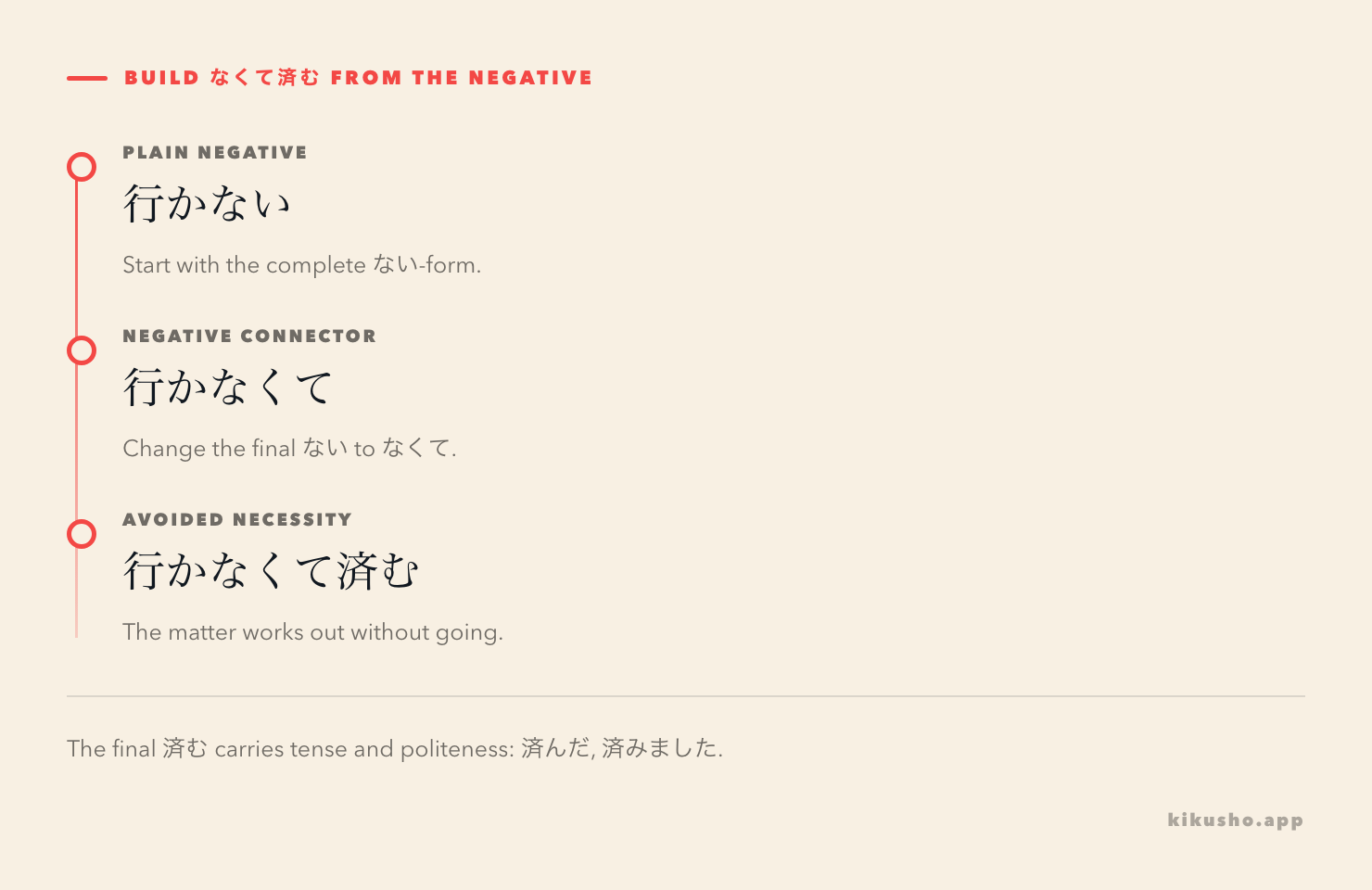
Make the plain negative in ない, change ない to なくて, and add 済む.
| Dictionary form | Plain negative | Target form |
|---|---|---|
| 行く(いく), go | 行かない | 行かなくて済む |
| 払う(はらう), pay | 払わない | 払わなくて済む |
| 作り直す(つくりなおす), remake | 作り直さない | 作り直さなくて済む |
| する, do | しない | しなくて済む |
| 来る(くる), come | 来ない(こない) | 来なくて済む(こなくてすむ) |
データを復元できたので、資料を作り直さなくて済みました。
データを ふくげん できたので、しりょうを つくりなおさなくて すみました。
We recovered the data, so we did not have to remake the documents.
The polite past ending belongs to 済みました. The avoided action stays in the connector 作り直さなくて.
Outside this construction, なくて can connect a negative reason or state: 財布がなくて払えなかった, “Without my wallet, payment was impossible.” Before 済む, however, Vなくて済む is a recognized pattern meaning that doing V was unnecessary. Read the complete construction before assigning the ordinary causal meaning of なくて.
ずに済む uses the ない-stem and has two irregular forms
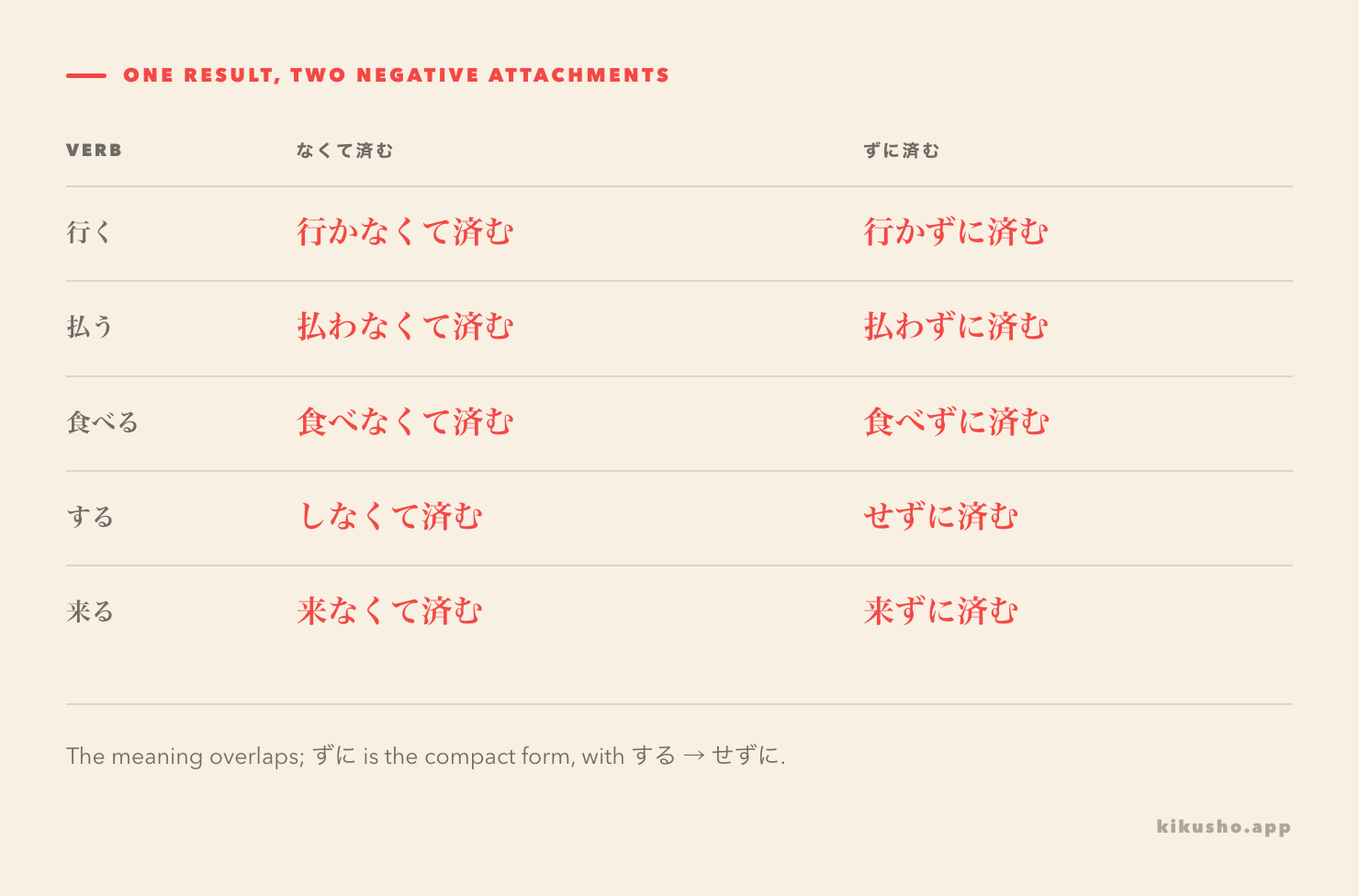
Remove ない from the plain negative and add ずに済む. This is the same attachment used by ordinary ずに, but the final 済む adds the “the matter worked out” result.
| Dictionary form | ない-stem | Target form |
|---|---|---|
| 行く | 行か | 行かずに済む |
| 払う | 払わ | 払わずに済む |
| 食べる | 食べ | 食べずに済む |
| する | し → せ | せずに済む |
| 来る | こ | 来ずに済む(こずにすむ) |
The する exception is the test favourite: せずに済む, not しずに済む. Compounds follow it, so 再検査する becomes 再検査せずに済む.
予約しておいたので、長く待たずに済みました。
よやくしておいたので、ながく またずに すみました。
I had made a reservation, so I did not have to wait long.
The earlier preparation explains the avoided wait. With no 済みました, 長く待たずに入った would only say that the person entered without waiting long; it would not evaluate the wait as a burden made unnecessary.
The meaning stays stable while the register shifts
Self Taught Japanese presents なくて済む, ないで済む and ずに済む as meaning-equivalent variants, while noting a somewhat more formal feel for the latter alternatives. Bunpro also lists all three under the same standard construction.
| Variant | Example | Practical note |
|---|---|---|
| なくて済む | 払わなくて済んだ | transparent negative て-form; easy in conversation |
| ないで済む | 払わないで済んだ | common close variant; keeps ない visible |
| ずに済む | 払わずに済んだ | compact; can fit more formal or written wording |
Do not force a sharp semantic boundary. All three can mean “I did not have to pay.” The speaker, setting and surrounding prose choose the register. The N2 task is to form each variant reliably and recognize the same avoided-necessity relation beneath them.
The general lesson on ずに explains why this connector often sounds more compact than ないで. The て済む lesson starts from the larger idea of a matter closing within a limit; the negative variants make the avoided action that limit.
The avoided event is often unpleasant, but control is not required
The form often carries relief because the omitted event would have cost time, money or effort:
保険に入っていたので、高い治療費を払わずに済んだ。
ほけんに はいっていたので、たかい ちりょうひを はらわずに すんだ。
I had insurance, so I did not have to pay high medical expenses.
It can also prevent something that is not a deliberate action:
自転車から落ちたが、けがをせずに済んだ。
じてんしゃから おちたが、けがを せずに すんだ。
I fell off my bicycle but escaped without injury.
Nobody chooses “to get injured” as an action. The pattern says the feared event did not occur and the situation ended more favourably. Translate the whole relation, not every piece mechanically as “did not have to do.”
The cause of relief commonly appears before ので, ため, おかげで or a conditional. These clauses are not part of the fixed ending, but they explain how avoidance became possible.
A counterfactual can reveal that the burden did occur
In a past conditional followed by のに, the avoided result belongs to an unreal alternative:
もっと早く連絡すれば、追加料金を払わずに済んだのに。
もっと はやく れんらく すれば、ついかりょうきんを はらわずに すんだのに。
If I had contacted them earlier, I would not have had to pay the extra fee.
The speaker did not contact them early enough and did pay. 払わずに済んだ describes what the unreal condition would have prevented; のに signals regret about the actual result. Without checking the conditional frame, a reader could wrongly conclude that payment was successfully avoided.
For an ordinary completed success, 済んだ or polite 済みました reports the past avoidance. Nonpast 済む can state a present arrangement or future possibility:
- 今日は残業しなくて済む。 I will not have to work overtime today.
- 昨日は残業せずに済んだ。 Yesterday I managed without working overtime.
Keep the reason and the avoided burden on the same card
The fragment 払わずに済んだ records relief but hides why payment disappeared. In Kikusho, retain 保険に入っていたので with the target phrase. The review then asks you to reconstruct a complete relation: insurance supplied the condition, and the high expense was the burden avoided.
For a register pair, save one natural context twice: 窓口へ行かなくて済んだ and 窓口へ行かずに済んだ. A short note can mark the second as compact or somewhat more formal. That trains a real choice without inventing a difference in outcome.
Practice questions
Work through all six original questions before revealing the shared explanations.
Question 1
Which option turns 作り直す into なくて済む correctly?
- A. 作り直さなくて済む
- B. 作り直しなくて済む
- C. 作り直さないて済む
- D. 作り直さずて済む
Question 2
Fill the gap with the ずに済む form required by する.
オンラインで手続きしたので、窓口で申請を( )。
- A. しずに済んだ
- B. せないで済んだ
- C. せずに済んだ
- D. しなくずに済んだ
Question 3
Put the four fragments into one sentence. Which fragment fills ★?
予約しておいたので、__ __ ★ __。
- A. 済みました
- B. 待た
- C. に
- D. ず
Question 4
Which sentence merely says one action was omitted while another happened, without saying that the omission resolved a burden?
- A. 朝食を食べずに家を出た。
- B. 朝食を作らずに済んだ。
- C. 朝食を作らなくて済んだ。
- D. 朝食を作らないで済んだ。
Question 5
Choose the best interpretation.
もっと早く予約すれば、長く待たずに済んだのに。
- A. The speaker booked early and avoided every wait.
- B. The speaker did not book early enough and regrets the long wait.
- C. The speaker is forbidden to make a reservation.
- D. The speaker always waits without making reservations.
Question 6
Complete the passage with the form that matches its compact written register.
保険に入っていたため、大きな費用を払わ( )。そのおかげで、貯金を使わなくて済んだ。
- A. なくてはいけなかった
- B. ずに済んだ
- C. ずにはいられなかった
- D. ないことにはならなかった
Fix the six responses before opening the explanations; the final passage deliberately uses both target variants.
Answers and explanations
The result word 済む should always tell you that the situation reached an acceptable end without the preceding burden.
Answer 1: A. The plain negative of 作り直す is 作り直さない. Change final ない to なくて, then add 済む: 作り直さなくて済む. B uses the polite stem where the ない-form stem is needed; C fails to change ない; D mixes the ず and なくて attachments.
Answer 2: C. する has the irregular ず-form せず, so the completed phrase is 申請をせずに済んだ. The なくて variant would be regular, 申請をしなくて済んだ, but none of the other choices forms it correctly.
Answer 3: C at ★. The order is B → D → C → A: 待たずに済みました. Remove ない from 待たない to get 待た, add ずに, then place tense and politeness on 済みました.
Answer 4: A. 食べずに家を出た says the speaker left home with breakfast uneaten. It does not say that skipping breakfast settled a problem or removed a necessity. B, C and D use ずに済む, なくて済む and ないで済む to present making breakfast as a burden that was avoided.
Answer 5: B. The unreal past conditional plus のに expresses regret: an earlier reservation would have prevented the long wait, but that condition was not met. Reading only 待たずに済んだ and ignoring the frame would reverse the actual outcome.
Answer 6: B. 払わずに済んだ fits the compact register and says insurance made the large payment unnecessary. A says payment was obligatory. C says the speaker could not help paying. D does not form the intended avoided-necessity relation. The next sentence switches naturally to the meaning-equivalent 使わなくて済んだ.
Common questions
What do なくて済む and ずに済む mean?
Both mean that an expected, burdensome or undesirable action or event was avoided: “not have to do” or “get by without.” The surrounding condition explains why the matter could be resolved without it.
What is the difference between なくて済む and ずに済む?
Their central meaning is the same. なくて済む uses the ordinary negative て-form and is easy in conversation; ずに済む is more compact and can feel somewhat more formal. Choose by register rather than inventing a different outcome.
How does する change before ずに済む?
する becomes せずに済む, not しずに済む. With なくて済む, the form is regular: しない becomes しなくて済む.