On this page
Use がてら for one outing or opportunity that serves two purposes, かたがた when one purpose is a formal courtesy, and かたわら for two roles or activities sustained in parallel. All three can be translated with “while” or “at the same time,” but the scene and register decide which one fits.
散歩がてら、駅前の本屋に寄った。
さんぽがてら、えきまえのほんやによった。
I stopped at the bookstore by the station while out for a walk.
先日のお礼かたがた、先生のお宅に伺いました。
せんじつのおれいかたがた、せんせいのおたくにうかがいました。
I visited my teacher to thank them for the other day and to pay my respects.
会社で働くかたわら、夜は専門学校で学んでいる。
かいしゃではたらくかたわら、よるはせんもんがっこうでまなんでいる。
Alongside working at a company, I study at a vocational school in the evenings.
The walk and bookstore visit belong to one outing. The visit to the teacher carries the formal purpose お礼. The job and evening study form two continuing parts of one life rather than one simultaneous moment.
This page teaches the three assigned N1 grammar items がてら (g-e1cc93374df9), かたがた (g-0a1336470405) and かたわら (g-234a61d16a05). The level label is a study-guide estimate: reference lists disagree on がてら and かたわら, and the JLPT organizers explain that they no longer publish an exhaustive item list.
Choose the scene before the English translation
| Form | Scene | Typical material before it | Register |
|---|---|---|---|
| がてら | one outing or occasion carries two purposes | noun; verb ます-stem | neutral, often conversational |
| かたがた | a visit or message carries a formal courtesy purpose | a limited set of action nouns | formal, often business or written |
| かたわら | two roles or recurring activities continue in parallel | dictionary-form verb; noun + の | formal or written |
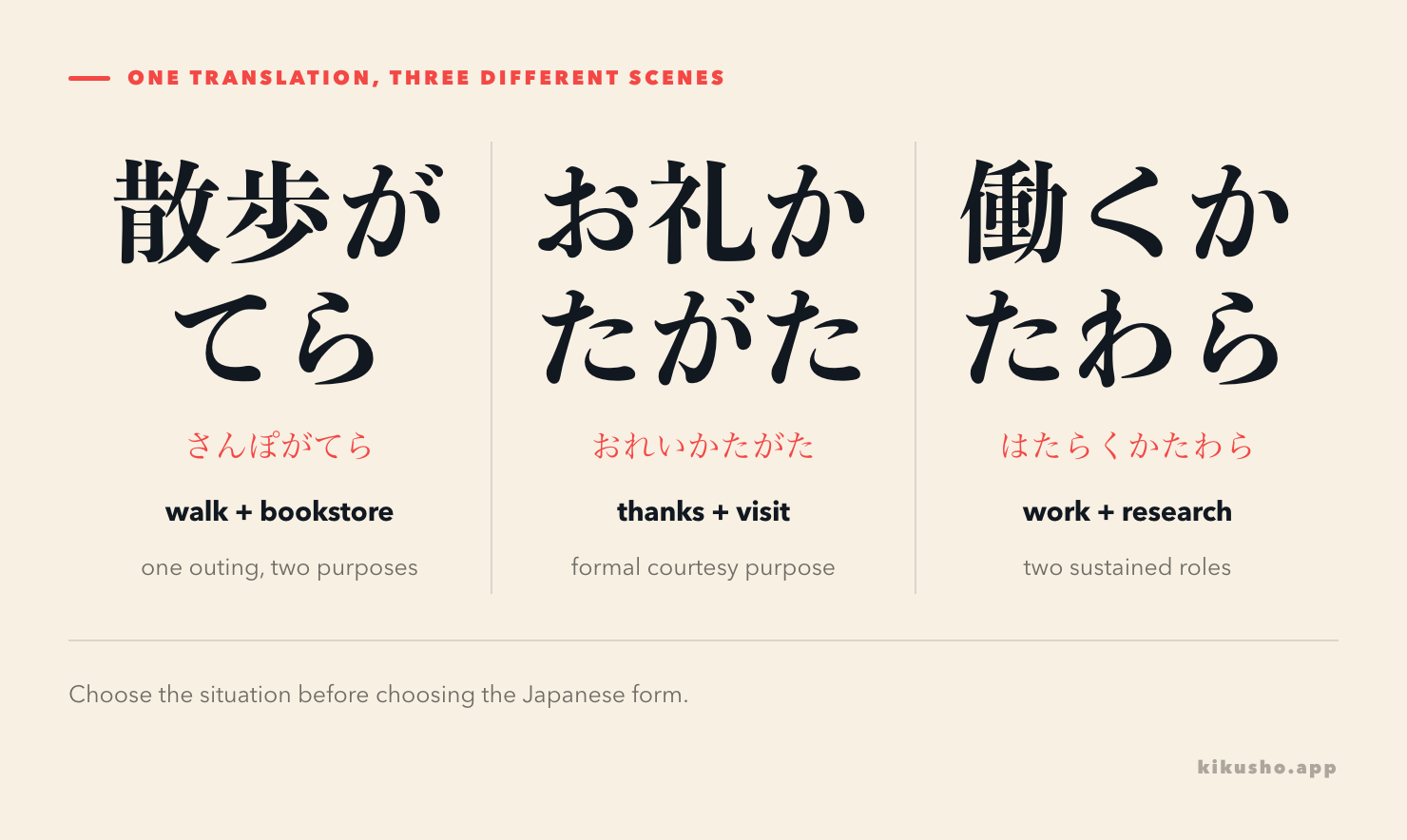
The decision is not simply casual versus formal. がてら and かたがた both let one action serve another purpose, but かたがた is tied to courteous social acts and conventional nouns. かたわら changes the time scale: it usually describes an ongoing arrangement rather than one trip or visit.
がてら turns one occasion into two purposes
Attach がてら directly to a noun or to a verb's ます-stem.
| Base | Formation | Example |
|---|---|---|
| 散歩, a walk | noun + がてら | 散歩がてら |
| 運動, exercise | noun + がてら | 運動がてら |
| 見ます, see or check | ます-stem + がてら | 見がてら |
| 行きます, go | ます-stem + がてら | 行きがてら |
運動がてら、会社まで歩いて行く。
うんどうがてら、かいしゃまであるいていく。
I walk to work, making the trip serve as exercise too.
留学中の妹の様子を見がてら、大阪を観光した。
りゅうがくちゅうのいもうとのようすをみがてら、おおさかをかんこうした。
I visited Osaka both to see how my sister studying abroad was doing and to sightsee.
便利ジャパン's がてら explanation confirms both attachments and describes one action serving two purposes. It also notes the strong tendency toward movement, as in walking, driving or going somewhere. That tendency is useful, but it is not a mechanical rule that every sentence must contain a motion verb. The important test is whether one occasion naturally carries the second purpose.
The nearby ついでに more clearly ranks A as the established occasion and B as an extra action made convenient by it. がてら can make the two purposes feel more balanced:
散歩のついでに、牛乳を買った。
さんぽのついでに、ぎゅうにゅうをかった。
While out for my walk, I bought milk as an extra errand.
運動がてら、隣の町まで買い物に行った。
うんどうがてら、となりのまちまでかいものにいった。
I went shopping in the next town, also making the trip exercise.
The 一度に and ついでに lesson develops the main-occasion and extra-errand relationship. Do not choose がてら just because an English translation contains “while.”
かたがた packages courtesy into a formal act
Attach かたがた directly to an action noun. Its range is conventional rather than freely productive.
| Common expression | Courtesy purpose |
|---|---|
| お礼かたがた | to express thanks, together with another act |
| お詫びかたがた | to apologize, together with another act |
| ご挨拶かたがた | to offer greetings, together with another act |
| ご報告かたがた | to make a report, together with another act |
| お見舞いかたがた | to visit or contact someone to offer sympathy |
| お祝いかたがた | to offer congratulations, together with another act |
合格のご報告かたがた、先生にご挨拶に伺った。
ごうかくのごほうこくかたがた、せんせいにごあいさつにうかがった。
I called on my teacher to report that I had passed and to offer my greetings.
お詫びかたがた、直接事情をご説明いたします。
おわびかたがた、ちょくせつじじょうをごせつめいいたします。
I will explain the circumstances in person and offer my apologies.
日本語教師のまる得 identifies the restricted noun set and the construction's use in formal occasions and letters. Enuncia's comparison independently contrasts that formal pattern with everyday がてら and records the same collocations, including お礼, お詫び, ご報告 and お見舞い.
This is why 散歩かたがたパンを買った is a poor default. The sentence is a casual dual-purpose outing, so 散歩がてらパンを買った is natural. Adding かたがた does not merely make any activity more polite; it invokes a formal social frame.
かたわら stretches the comparison across time
Use a dictionary-form verb before かたわら, or put の after a noun.
| Base | Formation | Example |
|---|---|---|
| 働く, work | dictionary form + かたわら | 働くかたわら |
| 研究する, conduct research | dictionary form + かたわら | 研究するかたわら |
| 仕事, work | noun + の + かたわら | 仕事のかたわら |
| 子育て, raising children | noun + の + かたわら | 子育てのかたわら |
研究所に勤めるかたわら、地域の科学教室でも教えている。
けんきゅうじょにつとめるかたわら、ちいきのかがくきょうしつでもおしえている。
Alongside working at a research institute, she also teaches at a local science program.
子育てのかたわら、翻訳の仕事を続けている。
こそだてのかたわら、ほんやくのしごとをつづけている。
Alongside raising children, he continues to work as a translator.
日本語NET describes these as long-running, often habitual activities that can occur at different times. Its contrast with ながら matters: テレビを見ながら新聞を読む describes two actions in one immediate scene, while 会社で働くかたわら大学院で学ぶ describes two commitments maintained across months or years.
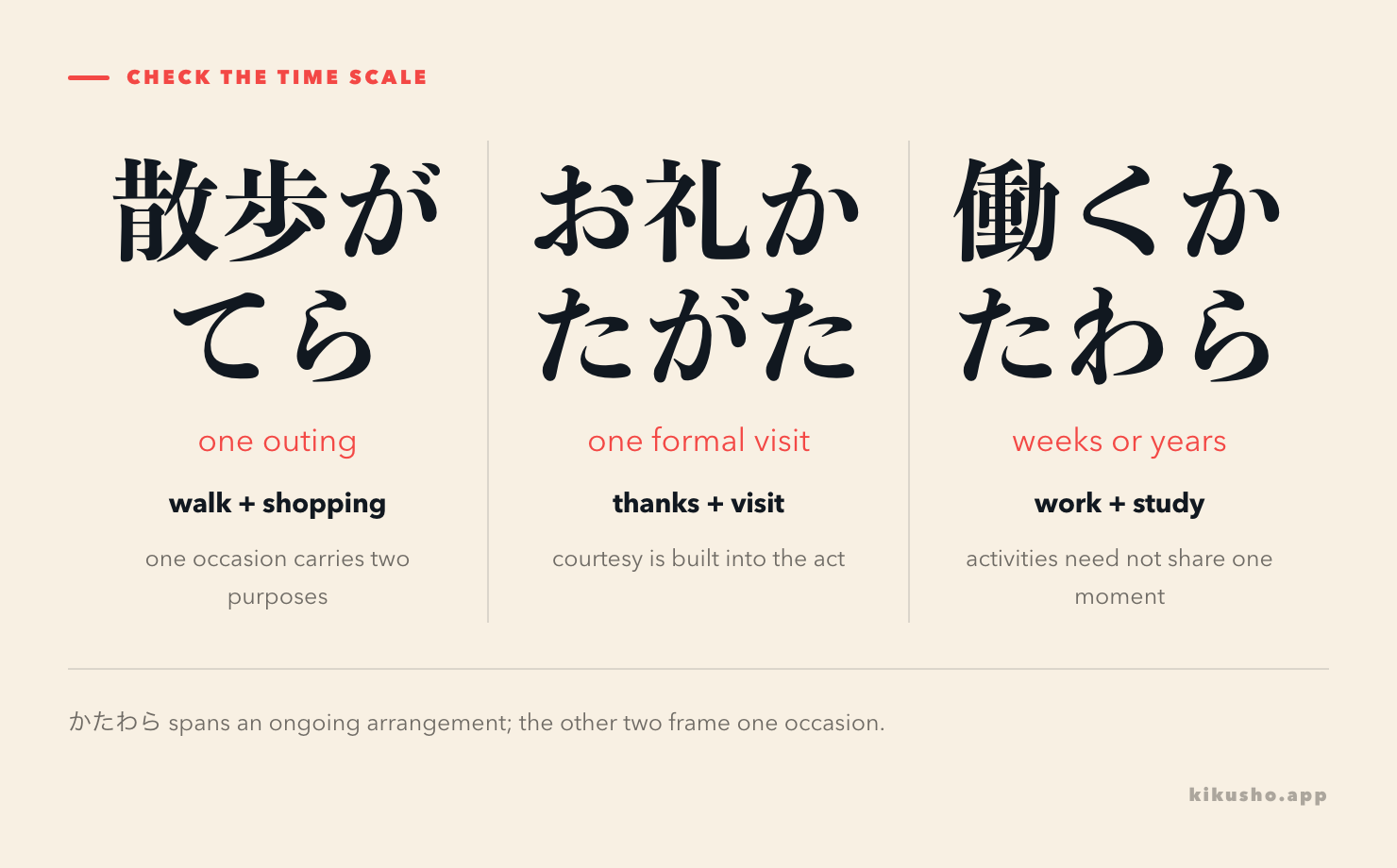
The two-action ながら lesson also covers a longer overlap, as in working while attending university. The distinction is a tendency of focus and style rather than a perfect ban: かたわら presents two established spheres of activity in a more formal, written way, while ながら is the general construction for overlapping actions.
Four checks settle most choices
Ask these in order:
- Are the two activities sustained roles or habits? Choose かたわら.
- Is this one formal visit, message or act of courtesy? Choose かたがた.
- Is this one outing or occasion serving two purposes? Choose がてら.
- Is B merely an extra errand made convenient by A? Consider ついでに instead.
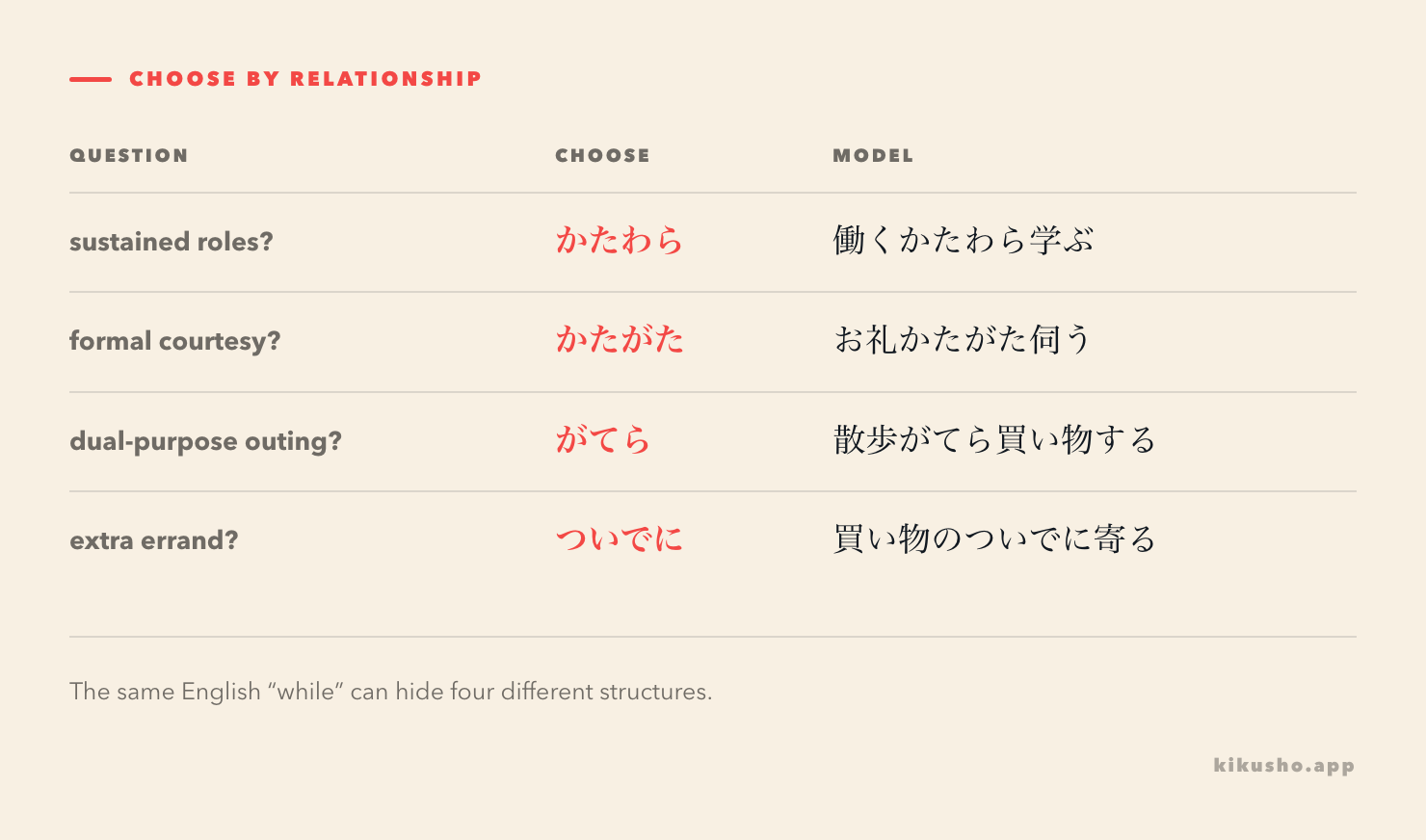
For a Kikusho card, save enough context to preserve the deciding clue. お礼かたがた without the formal visit is incomplete evidence; 働くかたわら without the continuing second role hides the time scale. Capture the whole sentence, check it before saving, and recall the scene as well as the English gloss during offline review.
Practice: choose by purpose, register and time scale
Complete all seven questions before opening the explanations.
Question 1 — grammar choice. You walk to a bakery partly for exercise. Complete 運動__、少し遠いパン屋まで歩いて行った。
- ア. のかたわら
- イ. かたがた
- ウ. がてら
- エ. のながら
Question 2 — attachment. Which completion correctly says “Alongside working at a hospital, she conducts research at a university”?
病院で__、大学でも研究している。
- ア. 働きがてら
- イ. 働くかたわら
- ウ. 働くかたがた
- エ. 働きのかたわら
Question 3 — register. You are writing a formal message saying that you will visit a former supervisor to thank them and give an update. Which opening best fits?
- ア. お礼かたがた、近況をご報告に伺います。
- イ. お礼がてら、近況をご報告に伺います。
- ウ. お礼のかたわら、近況をご報告に伺います。
- エ. お礼ながら、近況をご報告に伺います。
Question 4 — sentence composition. Put these three pieces in natural order to say “While out for a walk, I stopped by the library too.”
- 図書館にも
- 散歩がてら
- 寄った
Question 5 — time scale. Which sentence naturally presents two continuing roles rather than two actions in one immediate scene?
- ア. 彼はピアノを弾くかたわら歌った。
- イ. 彼は教師として働くかたわら、小説を書いている。
- ウ. 彼はお礼かたがた、小説を書いている。
- エ. 彼は散歩がてら、教師として働いている。
Question 6 — interpretation. In お見舞いかたがた、入院中の叔父に必要な書類を届けた, what makes かたがた appropriate, and what practical action shares the visit?
Question 7 — connected text. Choose the three forms for a dual-purpose walk, a formal thank-you visit, and two long-running roles, in that order.
朝は運動( )、駅まで歩いています。今日は先日のお礼( )、先生の研究室に伺いました。先生は大学で教える( )、地域の日本語教室も手伝っています。
- ア. がてら/かたがた/かたわら
- イ. かたがた/がてら/かたわら
- ウ. のかたわら/かたがた/がてら
- エ. がてら/のかたわら/かたがた
Answers and explanations
Answer 1. ウ, がてら. 運動がてら lets the walk serve as exercise and transportation in one outing. かたがた would impose a formal courtesy frame, and noun + かたわら requires の and a continuing parallel activity. のながら is not the attachment for simultaneous ながら.
Answer 2. イ, 働くかたわら. A verb takes かたわら in its dictionary form. The hospital job and university research are sustained parallel activities. 働きがてら would use the ます-stem correctly for がてら, but it would frame one occasion serving two purposes rather than two continuing roles.
Answer 3. ア, お礼かたがた、近況をご報告に伺います. お礼 is one of the conventional courtesy nouns used with かたがた, and 伺います supports the formal visit. がてら is natural for a more ordinary dual-purpose outing; のかたわら would require a continuing role, and お礼ながら is not the intended construction.
Answer 4. 散歩がてら、図書館にも寄った. The walk supplies one purpose, and the library stop shares the outing. The noun attaches directly to がてら, without の.
Answer 5. イ, 彼は教師として働くかたわら、小説を書いている. Teaching and writing are continuing roles maintained in parallel. ア describes two immediate simultaneous actions and naturally takes 弾きながら. ウ combines a courtesy expression with an unrelated long-term activity, and エ tries to turn a lasting occupation into the second purpose of one walk.
Answer 6. お見舞い is a conventional formal social purpose, so it licenses かたがた. Delivering the necessary documents is the practical action completed on the same visit. The construction does not claim that offering sympathy and handing over papers occupy the same instant.
Answer 7. ア, がてら/かたがた/かたわら. 運動がてら makes the walk serve as exercise. お礼かたがた marks the formal courtesy purpose of visiting the teacher. 教えるかたわら joins the professor's continuing university role with recurring help at the community class.
The three items are taught here as N1 grammar
JLPT Sensei lists がてら, かたがた and かたわら at N1. 日本語NET, Enuncia, 便利ジャパン and 日本語教師のまる得 independently use the same N1 placement for the forms they cover. Jonathan Waller's Tanos materials contain surface matches for がてら and かたわら in both its N1 and N2 grammar PDFs without establishing a separate use. This lesson records that disagreement and follows the N1 placement shared by the other inspected teaching references.
For this three-form comparison, OpenAI Codex completed the AI language review. It checked the attachments, movement and duration tendencies, formal collocations, Japanese examples, kana, translations, distractors and every question-to-explanation mapping. No human review is claimed.
Common questions
What is the difference between がてら, かたがた and かたわら?
がてら combines two purposes in one outing or opportunity. かたがた adds a formal courtesy purpose such as thanks, an apology or a report. かたわら presents two roles or activities maintained in parallel over time.
What comes before がてら?
Attach がてら to a noun such as 散歩 or to the ます-stem of a verb: 散歩がてら and 見がてら. It is especially natural with outings, movement and occasions that can serve two purposes.
Which nouns commonly take かたがた?
Conventional choices include お礼, お詫び, ご挨拶, ご報告, お見舞い and お祝い. The construction belongs mainly to formal visits, letters and business communication, so it does not freely replace casual がてら.
Does かたわら mean two actions happen at the same instant?
No. It usually presents sustained roles or recurring activities that run in parallel, even when they occur at different times. Use ながら for two actions performed together in one immediate scene.