On this page
ごとき, ごとく and ごとし all make a formal comparison: choose ごとき before a noun, ごとく before an action or quality, and ごとし when the comparison ends the statement. A neutral noun comparison normally takes Nの, as in 風のごとく走る, while direct Nごとき belongs to a separate evaluative use such as 私ごときが.
JLPT Sensei lists the family at N1 and gives the same three syntactic roles. 毎日のんびり日本語教師 describes it as an older expression now used mainly in writing and documents noun and verb attachment. The N1 label is a study-list placement rather than an official syllabus entry because the JLPT does not publish an exhaustive grammar list.
One comparison, three sentence roles
The three endings descend from the classical adjective ごとし. In modern Japanese, it is most useful to treat them as a compact set whose form changes according to what comes next.
| What happens next? | Form | Modern equivalent | Example |
|---|---|---|---|
| a noun follows | Nのごとき + noun | Nのような + noun | 氷のごとき冷たい視線 |
| an action or quality follows | Nのごとく + verb/adjective | Nのように + verb/adjective | 風のごとく走る |
| the statement ends | Nのごとし | Nのようだ | 光陰矢のごとし |
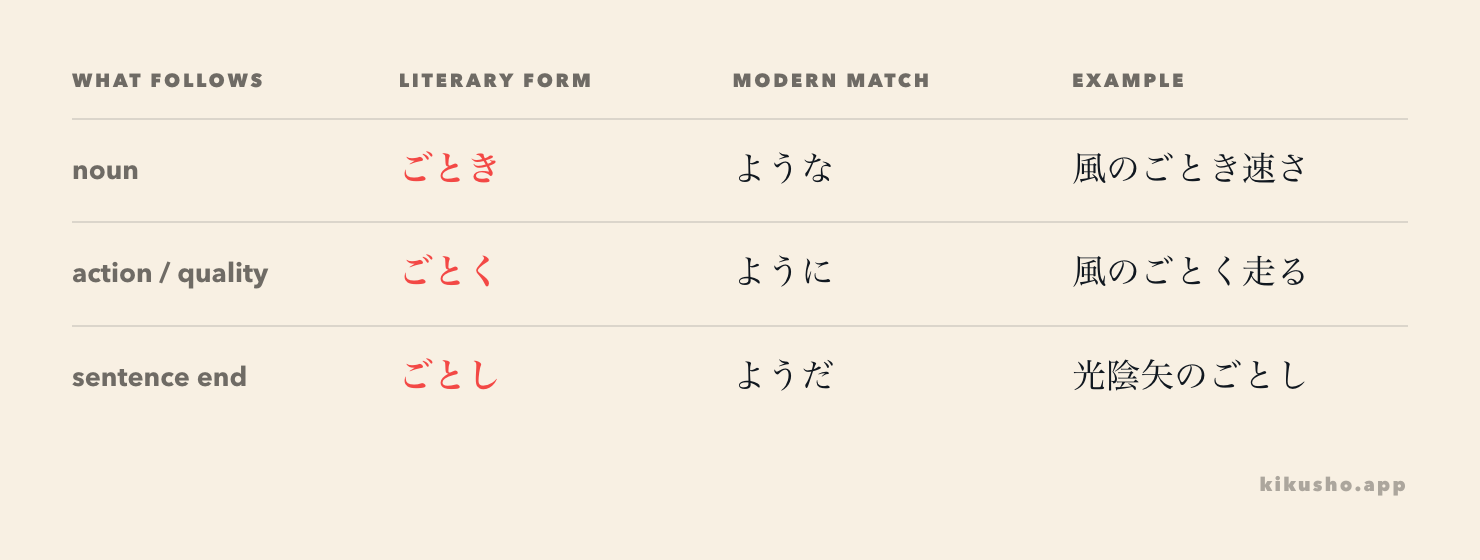
The decision looks to the right. The thing being compared can stay the same while the form changes:
彼は獣のごとき声を上げました。
かれは けもののごとき こえを あげました。
He let out a voice like that of a beast.
Here 声 follows, so the attributive ごとき modifies a noun.
彼は獣のごとく叫びました。
かれは けもののごとく さけびました。
He screamed like a beast.
Here 叫びました follows, so the adverbial ごとく describes how he screamed.
戦う姿は、まさに獣のごとし。
たたかう すがたは、まさに けもののごとし。
The sight of him fighting was truly like a beast.
Here the comparison itself completes the statement, so ごとし is the predicate. This final form is especially literary. It may appear without polite です, even in otherwise modern prose, because the old-fashioned ending is part of its effect.
Attach nouns with の and clauses with が or かの
For a neutral comparison built from a noun, use Nの before all three forms.
| Job | Formation | Example |
|---|---|---|
| noun modifier | Nのごとき + noun | 宝石のごとき輝き |
| manner or degree | Nのごとく + verb/adjective | 宝石のごとく輝く |
| sentence predicate | Nのごとし | その輝きは宝石のごとし |
A verb can be in the dictionary form or the past form. It is commonly followed by が or かの before the ごとし form:
| Comparison clause | Before a noun | Before a predicate | At sentence end |
|---|---|---|---|
| 時が止まる | 時が止まるかのごとき静けさ | 時が止まるかのごとく静かだ | 時が止まるかのごとし |
| 何もなかった | 何もなかったかのごとき態度 | 何もなかったかのごとく振る舞う | 何もなかったかのごとし |
The longer かの sequence presents the preceding clause as an imagined scene, much like かのよう. がごとく also occurs, especially in literary set pieces. 便利ジャパン gives noun + の and verb + が as the central attachments, while the Japanese-teacher reference above records both が and かの after dictionary and past verb forms.
For reliable production, start with the transparent noun pattern and learn clause-based examples as complete frames. A dense literary sentence is a poor place to improvise an attachment you have never seen.
The modern よう forms reveal the structure
The three forms correspond closely to ような, ように and ようだ.
| Literary comparison | Ordinary modern comparison |
|---|---|
| 氷のごとき冷たさ | 氷のような冷たさ |
| 氷のごとく冷たい | 氷のように冷たい |
| その冷たさは氷のごとし | その冷たさは氷のようだ |
This is a structural comparison, not a claim that the registers are interchangeable. The ごとし family sounds literary, formal, proverbial or deliberately dramatic. In normal conversation, ような/ように/ようだ is usually natural.
The saying 光陰矢のごとし illustrates why learners still meet the older form. It compares the passing of time to an arrow and ends with ごとし. Replacing it mechanically with ようだ would communicate the comparison, but it would lose the recognized proverb and its classical tone.
The earlier lesson on かのように, かのような and かのようだ teaches the modern as-if pattern. Its three endings provide the same right-hand test: a following action selects に, a following noun selects な, and a completed statement selects だ.
Direct noun + ごとき lowers its target
When ごとき attaches directly to a person or thing, without the comparison marker の, it often carries an evaluative meaning: “someone or something as insignificant as...” The direction of that judgment depends on whose status is being lowered.
私ごときが意見を申し上げるのは恐縮ですが、もう一度ご検討ください。
わたしごときが いけんを もうしあげるのは きょうしゅくですが、もういちど ごけんとうください。
I hesitate to offer an opinion as someone of my standing, but please reconsider.
The speaker lowers themself. This can signal humility, though it is stronger and more stylized than an ordinary polite hedge.
新人ごときに負けるはずがない。
しんじんごときに まける はずがない。
There is no way I could lose to a mere newcomer.
The speaker lowers another person. That sounds scornful. The particle required by the rest of the sentence follows ごとき: 私ごときが, 新人ごときに, そんな失敗ごときで. The Japanese-teacher reference keeps this contemptuous pattern separate from comparison, which is a useful warning not to merge the two constructions.
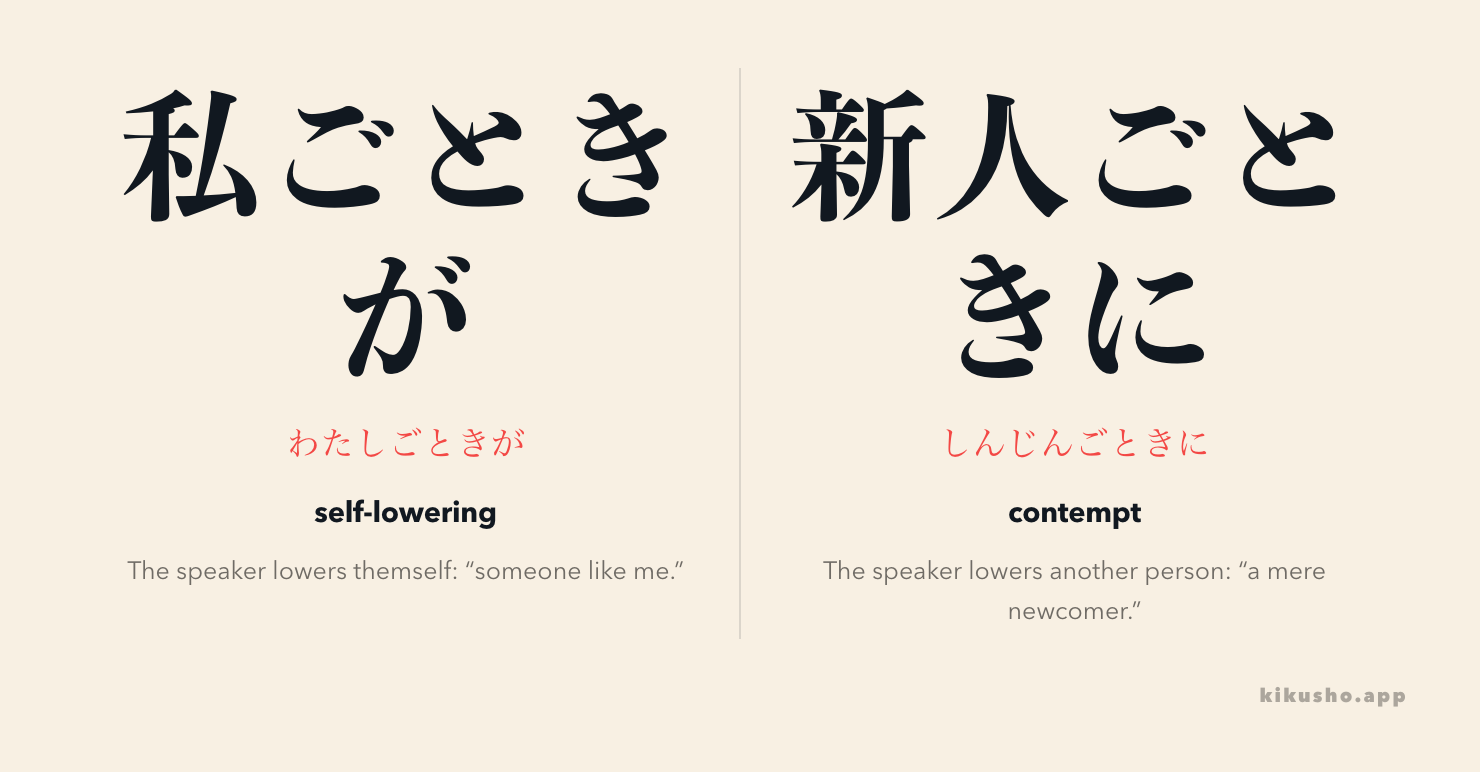
Do not remove の from a neutral simile simply because direct attachment exists. 風のごとき速さ compares speed with the wind. 私ごとき judges the speaker's standing. They share historical material, but they do different work in a modern sentence.
Read the register before you reuse it
The forms appear in fiction, historical writing, speeches, headlines, slogans and set sayings. A writer may also use them in modern prose to sound solemn, epic or ironic. Try IT's classical grammar lesson identifies ごとく as the continuative form, ごとし as the sentence-ending form and ごとき as the noun-modifying form, which explains why the three-way division survives so neatly.
Kanji spellings 如き/如く/如し occur, especially in deliberately literary text. Hiragana is also common and is easier to recognize as one family. Reading both spellings matters more than forcing the kanji into your own everyday writing.
When you save an example in Kikusho, keep the material on both sides: 風のごとく走る, not only ごとく. The word to the right tells you why that form was chosen, and the noun or clause to the left tells you how it attaches.
Common mistakes
Using ごとき before a verb
ごとき expects a following noun. If an action follows, use ごとく.
× 鳥のごとき空を飛んだ。
○ 鳥のごとく空を飛んだ。
Flew through the sky like a bird.
Using neutral Nのごとき and evaluative Nごとき as one pattern
The presence of の matters. 王のごとき威厳 is a simile, “dignity like a king's.” 王ごときに従わない lowers the king, “I will not obey a mere king.” The second sentence is confrontational because of the evaluation, not merely formal because it contains ごとき.
Treating the form as ordinary conversation
Grammatical does not mean neutral in every setting. 風のごとく走った fits literary narration; 風のように走った is the ordinary modern version. Use the formal form when its register suits the text.
Confusing comparison with deliberate pretence
何も知らないかのごとく話した describes a manner that resembles ignorance. It does not by itself prove intentional deception. If the person knowingly performed that appearance, 知らないふりをした states deliberate pretence. The lesson on ふりをする and まるで develops that distinction.
Practice
Answer all seven items before opening the shared explanation block.
Question 1
Choose the form that modifies the noun 静けさ.
海底の__静けさが部屋を包みました。
ア. ごとき
イ. ごとく
ウ. ごとし
エ. ごとくに
Question 2
Choose the form that describes how the leaves moved.
木の葉が波の__揺れていました。
ア. ごとき
イ. ごとく
ウ. ごとし
エ. ごときに
Question 3
Choose the form that completes the statement.
光陰、矢の__。
ア. ごとき
イ. ごとく
ウ. ごとし
エ. ごときの
Question 4
Which sentence uses a neutral comparison rather than lowering a person?
ア. 私ごときが口を出すべきではありません。
イ. 新人ごときに何ができる。
ウ. 王のごとき威厳を備えている。
エ. 子どもごときに負けてしまった。
Question 5
Order the chunks to make a literary sentence meaning “He ran away like the wind.”
__ __ __ __。
- 走り去った
- 彼は
- 風の
- ごとく
Question 6
Rewrite the ordinary modern comparison with a literary form while keeping the same sentence role.
雪のような白い肌
Question 7
Read the passage. Which instance of ごとき is a simile, and which one lowers its target?
彼は岩のごとき意志を持つ選手だった。「私ごときが代表でよいのでしょうか」と本人は言った。
Answers and explanations
Answer 1
ア. ごとき. The noun 静けさ follows, so the comparison needs the noun-modifying form: 海底のごとき静けさ, “silence like the seabed.”
Answer 2
イ. ごとく. 揺れていました is the following action. The adverbial form describes how the leaves moved: 波のごとく揺れる.
Answer 3
ウ. ごとし. The comparison ends the saying, so the predicate form is required: 光陰矢のごとし, “time flies like an arrow.”
Answer 4
ウ. 王のごとき威厳を備えている. 王のごとき contains the neutral comparison marker の and modifies 威厳. The direct noun combinations in the other choices lower 私, 新人 or 子ども.
Answer 5
2 → 3 → 4 → 1: 彼は風のごとく走り去った。 The noun comparison 風の comes before adverbial ごとく, which leads into the action 走り去った.
Answer 6
雪のごとき白い肌. The comparison modifies the noun phrase 白い肌, so noun-modifying ごとき replaces ような. 雪のごとく白い肌 is also grammatical with a different grouping: ごとく then modifies the adjective 白い. The prompt asks you to keep the original noun-modifying role.
Answer 7
岩のごとき is a neutral simile modifying 意志: his will is compared to rock. 私ごときが directly attaches to 私 and lowers the speaker, giving a self-effacing “someone like me” meaning.
A three-step reading check
When you meet one of these forms, make three decisions in order:
- Look right. A noun points to ごとき, an action or quality to ごとく, and the end of a statement to ごとし.
- Look left. Nの normally marks a neutral comparison; a verb clause may lead through が or かの.
- Check for direct noun + ごとき. If の is absent and a person or thing is being ranked, expect self-lowering or contempt rather than a plain simile.
That sequence turns an old literary paradigm into a practical reading decision. For broader comparison and evidence choices in contemporary Japanese, continue with そう, よう, らしい and みたい.
Common questions
What is the difference between ごとき, ごとく and ごとし?
They express the same formal comparison but do different jobs. ごとき modifies a following noun, ごとく modifies an action or quality, and ごとし completes the sentence as its predicate.
How do ごとき, ごとく and ごとし attach to a noun?
A neutral comparison normally uses noun + の: 風のごとき, 風のごとく or 風のごとし. Direct noun + ごとき, as in 私ごとき or お前ごとき, is a related evaluative pattern that lowers the person named.
Are ごとき, ごとく and ごとし common in conversation?
They sound literary, formal or deliberately dramatic. Ordinary conversation usually uses ような, ように and ようだ, while fixed sayings and stylized writing preserve the ごとし family.
What does 私ごとき mean?
私ごとき lowers the speaker and means roughly someone like me. It can express modesty, but the same direct-noun pattern can sound contemptuous when aimed at another person, so it is not a neutral substitute for noun + のごとき.