On this page
Choose ぐるみ when a whole group acts or is involved together, まみれ when a substance covers a surface or a harmful condition engulfs someone, and ずくめ when one kind of thing fills a situation, sequence or appearance. All three follow nouns, but “all” describes participation, coating or composition in a different way each time.
JLPT Sensei places all three forms at N1. Its individual pages document noun + ぐるみ for group-wide involvement and noun + まみれ for being covered or stained. Japanese teacher references independently confirm the distinctions and the limited combinations accepted by ずくめ. These level labels are preparation estimates because the JLPT publishes no exhaustive grammar syllabus.
The deciding question is what becomes complete
The English phrases “all together,” “covered in” and “nothing but” can blur into one loose idea of totality. Japanese keeps three scenes apart.
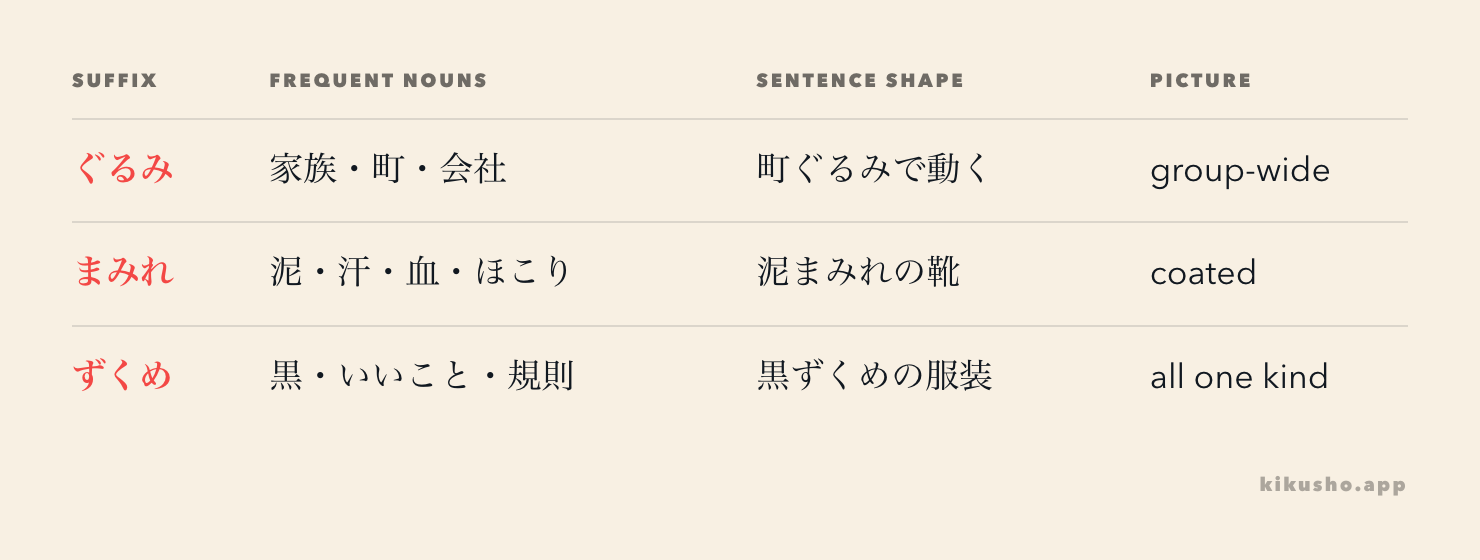
| Form | What becomes complete? | Typical nouns | Core example |
|---|---|---|---|
| N + ぐるみ | participation by a whole group or unit | 家族, 町, 会社 | 町ぐるみで取り組む |
| N + まみれ | contact across a surface, or harmful entanglement | 泥, 汗, 血, ほこり, 借金 | 泥まみれの靴 |
| N + ずくめ | a situation or appearance made up of one type | 黒, いいこと, ごちそう, 規則 | 黒ずくめの服装 |
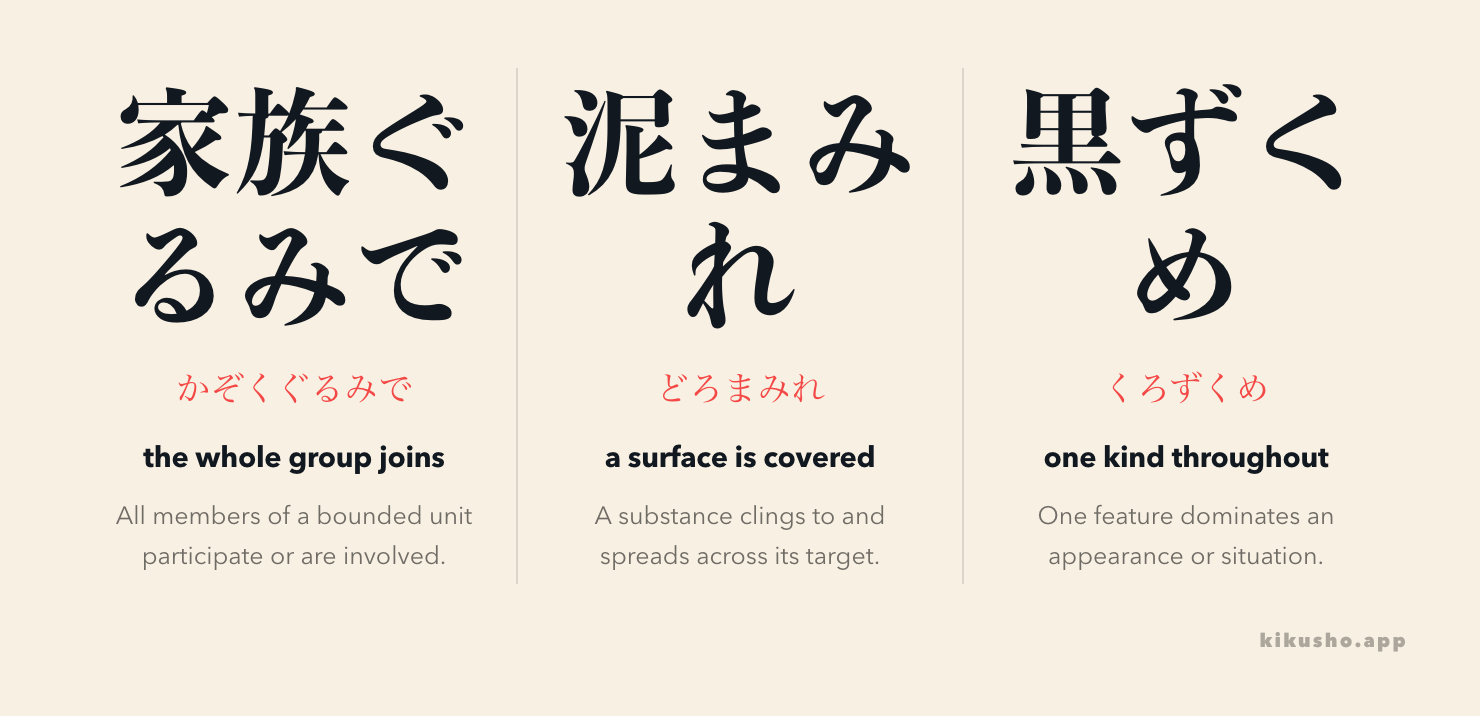
The forms do not compete merely because an English translation contains “all.” 会社ぐるみの不正 says the organization was involved across its ranks. 疑惑まみれの会社 says allegations engulf the company. 規則ずくめの会社 says rules dominate its environment. Each sentence draws a different map of the same company.
ぐるみ brings the whole group into one action
Attach ぐるみ to a noun naming a bounded group, community or unit. The members or parts participate together, are involved together, or are treated as one whole.
地域ぐるみで防災訓練に取り組みました。
ちいきぐるみで ぼうさいくんれんに とりくみました。
The entire community took part in disaster-prevention training.
The training does not cover the region like a material. The people and organizations inside the region join the activity.
彼とは十年以上、家族ぐるみの付き合いがあります。
かれとは じゅうねんいじょう、かぞくぐるみの つきあいが あります。
Our families have been close for more than ten years.
Both families are included in the relationship. 家族ぐるみ is therefore wider than saying that two individuals are friends.
The usual sentence shapes are:
| Shape | Job | Example |
|---|---|---|
| N + ぐるみで + action | the whole group performs or joins an action | 町ぐるみで清掃する |
| N + ぐるみの + noun | a relationship, effort or involvement includes the group | 家族ぐるみの付き合い |
| N + ぐるみ + copula | the group-wide unit is identified or judged | 隠蔽は会社ぐるみだった |
にほんご部 describes the meaning as “the whole of that thing” and notes frequent use with groups or areas such as 家族, 会社 and 地域. The event itself may be admirable or blameworthy. 町ぐるみの活動 is cooperative; 会社ぐるみの隠蔽 is collective wrongdoing. ぐるみ marks scope, not approval.
Do not generalize from 身ぐるみ, a lexicalized expression meaning all that someone has or is wearing. For productive N1 use, start with clear group and unit nouns rather than assuming ぐるみ can mean “all of” after any noun.
まみれ puts something unwanted across a surface
Attach まみれ to a noun for material that clings to or covers a person, object or surface. Common combinations include 汗まみれ, 泥まみれ, 血まみれ, 油まみれ, ほこりまみれ and 砂まみれ.
倉庫を片づけたら、服がほこりまみれになりました。
そうこを かたづけたら、ふくが ほこりまみれに なりました。
After cleaning the storeroom, my clothes became covered in dust.
選手たちは汗まみれで練習を続けました。
せんしゅたちは あせまみれで れんしゅうを つづけました。
The players continued practising, drenched in sweat.
The common shapes are Nまみれだ, Nまみれの + noun, Nまみれで + clause and Nまみれになる. Use の, not な, before a following noun: 泥まみれの靴, not 泥まみれな靴.
日本語教師のまる得 limits the basic physical use to substances such as liquids and powders that cling across a surface. The same page also records conventional figurative extensions for damaging conditions:
その事業は借金まみれの状態から立て直された。
その じぎょうは しゃっきんまみれの じょうたいから たてなおされた。
The business was rebuilt from a state of being mired in debt.
借金, 疑惑, 嘘 and 汚職 do not literally stick to a surface. They are understood as harmful conditions that surround and compromise their target. This extension does not license every abstract noun. Learn the recurring combinations you meet.
ずくめ makes one kind dominate the whole scene
Attach ずくめ to a noun when an appearance, experience or sequence is composed throughout of that same kind. It can evaluate the result positively, negatively or neutrally.
今年の旅行は、いいことずくめでした。
ことしの りょこうは、いいことずくめでした。
This year's trip was full of good things from beginning to end.
入口には黒ずくめの人物が立っていました。
いりぐちには くろずくめの じんぶつが たっていました。
A person dressed entirely in black was standing at the entrance.
新しい職場は規則ずくめで、息苦しく感じます。
あたらしい しょくばは きそくずくめで、いきぐるしく かんじます。
The new workplace is all rules, and it feels stifling.
The grammatical frame is simple: Nずくめだ, Nずくめの + noun, or Nずくめで + clause. The lexical choice is harder. Tanosuke's N1 explanation notes that the pattern is strongly idiomatic and lists familiar combinations such as いいことずくめ, ごちそうずくめ and 黒ずくめ. A learner should not attach it freely to every noun that happens to be numerous.
The kanji spelling 尽くめ appears, but hiragana ずくめ is common in learning materials and ordinary prose. Recognizing both is useful; the choice of script does not change the construction.
まみれ and だらけ overlap only in the coating zone
The existing N3 form だらけ also describes abundance, usually with an unwanted flavor. Its range is wider than physical coating.
部屋は本だらけです。
The room is full of books.
Books fill the room, but they do not cling to its surface, so 本まみれ is ordinarily the wrong image. With mud, dust or sand, both forms may work while shifting attention:
- 泥まみれの手 pictures mud adhering across the hands.
- 泥だらけの床 presents mud in many places across the floor.
The boundary depends on how the speaker construes the scene, so it is not a rigid substance list. The lesson on だらけ, がち and 気味 develops the accumulation side. For this N1 choice, ask whether the sentence makes you picture contact and coating. If it does, まみれ is the precise candidate.
ずくめ differs from both. いいことずくめ is natural because favorable events make up the whole experience. いいことまみれ would turn goodness into an odd clinging substance, while いいことだらけ can occur colloquially but foregrounds abundance rather than the established all-through sequence of ずくめ.
The wrong suffix changes the geometry of the sentence
These errors are revealing because each suffix imposes a scene.
A group cannot become a coating
× 町まみれで清掃活動をした。
○ 町ぐるみで清掃活動をした。
The intended meaning is town-wide participation. Nothing called 町 is stuck to a surface.
A substance does not form an organized participant group
× 靴が泥ぐるみになった。
○ 靴が泥まみれになった。
Mud physically covers the shoes. ぐるみ would require a bounded unit whose members or parts are included together.
ずくめ is not a free synonym for “many”
× 棚は本ずくめだった。
○ 棚は本だらけだった。
Natural ずくめ combinations present a recognized all-of-one-kind state or sequence. A shelf containing many books simply calls for an abundance expression.
A useful Kikusho capture preserves the suffix's whole frame. A card with 町ぐるみで, 泥まみれの or いいことずくめだ retains both the accepted combination and its sentence role. Later review can then recover one of three visible scenes instead of relying on three loose English definitions.
Practice
Choose or build each form in Questions 1–7. Reveal the explanations only after the last item.
Question 1
The whole town joins a recycling campaign. Choose the suffix.
町__でリサイクル運動に取り組んでいる。
ア. ぐるみ
イ. まみれ
ウ. ずくめ
エ. だらけ
Question 2
Dust clings across an old box. Choose the most precise form.
押し入れから、ほこり__の箱が出てきた。
ア. ぐるみ
イ. まみれ
ウ. ずくめ
エ. ばかり
Question 3
All parts of the person's outfit are black. Choose the established combination.
黒__の人物が駅に立っていた。
ア. ぐるみ
イ. まみれ
ウ. ずくめ
エ. にわたって
Question 4
Which sentence correctly modifies a following noun?
ア. 泥まみれな靴を洗った。
イ. 泥まみれの靴を洗った。
ウ. 泥まみれに靴を洗った。
エ. 泥のまみれ靴を洗った。
Question 5
Order the chunks to say “Our families have known each other for a long time.”
__ __ __ __。
- 付き合いがある
- 家族ぐるみの
- 長年
- 私たちには
Question 6
Choose the sentence in which まみれ is inappropriate.
ア. 作業着が油まみれになった。
イ. 選手は汗まみれで走り続けた。
ウ. 机の上は本まみれだった。
エ. 会社は疑惑まみれだった。
Question 7
Read the passage. Explain why each suffix is different.
地域ぐるみで祭りを準備した。当日は全員が汗まみれになったが、催しは成功し、最後までいいことずくめだった。
Answers and explanations
Answer 1
ア. ぐるみ. The town is a bounded community whose members join one campaign. 町ぐるみで marks town-wide participation; it does not describe material covering a surface or one type filling an experience.
Answer 2
イ. まみれ. Dust is a powder-like substance clinging across the box, so ほこりまみれの箱 gives the coating image. The suffix takes の before the noun 箱.
Answer 3
ウ. ずくめ. 黒ずくめ is the established expression for an appearance that is black throughout. It takes の before 人物.
Answer 4
イ. 泥まみれの靴を洗った. The whole Nまみれ expression modifies a following noun with の. It does not behave as a な-adjective, so まみれな is incorrect here.
Answer 5
4 → 3 → 2 → 1: 私たちには長年家族ぐるみの付き合いがある。 家族ぐるみの modifies 付き合い and says that the relationship includes the families rather than only two individuals.
Answer 6
ウ. 机の上は本まみれだった. Books may fill or clutter a desk, but they do not normally cling to it as a coating. 本だらけだった is the natural abundance expression. Oil, sweat and the conventional figurative 疑惑まみれ fit the target pattern.
Answer 7
地域ぐるみで includes the whole community in the preparation. 汗まみれ pictures sweat covering the participants' bodies or clothes. いいことずくめ evaluates the event as a sequence composed throughout of favorable developments. The passage therefore uses group scope, surface coverage and all-of-one-kind composition in turn.
Three nouns can settle the choice
Instead of memorizing three translations, anchor each form to a noun that exposes its structure: 町ぐるみ, 泥まみれ, 黒ずくめ. Then test a new sentence against those models. Does a bounded unit join the event, does a substance adhere to a target, or does one type dominate the whole scene? If none fits, an expression such as だらけ, ばかり or a plain quantity phrase may be the form you need.
The nearby ばかり comparison is useful when the issue is restriction or repeated choice rather than participation, coating or composition. For duration and geographical spread, にわたって marks the span itself without assigning any of these three kinds of totality.
Common questions
What is the difference between ぐるみ, まみれ and ずくめ?
ぐるみ includes every member or part of a bounded group, まみれ describes a surface covered in a substance or a person trapped in a harmful condition, and ずくめ says that a situation, sequence or appearance consists throughout of one kind of thing.
What is the difference between まみれ and だらけ?
まみれ focuses on something such as mud, sweat or dust clinging to and covering a surface. だらけ more broadly presents many unwanted instances spread through a place or object, so 本だらけ is natural while 本まみれ is ordinarily not.
Can ずくめ follow any noun?
No. It is strongly collocational. Learn recurring combinations such as 黒ずくめ, いいことずくめ, ごちそうずくめ and 規則ずくめ instead of treating it as a productive translation of all or full of.
Are ぐるみ, まみれ and ずくめ all negative?
No. ぐるみ is neutral about whole-group involvement, though its event may be good or bad. まみれ usually evokes dirt, harm or entanglement. ずくめ can be positive, negative or neutral depending on the noun.