On this page
Use だらけ for an unwanted accumulation, がち for a repeated tendency, and 気味 for a mild current state. All three often describe something undesirable, but they answer different questions: how much is present, how often it happens, or what the situation is like now.
The English words “full of,” “tend to,” and “a little” help at first. The more reliable choice comes from the evidence in the sentence: visible instances point to だらけ, repetition over time points to がち, and a slight condition at the reference time points to 気味.
Choose the axis before choosing the pattern
Imagine a team checking a report and its schedule:
この書類は間違いだらけだ。
この しょるいは まちがいだらけだ。
This document is riddled with mistakes.
忙しいと、数字を見落としがちだ。
いそがしいと、すうじを みおとしがちだ。
When busy, we tend to overlook figures.
作業は少し遅れ気味だ。
さぎょうは すこし おくれぎみだ。
The work is running a little behind.
The first sentence counts a bad result spread through the document. The second summarizes a habit that recurs under a condition. The third diagnoses the schedule's present direction without saying that delay is a repeated habit.
| Pattern | Main evidence | Basic attachment |
|---|---|---|
| だらけ | many instances or a substance throughout something | noun + だらけ |
| がち | repeated frequency or proneness over time | verb ます-stem / noun + がち |
| 気味(ぎみ) | a mild current state or slight directional change | verb ます-stem / noun + 気味 |
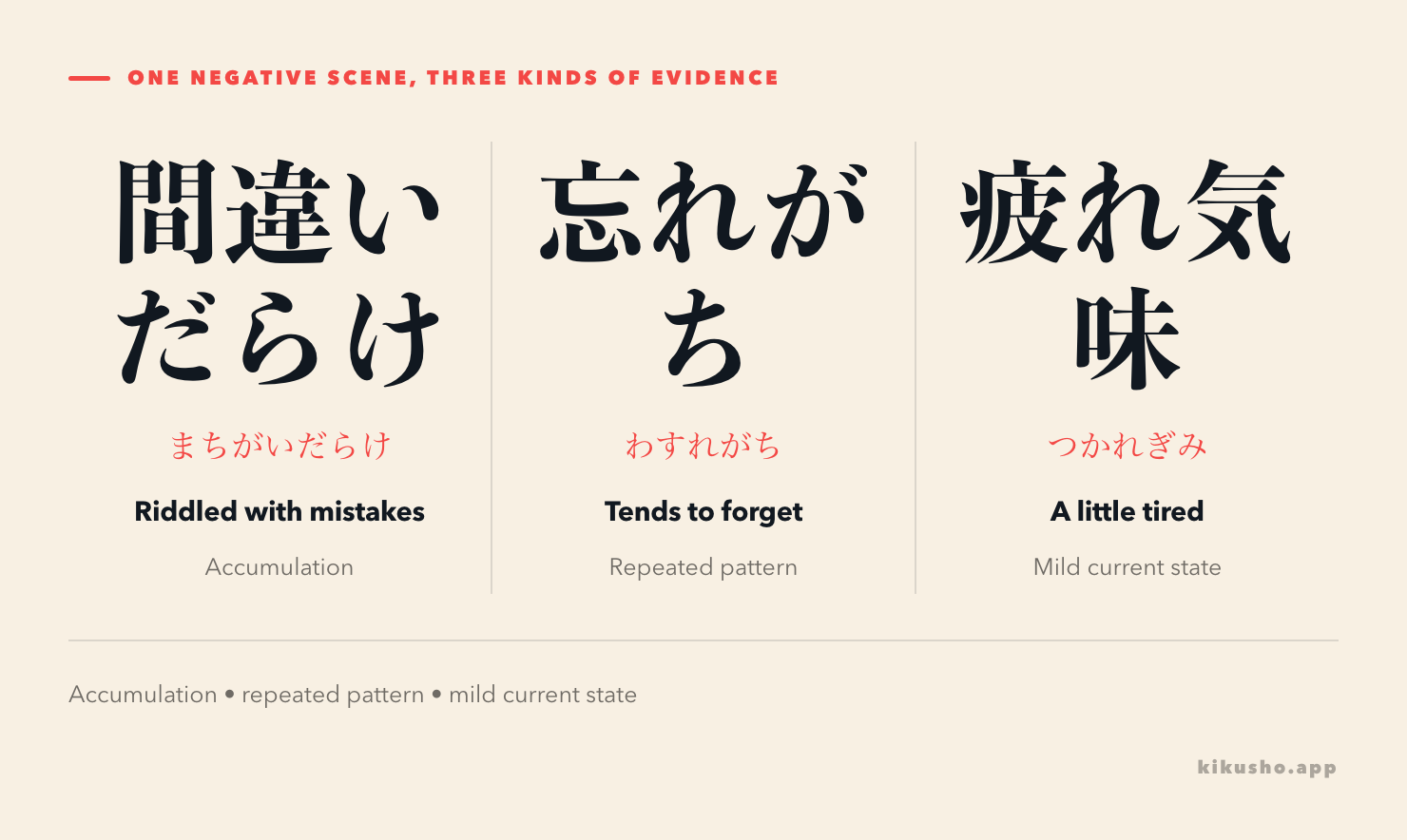
These categories can describe the same broad problem from different angles. A person can have a report 間違いだらけ, be ミスしがち when rushed, and feel 疲れ気味 today. The forms are not interchangeable merely because every sentence sounds negative.
N plus だらけ fills the scene with instances
だらけ follows a noun and presents its referent as abundant across a person, object, or place. The noun often names something unwanted that can be seen, counted, or imagined as covering the target.
子どもたちは泥だらけになって帰ってきた。
こどもたちは どろだらけに なって かえってきた。
The children came home covered in mud.
この作文は漢字の間違いだらけです。
この さくぶんは かんじの まちがいだらけです。
This composition is full of kanji mistakes.
傷だらけの机を修理した。
きずだらけの つくえを しゅうりした。
I repaired the desk that was covered in scratches.
The attachment stays nominal:
| Job | Form | Example |
|---|---|---|
| predicate | N + だらけだ | 部屋はほこりだらけだ |
| noun modifier | N + だらけの + N | 泥だらけの靴 |
| resulting state | N + だらけになる | 傷だらけになった |
JLPT Sensei's だらけ reference and Bunpro's だらけ entry both support the N3 placement, noun attachment, and “full of” meaning with an ordinarily undesirable result. JLPTPass similarly treats it as a pervasive accumulation.
The negative coloring is common rather than automatic. 猫だらけの島 can sound delighted if the speaker loves cats. Even there, だらけ highlights abundance spread through the scene; it is less neutral than simply giving a number with たくさんいる.
This is different from limiting a choice with Nばかり, “nothing but N.” 本ばかり読んでいる says that someone keeps choosing books. 本がほこりだらけだ says dust covers the books. The ばかり comparison separates restriction and approximation from this accumulation pattern.
がち turns repeated events into a tendency
がち follows a verb's ます-stem or a noun. It says that an event occurs relatively often, or that a person or situation is prone to it.
急ぐと、大事な説明を忘れがちです。
いそぐと、だいじな せつめいを わすれがちです。
When I hurry, I tend to forget important explanations.
彼は冬になると病気がちだ。
かれは ふゆに なると びょうきがちだ。
He tends to be ill during winter.
在宅勤務では運動不足になりがちな人もいる。
ざいたくきんむでは うんどうぶそくに なりがちな ひとも いる。
Some people are prone to becoming inactive when working from home.
The forms in these examples are 忘れます → 忘れがち, 病気 + がち, and the noun modifier なりがちな人. The tendency is usually viewed as inconvenient, undesirable, or worth correcting. ありがちな間違い, however, can simply mean “a common mistake”; the construction does not add moral blame by itself.
JLPT Sensei, JLPTPass, and Coto Academy agree on the N3 placement, verb-stem or noun attachment, repeated tendency, and usual negative coloring. The important time scale is larger than a single moment. 忘れがち summarizes several occasions or a recognized disposition.
When you save an example in Kikusho, capture its time cue as well as the target form. Words such as いつも, 忙しいと, and 冬になると make the repeated evidence for がち visible. 今日 or 今週は少し may instead support a current-state reading with 気味.
気味(ぎみ) gives a mild current diagnosis
気味 also follows a verb's ます-stem or a noun, but it usually describes a condition that is slightly present now or a movement that has begun to lean in one direction.
今日は少し風邪気味なので、早く帰ります。
きょうは すこし かぜぎみなので、はやく かえります。
I feel as if I am coming down with a slight cold today, so I will go home early.
最近、寝不足で疲れ気味だ。
さいきん、ねぶそくで つかれぎみだ。
Lately, I have been a little tired from lack of sleep.
工事は予定より遅れ気味です。
こうじは よていより おくれぎみです。
The construction is running slightly behind schedule.
The pattern behaves like a noun: 風邪気味だ, 疲れ気味の顔, and 遅れ気味に進む. In this use, 気味 is read ぎみ. The separate expression 気味が悪い is read きみがわるい and means “creepy” or “unpleasant.”
JLPT Sensei's 気味 page and JLPTPass support the N3 placement, verb-stem or noun attachment, and slight-state meaning. Benri Japan's 気味 entry makes the key comparison explicit: がち focuses on how frequently something occurs, while 気味 presents a mild state felt at the current reference time.
Because 気味 softens the diagnosis, it pairs naturally with 少し, “a little,” and conditions whose degree can be tentative. If the speaker describes a severe, fully established condition, a direct predicate is usually clearer than forcing 気味 into the sentence.
The same stem reveals the がち and 気味 contrast
The difference becomes clearest when the stem stays the same and only the time scale changes.
最近、会議に遅れがちだ。
さいきん、かいぎに おくれがちだ。
Lately, I tend to arrive late for meetings.
今日の会議は予定より遅れ気味だ。
きょうの かいぎは よていより おくれぎみだ。
Today's meeting is running a little behind schedule.
The first sentence compresses several meetings into a recurring behavior. The second evaluates the progress of one meeting now. 最近 alone does not force がち: 最近、疲れ気味だ can describe a mild condition persisting lately. Ask whether the speaker is counting repeated events or diagnosing the present condition.
| Observation | がち | 気味 |
|---|---|---|
| tiredness | 疲れがち: often becomes tired | 疲れ気味: somewhat tired now or lately |
| delay | 遅れがち: repeatedly arrives or falls behind | 遅れ気味: currently running a little behind |
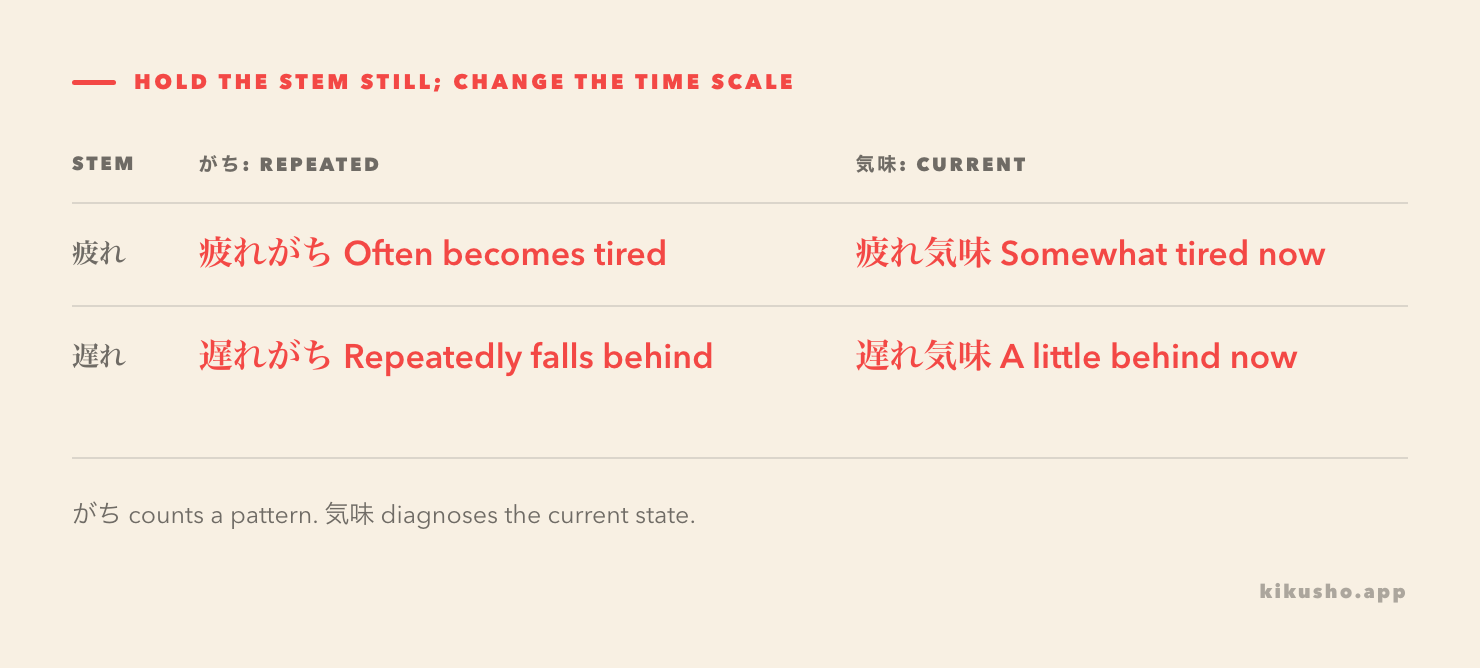
An English translation with “tends to” may hide this distinction. A learner dictionary can gloss both forms as a tendency, but Japanese still separates a history of recurring cases from a current state that has moved slightly away from normal.
Keep the three diagnostics separate
Use this sequence when more than one option seems plausible:
- Is a noun visibly or conceptually spread throughout the target? Choose N + だらけ.
- Are there repeated occasions or a stable proneness? Choose Vます-stem / N + がち.
- Is the speaker making a mild diagnosis of the state now? Choose Vます-stem / N + 気味.
Do not substitute one attachment for another. 泥だらけ is natural because mud is the material covering something. 泥がち would need a special context establishing mud as a recurring tendency, and 泥気味 would need mud to behave like a slight state; neither expresses ordinary “covered in mud.” Conversely, 忘れだらけ does not replace 忘れがち, because forgetting is being counted as a recurring event rather than a collection of objects filling a surface.
Some neighboring forms deserve separate study. まみれ also describes something covered in a substance, and っぽい can describe a characteristic or an impression. They do not change the basic three-way decision in this lesson. Likewise, the がる, がり, and たがる lesson deals with outward evidence of feelings and wants, not repeated frequency with がち.
These are supported N3 study labels
The teaching sources above place all three target patterns at N3, and they agree on the attachment and core meanings taught here. Because the exam authority does not define a complete grammar syllabus, Kikusho treats N3 as the best-supported study placement rather than a promise about a particular test paper.
Practice
Choose the evidence first: accumulation, repetition, or a mild current state.
Question 1. The editor finds mistakes throughout a draft. Complete: この原稿は誤字__だ。
ア. 気味
イ. だらけ
ウ. がち
エ. だけ
Question 2. When busy, Ken repeatedly forgets to reply. Complete: 健さんは忙しいと、メールの返信を忘れ__です。
ア. 気味
イ. だらけ
ウ. がち
エ. ばかり
Question 3. Today's train is running a little late. Complete: 今日の電車は少し遅れ__だ。
ア. 気味
イ. だらけ
ウ. がち
エ. ほど
Question 4. Use all three chunks once to mean “I tend to be late for meetings”: 会議に / 遅れがちです / 私は
Question 5. Explain the difference between 最近、疲れがちだ and 最近、疲れ気味だ. What evidence would make each one appropriate?
Question 6. Choose the natural noun modifier for shoes covered in mud.
ア. 泥がちな靴
イ. 泥気味な靴
ウ. 泥だらけの靴
エ. 泥だらけな靴
Question 7. Read the report and choose the pair.
山田さんは今月、会議に遅れることが何度もあったので、遅れ__だ。今日の会議も、予定より十分ほど遅れ__で進んでいる。
ア. 甲: 気味 / 乙: だらけ
イ. 甲: だらけ / 乙: がち
ウ. 甲: がち / 乙: 気味
エ. 甲: 気味 / 乙: がち
Answers and explanations
Answer 1. イ. だらけ. The draft contains many instances of 誤字, so the noun takes だらけ: 誤字だらけだ. The sentence describes an accumulation, not a recurring habit or mild current condition.
Answer 2. ウ. がち. 忘れます loses ます before がち, and 忙しいと supplies a recurring condition. The sentence summarizes Ken's repeated behavior.
Answer 3. ア. 気味. 今日 and 少し frame one current schedule as mildly late: 遅れ気味だ. Repetition across several trains would support 遅れがち instead.
Answer 4. 私は会議に遅れがちです. The ます-stem 遅れ takes がち because the speaker describes a recurring tendency to arrive late.
Answer 5. 疲れがち says that becoming tired happens repeatedly or easily; evidence could be several demanding days or a recognized pattern. 疲れ気味 diagnoses the speaker as somewhat tired now or over the current period, even without several separate episodes.
Answer 6. ウ. 泥だらけの靴. A substance spread over the shoes takes noun + だらけ, and the whole expression modifies 靴 with の.
Answer 7. ウ. 甲: がち / 乙: 気味. 何度もあった establishes repeated lateness across the month, so the first blank is がち. The second sentence evaluates today's meeting as ten minutes behind now, so it takes 気味.
Common questions
What is the difference between だらけ, がち, and 気味?
だらけ describes many instances of something or a substance covering a thing. がち describes something that happens repeatedly or a person who is prone to it. 気味 describes a mild current state or a slight movement in a direction.
What can come before だらけ?
A noun comes before だらけ: 間違いだらけ, 泥だらけ, or 傷だらけ. The whole expression can end a sentence with だ, modify a noun with の, or combine with になる.
How do がち and 気味 attach to verbs?
Both follow the ます-stem of a verb: 忘れがち and 遅れ気味. They can also follow nouns, as in 病気がち and 風邪気味. Their meanings still differ: repeated frequency for がち and a mild present condition for 気味.
Is 気味 in 風邪気味 read きみ or ぎみ?
It is read ぎみ in this suffix-like grammar pattern. The lexical expression 気味が悪い uses the reading きみ and means creepy or unpleasant, so it is a different construction.