On this page
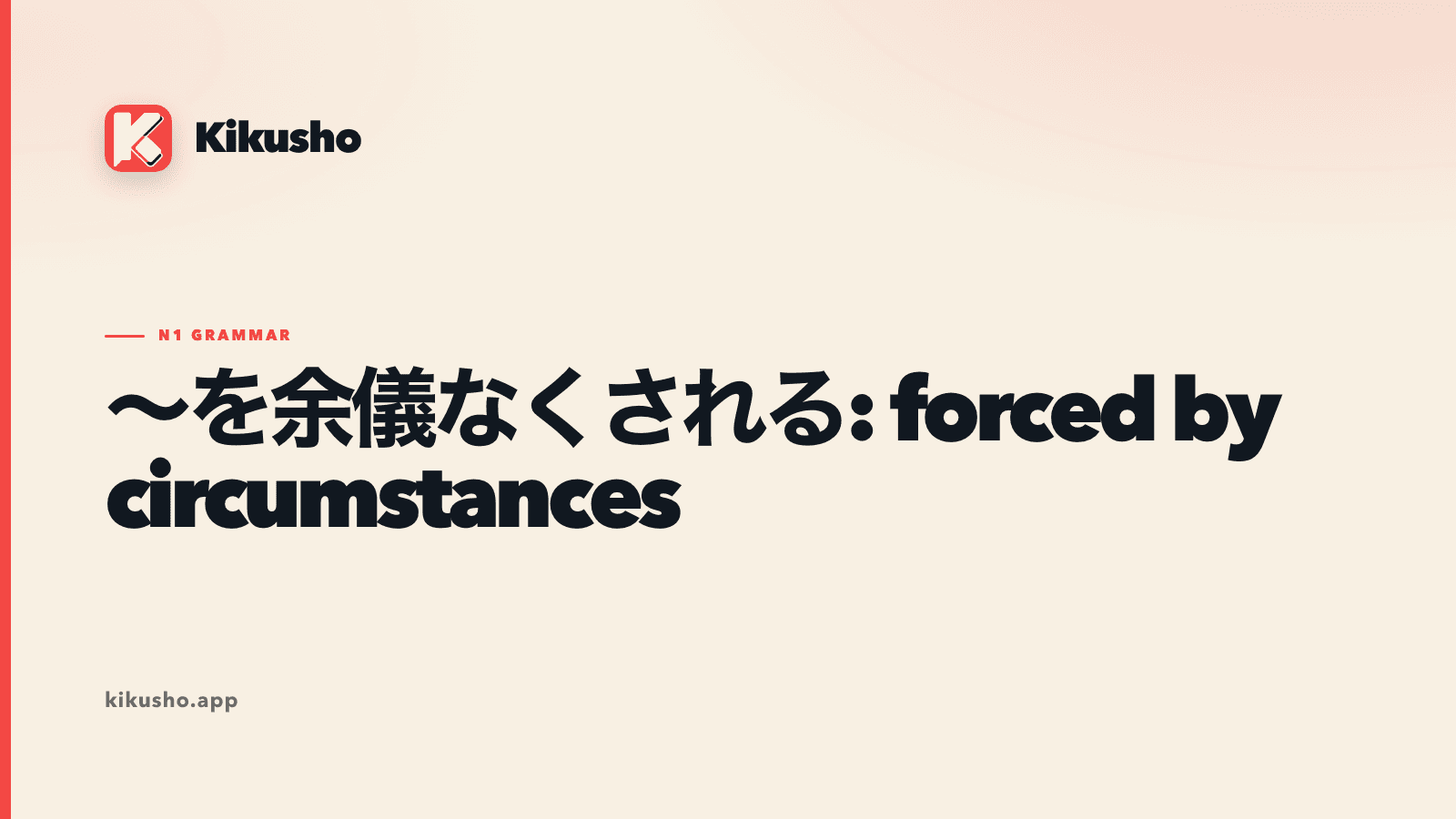
A power cut can turn a research report into 研究チームは停電で、実験の中断を余儀なくされた: the research team was forced to suspend its experiment. ~を余儀なくされる (o yoginaku sareru) presents an action or situation that circumstances imposed, leaving the affected party without a workable alternative.
This N1 grammar lesson teaches that construction and a short perspective contrast with ~を余儀なくさせる, “force someone into something.” The level is an editorial estimate shared by Bunpro's lesson and Mainichi Nonbiri's explanation, rather than an official exhaustive JLPT syllabus. Knowing how Japanese passives shift the sentence's focus will help with the final verb.
The noun names the outcome you were forced into
Use noun + を余儀なくされる. Read 余儀 as よぎ; the whole construction is をよぎなくされる. The noun usually names an action, change or living situation. Here are three attachments:
| Outcome noun | Attached form | Meaning in context |
|---|---|---|
| 中断(ちゅうだん) | 実験の中断を余儀なくされた | was forced to suspend an experiment |
| 縮小(しゅくしょう) | 生産の縮小を余儀なくされている | is having to scale down production |
| 休養(きゅうよう) | 長期の休養を余儀なくされた | was forced to take an extended rest |
Do not insert する after the event noun: 中断を余儀なくされた already works. If you need a longer verbal description, a clause made into a noun with こと can occupy that slot: 実験を中断することを余儀なくされた. Direct 中断するを余儀なくされた is malformed because the verb has not been nominalized. Mainichi Nonbiri's examples include a clause ending in こと before を, alongside the shorter noun attachments. Attachment reference.
A useful way to remember なく is through 余儀ない, whose relevant dictionary sense concerns having no other method available. It is not a negative command telling someone to avoid the preceding action. Shogakukan's dictionary entry.
The final verb carries tense and the continuing condition
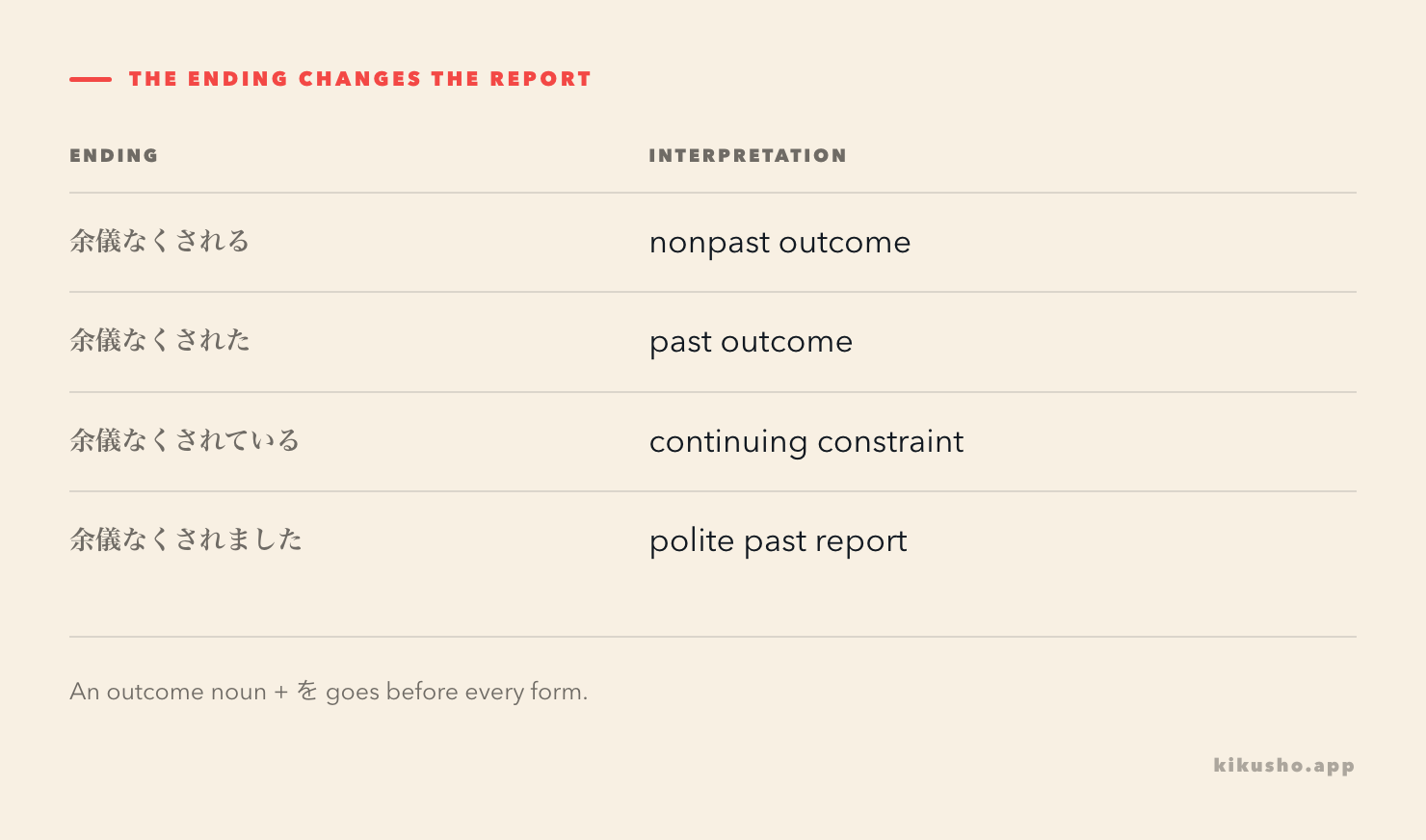
Keep the noun and を余儀なく in place; change the ending according to the report.
| Ending | Full attachment | What it presents |
|---|---|---|
| される | 中断を余儀なくされる | a nonpast forced outcome, interpreted through context |
| された | 中断を余儀なくされた | an outcome imposed in the past |
| されている | 縮小を余儀なくされている | a continuing condition of being compelled |
| されました | 中断を余儀なくされました | a past report with a polite ending |
当社は原材料不足のため、生産の縮小を余儀なくされています。
とうしゃは げんざいりょうぶそくのため、せいさんの しゅくしょうを よぎなくされています。
“Our company is being forced to scale down production because of a shortage of raw materials.”
The company remains under that constraint. A ている ending does not by itself tell you whether workers are physically reducing output at this exact moment. With された, the sentence would report that the shortage imposed the reduction in the past. The surrounding text supplies dates, duration and whether the constraint later ended.
The cause may be stated even when the affected party comes first
Return to the research example:
研究チームは停電で、実験の中断を余儀なくされた。
けんきゅうチームは ていでんで、じっけんの ちゅうだんを よぎなくされた。
“The research team was forced to suspend its experiment because of a power cut.”
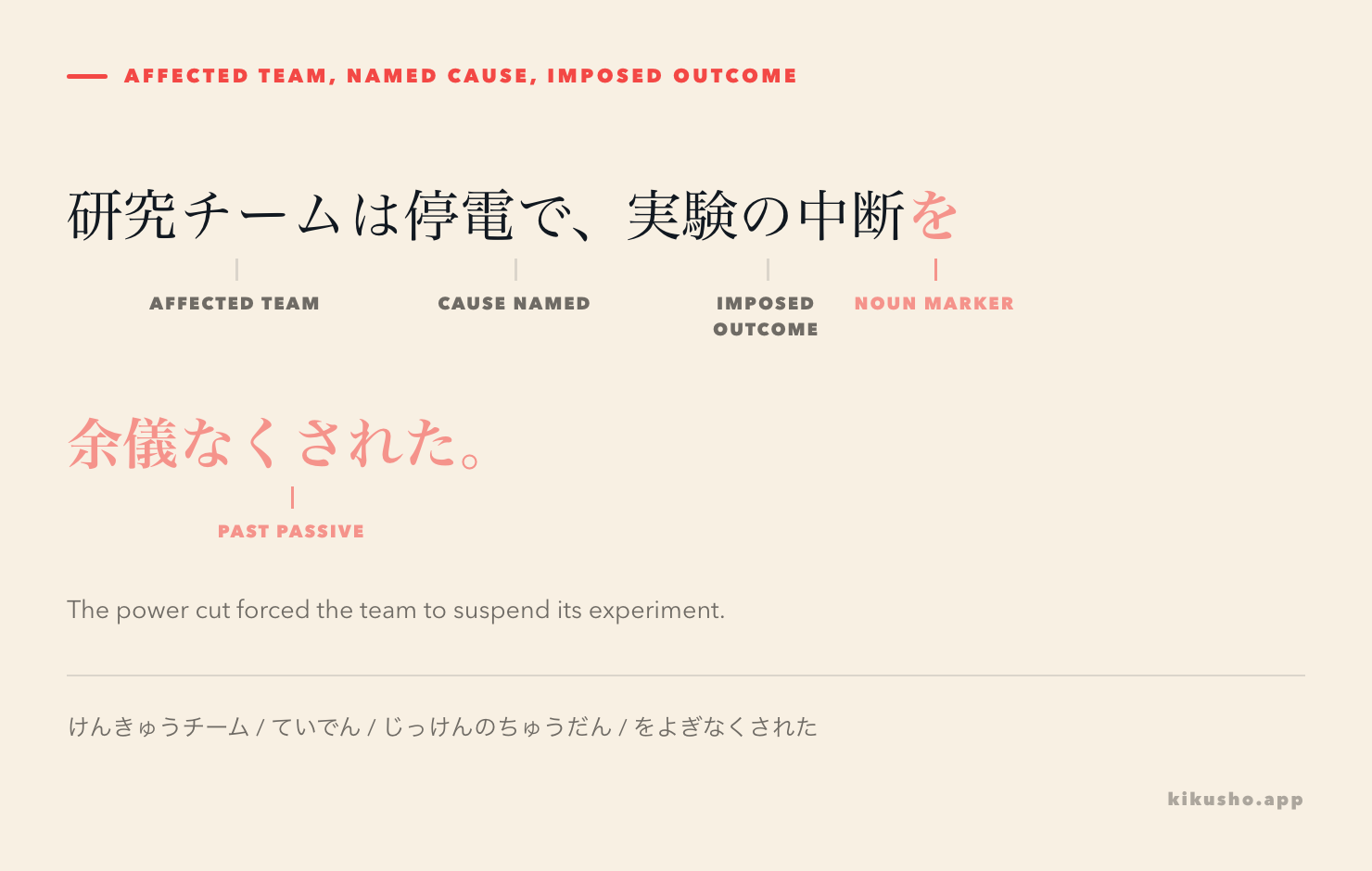
研究チーム is the affected team. 停電で identifies the cause; 実験の中断 identifies the imposed outcome. Nothing in this pattern requires the cause to remain secret. You could omit 停電で when the previous sentence already explains the outage.
Now give the cause the subject role:
停電が、研究チームに実験の中断を余儀なくさせた。
ていでんが、けんきゅうチームに じっけんの ちゅうだんを よぎなくさせた。
“The power cut forced the research team to suspend its experiment.”
With ~を余儀なくさせる (o yoginaku saseru), the cause imposes the outcome. Here が marks that cause and に marks the affected team. Changing された to させた while leaving 研究チーム as the subject would change the team's role: it would become the forcing side. Mainichi Nonbiri's separate causative lesson explains this contrast.
Formal reporting does not guarantee innocence or respect
You will encounter this wording in reports, announcements and accounts of disrupted plans. An older JETRO business-communication guide places it among expressions that can leave responsibility unclear. That is a possible use in discourse. It does not establish a grammatical ban on identifying a cause, or prove that the speaker was blameless.
彼は自分の不注意による事故で、退職を余儀なくされた。
かれは じぶんの ふちゅういによる じこで、たいしょくを よぎなくされた。
“He was forced to leave his job following an accident caused by his own carelessness.”
The sentence attributes the accident to him while presenting resignation as the resulting constraint. Many examples describe unwelcome consequences. Still, judge the constraint from the circumstances, rather than assuming the outcome noun must name something inherently bad.
Formal style and levels of politeness also answer different questions. された can occur in formal writing without addressing a listener politely. されました adds a polite ending. The passive inside this expression does not automatically confer respect on the subject.
In a personal conversation about a minor change of plans, this construction may sound heavy. There is no special casual contraction to memorize here; use a plainer explanation of what happened. If you want a verb-based necessity construction, follow the separate ~ざるを得ない lesson; it has a different attachment rule.
An event can undergo the disruption too
People and organizations are frequent subjects, but they are not the only possibilities:
大会は台風のため、延期を余儀なくされた。
たいかいは たいふうのため、えんきを よぎなくされた。
“The tournament had to be postponed because of the typhoon.”
The tournament cannot feel reluctance. The sentence describes an imposed change to the organizers' intended event. Bunpro explicitly allows exceptions to its usual person-or-company subject pattern and includes an event example. Avoid turning a common subject type into an absolute restriction. Subject reference.
When reading, identify three things: the affected party or event, the outcome noun before を, and the evidence for compulsion. For a different function of formal prose, the N1 lesson on ~べく and ~んがため deals with intended purposes.
The event nouns can be the part that slows you down in a notice. Kikusho's text capture lets you save a word from that notice as an editable card with its reading and example; keeping 中断 together with the experiment context gives your later vocabulary review a concrete situation to recall.
Practice: six questions
Attempt the full set before scrolling to the shared solutions. The readings given above apply to repeated words below.
Question 1 — choose an attachment. Complete the report meaning “The company was forced to reduce production.”
当社は原材料不足で、____余儀なくされた。
- A. 生産を縮小するを
- B. 生産の縮小に
- C. 生産の縮小を
- D. 生産の縮小が
Question 2 — choose the perspective. The power cut is the subject and the research team is the affected party. Complete the sentence.
停電が、研究チームに実験の中断を余儀なく____。
- A. された
- B. させた
- C. させられた
- D. ならなかった
Question 3 — interpret the report. Which conclusion follows from 当社は生産の縮小を余儀なくされています?
- A. The company is presently under a constraint requiring reduced production.
- B. The company voluntarily selected a smaller production target.
- C. The company has definitively finished reducing production and recovered.
- D. The company is forcing another business to reduce production.
Question 4 — compose a sentence. Arrange these four fragments after 店は新しい規制で to report a forced reduction in opening hours. Keep された at the sentence's end.
- A. 余儀なく
- B. 営業時間の
- C. された
- D. 短縮を
Question 5 — repair the attachment. Correct 研究チームは実験を中断するを余儀なくされた. Preserve 実験を中断する by adding the missing nominalizer. Write the complete sentence.
Question 6 — grammar in connected text. Read this short account. Which sentence supplies a coherent explanation of the closure without turning it into a voluntary choice?
工場は機械の故障で操業を続けられなくなった。修理には一週間かかる。その間、____。
こうじょうは きかいの こしょうで そうぎょうを つづけられなくなった。しゅうりには いっしゅうかん かかる。
- A. 工場は自由に休業日を選んだ
- B. 工場は休業を余儀なくさせた
- C. 工場は休業を余儀なくされた
- D. 工場は修理をしなくても操業を続けられた
Keep your six responses together so you can check attachment and perspective separately.
Answers and explanations
Answer 1: C. The outcome noun takes を: 当社は原材料不足で、生産の縮小を余儀なくされた. A puts を directly after a verb; B and D replace the required marker with に or が. A longer nominalized clause would be possible, but A lacks こと.
Answer 2: B. 停電が、研究チームに実験の中断を余儀なくさせた gives the cause the subject role. A would use the affected-side passive with the power cut as its subject. C uses a causative-passive ending, again making the power cut undergo compulsion; D does not form this construction. The intended cause-to-team relation is explicit in the prompt.
Answer 3: A. されている presents the ongoing imposed condition. B removes the constraint, C adds completion and recovery that the sentence never states, and D reverses the forcing relationship. Dates and actual production activity still require context.
Answer 4: B → D → A → C. 店は新しい規制で営業時間の短縮を余儀なくされた。 “The shop was forced to shorten its opening hours because of new regulations.” Read 規制 as きせい and 営業時間の短縮 as えいぎょうじかんのたんしゅく. The supplied beginning already names the cause. Join 営業時間の to 短縮, then attach を余儀なくされた. The fixed final fragment rules out moving the predicate earlier.
Answer 5: 研究チームは実験を中断することを余儀なくされた。 Adding こと makes 実験を中断する available as a noun phrase before を. 実験の中断を余儀なくされた would also be grammatical, but it would not preserve the verb phrase as this question requests.
Answer 6: C. その間、工場は休業を余儀なくされた。 The breakdown prevents operation, and the week of repair supplies the closure period. Read 休業 as きゅうぎょう. A introduces freedom of choice contrary to the task, B presents the factory as the forcing party, and D contradicts the stated inability to continue operating.
Common questions
What does yoginaku sareru mean?
~を余儀なくされる describes being forced into an action or situation because circumstances leave no acceptable alternative. It normally follows a noun naming that action or situation, as in 中断を余儀なくされた, was forced to interrupt something.
Can a verb go directly before を余儀なくされる?
A dictionary-form verb does not attach directly to を in this pattern. Use an event noun, such as 中断, or nominalize a clause with こと: 中断することを余儀なくされた.
Does を余儀なくされる hide who caused the problem?
It puts the affected party or event in focus, and the cause can be omitted. However, the cause can also be stated explicitly. The construction does not establish that the affected party bears no responsibility.
How is を余儀なくさせる different?
~を余儀なくされる presents the party undergoing a forced outcome. ~を余儀なくさせる presents the cause imposing that outcome, with the affected party optionally marked by に. Both are formal constructions.