On this page
ことになっている (koto ni natte iru) reports that a rule, schedule or arrangement is already established. この寮では、夜十時以降は静かにすることになっています means “In this dormitory, the rule is to keep quiet after ten,” while 会議は十時に始まることになっています means “The meeting is scheduled to start at ten.”
The construction does more than say that someone decided something. Its ている presents the result as the current setup: a regulation remains in force, a timetable is fixed, or an agreement is still expected to be followed.
Build it from a plain verb
Put the action in the dictionary form or plain negative form before ことになっている. Change only the final いる for politeness or tense.
| Meaning | Pattern | Example |
|---|---|---|
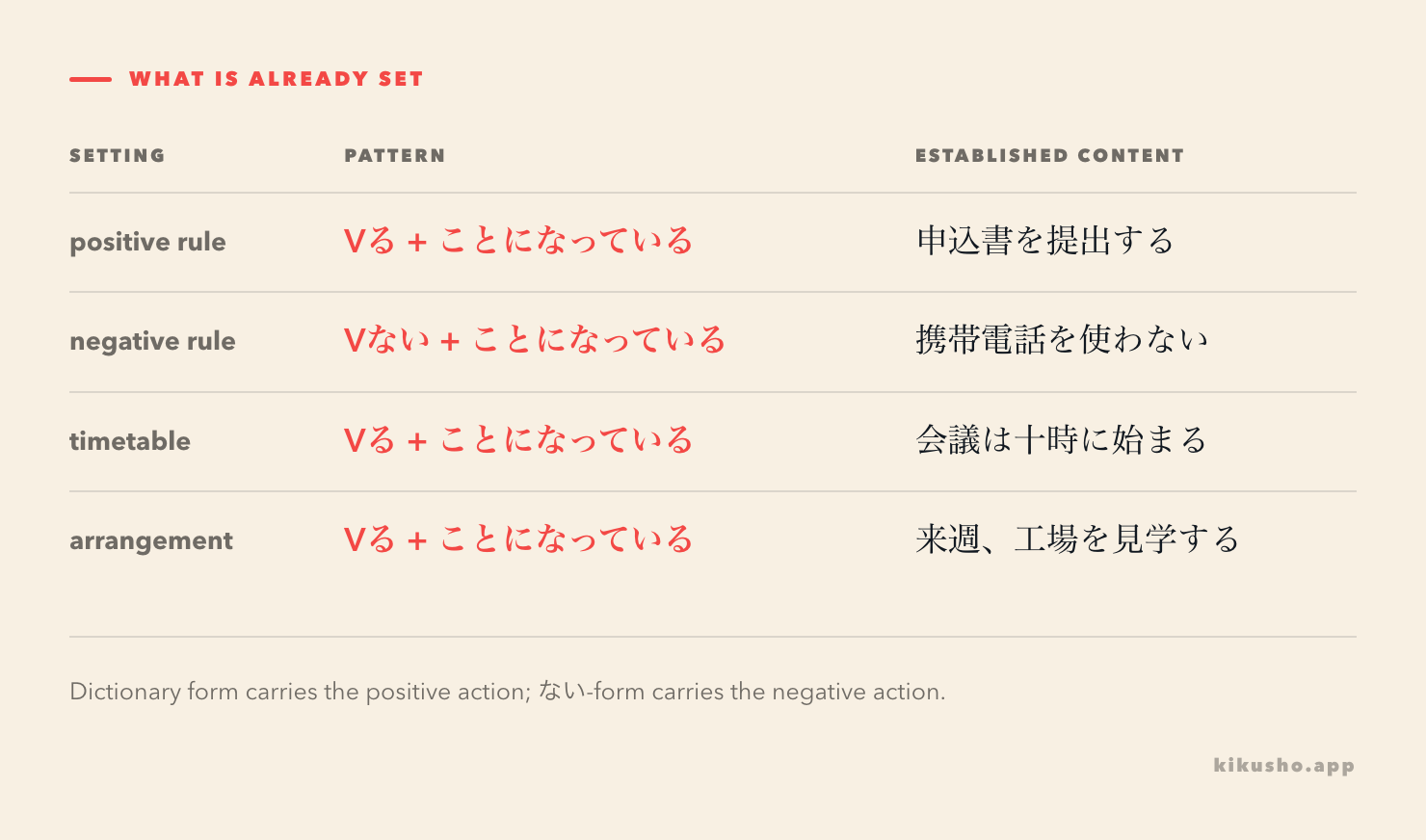
| established positive rule or schedule | V dictionary + ことになっている | 提出することになっている |
| established negative rule | Vない + ことになっている | 使用しないことになっている |
| polite report | V + ことになっています | 始まることになっています |
| past standing arrangement | V + ことになっていた | 働くことになっていた |
申込書は金曜日までに提出することになっています。\ もうしこみしょは きんようびまでに ていしゅつすることになっています。\ The rule is that application forms must be submitted by Friday.
会議中は携帯電話を使わないことになっています。\ かいぎちゅうは けいたいでんわを つかわないことになっています。\ The rule is that mobile phones are not to be used during the meeting.
The negative belongs in the action: 使わないことになっている. Negating the end gives a different claim. 使うことになっていない says that using it is not the established arrangement; it does not state the positive prohibition as directly.
JLPT Sensei teaches this formation for rules and scheduled arrangements at N3. Bunpro gives the same dictionary-form and ない-form attachments but places the item at N2. The level boundary differs between study resources; the grammatical job described here does not.
ている shows a decision that remains in force
The sequence is easier to understand if you compare a new outcome with its continuing result.
来月、大阪へ転勤することになった。\ らいげつ、おおさかへ てんきんすることになった。\ It has been decided that I will transfer to Osaka next month.
来月、大阪へ転勤することになっている。\ らいげつ、おおさかへ てんきんすることになっている。\ I am scheduled to transfer to Osaka next month.
The first sentence reports the decision or outcome. The second looks at the arrangement now on the books. It can be used before the transfer happens because ている describes the present state of the plan, not an action currently unfolding.
This is the same viewpoint shift that appears in many result-state expressions. Do not translate なっている word by word as “is becoming.” In this construction, natural English often needs “the rule is,” “is scheduled to,” “is arranged to,” or “is supposed to,” depending on the source of the arrangement.
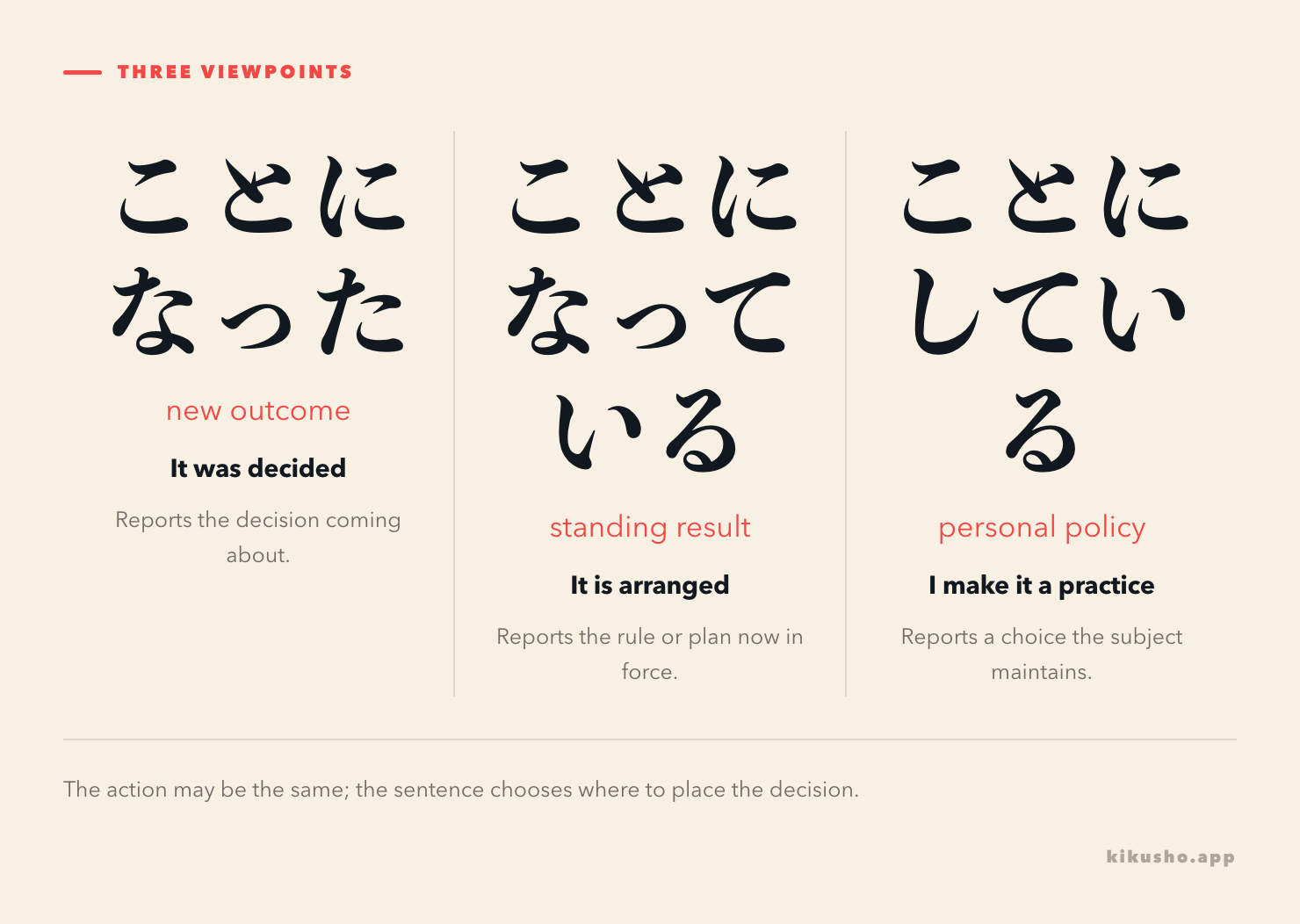
The ことにする and ことになる lesson teaches the earlier choice between making a decision and reporting an outcome. Here, ことになっている starts after that point: the outcome has become the rule or plan people currently recognise.
The source is usually larger than one person's preference
An institution, group agreement, timetable, contract, custom or system commonly supplies the rule. Japanese often leaves that source unstated because the setting makes it clear.
この寮では、夜十時以降は静かにすることになっている。\ この りょうでは、よる じゅうじいこうは しずかにすることになっている。\ In this dormitory, the rule is to keep quiet after ten at night.
来週、工場を見学することになっています。\ らいしゅう、こうじょうを けんがくすることになっています。\ We are scheduled to tour the factory next week.
Neither sentence needs to name the committee, manager or person who set the arrangement. That absence does not prove the speaker had no involvement. The sentence simply foregrounds the established result rather than the decision-making process.
Benri Japan likewise describes the construction as a rule or confirmed schedule rather than an individual's will. That distinction explains why ことになっている works well in school, workplace and administrative settings without sounding like a direct personal command.
A reported rule is different from a rule printed as an instruction
Compare two ways a workplace can communicate the same policy:
会議中は携帯電話を使わないこと。\ Do not use mobile phones during meetings.
会議中は携帯電話を使わないことになっています。\ The rule is that mobile phones are not to be used during meetings.
The first is the compact wording printed in a list of instructions. The second is a full sentence that reports what the rule is. The sentence-final こと lesson covers the first format; adding になっている changes its role from issuing the rule to describing the established arrangement.
The reported form can appear in conversation: a receptionist may explain a building policy with ことになっています. It also appears in explanatory writing. For more formal regulations, こととなっている can replace ことになっている. The meaning remains close, but と gives the wording a more formal, document-like register. A correction note from publisher Sanshusha explicitly distinguishes the ordinary rule expression from the harder formal variant.
ことにしている is your policy, not the system's
Both expressions can describe something repeated, but they assign the policy differently.
毎朝、三十分走ることにしている。\ まいあさ、さんじゅっぷん はしることにしている。\ I make it a practice to run for thirty minutes every morning.
このチームでは、毎朝九時に進捗を共有することになっている。\ この チームでは、まいあさ くじに しんちょくを きょうゆうすることになっている。\ In this team, the rule is to share progress every morning at nine.
The runner presents a continuing personal decision with ことにしている. The team member reports a standing team procedure with ことになっている. A habitual action alone does not choose the construction; ask whose policy or arrangement the sentence presents.
| Construction | Main viewpoint | Useful question |
|---|---|---|
| ことになった | a decision or outcome came about | What was decided? |
| ことになっている | the rule or arrangement is in force | What is the current setup? |
| ことにしている | a person maintains a policy or habit | What do I choose to keep doing? |
Schedules must be established, not merely predicted
ことになっている fits a timetable or confirmed arrangement. It does not merely express what the speaker thinks will happen.
会議は十時に始まることになっています。\ かいぎは じゅうじに はじまることになっています。\ The meeting is scheduled to start at ten.
会議は十時に始まるはずです。\ かいぎは じゅうじに はじまるはずです。\ The meeting should start at ten / I expect it to start at ten.
The first points to the schedule. The second presents an expectation based on the speaker's information or reasoning. In real life, either expectation can be wrong, but the grammar identifies where the claim comes from. A plan that is still tentative needs another expression; 予定だ can state a plan without packaging it as a standing rule.
You may also meet Nということになっている when a category or threshold is officially defined:
この試験では、八十点以上が合格ということになっている。\ この しけんでは、はちじゅってんいじょうが ごうかくということになっている。\ For this exam, a score of 80 or higher is defined as passing.
The quoted content before という is what the system treats as established. Keep this extension separate from Vたことになっている, which can sometimes mean that something is treated as though it happened. That separate use is outside this lesson's rule-and-schedule scope.
Practice
Question 1 — choose the standing rule
A dormitory policy requires quiet after ten. Which sentence reports that established rule?
A. 夜十時以降は静かにすることになっている。\ B. 夜十時以降は静かにすることになった。\ C. 夜十時以降は静かにすることにしている。
Question 2 — make the negative rule
Complete the sentence: “The rule is that mobile phones are not to be used during the meeting.”
会議中は携帯電話を( )ことになっています。
A. 使うない\ B. 使わない\ C. 使っていない
Question 3 — distinguish decision from schedule
Your transfer was decided yesterday. Today you are explaining the schedule now in place. Which ending fits?
来月、大阪へ転勤する( )。
A. ことになっている\ B. ことにしている\ C. ことにならない
Question 4 — sentence composition
Arrange the chunks into a polite sentence meaning “We are scheduled to tour the factory next week.”
見学する / 来週 / ことになっています / 工場を
Question 5 — choose the personal policy
You chose an exercise routine for yourself and maintain it. Which sentence fits?
A. 毎朝、三十分走ることにしている。\ B. 毎朝、三十分走ることになっている。
Question 6 — text grammar
Read the notice explanation:
この図書館では、飲み物は一階でだけ飲むことになっています。二階では飲まないことになっています。
Where may visitors drink, where may they not drink, and which verb forms carry the positive and negative rules?
Question 7 — interpret the definition
What does this sentence establish?
この試験では、八十点以上が合格ということになっている。
A. The speaker personally aims to score 80.\ B. A score of 80 or higher is officially treated as passing.\ C. The passing score changed to 80 during the conversation.
Answers and explanations
Answer 1. A. 静かにすることになっている presents the policy as currently in force. B reports that a decision came about, which would fit an announcement of a new rule. C sounds like the subject's own maintained policy, not the dormitory's regulation.
Answer 2. B. 使わないことになっています puts the plain negative action before the construction. 使うない is not a valid negative form. 使っていない means the action is not currently occurring and does not build this rule pattern.
Answer 3. A. 来月、大阪へ転勤することになっている reports the standing transfer arrangement. The decision may have been made yesterday, but the arrangement remains current today. B would present the transfer as a continuing personal policy, and C says it will not turn out that way.
Answer 4. 来週、工場を見学することになっています。 The order is 来週 / 工場を / 見学する / ことになっています. Dictionary-form 見学する names the scheduled action, and the polite ending reports the confirmed arrangement.
Answer 5. A. ことにしている presents running as the speaker's continuing choice. B would need a context in which a team, programme or other arrangement sets the running routine.
Answer 6. Visitors may drink only on the first floor and may not drink on the second. Dictionary-form 飲む carries the positive rule in 飲むことになっています. Plain negative 飲まない carries the prohibition in 飲まないことになっています.
Answer 7. B. 合格ということになっている reports the exam's established definition: 80 points or more counts as passing. It does not describe the speaker's goal, and the continuing なっている does not by itself announce a new change.
Save the source of the obligation
If a notice says 申込書は金曜日までに提出することになっています, the useful memory is not only that 提出する means “submit.” The deadline and the established-rule viewpoint explain why the action is expected.
Save the whole line in Kikusho so the card can retain the deadline, the institution behind the rule and a note that ことになっている reports an arrangement already in force. On review, ask whether the sentence announces a new decision, describes a standing system, or presents one person's habit. That three-way choice is what a bare English gloss loses.
Common questions
What does ことになっている mean?
Verb + ことになっている reports that a rule, schedule or arrangement is already established. 会議は十時に始まることになっています means “The meeting is scheduled to start at ten,” while 携帯電話を使わないことになっています reports a rule against using mobile phones.
What is the difference between ことになる and ことになっている?
ことになる presents a decision or outcome coming about. ことになっている presents that decision as the arrangement currently in force. 転勤することになった reports that a transfer was decided; 転勤することになっている reports the standing schedule or expectation.
What is the difference between ことになっている and ことにしている?
ことになっている usually points to a rule or arrangement established by an institution, group, agreement or timetable. ことにしている presents the speaker's own continuing policy or habit, such as choosing to run every morning.
Is ことになっている N3 or N2 grammar?
Teaching lists differ. JLPT Sensei and several Japanese teaching resources place this use at N3, while Bunpro labels it N2. This lesson follows the Kikusho N3 curriculum; the JLPT does not publish an exhaustive official grammar list.