On this page
ことはない often tells someone they needn't do an action, especially as reassurance or advice; 必要はない states the lack of necessity explicitly. Both can mean “there's no need to,” so a difference in tone does not automatically make one right and the other wrong.
The useful question is what your reply is doing. Are you relieving someone of a worry or an unnecessary effort? Are you explaining what a procedure requires? Start there, then check whether the sentence is about necessity at all.
This N3 grammar comparison teaches dictionary-form V + ことはない and V + 必要はない, with 必要 read ひつよう. JLPT Sensei, Bunpro and Meguro Language Center place the no-need ことはない at N3. The comparison uses earlier necessity vocabulary: Bunpro places its underlying 必要がある pattern at N4, although Nihongo to Japan labels its negative-necessity lesson N2. Those page labels do not establish a universal boundary. The JLPT supplies no exhaustive official grammar syllabus.
The deciding test is the action's necessity, then your purpose in saying so
“No need” removes a requirement or questions the value of an effort. It does not, by itself, say that the action is impossible or forbidden. A reason nearby often tells you what the speaker has in mind.
名前だけ書けば大丈夫です。住所まで書くことはありません。
なまえだけかけばだいじょうぶです。じゅうしょまでかくことはありません。
Your name is enough. You don't need to go as far as writing your address.
The speaker is releasing you from extra work. Compare an instruction that states the procedure directly:
この用紙には、住所を書く必要はありません。
このようしには、じゅうしょをかくひつようはありません。
There is no need to write your address on this form.
Both leave the address unnecessary in the stated context. ことはありません frames the first as advice about how far to go; 必要はありません names the absence of a requirement. Neither sentence alone tells you that writing an address is prohibited.
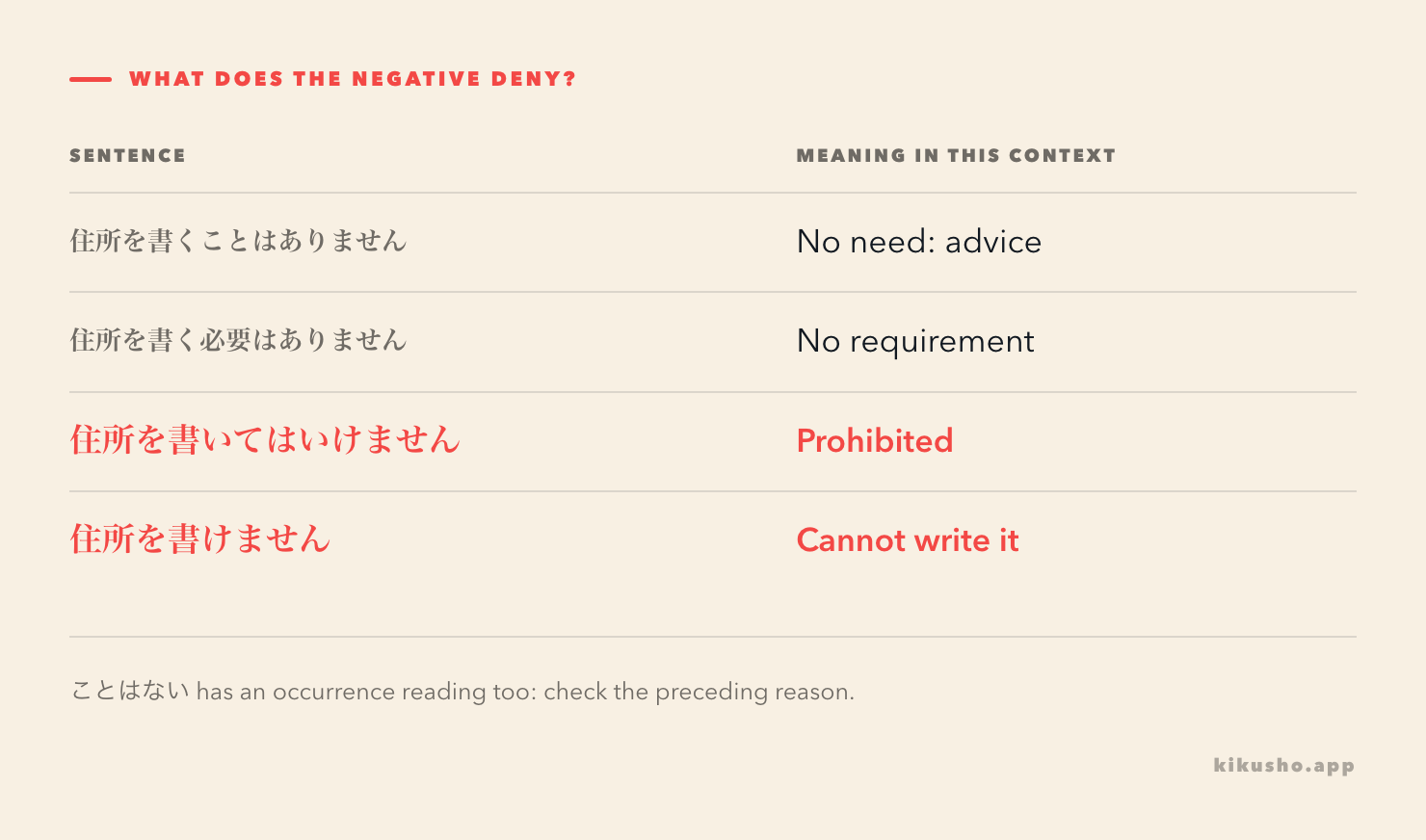
| Sentence | What it denies |
|---|---|
| 住所を書くことはありません | The need to write the address, in this advice context. |
| 住所を書く必要はありません | A requirement to write the address. |
| 住所を書いてはいけません | Permission to write the address. |
| 住所を書けません | The ability or possibility of writing it. |
For the third row, てはいけない is the prohibition pattern. For the last, the potential form supplies 書ける → 書けない. These are different claims, not more emphatic translations of “unnecessary.”
ことはない commonly addresses someone else's worry or effort
The ordinary attachment for this no-need meaning is dictionary form + ことはない. Keep the action affirmative; the negative comes after ことは.
| Action | No-need phrase |
|---|---|
| 書く(かく), write | 書くことはない |
| 答える(こたえる), answer | 答えることはない |
| 準備する(じゅんびする), prepare | 準備することはない |
| 来る(くる), come | 来ることはない |
The last begins くる, not the past reading きた. 書きことはない uses a stem where this pattern needs 書く. 書いたことがない is the separate “have never written” experience construction.
わからない質問には、無理に答えることはないよ。
わからないしつもんには、むりにこたえることはないよ。
You don't have to force yourself to answer questions you don't understand.
That is advice to a listener, not a claim that answering is forbidden. MLC's note describes this use as common for general matters or advice to another person, and less common for one's own affairs. “Less common” does not mean the word 私 makes it ungrammatical; it means this is a poor default for neutrally describing your own plan.
Reassurance also depends on delivery. よ can address the listener directly, but it is not a warmth guarantee. With a reproachful tone, そんなに怒ることはない can mean that the person's anger is unwarranted. Japanese teacher Katsukawa's explanation explicitly notes that a no-need judgment can sound like criticism. It is not always a comforting phrase.
必要はない names the missing requirement and also works in personal planning
Use dictionary form + 必要はない without inserting こと:
明日はオンラインで面談できるので、会社に行く必要はない。
あしたはオンラインでめんだんできるので、かいしゃにいくひつようはない。
Since tomorrow's interview can be online, there is no need to go to the office.
面談(めんだん) is an interview or one-to-one meeting. The point is the requirement for physical attendance, not whether visiting the office is possible. 必要 makes that meaning explicit.
The Bunpro necessity lesson explains verb attachment directly before 必要 and its negative use. 必要がない also denies a need. With は, the need is presented as the topic, often with contrast; が is another ordinary choice. Do not translate は here as if it created an entirely different permission rule.
You can use this expression for a personal decision: 私は会社に行く必要はないと判断しました means “I concluded that I didn't need to go to the office.” Read 判断 as はんだん. It states your assessment. In contrast, an isolated 私は会社に行くことはない may be heard as “I never go to the office,” because ことはない has an occurrence reading too.
Their overlap permits both reassurance and practical explanations
必要はない is not restricted to cold instructions. 心配する必要はないよ can reassure someone too. Conversely, the polite ことはありません can explain that an effort is unnecessary. Nihongo to Japan's necessity lesson includes both factual and listener-directed uses; MLC uses polite ことはありません for practical advice.
A sensible preference is to reach for ことはない when addressing needless worry or effort, and for 必要はない when you want the requirement itself unmistakable. Context, relationship and ending still matter. A quiz offering both in a simple “don't worry” sentence would often be testing an editorial preference rather than a unique grammatical answer.
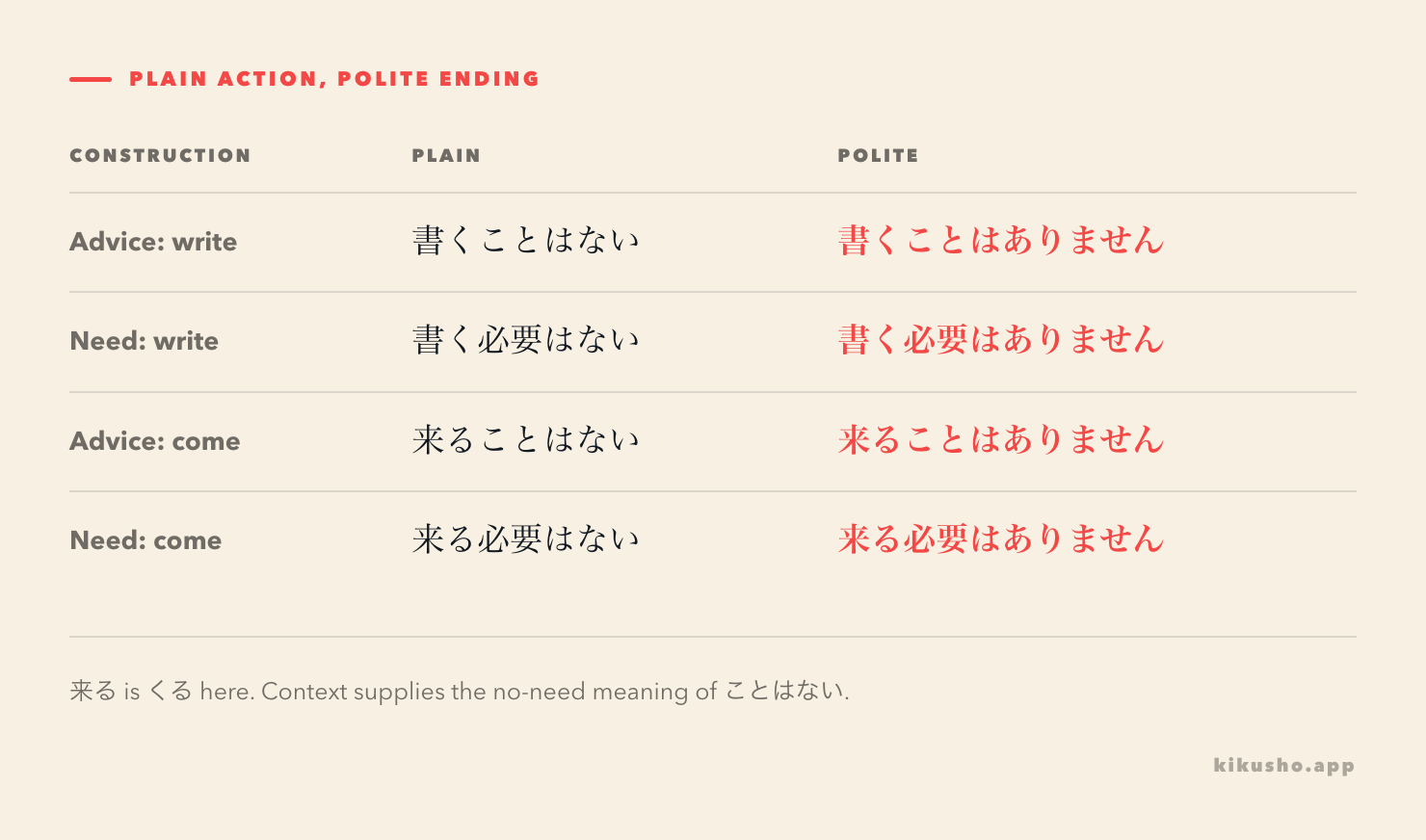
Keep the plain action before either construction when the ending is polite:
| Plain | Polite alternatives |
|---|---|
| 書くことはない | 書くことはないです / 書くことはありません |
| 書く必要はない | 書く必要はないです / 書く必要はありません |
MLC records both polite endings for ことはない. In conversation you may hear は omitted, as in 答えることないよ; learn the full pattern first. Politeness at the end does not make 書きますことはありません or 書きます必要はありません the attachment to use.
ことはない can deny occurrence instead of necessity
Read the surrounding statement before replacing every ことはない with 必要はない. Bunpro distinguishes no need from an event never happening.
停止には手動の操作が必要です。この装置は、自動で停止することはありません。
ていしにはしゅどうのそうさがひつようです。このそうちは、じどうでていしすることはありません。
Stopping it requires manual operation. This device never stops automatically.
The first sentence establishes manual operation; the second denies automatic stopping. Substituting 自動で停止する必要はありません would say automatic stopping is unnecessary, leaving its actual behaviour unstated.
Also separate 書いたことがない, “have never written,” from 書くことはない, “no need to write” in the earlier advice context. The experience lesson explains the past-form pattern. Swapping just は and が is not a reliable shortcut: the verb form and the intended meaning matter together. Other constructions such as ないことはない need their own explanation; they are outside this comparison.
Practice
Six original questions follow. All solutions are in the shared block below Question 6. Choose by the stated meaning or attachment, rather than assuming only one target form could ever sound reassuring.
Question 1
Choose the verb form for the no-need advice.
資料はメールで送れますから、わざわざ会社に__ことはありません。
資料(しりょう) = material; 送れる(おくれる) = can send; わざわざ = going out of one's way.
A. 来て
B. 来ます
C. 来た
D. 来る
Question 2
Which completion explains that no new stamp purchase is needed?
封筒には切手が貼ってありますから、新しく切手を買う__。
封筒(ふうとう) = envelope; 切手(きって) = stamp; 貼ってある(はってある) = has been stuck on in preparation.
A. 必要はない
B. ことがある
C. ことになった
D. はずがない
Question 3
Arrange the numbered pieces after わからなければ. Include every piece exactly once.
わからなければ、__ __ __ __。
- ことは\
- 無理に\
- ありません\
- 答える
無理に(むりに) = by forcing oneself; 答える(こたえる) = answer.
Question 4
Reconstruct the printing statement from the numbered pieces, without repeating any.
この申込書は、紙に__ __ __ __。
- 必要\
- ありません\
- 印刷する\
- は
申込書(もうしこみしょ) = application form; 印刷(いんさつ) = printing.
Question 5
Read the event instructions. What do they say about watching the video?
参加する前に、動画を見る必要はありません。当日、担当者が手順を説明します。ただし、会場の作業中は動画を見てはいけません。
参加(さんか) = participation; 動画(どうが) = video; 当日(とうじつ) = on the day; 担当者(たんとうしゃ) = person in charge; 手順(てじゅん) = procedure; 会場(かいじょう) = venue; 作業中(さぎょうちゅう) = during the work.
A. Watching before the event is forbidden, but watching during the work is required.
B. Watching beforehand is not required; watching during the work is prohibited.
C. Watching beforehand is required because no explanation will be given.
D. Watching at any time is impossible because there is no video.
Question 6
Read the reply. Which interpretation preserves both its advice and its practical limitation?
A:明日までに全部答えなければなりませんか。
B:まだ決まっていない項目まで、無理に答えることはありません。今わかることだけ書いてください。残りは来週でも大丈夫です。
全部(ぜんぶ) = all; 項目(こうもく) = item on a form; 残り(のこり) = the remainder; 来週(らいしゅう) = next week.
A. You must invent answers to every undecided item by tomorrow.
B. You are forbidden to write any answer, including information you know.
C. You needn't force answers to undecided items; write what you know now and leave the rest until next week.
D. The reply reports that you have never answered a form before.
Answers and explanations
Answer 1
D: 来る. The no-need pattern takes the dictionary form, read くる: わざわざ会社に来ることはありません. The materials can be emailed, so the listener needn't make the trip. A is a て-form; B is polite rather than plain dictionary form; C is past and does not form the requested no-need advice. The reply says nothing about the listener's past visits.
Answer 2
A: 必要はない. The envelope already has a stamp, so no new stamp purchase is needed. B says a purchase sometimes happens; C says a purchase has been decided or arranged; D denies an expected possibility rather than a requirement. The person could buy another stamp, but the stated situation supplies no need to do so.
Answer 3
2 → 4 → 1 → 3.
わからなければ、無理に答えることはありません。
If you don't understand, you don't need to force an answer.
無理に describes 答える. Its dictionary form precedes ことは, and ありません supplies the polite negative. Putting ありません before the verb would not produce this construction. The sentence offers advice, not a report of never having answered.
Answer 4
3 → 1 → 4 → 2.
この申込書は、紙に印刷する必要はありません。
There is no need to print this application form on paper.
印刷する directly modifies 必要; は marks that need as the topic; ありません denies it politely. An extra こと is not needed. The result states that printing is unnecessary, not that printed applications are unacceptable.
Answer 5
B. Before participation, 必要はありません removes a requirement. During the work, てはいけません prohibits watching. A reverses both relationships. C contradicts the announced explanation on the day. D invents a claim about the video's existence and confuses necessity with possibility. The two rules apply at different times, so they do not contradict each other.
Answer 6
C. The no-need advice concerns 項目 that have not yet been settled, especially forcing answers to them. 今わかることだけ limits the immediate task to what is known; 残りは来週でも大丈夫 allows the rest next week. A invents forced guesses, B ignores the instruction to write known information, and D mistakes dictionary-form advice for past experience. The reassurance does not erase the remaining task.
Keep the reason beside the reply
A reply that removes pressure is easier to interpret when you retain what prompted it. For a line you capture through Kikusho's text entry, keep the question with the response in the editable example. Add a short note about the reason: the deadline is later, the work is already done, or another route is available.
At review time, hide that reason and supply one that makes the reply sensible. Then uncover the original and check the scope: which action, which item, which time? “No need” can release a single part of a task while leaving the rest due. A two-line exchange gives you something an isolated reassuring phrase cannot: the exact pressure being removed.
Common questions
What is the difference between ことはない and 必要はない?
Both can mean there is no need to do something. ことはない commonly offers advice or reassurance; 必要はない explicitly states an absence of necessity. They overlap, and tone alone does not make only one grammatical.
Does 必要はない mean that an action is forbidden?
No. It means the action is unnecessary. Prohibition requires a different expression, such as てはいけない. A procedure can remove a requirement without forbidding the optional action.
Is ことはない the same as たことがない?
No. Dictionary-form verb + ことはない can express no need or an event never occurring, depending on context. Past-form verb + ことがない expresses lack of past experience.