On this page
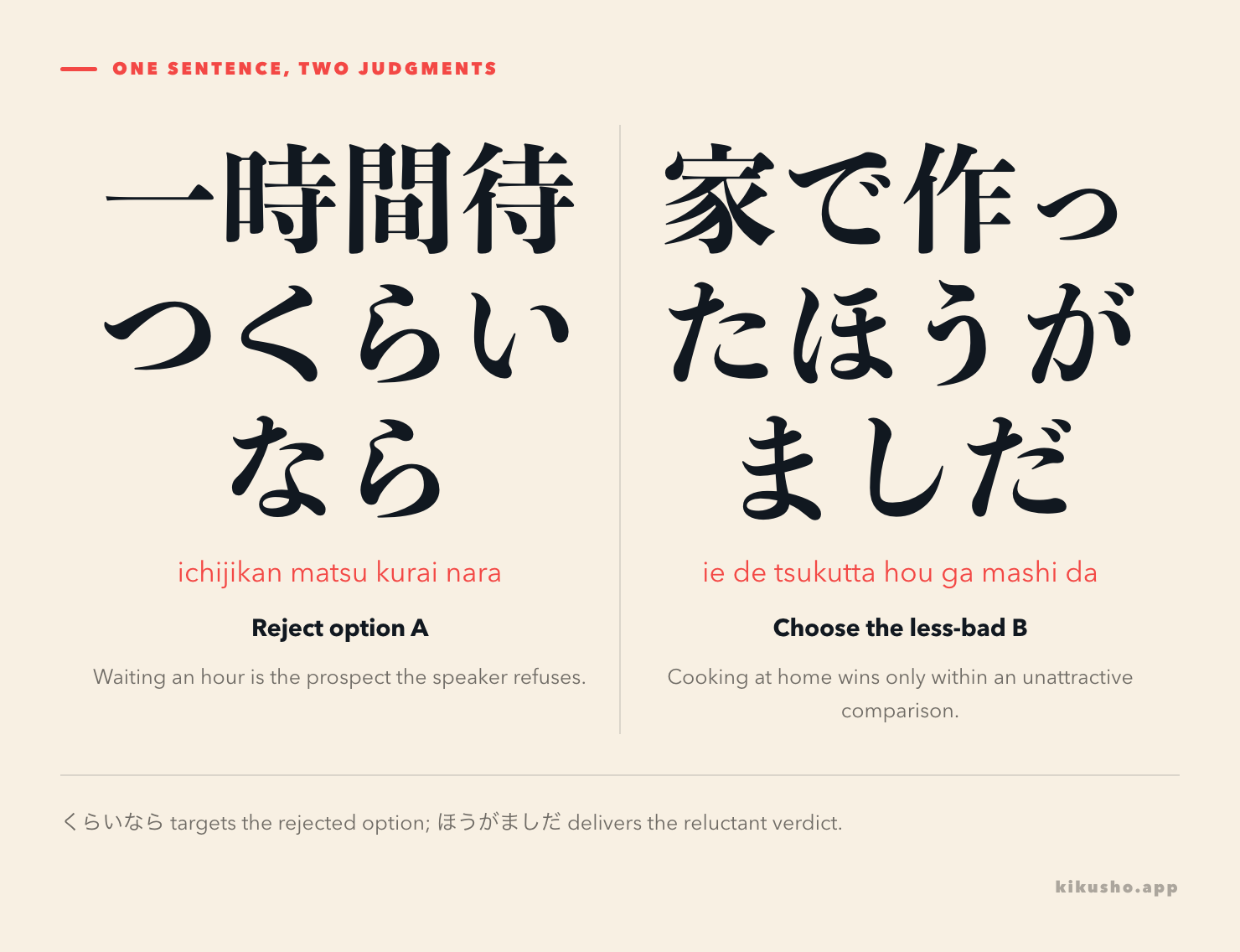
Picture two doors that both lead somewhere unpleasant. Aくらいなら slams the door on A; Bほうがましだ points to B and says it is the less bad route. The two patterns often share one sentence, but each controls a different side of the choice.
あの店で一時間待つくらいなら、家で簡単な物を作ったほうがましだ。
あのみせでいちじかんまつくらいなら、いえでかんたんなものをつくったほうがましだ。
Rather than wait an hour at that restaurant, I would be better off making something simple at home.
Waiting is the rejected option. Cooking at home may still be inconvenient, so ましだ does not praise it; it ranks it above the alternative.
The test is rejected option or less-bad verdict
First locate the two options. Then ask which job the expression performs.
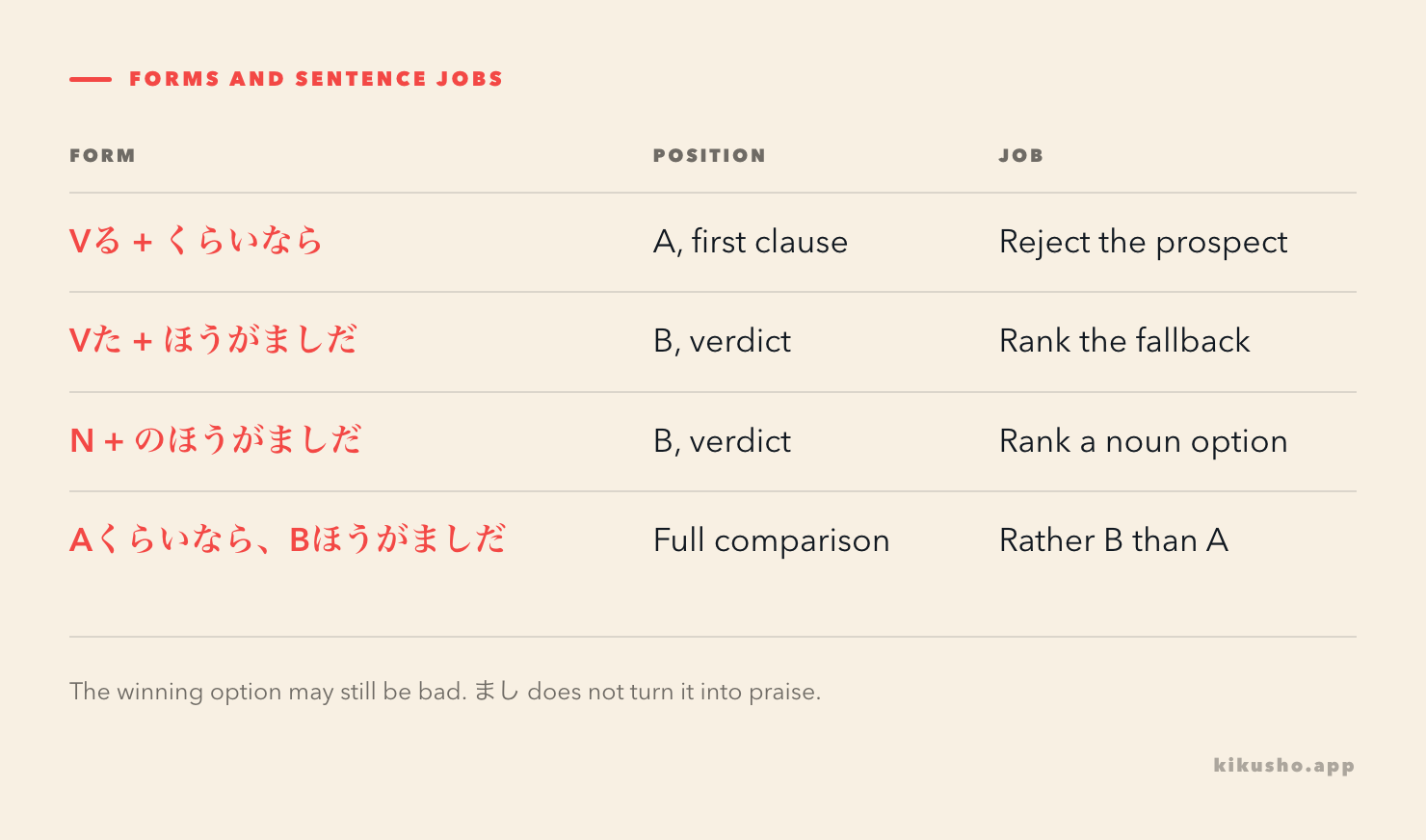
| Part | Job | What it says |
|---|---|---|
| A + くらいなら | presents the prospect the speaker strongly rejects | “If it means doing A…” / “Rather than A…” |
| B + ほうがましだ | gives the speaker's verdict on the alternative | “B would at least be less bad.” |
| Aくらいなら、Bほうがましだ | builds the full comparison | “I would rather B than A.” |
The order matters. A is not merely one neutral candidate in a survey. It is the option the speaker dislikes enough to prefer B, sometimes with deliberate exaggeration. B wins only inside that negative comparison.
JLPT Sensei presents the combined frame as V-A + くらいなら、V-B + ほうがましだ. Hedgehog Japanese independently describes まし as choosing the better member of two low-quality options. Together, those descriptions explain why the English “better” can be misleading: the winner may still be bad.
くらいなら makes the rejected option the premise
For the central comparison, attach くらいなら or ぐらいなら to a dictionary-form verb. The variants do the same grammatical work.
内容を理解せずに暗記するくらいなら、項目を半分に減らしたい。
ないようをりかいせずにあんきするくらいなら、こうもくをはんぶんにへらしたい。
Rather than memorize without understanding, I would prefer to cut the number of items in half.
The second clause does not need ほうがましだ. It can state a desire, decision, recommendation or command that replaces A.
| Ending after Aくらいなら | Effect | Example conclusion |
|---|---|---|
| Bほうがましだ | B is the lesser evil | 一からやり直したほうがましだ |
| Bほうがいい | B is the better course | 延期したほうがいい |
| Bたい | the speaker prefers B | 家にいたい |
| B | a direct alternative | 今回は参加しない |
不正確な数字を出すくらいなら、発表を延期したほうがいい。
ふせいかくなすうじをだすくらいなら、はっぴょうをえんきしたほうがいい。
Rather than release inaccurate figures, it would be better to postpone the announcement.
The sentence strongly rejects publishing bad figures, then recommends a practical alternative. ほうがいい fits because postponement can be sound advice. If the speaker said 延期したほうがましだ, postponement would sound unattractive too, merely preferable to the worse option.
Tanosuke gives V dictionary + くらいなら/ぐらいなら, notes that the first clause is the main target of rejection, and distinguishes the pattern from a neutral より comparison. Mainichi Nonbiri likewise describes the second event as more desirable to the speaker and confirms that くらい and ぐらい do not differ in meaning here.
This is a subjective comparison. 電車よりバスのほうが安い can report a fare difference. 電車に乗るくらいならバスで行く makes the train option objectionable from the speaker's perspective. The むしろ and より lesson covers a neutral benchmark and a corrected preference without automatically adding this rejection.
ほうがましだ gives the less-bad verdict
まし means that something is preferable when the alternatives are unsatisfactory. The structure can compare noun phrases or actions.
| Compared item | Formation | Example |
|---|---|---|
| noun | N + のほうがましだ | 冷たい弁当のほうがましだ |
| action | plain verb clause + ほうがましだ | 歩いて帰るほうがましだ |
| chosen action in a recommendation-like comparison | Vた + ほうがましだ | 歩いて帰ったほうがましだ |
どちらも不便だが、まだ午前の便のほうがましだ。
どちらもふべんだが、まだごぜんのびんのほうがましだ。
Both are inconvenient, but the morning flight is still the less bad option.
No くらいなら is necessary because どちらも不便だが already supplies the poor set of choices. The comparison may also use より:
満員のバスに乗るより、歩いて帰ったほうがましだ。
まんいんのバスにのるより、あるいてかえったほうがましだ。
I would rather walk home than take the crowded bus.
JLPT Sensei gives plain verb clauses and Nの before ほうがましだ and notes its frequent use after より or くらいなら. Hedgehog Japanese also records both independent comparison and the combined AくらいならBほうがましだ frame. Neither source treats B as a good outcome. That negative background is part of the construction.
まだ can reinforce the limited nature of the praise: 去年の先生のほうがまだましだった means last year's teacher was at least somewhat better, while keeping the unfavorable comparison alive. Do not confuse this with まだしも, a separate pattern that sets a tolerable A against a worse B.
Together, the forms reveal both sides of the scale
あいまいな説明で提出するくらいなら、期限を相談して書き直したほうがましだ。
あいまいなせつめいでていしゅつするくらいなら、きげんをそうだんしてかきなおしたほうがましだ。
Rather than submit it with a vague explanation, it would be less bad to discuss the deadline and rewrite it.
The first half tells you what the speaker cannot accept. The second says which fallback wins. Remove one pattern and the remaining sentence can still work, but it loses one side of that architecture.
あいまいな説明で提出するくらいなら、書き直す。
If the alternative is submitting it with a vague explanation, I will rewrite it.
期限を少し延ばしてもらって書き直したほうがましだ。
It would be less bad to get a short extension and rewrite it.
The first retains strong rejection but gives a flat decision. The second retains the less-bad verdict, with the competing bad option recoverable from context.
Similar forms change the evaluation
ほうがいい can recommend a genuinely good option
資料がまだ読みにくいなら、見出しを追加したほうがいい。
If the document is still hard to scan, you should add headings.
Adding headings can simply be good advice. Replacing the ending with 追加したほうがましだ suggests that adding them is itself undesirable, though less bad than the unstated alternative. Use まし only when that reluctant comparison makes sense.
だけましだ finds a saving feature in the situation you have
雨で試合は中止になったが、翌日に延期できただけましだ。
The match was canceled because of rain, but at least it could be postponed until the next day.
The speaker is not choosing postponement instead of cancellation. 翌日に延期できた is one real consolation inside an accepted bad situation. Our だけましだ and まだしも comparison separates that saving feature from a tolerable benchmark. By contrast, 試合を中止するほうがましだ ranks cancellation as the preferable action among bad options.
くらいなら is not every conditional なら
Ordinary なら can take up a topic or condition without rejecting it: 京都に行くなら、秋がいい means “If you are going to Kyoto, autumn is good.” Adding くらい would frame going to Kyoto as an objectionable option in a larger comparison, which is probably not the intended meaning. The ば and なら lesson explains the ordinary conditional before you add this evaluative use of くらい.
The strong stance can sound theatrical, rude or unfair when A involves another person's work or identity. そんな店に行くくらいなら、家で食べたほうがましだ does not offer a mild restaurant recommendation; it disparages the restaurant. A dramatic sentence can be grammatically natural while being socially expensive.
The level label depends on the syllabus
The two inventory records used here come from JLPT Sensei, which places both ほうがましだ and くらいなら at N1. Mainichi Nonbiri also labels くらいなら N1. Other teaching sequences disagree: Tanosuke labels it N3, while Hedgehog Japanese links its くらいなら lesson as N2. That is a real placement difference, not a difference in the formation taught above.
The JLPT does not provide a complete public grammar-item list. For this curriculum, the assigned reference keeps the lesson in N1, while the disagreement tells you that the form may appear much earlier in another course. Recognizing its stance matters more than defending one publisher's number.
When you save one of these comparisons in Kikusho, keep both options on the card. 一時間待つくらいなら alone preserves the rejected action but loses the chosen fallback. 家で作ったほうがましだ alone loses what made home cooking merely “less bad.” The full contrast is what makes くらいなら and まし recoverable during review.
Practice
All seven prompts come before the shared answer block. Decide which side of the comparison each blank controls.
Question 1 — rejected option
Complete the sentence that rejects submitting unreliable data.
不確かな数字を発表する____、公表を一日延ばしたほうがいい。
ア. ほうがましだ
イ. くらいなら
ウ. だけましだ
エ. まだしも
Question 2 — less-bad verdict
Both routes are inconvenient, but the speaker judges walking less bad than waiting for the crowded bus.
満員のバスを待つより、歩いて帰った____。
ア. くらいなら
イ. だけましだ
ウ. ほうがましだ
エ. ことはない
Question 3 — neutral advice or reluctant comparison
The speaker believes adding headings is straightforwardly good advice, not a poor fallback. Choose the best ending.
資料が読みにくいなら、見出しを追加した____。
ア. ほうがいい
イ. くらいなら
ウ. だけましだ
エ. まだしも
Question 4 — arrange the full comparison
Arrange every fragment to say “Rather than keep accepting unreasonable work in silence, it would be less bad to explain the circumstances.”
無理な仕事を__ __ __ __。
- 事情を説明した
- 黙って引き受け続ける
- ほうがましだ
- くらいなら
Question 5 — identify the viewpoint
What does 去年の担当者のほうがまだましだった imply?
ア. Last year's person was excellent.
イ. Both comparisons are unfavorable, but last year's person was relatively better.
ウ. The speaker refuses to compare the two people.
エ. The current person has not yet started the job.
Question 6 — repair the attachment
Correct the underlined part while keeping the meaning “Rather than work carelessly, I would prefer not to accept the job.”
いい加減に働いたくらいなら、その仕事は引き受けたくない。
Question 7 — choose both blanks in context
使い方が分からないまま高い機械を買う( ① )、今の道具を使い続けた( ② )。新しい道具が嫌なのではなく、無駄な買い物を避けたいのだ。
ア. ① だけましだ / ② くらいなら
イ. ① くらいなら / ② ほうがましだ
ウ. ① ほうがいい / ② まだしも
エ. ① まだまし / ② だけましだ
Answers and explanations
Answer 1
イ. くらいなら. The clause before the blank is the prospect being rejected. The following clause offers postponement as the better course. ほうがましだ would belong after the alternative, while だけましだ evaluates a saving fact in an existing bad situation.
Answer 2
ウ. ほうがましだ. より supplies the rejected comparison and 歩いて帰ったほうがましだ gives the less-bad verdict. Walking need not be attractive; it only outranks waiting for the crowded bus.
Answer 3
ア. ほうがいい. Adding headings is presented as sound advice. ほうがましだ would imply that adding them is also an unattractive choice and merely beats something worse, a nuance the prompt explicitly excludes.
Answer 4
2 → 4 → 1 → 3: 無理な仕事を黙って引き受け続けるくらいなら、事情を説明したほうがましだ。 The dictionary-form compound 引き受け続ける introduces rejected option A. 説明した modifies ほう and receives the less-bad judgment.
Answer 5
イ. Both comparisons are unfavorable, but last year's person was relatively better. まし ranks within a poor set, and まだ emphasizes the limited relief. It does not mean the person was excellent or that comparison has been postponed.
Answer 6
Use the dictionary form: いい加減に働くくらいなら、その仕事は引き受けたくない。 In this target comparison, Vるくらいなら presents the unwanted prospect. 働いたくらいなら would not supply the taught attachment.
Answer 7
イ. ① くらいなら / ② ほうがましだ. Buying expensive equipment without understanding it is the rejected A. Continuing with the current tools is not ideal, but the speaker ranks it as the less wasteful fallback. The final sentence confirms that the stance concerns a wasteful purchase, not a blanket dislike of new tools.
Common questions
What is the difference between くらいなら and ほうがましだ?
Aくらいなら marks A as the option the speaker strongly rejects and introduces a preferable alternative. Bほうがましだ evaluates B as less bad than the comparison, without claiming that B is genuinely good.
Can くらいなら and ほうがましだ appear in the same sentence?
Yes. Aくらいなら、Bほうがましだ is a common pairing meaning that if A is the prospect, the speaker would rather choose B. A is rejected and B is ranked as the lesser problem.
What forms come before くらいなら and ほうがましだ?
The core くらいなら pattern follows a dictionary-form verb. ほうがましだ can follow a plain verb clause or noun plus の; a chosen action often appears as Vたほうがましだ.
Is くらいなら N1, N2 or N3 grammar?
References disagree. JLPT Sensei and Mainichi Nonbiri label it N1, while Tanosuke labels it N3 and other courses place it at N2. The JLPT publishes no exhaustive grammar list, so treat the level as study sequencing rather than an official boundary.