On this page
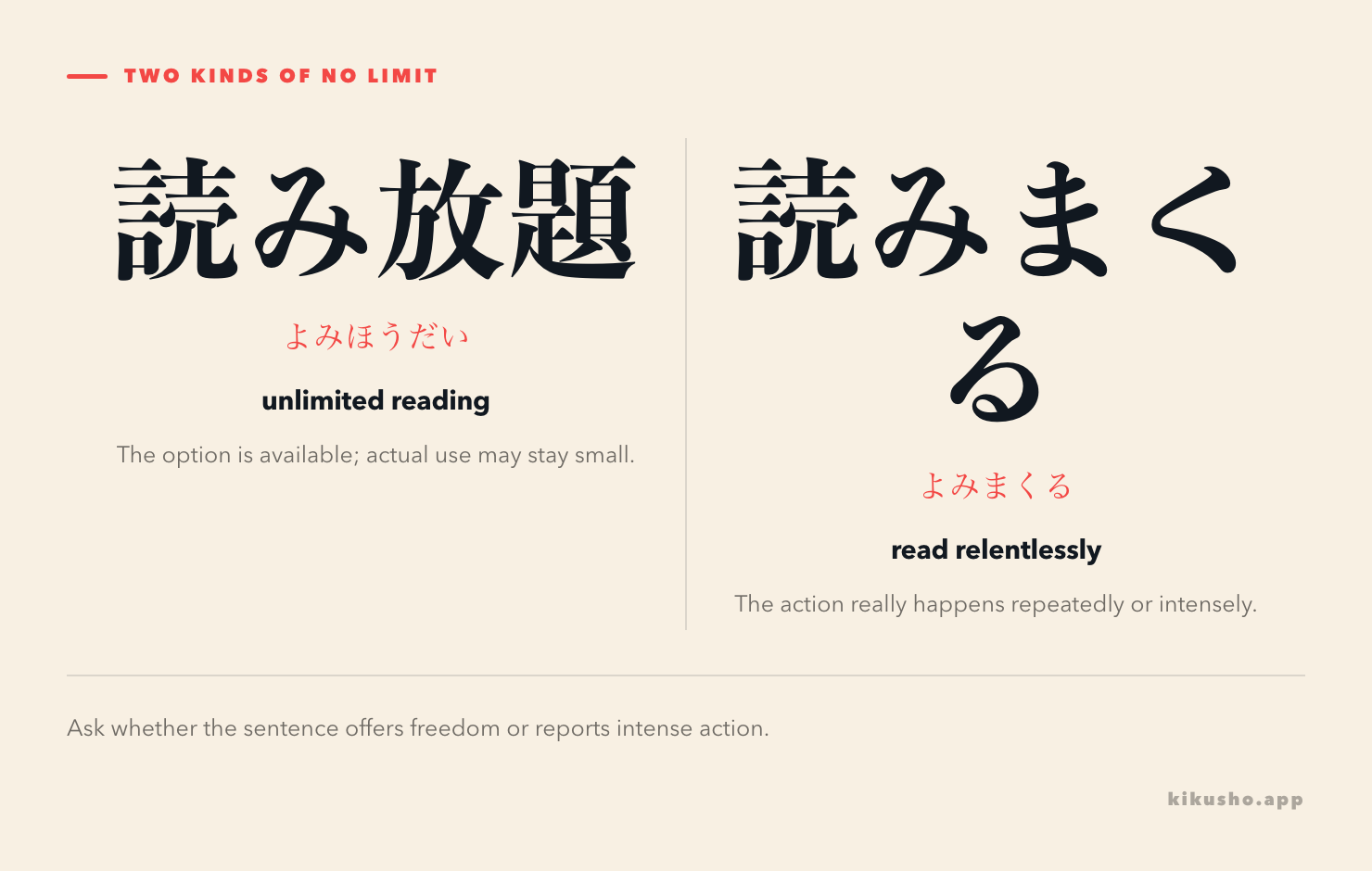
A restaurant can offer 食べ放題 even if you eat very little. You only use 食べまくる when someone really does eat again and again or with striking intensity. 放題 removes an ordinary limit; まくる describes the action racing past an ordinary measure.
この店はパンが食べ放題だが、今日は少ししか食べなかった。
このみせはパンがたべほうだいだが、きょうはすこししかたべなかった。
This restaurant offers unlimited bread, but I ate only a little today.
The first half promises access. It does not force the second half to contain a large amount of eating. That separation is the fastest way to stop treating the two forms as synonyms.
The test is available freedom or observed intensity
Both forms usually attach to a verb's ます-stem, so the decision cannot come from shape alone. Ask what the sentence claims.
| Form | Central claim | Typical perspective |
|---|---|---|
| V-stem + 放題 | the action is available without the usual limit, or is left unchecked | a plan, permission, opportunity or neglected state |
| V-stem + まくる | the action happens repeatedly, continuously or with exceptional force | an event the speaker observes or reports |
| Vたい + 放題 | someone acts as much as they want, often selfishly | criticism of unrestrained choice |
定額プランなら、映画が見放題です。
ていがくプランなら、えいががみほうだいです。
With the flat-rate plan, you can watch as many films as you like.
連休中は家で映画を見まくった。
れんきゅうちゅうはいえでえいがをみまくった。
I watched film after film at home during the long weekend.
The subscription sentence describes what the plan allows. The holiday sentence describes what the person did. One person could therefore have 見放題 access without 見まくる, while another could 見まくる purchased discs with no unlimited plan at all.
JLPT Sensei describes 放題 as doing something to one's heart's content or leaving it uncontrolled. Bunpro describes まくる as repeating or pursuing an action intensely. The shared idea is abundance, but the grammatical claim differs.
放題 turns the action into an unlimited option
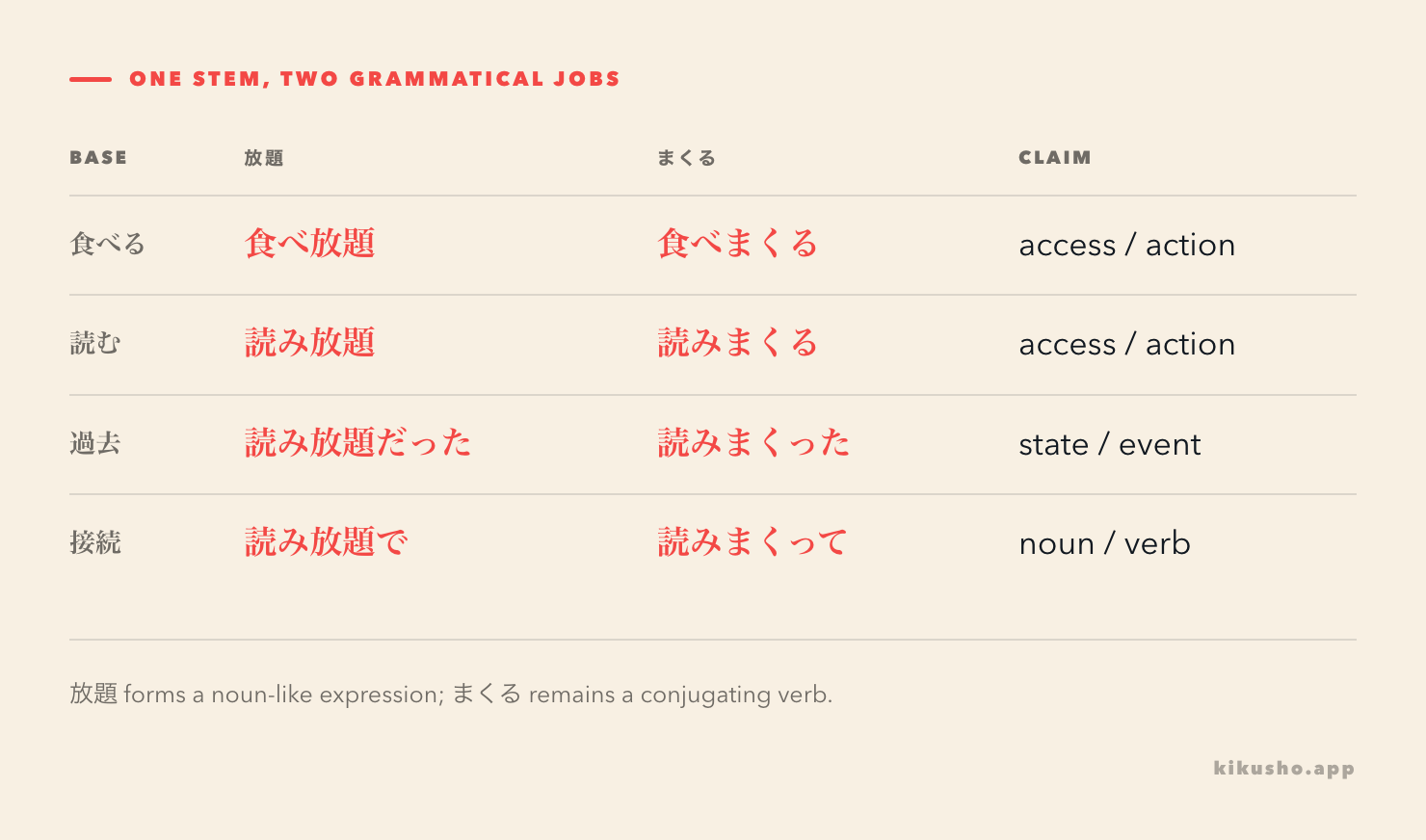
放題 is a suffix. Attach it to the ます-stem, then treat the result like a noun.
| Dictionary form | ます-stem | With 放題 | Meaning in context |
|---|---|---|---|
| 食べる | 食べ | 食べ放題 | all-you-can-eat |
| 飲む | 飲み | 飲み放題 | all-you-can-drink |
| 読む | 読み | 読み放題 | unlimited reading |
| 使う | 使い | 使い放題 | unlimited use |
That noun behavior explains 食べ放題の店, 読み放題が付いている and 二時間飲み放題だ. Do not conjugate 放題 as if it were the final verb. The copula or another expression after it carries tense and politeness.
In services and plans, the limit is usually price, time, number of uses or quantity:
この券を買えば、区内のバスが一日乗り放題になる。
このけんをかえば、くないのバスがいちにちのりほうだいになる。
If you buy this pass, you can ride the buses in the ward without limit for one day.
The same form can turn critical when nobody controls an action or state:
空き家の庭は草が伸び放題になっている。
あきやのにわはくさがのびほうだいになっている。
The grass in the vacant house's garden has been left to grow wild.
彼は反論する人がいないので、会議で言いたい放題言っていた。
かれははんろんするひとがいないので、かいぎでいいたいほうだいいっていた。
Because nobody challenged him, he said whatever he wanted in the meeting.
言いたい放題 contains the たい-form before 放題. It focuses on freedom to follow one's wishes without restraint, and the surrounding sentence often judges that behavior. Digital Daijisen records both the free-choice and left-uncontrolled meanings, with the ます-stem and たい-form among the attachments. J-nihongo independently separates unlimited service use from criticism of uncontrolled conduct.
まくる makes the action itself excessive or relentless
Attach まくる to the same ます-stem. The result is a compound verb, so まくる conjugates:
| Time or connection | Form | Example |
|---|---|---|
| non-past | V-stem + まくる | 書きまくる |
| past | V-stem + まくった | 書きまくった |
| linking form | V-stem + まくって | 書きまくって |
| desire | V-stem + まくりたい | 書きまくりたい |
締め切り前の一週間、彼女は原稿を書きまくった。
しめきりまえのいっしゅうかん、かのじょはげんこうをかきまくった。
For the week before the deadline, she wrote furiously.
The sentence may highlight many repetitions, sustained continuation, or sheer intensity. Context decides which English wording fits. 写真を撮りまくる normally suggests taking picture after picture. 風が吹きまくる presents the wind as blowing relentlessly.
Tanosuke gives V-stem + まくる and explains it as doing an action many times without much restraint. It also teaches volitional verbs as the normal choice. Usage is broader than a strict intention rule, however: dictionary evidence and other teaching references include forceful natural events and uncontrolled states. A safer production guide is to use まくる with a dynamic event that can meaningfully repeat or intensify, and to check established usage when the subject cannot act intentionally.
The form is vivid and conversational. In a formal report, 問い合わせが相次いだ or 何度も分析した will usually suit better than 問い合わせが来まくった or 分析しまくった. Casual narration, quoted speech and expressive commentary give まくる room to sound natural.
The same verb can describe two different scenes
With a suitable action, both forms are grammatical. The speaker chooses which fact matters.
今日は資料室の本が読み放題だ。
きょうはしりょうしつのほんがよみほうだいだ。
Today, the books in the reference room are available to read without limit.
今日は資料室で関連論文を読みまくった。
きょうはしりょうしつでかんれんろんぶんをよみまくった。
Today, I read paper after paper in the reference room.
The first sentence remains true before anyone opens a book. The second requires a real burst of reading. This also explains why advertisements favor 放題: the seller can promise access, while the customer controls how much of the action occurs.
In negative scenes, the contrast shifts from permission to control:
管理する人がいなくて、共有の道具は使い放題だった。
かんりするひとがいなくて、きょうゆうのどうぐはつかいほうだいだった。
With nobody managing them, the shared tools were there for anyone to use however they liked.
子どもたちは共有の道具を使いまくって、いくつか壊してしまった。
こどもたちはきょうゆうのどうぐをつかいまくって、いくつかこわしてしまった。
The children used the shared tools relentlessly and ended up breaking some.
使い放題 describes the unchecked situation. 使いまくって reports the intense behavior inside it. A single passage can contain both because they answer separate questions.
Nearby forms put the limit somewhere else
すぎる judges degree against a standard: 食べすぎた means the amount was excessive. 食べまくった paints the activity as vigorous or repeated, but the speaker does not have to state a harmful threshold. The すぎる and とても lesson separates excess from high degree.
続ける says that an action continues. It can be calm and neutral: 三時間読み続けた only gives duration. 読みまくった adds expressive force and often suggests a large number or intense pace. The action-phase lesson places 続ける among the compounds that mark an action's course.
も構わず names a concern that someone ignores, while ままに names the wish or force that guides an action. Neither one by itself claims unlimited availability or repeated action. The も構わず and ままに lesson maps that different kind of restraint.
When you capture one of these phrases in Kikusho, save the clause that reveals whether you saw an offer or an event. 読み放題 becomes memorable beside a monthly plan; 読みまくった needs the afternoon spent racing through articles. The shared verb stem is easy to notice. The surrounding scene preserves the distinction.
Practice
All seven questions appear before the answer block. Choose the claim the sentence needs, then check the attachment.
Question 1 — a service plan
Complete the sentence about unlimited access that does not guarantee heavy use.
このプランなら雑誌が____だが、毎月一冊読むとは限らない。
ア. 読みまくる
イ. 読み放題
ウ. 読みすぎる
エ. 読み続ける
Question 2 — repeated action
The photographers really took picture after picture. Choose the best form.
珍しい鳥が現れると、全員が写真を____。
ア. 撮り放題だった
イ. 撮りまくった
ウ. 撮りたい放題だった
エ. 撮るままだった
Question 3 — build the service noun
Arrange every fragment to say “This pass lets you ride the local trains as much as you like for one day.”
このパスなら__ __ __ __。
- 乗り放題
- 一日
- だ
- 地域の電車が
Question 4 — conjugate the compound verb
Change 質問する to complete a past-tense sentence meaning that the children asked question after question.
子どもたちは先生に____。
Question 5 — read an unchecked state
What does 庭の草が伸び放題になっている say?
ア. Visitors may pick as much grass as they want.
イ. The grass has been allowed to grow without control.
ウ. Someone is cutting the grass repeatedly.
エ. The grass grew beyond a measured height once.
Question 6 — compare the two claims
Explain the difference between these sentences.
会議で彼は意見を言いたい放題言った。
会議で彼は意見を言いまくった。
Question 7 — choose both forms in context
この施設では練習室が三時間( ① )だ。昨日は空いていたので、私は一人で発音を練習し( ② )。
ア. ① 使いまくり / ② 放題だった
イ. ① 使い放題 / ② まくった
ウ. ① 使いすぎ / ② 放題にした
エ. ① 使うまま / ② たい放題だった
Answers and explanations
Explanation 1
イ. 読み放題. The plan makes magazines available without a per-item limit. The final clause explicitly says that actual reading may remain small, so a form reporting intense action would contradict the point.
Explanation 2
イ. 撮りまくった. The sentence reports an event in which everyone repeatedly took pictures. 撮り放題だった would describe freedom or an opportunity to take pictures, not what the photographers really did.
Explanation 3
2 → 4 → 1 → 3: このパスなら一日地域の電車が乗り放題だ。 乗り is the ます-stem of 乗る, and 乗り放題 behaves as a noun followed here by だ. The duration 一日 sets the boundary of the unlimited offer.
Explanation 4
子どもたちは先生に質問しまくった。 Remove ます from 質問します to get 質問し, then add the past compound ending まくった. The result presents many questions or vigorous repeated questioning.
Explanation 5
イ. The grass has been allowed to grow without control. Here 放題 describes a neglected state. It does not grant visitors permission, report repeated cutting, or specify one measured threshold.
Explanation 6
The 言いたい放題 sentence focuses on the speaker saying whatever he wanted because ordinary restraint was absent; it readily sounds critical of selfish freedom. 言いまくった focuses on the amount, repetition or force of the speaking itself. Both may describe excessive behavior, but they choose different evidence.
Explanation 7
イ. ① 使い放題 / ② まくった. The facility makes the room freely available for three hours, so the first blank names an access condition. The speaker then really practiced intensely, so the second blank takes the conjugated action 練習しまくった.
Common questions
What is the difference between 放題 and まくる?
Verb-stem plus 放題 presents an action as freely available, permitted or left unchecked. Verb-stem plus まくる says that the action really occurs repeatedly, continuously or with unusual intensity.
What form comes before 放題 and まくる?
Both normally follow the verb's ます-stem: 食べます becomes 食べ放題 or 食べまくる, and 読みます becomes 読み放題 or 読みまくる. 放題 also occurs after the たい-form in expressions such as 言いたい放題.
Is 放題 always positive?
No. 食べ放題 and 読み放題 advertise welcome access, but 荒れ放題 and 言いたい放題 can criticize a state or behavior that nobody restrains.
Is まくる N1 grammar?
JLPT Sensei, Bunpro and Tanosuke place this use at N1, while other teaching sites place it at N2 or outside their JLPT lists. The JLPT publishes no exhaustive official grammar list, so the boundary is an estimate.