On this page
とても means a quality is high on its scale; ~すぎる says the degree has crossed a relevant limit. とても高い is “very expensive,” while 高すぎる is “too expensive,” perhaps for your budget or for what the item is worth.
The test is whether a limit has been crossed
Use this question before choosing the form: Is the speaker only describing a strong quality, or judging it against a limit?
| Form | What it does | Example | Meaning |
|---|---|---|---|
| とても + predicate | raises the degree | とても高い | very expensive |
| stem + すぎる | crosses a contextual limit | 高すぎる | too expensive |
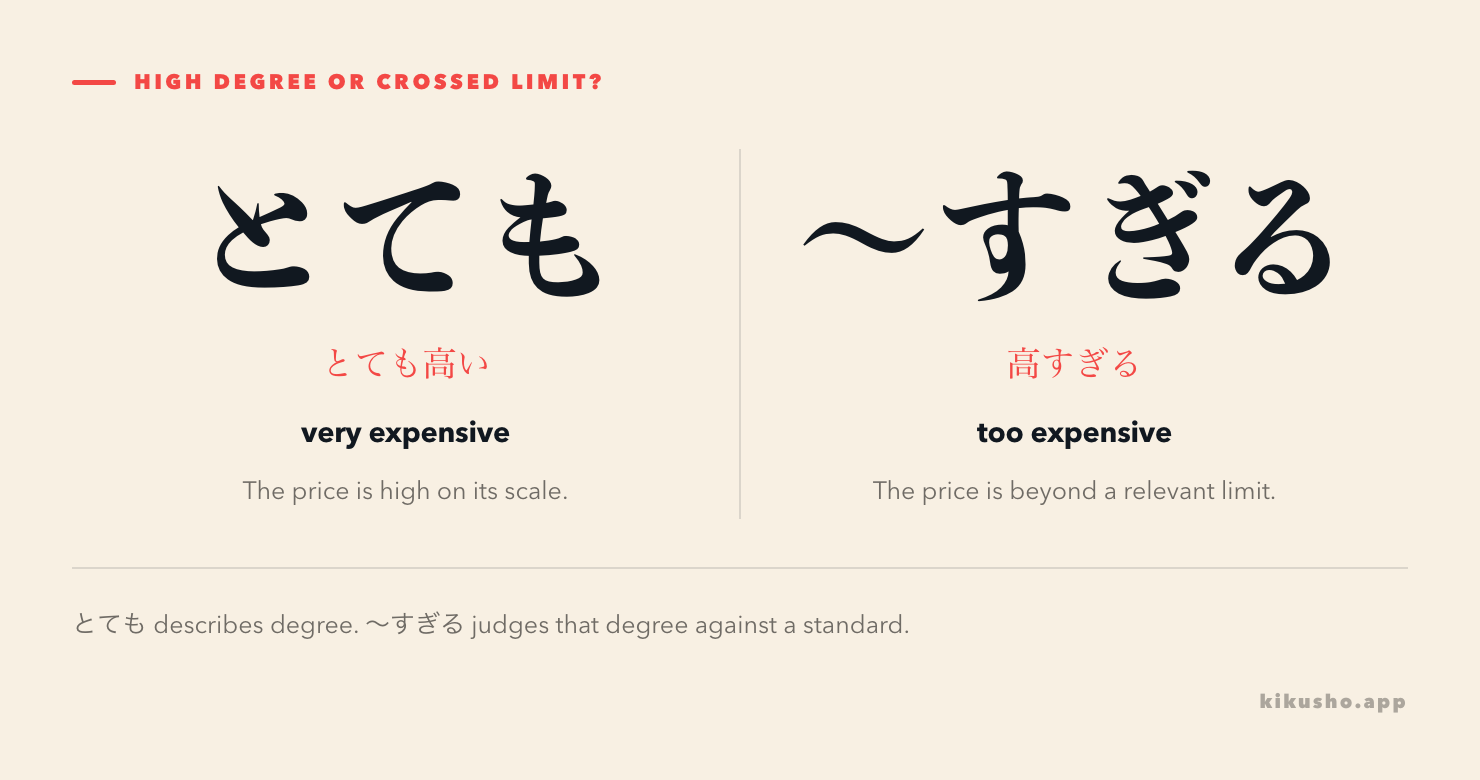
The difference is not simply that すぎる is stronger. Imagine a good restaurant:
この店の料理はとてもおいしいです。
The food at this restaurant is very good.
The high degree is welcome. Now imagine the portion:
一人には量が多すぎます。
The amount is too much for one person.
The portion has passed a practical limit. The phrase 一人には, “for one person,” makes the standard explicit. Without such a phrase, the situation still supplies one: price for a buyer, size for a room, speed for a safe journey, or time for a schedule.
とても sits before the quality it strengthens
とても is an adverb. It commonly comes before an adjective or a state whose degree can rise.
今日はとても暑いです。
It is very hot today.
この部屋はとても静かです。
This room is very quiet.
昨日はとても疲れました。
I was very tired yesterday.
Nothing changes inside 暑い, 静か, or 疲れました. とても stays separate and does not conjugate. Past tense and politeness remain on the predicate: とても暑かった, とても静かでした, とても疲れています.
JLPT Sensei's とても lesson places the adverb at N5 and shows it before adjectives and degree-bearing verbs. MLC Japanese's N5 degree guide likewise sets とても on the high affirmative side of the beginner degree scale.
Do not use とても as a general replacement for “a lot.” とても食べます is not the normal way to say “I eat a lot”; たくさん食べます gives the quantity. とても works naturally when the following expression has a degree to intensify, as in とても好き, とても忙しい, or とてもよく分かります.
For “not very,” the basic N5 pattern is あまり~ない: あまり高くない, “not very expensive.” The separate shape とても~ない can express “cannot possibly” in sentences such as とても食べられない, but that is not the affirmative degree use taught here.
~すぎる builds a new predicate
~すぎる comes from 過ぎる, “to pass” or “to go beyond.” Attached to another word, it presents an action or quality as passing its appropriate degree.
The attachment depends on what comes before it:
| Base | Class | What to remove | Result |
|---|---|---|---|
| 高い(たかい), expensive | い-adjective | final い | 高すぎる, too expensive |
| 静かな(しずかな), quiet | な-adjective | な | 静かすぎる, too quiet |
| 食べます(たべます), eat | verb | ます | 食べすぎる, eat too much |
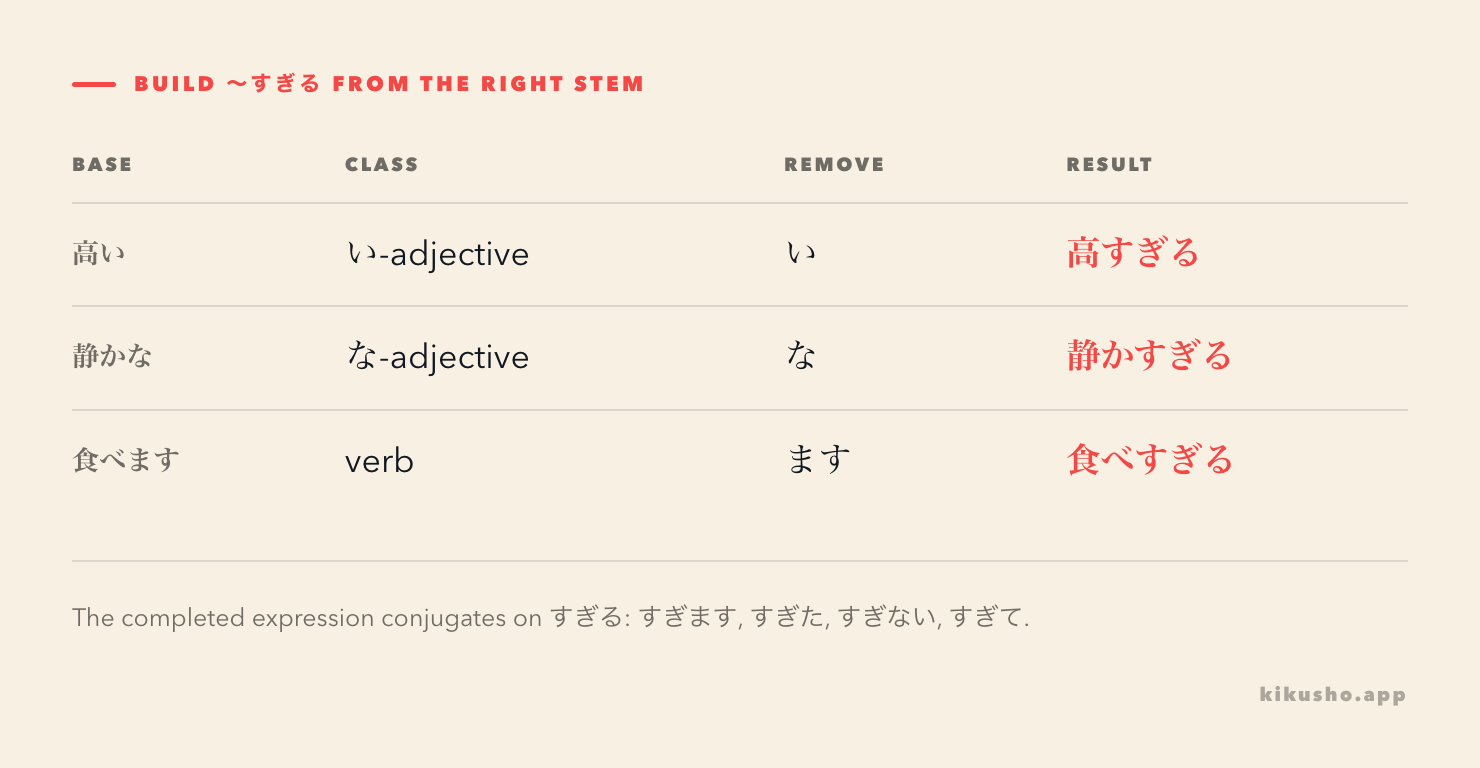
The Japan Foundation's Irodori adjective lesson gives the two adjective rules directly: remove い from an い-adjective and な from a な-adjective. Its verb grammar notes use the ます-stem and describe すぎる as going beyond the degree.
This makes several tempting forms incorrect:
- 高いすぎる keeps an い that must be removed; use 高すぎる.
- 静かなすぎる keeps the noun attachment な; use 静かすぎる.
- 食べるすぎる uses the dictionary form; use 食べすぎる.
The familiar exception is いい, “good.” Its changing stem is よ, so “too good” is よすぎる, not いいすぎる. This is the same よ seen in よかった and よくない. Review the two adjective classes in the い-adjective and な-adjective guide, and use the verb-group lesson when a ます-stem is not yet automatic.
The new word conjugates as an る-verb
Once attached, the whole すぎる expression behaves as an ichidan verb. The first part stays fixed while すぎる carries tense, politeness, negation, and connection.
| Job | 食べすぎる | 高すぎる |
|---|---|---|
| polite non-past | 食べすぎます | 高すぎます |
| plain past | 食べすぎた | 高すぎた |
| plain negative | 食べすぎない | 高すぎない |
| て-form | 食べすぎて | 高すぎて |
昨日、ケーキを食べすぎました。
I ate too much cake yesterday.
このかばんは重すぎて、持てません。
This bag is too heavy, so I cannot carry it.
The first example locates the excess in the amount eaten. The second uses すぎて to connect the excessive weight to its consequence. A broader N4 set shows how 過ぎる behaves beside other second verbs, but the choice against とても depends on the limit, not on the compound-verb label.
The limit can belong to one person
Two speakers can truthfully choose different forms for the same object because their thresholds differ.
このコートはとても高いです。
This coat is very expensive.
このコートは私には高すぎます。
This coat is too expensive for me.
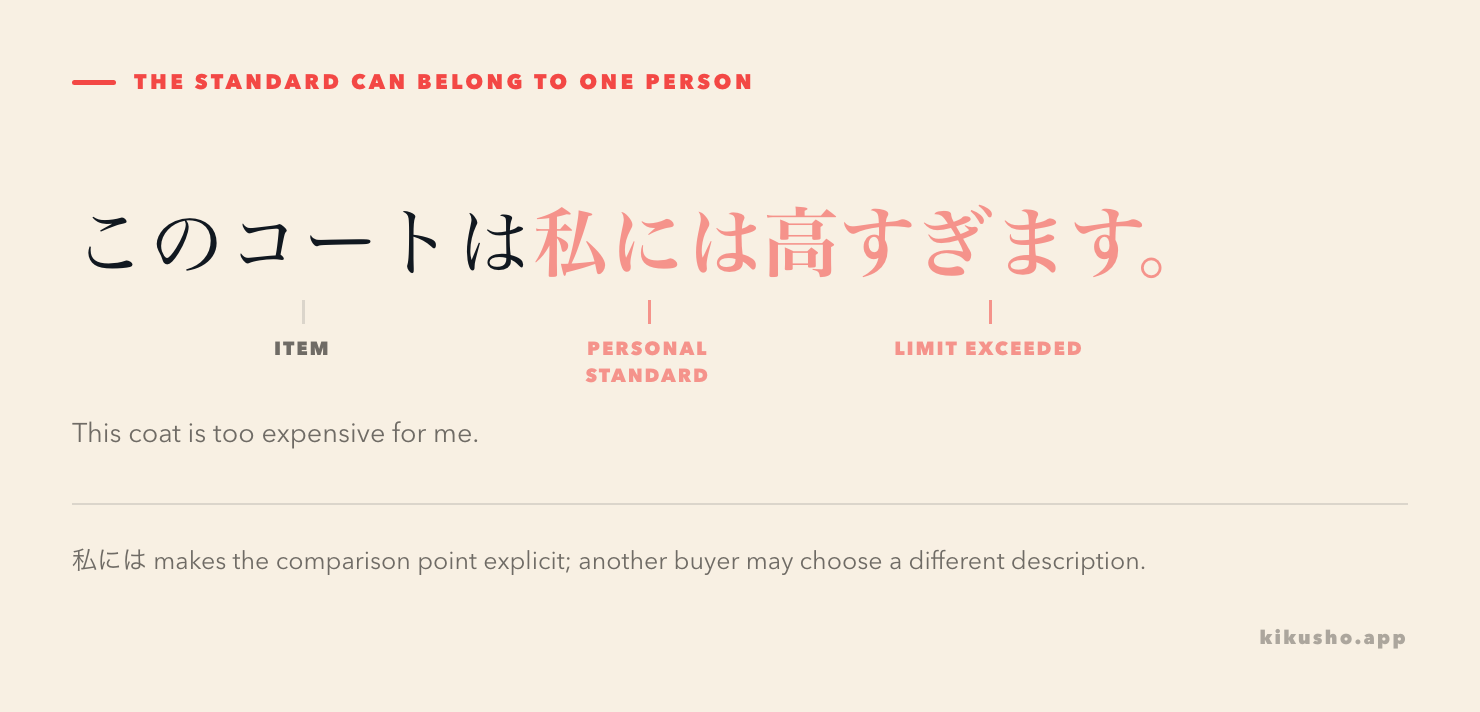
The first speaker reports a high price. The second compares that price with a personal budget. 私には does not create the grammar, but it makes the hidden standard visible. Similar phrases include 子どもには難しすぎる, “too difficult for a child,” and この部屋には大きすぎる, “too large for this room.”
This is why replacing every English “very” with すぎる can sound critical. 先生はとても親切です praises a very kind teacher. 先生は親切すぎます literally presents the kindness as beyond a limit, perhaps because the teacher helps so much that students stop acting independently. Context can turn that excess into affectionate exaggeration, but the threshold remains part of the effect.
Positive exaggeration keeps the idea of excess
In conversation, speakers often use すぎる with a positive quality:
この犬、かわいすぎる!
This dog is just too cute!
This is praise, not a complaint. The speaker playfully treats the cuteness as more than an ordinary scale can contain. とてもかわいい is a straightforward “very cute”; かわいすぎる is more emotional and exaggerated.
The same logic explains why ちょっと高すぎます is not contradictory. Here ちょっと softens the judgment: “It is a little too expensive.” The price still crosses the speaker's limit, but the criticism is delivered gently.
When you save a shop comment or a line of dialogue in Kikusho, keep the part that reveals the standard. A card containing 私には高すぎます preserves the personal limit; a card reduced to 高い only remembers “expensive” and loses the decision between とても and すぎる. Text or photo capture can keep that whole phrase together, and the draft remains editable before it joins your reviews.
Try all seven before reading the explanations
Question 1
A speaker likes the hotel and only wants to praise its quietness. Which sentence fits?
a) このホテルはとても静かです。
b) このホテルは静かすぎます。
c) このホテルは静かなすぎます。
d) このホテルはとても静かすぎます。
Question 2
Choose the correct form for “This bag is too heavy.”
a) このかばんは重いすぎます。
b) このかばんは重くすぎます。
c) このかばんは重すぎます。
d) このかばんはとても重すぎます。
Question 3
Complete the sentence with the correct form of 静かな: この町は夜になると、___と感じる人もいます。
a) 静かなすぎる
b) 静かすぎる
c) 静かにすぎる
d) とても静かすぎる
Question 4
Arrange all four chunks to say “Yesterday, I drank too much coffee.”
飲みすぎました
昨日
コーヒーを
、
Question 5
Read the short exchange and choose the best reply.
A:このシャツ、大きいですか。
B:はい。私には___。もっと小さいのがいいです。
a) とても大きいです
b) 大きすぎます
c) 大きいすぎます
d) とても大きすぎます
Question 6
Which form correctly means “too good” from いい?
a) いいすぎる
b) いすぎる
c) よすぎる
d) よくすぎる
Question 7
In この猫、かわいすぎる!, what does すぎる contribute?
a) A neutral factual degree with no speaker attitude
b) A playful, positive exaggeration that still treats the degree as beyond ordinary limits
c) A past-tense meaning
d) A polite comparison with another cat
Choose all seven responses before continuing. The answer block starts below.
Answers and explanations
Answer 1
a) このホテルはとても静かです。 とても raises the degree of 静か without judging the quietness as a problem. b) says “too quiet” and implies a limit has been crossed. c) keeps な before すぎる, and d) combines two degree choices unnecessarily.
Answer 2
c) このかばんは重すぎます。 Remove the final い from 重い and add すぎる. a) keeps that い, b) uses the adverbial く-form instead of the required stem, and d) stacks とても onto an expression that already marks excess.
Answer 3
b) 静かすぎる. Remove な from the noun-modifying form 静かな before attaching すぎる. The sentence says that some people find the town excessively quiet at night. a) keeps な, c) inserts adverbial に, and d) needlessly mixes the two target forms.
Answer 4
2 → 4 → 3 → 1: 昨日、コーヒーを飲みすぎました。 飲み is the ます-stem of 飲みます, and すぎました carries polite past tense for the completed excess.
Answer 5
b) 大きすぎます. The request for a smaller shirt proves that the current size crosses B's personal limit. a) only says the shirt is very large and does not itself explain the desired replacement. c) has the wrong attachment, and d) mixes the separate degree strategies.
Answer 6
c) よすぎる. いい uses よ as the stem when it changes, just as in よかった and よくない. The other three choices do not form this expression.
Answer 7
b) A playful, positive exaggeration that still treats the degree as beyond ordinary limits. The speaker praises the cat by presenting its cuteness as almost excessive. a) better describes the flatter とてもかわいい; c) would require かわいすぎた, and d) adds meanings absent from the sentence.
The useful evidence often sits outside the target form. A smaller replacement, a sore stomach, or 私には reveals the limit that makes すぎる the right choice. Learn to notice that evidence and “very” versus “too” stops being a translation guess.
Common questions
What is the difference between とても and すぎる?
とても raises a quality on a scale: とても高い means “very expensive.” ~すぎる says a relevant limit has been exceeded: 高すぎる means “too expensive.” The limit depends on the situation and the speaker.
How does すぎる attach to Japanese adjectives?
Remove the final い from an い-adjective, as in 高い → 高すぎる. Remove な from the noun-modifying form of a な-adjective, as in 静かな → 静かすぎる. The irregular adjective いい uses よ: よすぎる.
How does すぎる attach to a verb?
Use the ます-stem without ます: 食べます → 食べすぎる, 飲みます → 飲みすぎる, します → しすぎる, and 来ます → 来すぎる.
Is すぎる always negative?
It usually presents something as beyond a suitable amount, which often creates a problem. In expressive speech, positive words such as かわいい can take すぎる for praise, but the form still exaggerates the degree as beyond ordinary limits.