On this page
The curtain is due to rise in five minutes: いよいよ本番が始まる announces that the anticipated moment has arrived. If another rehearsal meant to calm everyone only makes them more nervous, 練習したら、かえって緊張した sends the result against its expected direction.
The test: threshold or reversal?
These adverbs do not compete for the same blank. They answer different questions about how the present situation relates to what came before it.
| Ask about the sentence | Choose | Core movement | Typical frame |
|---|---|---|---|
| Has a significant stage finally become imminent or begun? | いよいよ | buildup → awaited stage | いよいよ + event or change |
| Did the result oppose what someone expected or intended? | かえって | expectation → contrary result | Aが/たら、かえってB |
Both are adverbs and can modify a whole proposition. Neither attaches to one conjugation:
- いよいよ + phrase: いよいよ決勝戦が始まる
- phrase A + かえって + phrase B: 急いだら、かえって遅くなった
The contrast is a matter of discourse direction. いよいよ follows a line that has been building toward a stage. かえって bends a line away from the result that the first clause led you to expect.
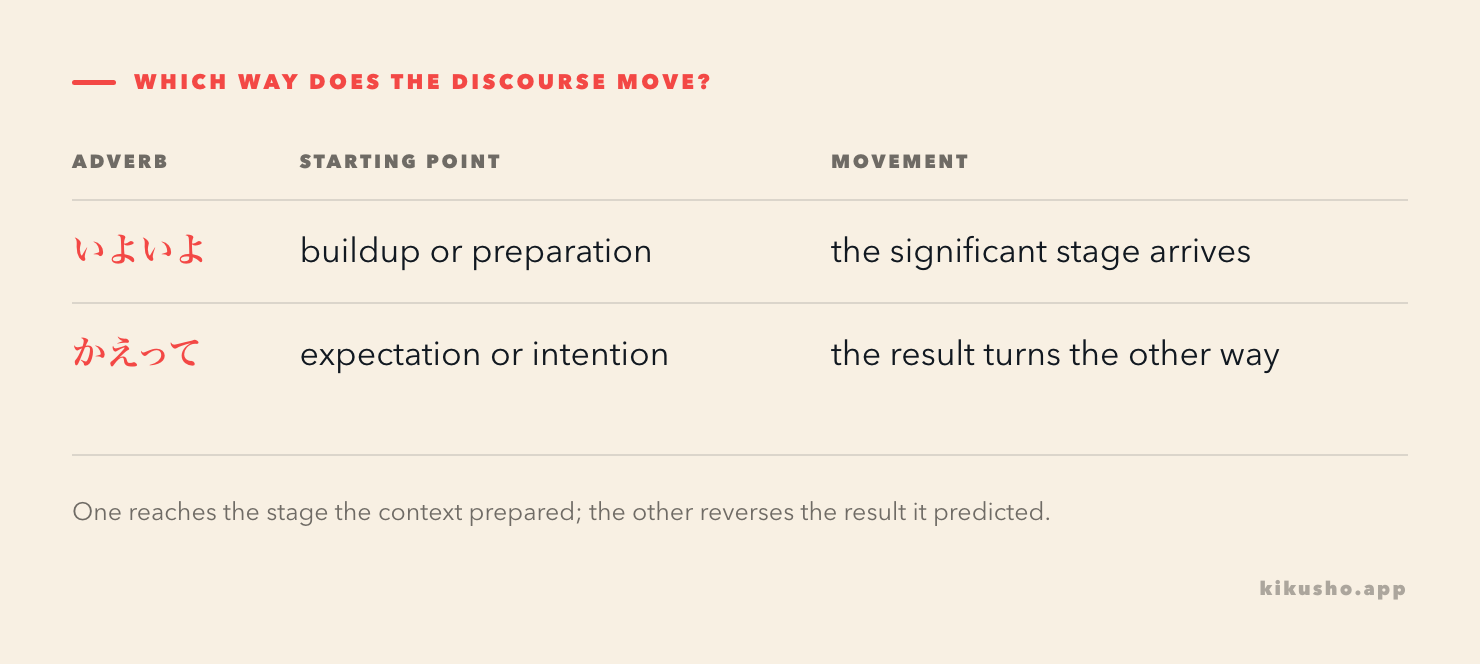
いよいよ reaches the significant stage
Use いよいよ when time, preparation or a developing condition has brought a noteworthy stage close enough to feel present.
半年間準備してきた発表会が、いよいよ明日始まる。
はんとしかん じゅんびしてきた はっぴょうかいが、いよいよ あした はじまる。
The presentation event we have prepared for over six months finally begins tomorrow.
The event can still be in the future. What matters is that “tomorrow” has become the immediate threshold after a long preparation. A past predicate is possible when the stage has just begun:
いよいよ新しい制度が始まった。
いよいよ あたらしい せいどが はじまった。
At last, the new system has begun.
The emotion does not have to be cheerful. いよいよ手術の日が来た can carry hope, fear or both. The adverb marks the importance and buildup of the moment; the surrounding sentence supplies the evaluation.
Kotobank's いよいよ entry records several related uses: a degree increasing, something uncertain becoming definite, a long-awaited event taking shape, and approach to a serious stage. Bunpro likewise describes いよいよ before a phrase and separates the “finally” reading from the “more and more” reading.
That degree use follows the same sense of mounting progression:
台風が近づき、風がいよいよ強くなってきた。
たいふうが ちかづき、かぜが いよいよ つよくなってきた。
As the typhoon approached, the wind grew stronger and stronger.
Here there is no ceremony or awaited calendar date. The wind is moving into a more intense stage. Context and the following predicate tell you whether いよいよ means “at last” or “increasingly.”
かえって turns away from the expected result
Use かえって, also written 却って, when the result contradicts a natural expectation created by an action, intention or comparison.
緊張しないように何度も練習したが、かえって不安になった。
きんちょうしないように なんども れんしゅうしたが、かえって ふあんに なった。
I rehearsed many times so that I would not be nervous, but it made me more anxious instead.
The intention predicts less anxiety. The outcome is more anxiety, so かえって marks the turn. が, のに, たら, つもりで and comparison frames often make the expected direction visible, but none is a required attachment.
Kotobank defines かえって as a state turning out opposite to expectation and distinguishes that reversal from the broader choice made with むしろ. Bunpro gives the productive A + かえって + B frame and examples in which an intended action backfires.
Contrary does not mean bad. The expected and actual directions can reverse toward a welcome result:
道に迷ったが、かえって面白い店を見つけることができた。
みちに まよったが、かえって おもしろい みせを みつけることが できた。
We got lost, but that unexpectedly allowed us to find an interesting shop.
Getting lost normally predicts inconvenience. Finding something worthwhile overturns that prediction. The surprise relation licenses かえって even though the outcome is favorable.
One performance can take both paths
Keep the setting fixed and follow the direction selected by each adverb.
準備が整い、いよいよ発表会が始まる。
The preparations are complete, and at last the presentation event is about to begin.
落ち着くために直前まで練習したら、かえって緊張してしまった。
We rehearsed until the last minute to calm down, but ended up more nervous instead.
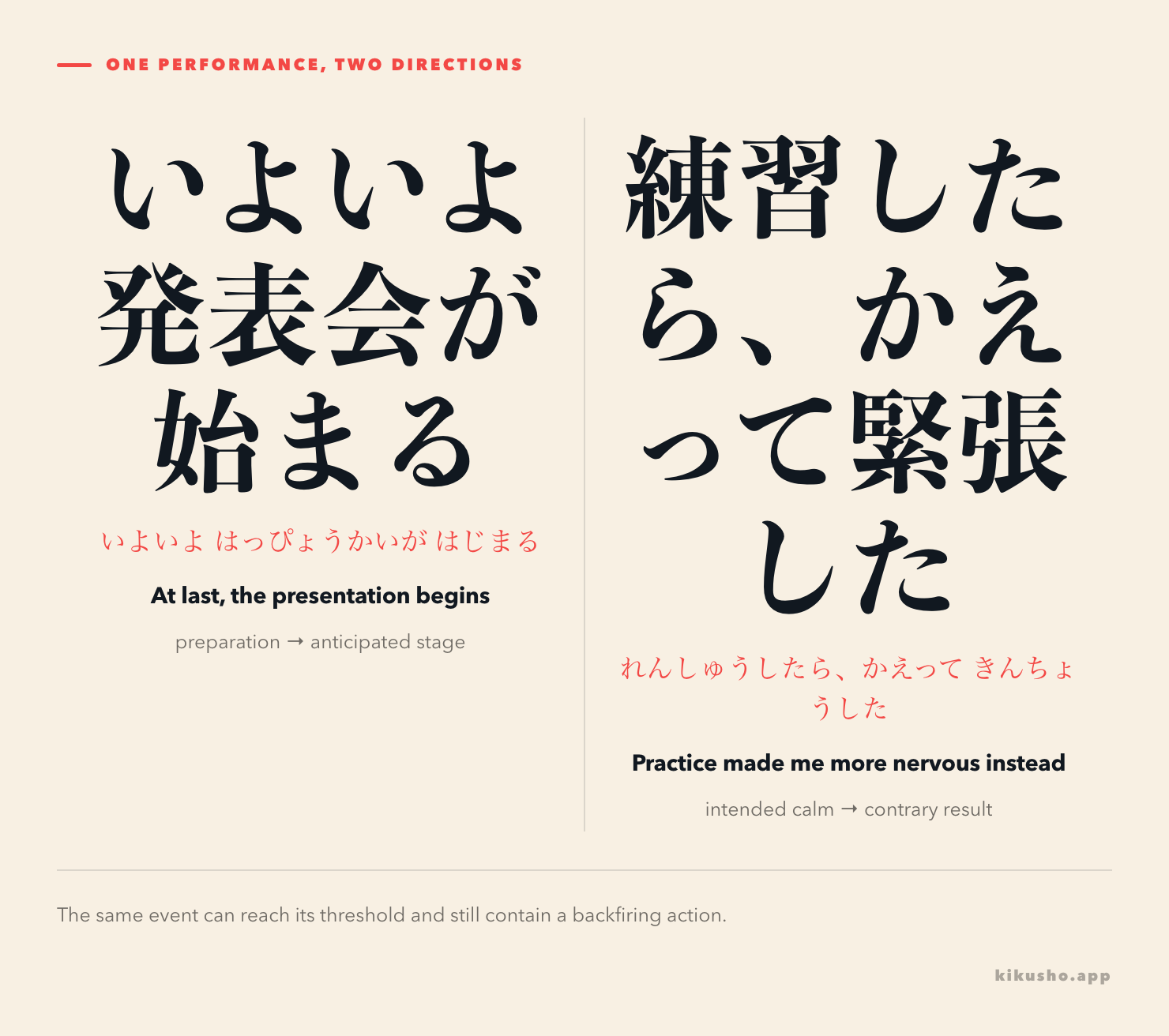
The first sentence needs a buildup, but no failed intention. The second needs an expectation to overturn, but no approaching climax. That is why exchanging the adverbs breaks the logic. かえって発表会が始まる gives the listener no prediction for the start to contradict. 練習したら、いよいよ緊張した suggests tension reached a significant new stage; it does not by itself say practice had the opposite effect.
When you keep one of these adverbs in Kikusho, retain the clause that gives it direction. かえって不安になった hides the expectation it reverses. 落ち着くために練習したが、かえって不安になった preserves both the intended and actual outcomes on one review card.
Where nearby adverbs stop overlapping
いよいよ and ついに can both appear when a long-awaited event arrives. The useful first distinction is viewpoint: いよいよ places you at the threshold of an anticipated stage, while ついに presents the decisive endpoint of a wait or process. Compare いよいよ決勝戦が始まる, “the final is about to begin at last,” with ついに決勝戦が終わった, “the final has finally ended.” The ついに, やっと, とうとう and いよいよ comparison develops that endpoint contrast and its genuine overlap.
かえって and むしろ overlap when a comparison makes the second side surprising:
広い部屋より、小さい部屋のほうがかえって落ち着く。
Rather unexpectedly, a small room feels calmer than a large one.
But むしろ can simply choose the more accurate or preferable description: 今日は外食するより、むしろ家で食べたい, “Rather than eating out today, I would prefer to eat at home.” Nothing backfired. The むしろ and よりも comparison shows how that preference or correction works without a contrary outcome.
Kana is the ordinary choice for both adverbs. 愈々 and 却って appear in dictionaries and some writing, but a learner does not need the kanji spellings to use either expression naturally.
The level labels are study estimates
JLPT Sensei places both adverbs at N2, and Bunpro also places いよいよ at N2. Bunpro and Tanos place かえって at N3, so its teaching order is disputed.
No public official list assigns every grammar item to one JLPT level. Kikusho teaches the pair here because longer N2 passages often depend on tracking whether a writer is advancing an anticipated development or reversing an expectation. Meeting かえって earlier does not alter that discourse role.
Practice: follow the expected direction
1 · The long-prepared opening
The museum has been under renovation for two years. Complete: 二年間の工事が終わり、__来週再開する。
A. かえって
B. いよいよ
C. むしろ
D. 少しも
2 · A solution that backfires
Choose the natural completion: 道が混んでいたので近道を選んだが、__時間がかかった。
A. いよいよ
B. ついに
C. かえって
D. 必ず
3 · Read the direction
Which sentence says that having less time unexpectedly improved concentration?
A. 時間が少なくなり、いよいよ集中できなくなった。
B. 時間が少ないほうが、かえって集中できた。
C. 時間が少ないより、むしろ集中したい。
D. 時間が少なくても、ついに集中しなかった。
4 · The second いよいよ
In 雨はいよいよ激しくなってきた, what does いよいよ contribute?
A. The rain has grown increasingly intense.
B. The rain produced the opposite result from an intention.
C. The speaker prefers rain to wind.
D. The rain stopped after a long wait.
5 · Make the expectation visible
Complete one sentence with かえって: “I drank coffee to stay awake, but it made me feel more tired instead.”
6 · Follow the whole rehearsal
Read: 半年間準備してきた発表会が、いよいよ明日始まる。落ち着くために今夜も練習するつもりだったが、先生に休むように言われた。休んだら、かえって自信が出てきた。 Which account is accurate?
A. The event was cancelled, and resting had the expected bad result.
B. The anticipated event is about to begin, and resting unexpectedly increased the speaker's confidence.
C. The event ended long ago, and the teacher demanded more practice.
D. Both adverbs report the same kind of gradual increase.
Answers and explanations
1 · B, いよいよ. Two years of work have reached the significant reopening stage. The sentence supplies buildup and an imminent event, without a contrary result.
2 · C, かえって. A shortcut is expected to save time, but this one took longer. かえって marks that reversal.
3 · B, 時間が少ないほうが、かえって集中できた. Less time would normally predict worse concentration, so improved concentration runs against the expectation. The other choices do not express that relation.
4 · A. This is the degree use: the rain is becoming more and more intense. No intention or comparison has reversed.
5 · 眠気を覚ますためにコーヒーを飲んだが、かえって疲れがひどくなった. The purpose clause establishes the expected effect, and the second clause overturns it. Other natural wording is possible if the same relation remains clear.
6 · B. いよいよ places the speaker at the threshold of the long-prepared event. Rest might appear to reduce readiness, yet it produces more confidence, so かえって marks the favorable surprise.
A reader who spots かえって can reconstruct an invisible prediction: something else was supposed to happen. That missing expectation is often the bridge between two sentences in an N2 passage, and naming it turns an adverb question into a simple comparison between the predicted path and the one the text actually took.
Common questions
What is the difference between いよいよ and かえって?
いよいよ marks an anticipated or significant stage as imminent or underway. かえって introduces a result that runs against an expectation, intention or comparison.
Does いよいよ always describe something positive?
No. It can announce a welcome event, a tense turning point or a worsening condition. Its core is mounting progression toward a significant stage, not positive emotion.
Does かえって always introduce a bad result?
No. Bad outcomes are common because attempted solutions often backfire, but a surprisingly good result can also take かえって if it reverses the expected direction.
Is かえって the same as むしろ?
They overlap in some comparisons. かえって highlights a result contrary to expectation, while むしろ can simply select the more accurate or preferable alternative.