On this page
The word before the expression decides most cases. Use 嬉しい限りだ when an adjective names a strong personal reaction, 光栄の至りです when a conventional formal noun presents the speaker's feeling, and 贅沢の極みだ when you classify something as the absolute extreme of a quality.
ご支援をいただき、心強い限りです。このような賞まで頂戴し、光栄の至りです。会場も料理も豪華で、まさに贅沢の極みでした。
ごしえんを いただき、こころづよい かぎりです。このような しょうまで ちょうだいし、こうえいの いたりです。かいじょうも りょうりも ごうかで、まさに ぜいたくの きわみでした。
Your support is deeply reassuring. I am profoundly honored even to receive an award like this. The venue and food were lavish: it was the height of luxury.
All three raise an evaluation to a limit, but they package it differently. 限りだ completes an adjective phrase. の至り and の極み are noun phrases, and the nouns that naturally enter them are not freely interchangeable.
This lesson reviews g-27f676e61212, 限りだ; g-c336a465571e, の至り; and g-25377d89aae5, の極み. JLPT Sensei and Bunpro place all three at N1, and the Kikusho reference inventory records no level disagreement. The JLPT itself does not release a complete official grammar list, so N1 remains a study-source placement rather than an official item label.
Start with the grammar before choosing the nuance
| What comes before it? | Natural pattern | Main job |
|---|---|---|
| i-adjective | 嬉しい限りだ | voice a strong felt reaction |
| na-adjective + な | 残念な限りだ | voice a strong felt reaction |
| conventional emotion or conduct noun + の | 光栄の至りだ | present a formal, often personal evaluation |
| quality or state noun + の | 無礼の極みだ | label an absolute extreme |
If the source word is already an adjective, 限りだ is the direct route. If the source word is a Sino-Japanese noun such as 光栄, 不徳, 贅沢 or 無礼, inspect the collocation and the sentence's viewpoint before deciding between 至り and 極み.
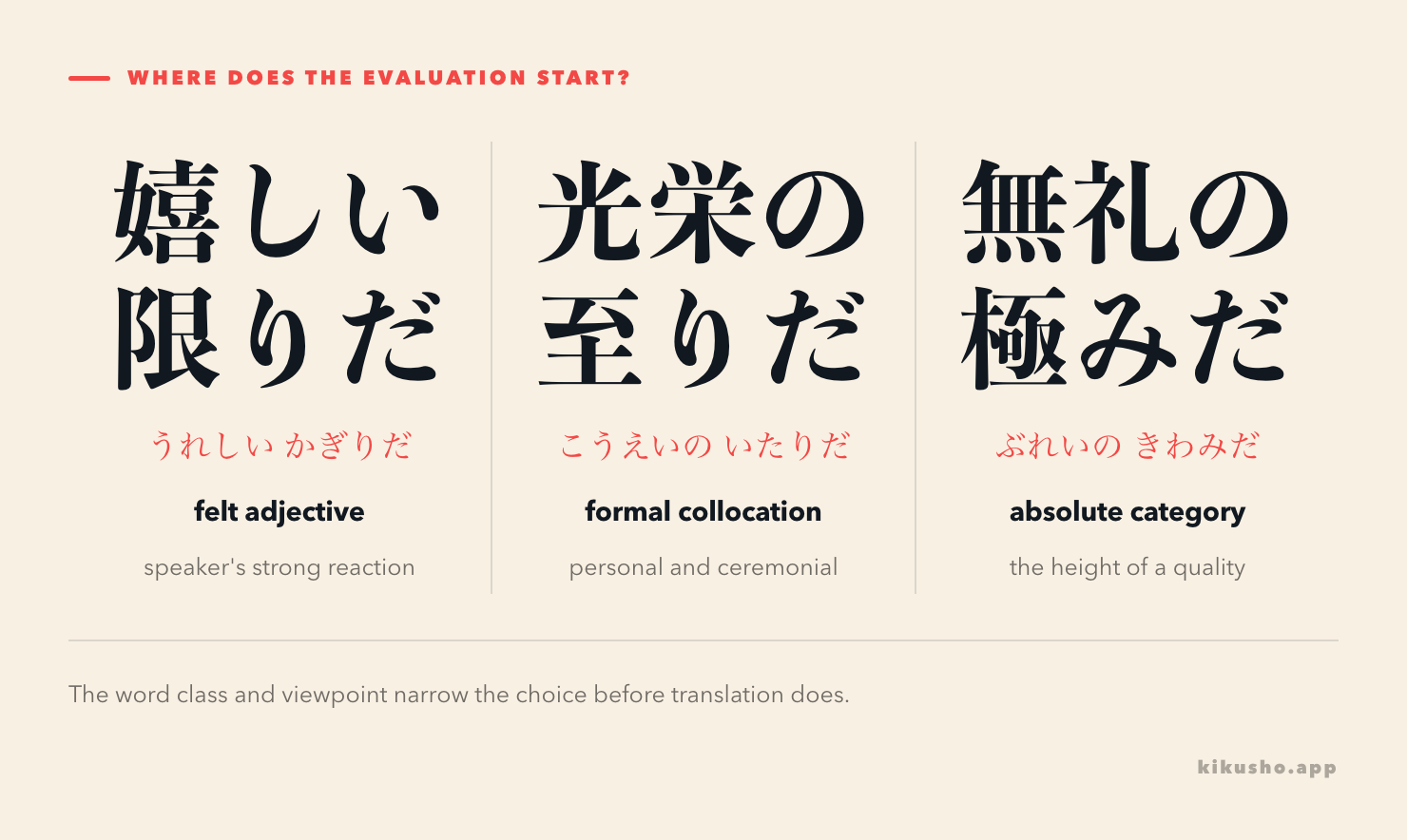
限りだ gives the speaker's adjective its highest intensity
The productive forms in this evaluation pattern are:
| Base | Attachment | Example |
|---|---|---|
| i-adjective | Aい + 限りだ | うれしい限りだ |
| na-adjective | Aな + 限りだ | 残念な限りだ |
| polite ending | A + 限りです | 心強い限りです |
長年の研究がようやく評価され、うれしい限りです。
ながねんの けんきゅうが ようやく ひょうかされ、うれしい かぎりです。
I am immensely happy that my years of research have finally been recognized.
同じ問題が何度も起きているのは、残念な限りだ。
おなじ もんだいが なんども おきているのは、ざんねんな かぎりだ。
It is extremely regrettable that the same problem keeps occurring.
Bunpro's 限りだ account gives i-adjective + 限りだ and na-adjective + な限りだ, and describes the judgment as intense but dependent on the speaker's perception. JLPT Sensei's N1 lesson likewise illustrates the form with feeling adjectives such as 嬉しい, 寂しい and 心細い.
That viewpoint limits what sounds natural. A measurable property such as 三メートル長い is better reported directly. 長い限りだ does not merely mean “extremely long.” The adjective in this pattern normally voices an evaluation or felt response: 頼もしい, 心強い, うらやましい, 残念だ.
Do not confuse this use with other constructions containing 限り. 生きている限り means “as long as one lives,” and 本日を限りに marks a final boundary. Neither is an intensified emotional adjective.
の至り belongs to a narrow formal vocabulary
The structure is N + の至り + だ/です/でございます. It is formal and strongly collocational. Common combinations include:
| Expression | Typical setting |
|---|---|
| 光栄の至り | ceremonial gratitude or honor |
| 感激の至り | deep emotion in a formal statement |
| 恐縮の至り | humble gratitude or apology |
| 赤面の至り | formal admission of embarrassment |
| 不徳の至り | accepting blame for one's failings |
| 若気の至り | looking back on youthful indiscretion |
多くの方に支えていただき、感激の至りです。
おおくの かたに ささえていただき、かんげきの いたりです。
I am deeply moved to have received support from so many people.
確認を怠り、ご迷惑をおかけしたことは、不徳の至りでございます。
かくにんを おこたり、ごめいわくを おかけしたことは、ふとくの いたりで ございます。
My failure to check, which caused you trouble, was entirely due to my own shortcomings.
Nihongo NET records noun-plus-の attachment, N1 placement and the markedly formal register. Bunpro notes that the noun is usually an emotion and gives the formal settings where phrases such as 光栄の至り and 赤面の至り occur.
The restriction is lexical as much as grammatical. うれしいの至り is malformed because an adjective has been placed before noun-linking の. Changing it to 喜びの至り fixes the word class but does not guarantee an established expression. In a formal speech, 感激の至り or 光栄の至り is the safer collocation. In a personal comment, うれしい限りです is direct and natural.
若気の至り deserves separate attention. It does not simply mean “extremely youthful.” It is a fixed retrospective label for a foolish act attributed to youth:
あの無謀な挑戦は、若気の至りだった。
あの むぼうな ちょうせんは、わかげの いたりだった。
That reckless attempt was an act of youthful indiscretion.
の極み turns a noun into an absolute category
The core frame is N + の極みだ. Because 極み is a noun, it also appears in frames such as の極みに達する, の極みにある and の極みを尽くす.
相手を公の場で侮辱するとは、無礼の極みだ。
あいてを おおやけの ばで ぶじょくするとは、ぶれいの きわみだ。
Insulting someone in public is the height of rudeness.
三日間ほとんど眠れず、隊員たちは疲労の極みに達していた。
みっかかん ほとんど ねむれず、たいいんたちは ひろうの きわみに たっしていた。
After barely sleeping for three days, the team members had reached utter exhaustion.
誰にも急かされず、雪を眺めながら朝食を取る。私には贅沢の極みだ。
だれにも せかされず、ゆきを ながめながら ちょうしょくを とる。わたしには ぜいたくの きわみだ。
Eating breakfast while watching the snow, with nobody rushing me, is the height of luxury for me.
Bunpro's の極み explanation treats the form as a formal noun-based label that works with positive and negative qualities. It also contrasts the slightly more personal の至り with the more categorical の極み. PassJapanese's direct comparison adds an important practical warning: both are hard, written expressions, and their preferred noun partners must be learned as collocations.
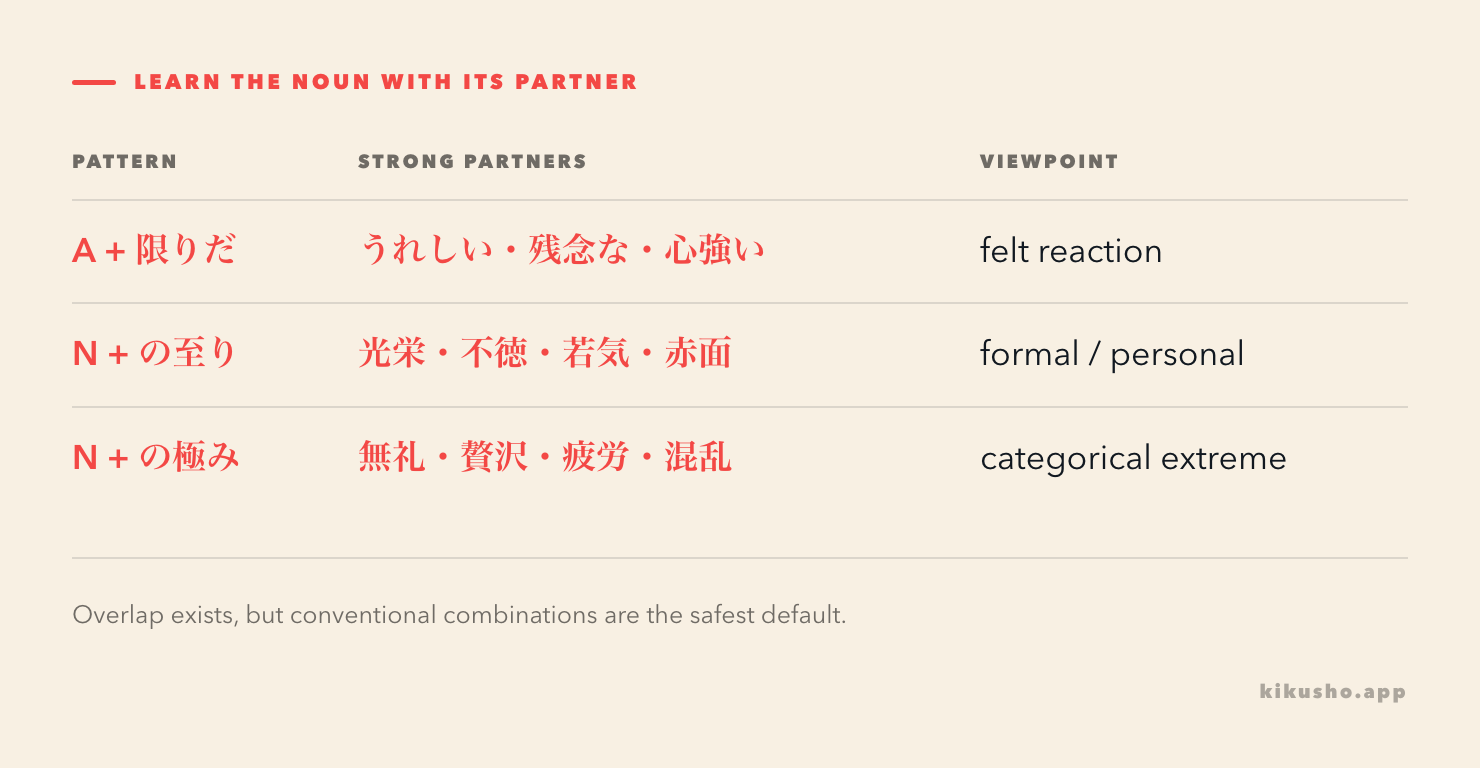
Overlap does not erase preference
感激の至り and 感激の極み are both attested. 光栄の至り is the conventional ceremonial choice, while some references and real examples also accept 光栄の極み. This is a preference, not a mathematical ban.
The sources themselves show the boundary. PassJapanese describes 光栄の極み as less natural beside the fixed 光栄の至り. Bunpro documents overlap and supplies 光栄の極み as an example. A careful learner should retain both facts: the construction is grammatical, but conventional phrasing still makes one version more expected in a formal greeting.
Use a three-part test:
- If you have a feeling adjective, attach 限りだ.
- If you have a conventional formal or humble noun phrase, prefer its established の至り collocation.
- If you are naming the epitome of a quality or state, use の極み.
This differs from ordinary degree marking. あまりにも豪華だ judges something as exceptionally or excessively lavish; 贅沢の極みだ names it as the very embodiment of luxury. The あまりにも and ほど lesson develops direct intensification and measurable degree.
Preserve the collocation when you review it
A card containing only 至り = utmost encourages substitutions Japanese does not make. Save 光栄の至り, 若気の至り or 不徳の至り as the unit, along with the formal scene where it appeared. For 限りだ, retain the adjective and its attachment. For の極み, keep the evaluated noun and the thing being classified.
Kikusho can turn the complete sentence you photographed, heard or pasted into an editable card. In this lesson, the useful review cue is not an English word such as “extremely.” It is the pair the sentence chose and the viewpoint that made that pair fit.
Practice: identify the source of the intensity
Question 1 — grammar choice. Complete the adjective pattern: 計画が中止になったのは、残念__。
① の至りだ
② な限りだ
③ の極みだ
④ に限りだ
Question 2 — grammar choice. A recipient says this in a formal award speech: このような賞をいただき、光栄__。
① 限りのです
② の至りです
③ に極みです
④ を限りです
Question 3 — text grammar. In 休日の朝、誰にも急かされずに庭でコーヒーを飲む。私には贅沢の極みだ, is the speaker primarily naming a felt adjective, using a ceremonial formula, or classifying an experience as the epitome of a quality?
Question 4 — repair the sentence. Rewrite 合格できて、うれしいの至りです in two natural ways: once while keeping the adjective, and once with a conventional formal noun.
Question 5 — grammar choice. Which sentence most naturally labels conduct as categorically extreme?
- ① その発言は無礼の極みだ。
- ② その発言は無礼な限りをした。
- ③ その発言は無礼の至りを話した。
- ④ その発言は無礼に極みです。
Question 6 — text grammar. Read the pair: 確認不足で事故を招いたのは、不徳の至りでございます。現場は混乱の極みにありました。 Why does the first evaluation choose 至り and the second 極み?
Question 7 — sentence composition. Use 疲労, 極み, and 達する to say that the rescue workers had reached utter exhaustion.
Answers and explanations
Walkthrough 1
② な限りだ. 残念 is a na-adjective, so the attributive な remains before 限り. The two noun-based expressions would require a suitable noun before の.
Walkthrough 2
② の至りです. 光栄の至り is an established ceremonial collocation for expressing profound honor. 光栄 is a noun here, not a na-adjective followed by な.
Walkthrough 3
The sentence classifies the unhurried breakfast as the epitome of luxury. 贅沢 supplies a quality noun, and の極みだ places the whole experience at that quality's absolute endpoint.
Walkthrough 4
With the adjective: 合格できて、うれしい限りです。 With a conventional formal noun: 合格できて、感激の至りです。 The repair changes both the attachment and, in the second version, the lexical choice.
Walkthrough 5
①. 無礼の極み labels the remark as the height of rudeness. The other choices break the attachment or invent a verb frame that these expressions do not take.
Walkthrough 6
不徳の至り is a conventional humble formula in which the speaker accepts blame for personal failings. 混乱の極み categorizes the scene as having reached the absolute extreme of confusion. The first is personal and formulaic; the second evaluates a state.
Walkthrough 7
救助隊員たちは疲労の極みに達していた。 疲労 is the state noun, の極み names its extreme, and に達する presents movement to that endpoint.
The English gloss “extremely” disappears from all three answers. Japanese instead asks what kind of word carries the evaluation, which combinations convention has preserved, and whether the sentence speaks from inside a feeling or labels the quality from outside it.
Common questions
What is the difference between 限りだ, の至り and の極み?
限りだ intensifies an adjective that expresses the speaker's reaction. の至り follows a restricted set of nouns in formal statements, greetings and apologies. の極み labels a feeling, state or quality as its absolute extreme.
Can an adjective go before の至り or の極み?
Not directly in these patterns. Both take noun + の. Use 嬉しい限りだ with an i-adjective, or replace it with a suitable noun phrase such as 感激の至り.
Are の至り and の極み interchangeable?
They overlap with some nouns, but collocation and viewpoint matter. の至り often sounds personal, humble and formulaic; の極み more readily gives a categorical evaluation such as 無礼の極み or 贅沢の極み.
Is 限りだ always about a maximum degree?
No. This lesson teaches the N1 adjective + 限りだ evaluation. Other constructions with 限り express duration, conditions, scope, restriction or a final boundary.