On this page
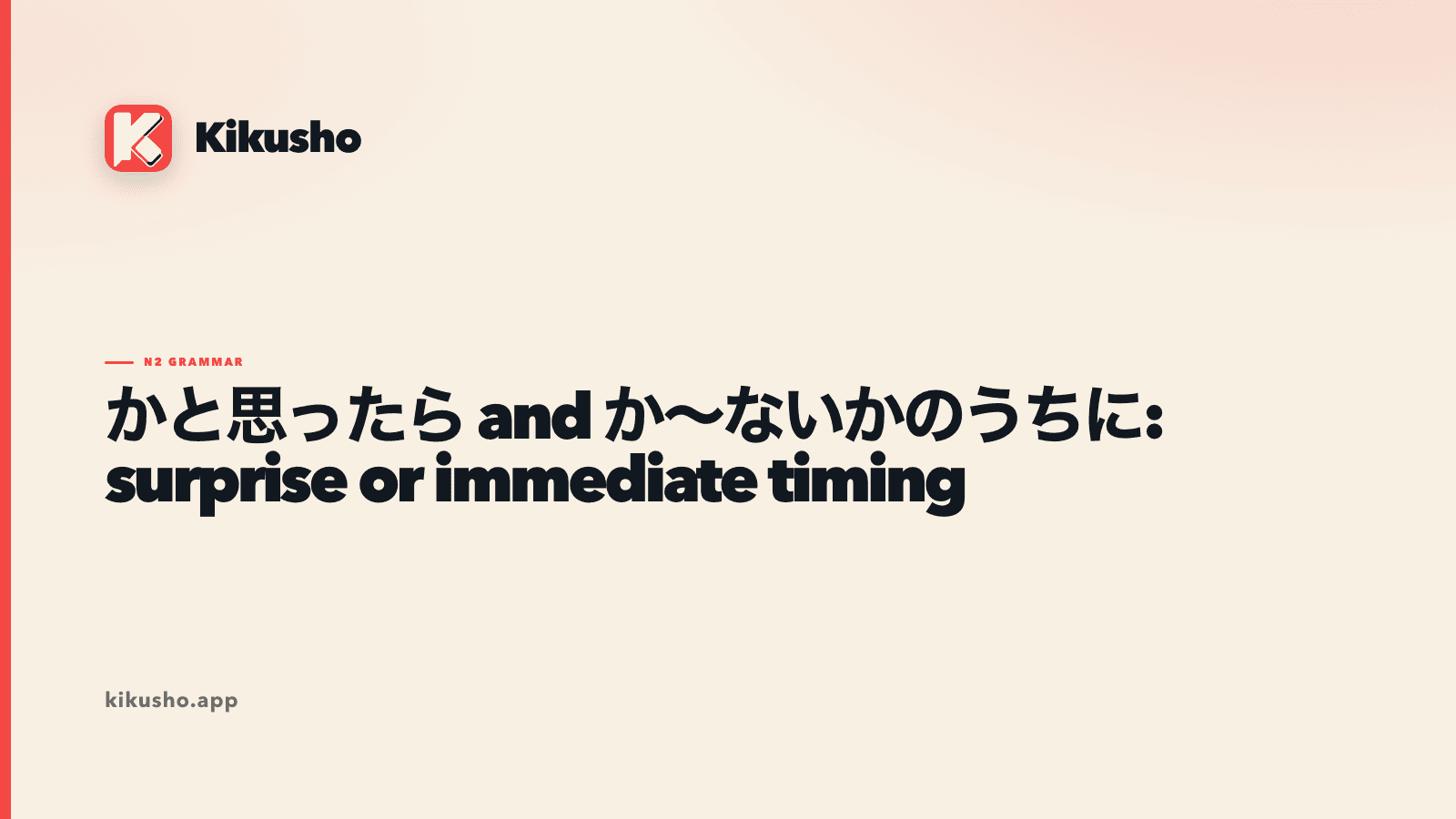
Aかと思ったらB says that B appeared just after A and usually carries surprise or contrast. VるかVないかのうちにB says that B happened at almost the same instant as A, before the observer could clearly tell whether A was complete.
空が明るくなったかと思ったら、急に雨が降り出した。
そらがあかるくなったかとおもったら、きゅうにあめがふりだした。
Just when the sky seemed to brighten, it suddenly started raining.
ベルが鳴るか鳴らないかのうちに、生徒たちは教室を飛び出した。
ベルがなるかならないかのうちに、せいとたちはきょうしつをとびだした。
The students rushed out of the classroom just as the bell began to ring.
English can translate both as “as soon as” or “no sooner than.” The useful distinction is what the speaker wants you to notice: an unexpected new scene with かと思ったら, or an almost invisible timing boundary with か~ないかのうちに.
かと思ったら turns an observation into a surprise
The dependable form is Vた + かと思ったら / かと思うと + B. Clause A is something the speaker has just observed. Clause B replaces that scene so quickly that A barely had time to settle in the speaker's mind.
赤ちゃんは泣き出したかと思ったら、もう笑っている。
あかちゃんはなきだしたかとおもったら、もうわらっている。
One moment the baby started crying, and the next they were already smiling.
田中さんは席に戻ったかと思うと、また立ち上がった。
たなかさんはせきにもどったかとおもうと、またたちあがった。
No sooner had Tanaka returned to his seat than he stood up again.
The clauses often contrast: bright then rainy, crying then smiling, sitting then standing. An exact opposite is not required, but B should feel new, sudden or contrary to what A led the observer to expect.
The variants かと思ったら and かと思うと share the core meaning. と思ったら and と思うと also occur without か and are slightly softer. In all four, the main clause normally reports an event or state rather than the speaker's deliberate request, plan or command.
私は家に着いたかと思ったら、すぐ買い物に出かけた。△
If both actions are the speaker's controlled choices, this sounds as if the speaker is watching themself from outside. Plain 家に着いてすぐ、買い物に出かけた is more natural: “I went shopping as soon as I got home.” Weather, automatic changes and another person's behavior fit かと思ったら much more easily.
Bunpro's N2 entry for かと思ったら and かと思うと likewise emphasizes suddenness and the speaker's perception, rather than a merely fast schedule.
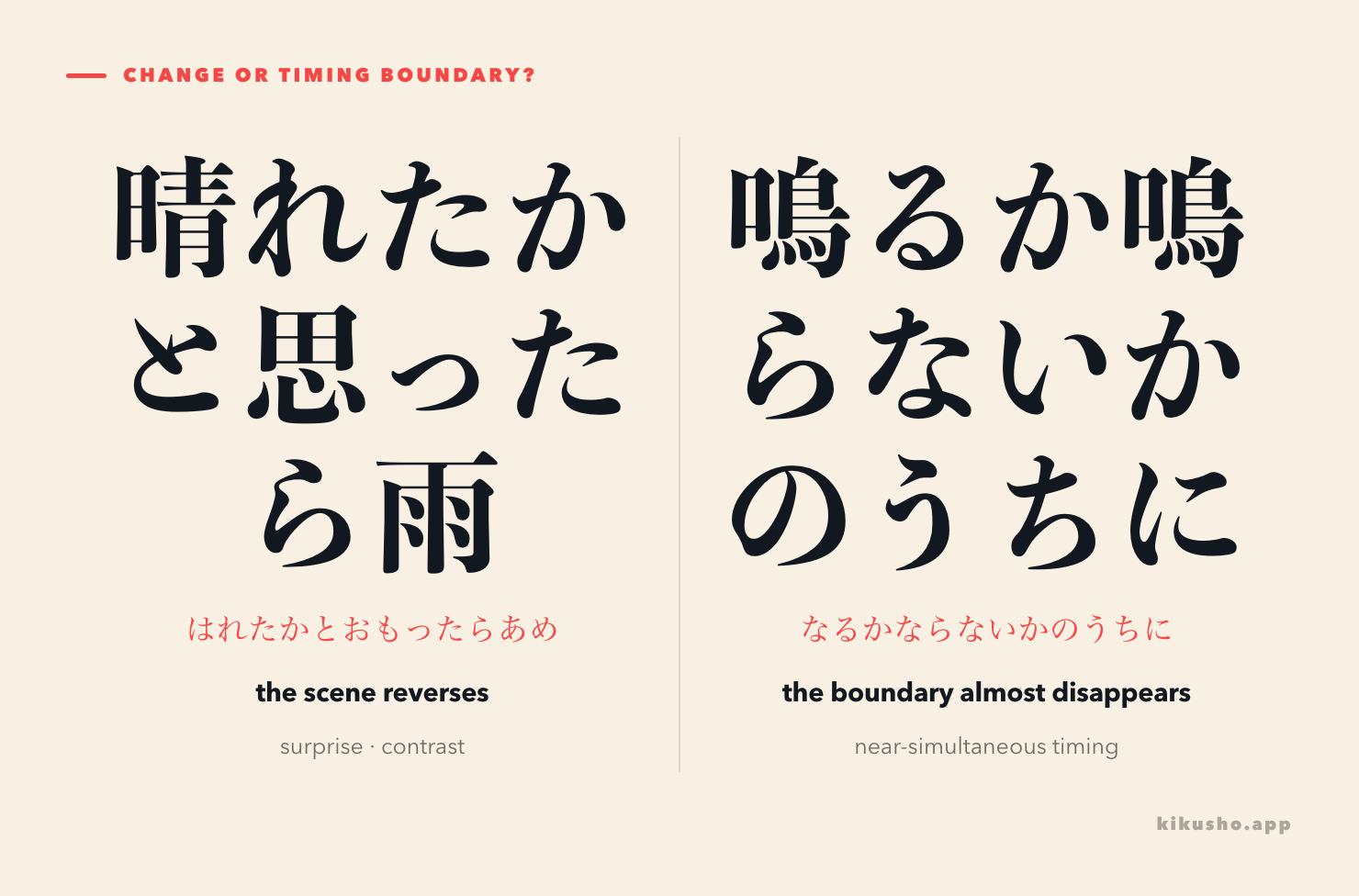
か~ないかのうちに makes the boundary uncertain
This pattern repeats one verb: Vる + か + Vない + かのうちに + B.
ドアが開くか開かないかのうちに、猫が外へ飛び出した。
ドアがあくかあかないかのうちに、ねこがそとへとびだした。
The cat darted outside just as the door began to open.
名前を呼ばれるか呼ばれないかのうちに、彼は返事をした。
なまえをよばれるかよばれないかのうちに、かれはへんじをした。
He answered almost before his name had been called.
The affirmative and negative forms do not present two real alternatives. Together they locate B at the boundary of A: had the door opened, or had it not quite opened yet? The events were too close to separate cleanly.
The verb before かのうちに may also appear in the past in descriptions such as 着いたか着かないかのうちに, but the dictionary-form pair is the safest productive model. Keep the same verb and change only its polarity: 鳴るか鳴らないか, 座るか座らないか, 終わるか終わらないか.
B usually reports an immediate, non-volitional event. A planned future action, request or command weakens the “the events were nearly simultaneous” observation:
駅に着くか着かないかのうちに、電話が鳴った。○
えきにつくかつかないかのうちに、でんわがなった。
My phone rang just as I was arriving at the station.
駅に着くか着かないかのうちに、電話してください。△
For “Please call as soon as you arrive,” use 駅に着いたら、すぐ電話してください. The N2 pattern sounds like a narrator reporting two events whose boundaries nearly coincide.
Japanese with Kanako's explanation of か~ないかのうちに gives the same repeated-verb structure and near-simultaneous reading. Nihongo no Sato's comparison of rapid-sequence expressions also separates this uncertain boundary from the surprise and contrast carried by かと思ったら.
Focus decides even when both patterns are possible
電車が止まったかと思ったら、また動き出した。
でんしゃがとまったかとおもったら、またうごきだした。
Just when the train seemed to have stopped, it started moving again.
The reversal is the point: stopped, then moving again. The observer sounds surprised.
電車が止まるか止まらないかのうちに、乗客が立ち上がった。
でんしゃがとまるかとまらないかのうちに、じょうきゃくがたちあがった。
Passengers stood up just as the train was coming to a stop.
Here the point is timing. The passengers stood before anyone could confidently mark the stop as complete.
| What you want to foreground | Form | Typical B |
|---|---|---|
| a surprising new or opposite scene | Vたかと思ったら | an observed change |
| two boundaries that almost coincide | VるかVないかのうちに | an immediate event |
| a fast but ordinary sequence | Vてすぐ | a planned action is possible |
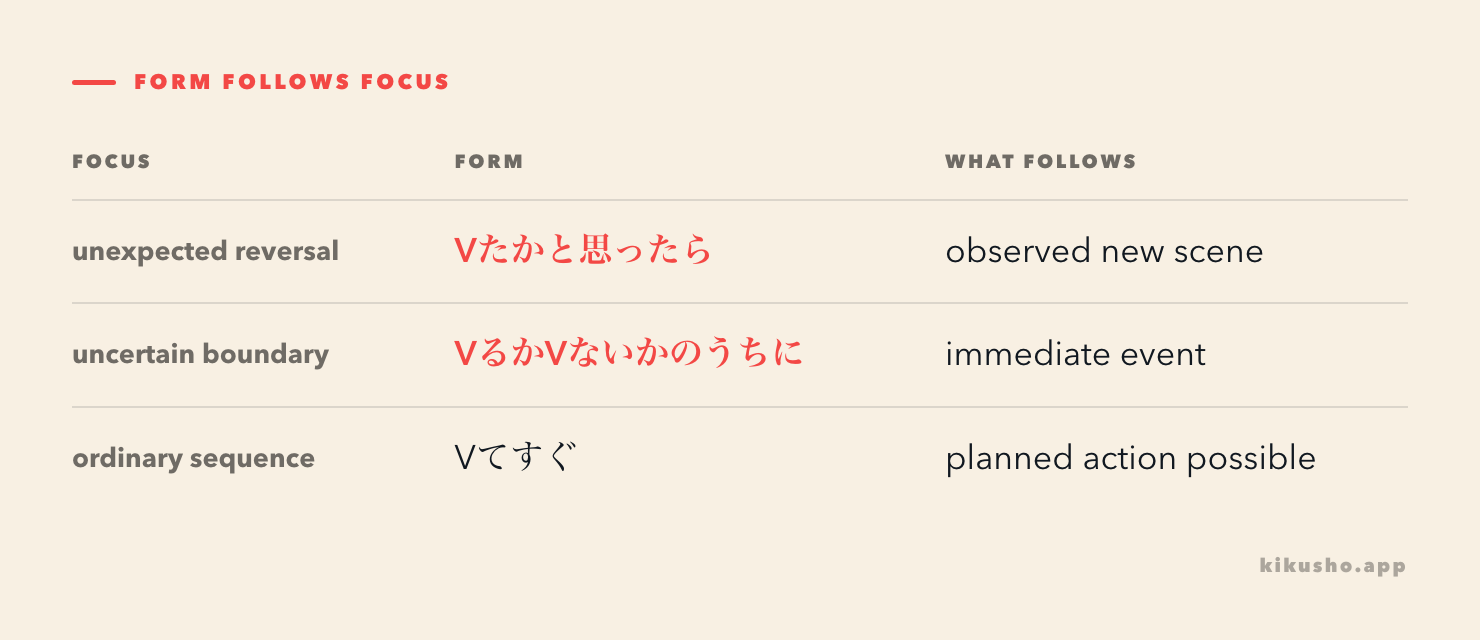
If nothing is surprising and the exact boundary does not matter, Vてすぐ is clearer. If B erupts at the instant A is completed, ~たとたん foregrounds that sudden trigger. Ordinary ~うちに instead marks a window of opportunity or a change that happens during a state; it does not repeat affirmative and negative forms.
Keep the sequence pattern separate from literal thought
と思ったら can also be an ordinary quotation followed by conditional たら. Context and the form before it reveal which reading is intended.
山田さんが来ると思ったら、来なかった。
やまださんがくるとおもったら、こなかった。
I thought Yamada would come, but he did not.
This reports the content of a thought: 来ると思った. It does not use the N2 rapid-sequence pattern.
山田さんが来たかと思ったら、すぐ帰ってしまった。
やまださんがきたかとおもったら、すぐかえってしまった。
No sooner had Yamada arrived than he left again.
Here Vたかと思ったら presents one observed event and the surprising scene that immediately followed it. The か and completed 来た make the sequence reading clear.
When you save either form in Kikusho, keep a complete two-clause example. For かと思ったら, tag the relationship as “observed A → surprising B.” For か~ないかのうちに, underline the repeated verb and tag it “A's boundary ≈ B.” This records the choice that an English gloss such as “as soon as” hides.
Practice: choose surprise or an uncertain boundary
Work through the six tasks first. The explanations stay hidden until you choose to reveal them.
Question 1 — surprising reversal. Which form best completes the sentence?
雨がやんだ__、また激しく降り出した。
- ア. かと思ったら
- イ. かやまないかのうちに
- ウ. うちに
- エ. 間に
Question 2 — repeat the same verb. Which phrase has the correct form?
チャイムが__、学生たちは立ち上がった。
- ア. 鳴ったと思ううちに
- イ. 鳴るか鳴らないかのうちに
- ウ. 鳴るか鳴ったかと思ったら
- エ. 鳴らないかの間に
Question 3 — speaker control. Which sentence is least natural with かと思ったら because both actions are the speaker's deliberate choices?
- ア. 空が晴れたかと思ったら、雪が降り始めた。
- イ. 子どもは眠ったかと思ったら、また起きてきた。
- ウ. 私は朝食を食べたかと思ったら、計画どおり図書館へ行った。
- エ. 電車は止まったかと思ったら、また動き出した。
Question 4 — nearly simultaneous timing. Choose the best completion.
ドアが開く__、犬が庭へ飛び出した。
- ア. と思ったので
- イ. か開かないかのうちに
- ウ. 以上は
- エ. からには
Question 5 — sentence composition. Arrange these chunks into “He answered almost before his name was called.” Use each once.
- 名前を呼ばれるか
- 呼ばれないかのうちに
- 彼は
- 返事をした
Question 6 — connected text. Choose the pair that best fits both blanks.
弟は部屋に入った( )、すぐ出てきた。ドアが閉まる( )、今度は電話が鳴った。
- ア. かと思ったら/か閉まらないかのうちに
- イ. うちに/かと思ったら
- ウ. か入らないかのうちに/以上は
- エ. と思ったので/間に
Reveal the panel only after you have committed to an answer for each item.
Answers and explanations
Answer 1. ア, かと思ったら. The rain appears to have stopped, then the scene reverses and it starts heavily again. The quick contrast and the observer's surprise matter more than an uncertain boundary.
Answer 2. イ, 鳴るか鳴らないかのうちに. The construction repeats one verb in dictionary and negative forms. The students stand so quickly that the bell's beginning and their movement are almost simultaneous.
Answer 3. ウ. Eating breakfast and going to the library according to plan are the speaker's controlled sequence. 朝食を食べてすぐ、計画どおり図書館へ行った is natural. The other sentences describe observed, surprising changes.
Answer 4. イ, か開かないかのうちに. The dog moves at the door's opening boundary, before the observer can clearly say it is fully open.
Answer 5. 名前を呼ばれるか呼ばれないかのうちに、彼は返事をした. The repeated passive verb marks the uncertain boundary; his answer follows almost simultaneously.
Answer 6. ア, かと思ったら/か閉まらないかのうちに. The brother's immediate reappearance is a surprising new scene. The phone then rings at almost the same instant that the door closes, so the repeated-verb timing pattern fits the second blank.
Level and review note
Both assigned items carry N2 in the frozen inventory, based on JLPT Sensei. Bunpro's current pages use the same N2 label for かと思ったら / かと思うと and か~ないかのうちに, so no provider conflict is recorded for this pair.
Treat the N2 placement as a study guide, not as a claim about an official item list. The JLPT FAQ explains that detailed vocabulary, kanji and grammar lists are not published. The dependable reading test is therefore the sentence's focus: a sudden observed change, or two events whose timing boundaries almost merge.
This version was checked by OpenAI Codex as an AI reviewer. The check covered both constructions, every Japanese example and translation, and the reasoning for each exercise answer; it did not include human proofreading.
Common questions
What is the difference between かと思ったら and か~ないかのうちに?
かと思ったら presents B as a sudden, often surprising change observed just after A. か~ないかのうちに focuses on timing: B happens so close to A that it is hard to tell whether A has fully happened yet.
How do I form か~ないかのうちに?
Repeat the same verb in affirmative dictionary form and negative form: VるかVないかのうちに. For example, ベルが鳴るか鳴らないかのうちに means just as the bell began to ring.
Can I use かと思ったら for my own deliberate action?
Usually not when both clauses describe the speaker's controlled actions. The pattern presents an observed event or state and a surprising new scene, so it is most natural for weather, changes and other people's behavior.
Is かと思ったら the same as quoted と思ったら?
No. 来ると思ったら、来なかった can literally mean I thought they would come, but they did not. The N2 sequence pattern normally has a completed event before it: 来たかと思ったら、すぐ帰った.