On this page
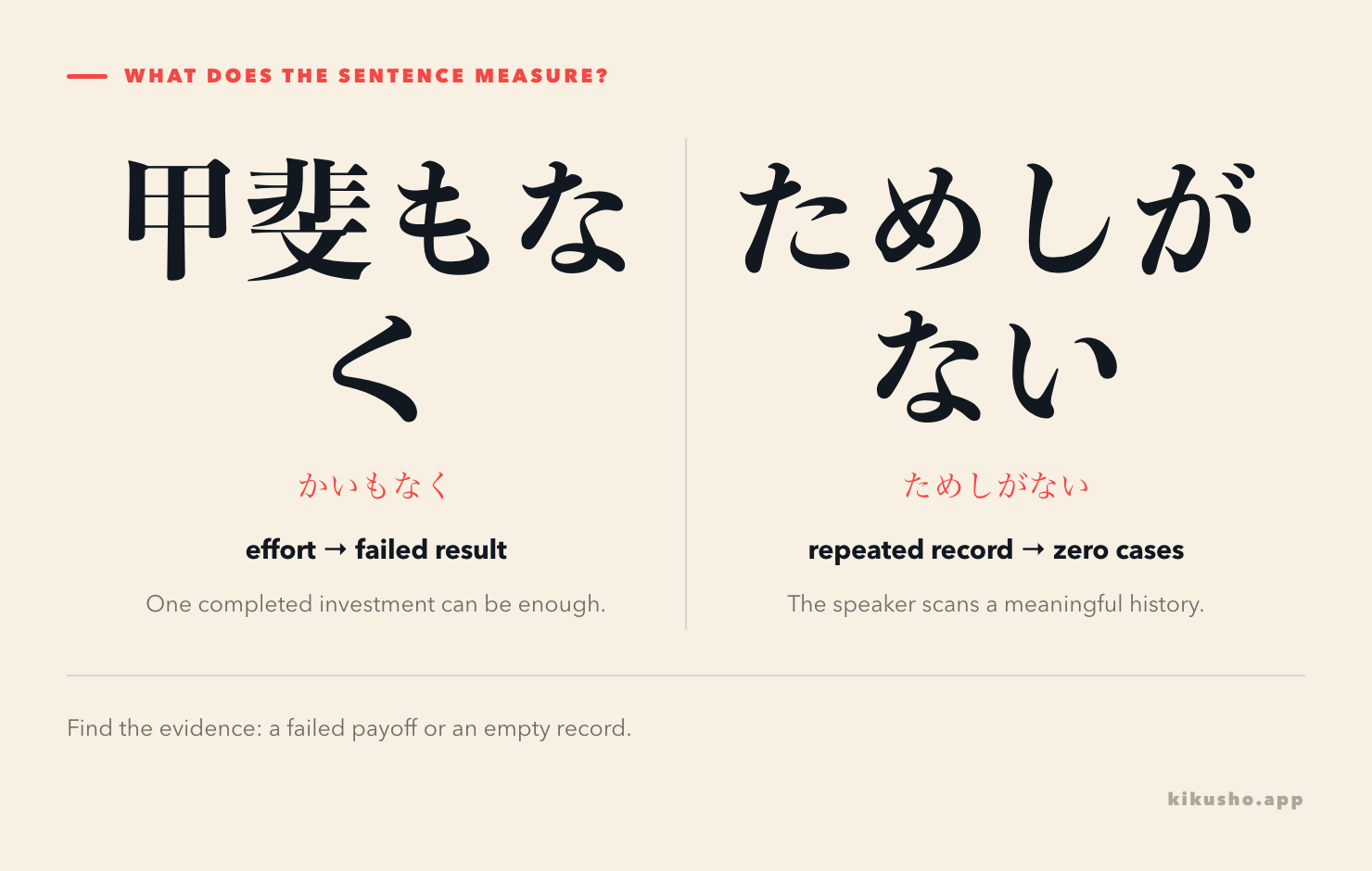
甲斐もなく(かいもなく) says that a particular effort failed to produce the hoped-for result. ためしがない looks across a history of occasions and says that the expected event has not happened even once.
何度も説明した甲斐もなく、彼はまた同じ間違いをした。
なんどもせつめいしたかいもなく、かれはまたおなじまちがいをした。
Despite explaining it many times, he made the same mistake again.
彼は説明を最後まで聞いたためしがない。
かれはせつめいをさいごまできいたためしがない。
He has never once listened to an explanation all the way through.
Both sentences are negative, but they organize the evidence differently. The first evaluates the return on the speaker's effort. The second gives the listener a summary of the other person's record.
One failed result or a record with no success
Use this decision test before translating:
| What the sentence measures | Dependable form | Minimum context needed |
|---|---|---|
| effort A failed to produce result B | Vた + 甲斐もなく / Nの甲斐もなく | one completed effort and its result |
| the relevant history contains zero cases of V | Vた + ためしがない | repeated opportunities or a meaningful time span |
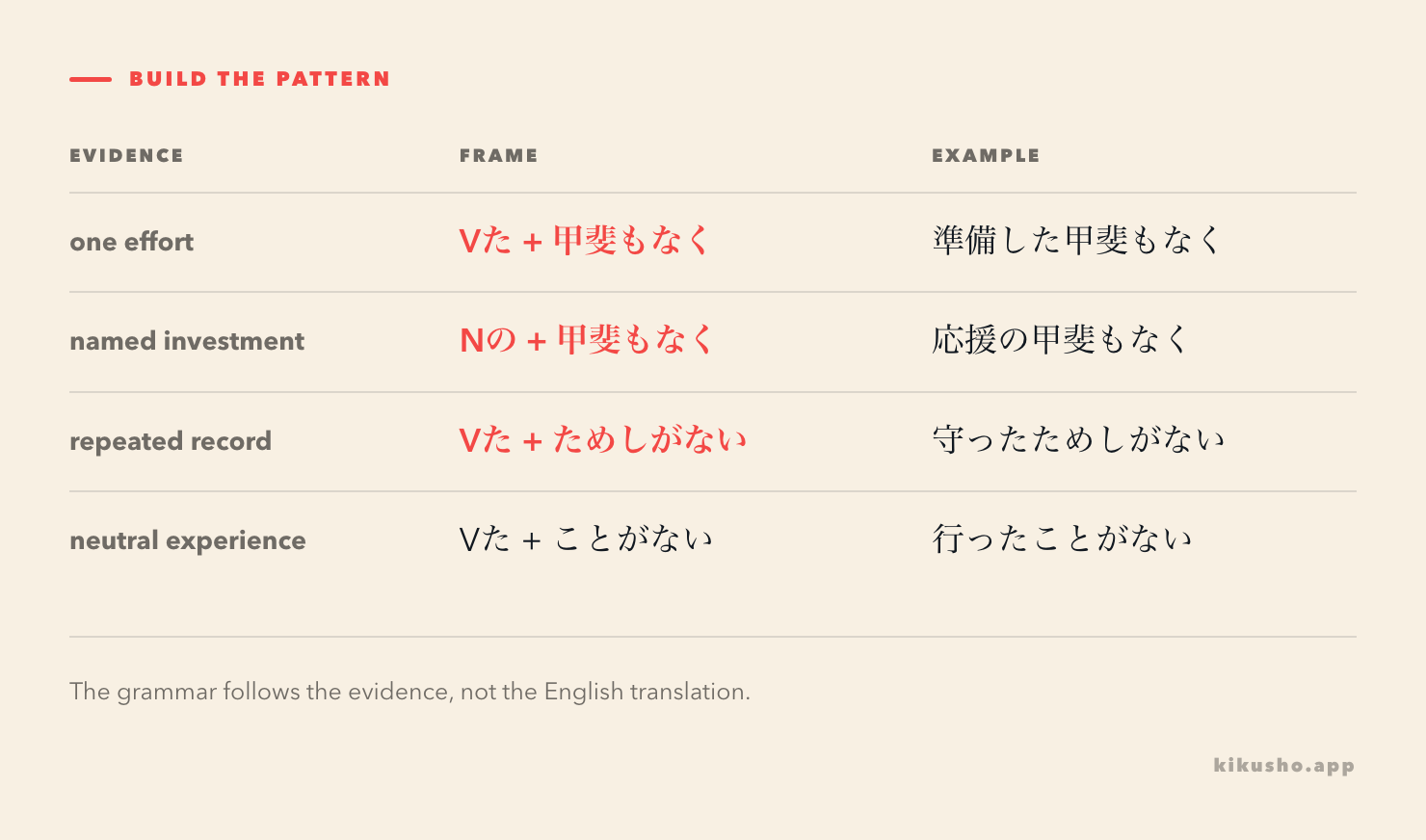
| a past experience simply has not occurred | Vた + ことがない | no disappointment or repeated expectation required |
甲斐もなく answers “Did that investment pay off?” ためしがない answers “Has this ever happened in the record we are considering?” A single event can satisfy the first question. The second normally invites a series: every meeting, every deadline, every attempt, or everything observed until now.
甲斐もなく connects investment and disappointment
甲斐(かい) is the value, effect or reward obtained from doing something. The positive 甲斐がある says that an effort proved worthwhile. Replacing that positive judgment with 甲斐もなく creates a connective form: despite the effort, the desired result did not follow.
徹夜で資料を直した甲斐もなく、企画は採用されなかった。
てつやでしりょうをなおしたかいもなく、きかくはさいようされなかった。
Despite staying up all night to revise the materials, the proposal was not accepted.
The sentence contains two jobs. 徹夜で資料を直した names the investment; 企画は採用されなかった names the disappointing result. Without that result, the listener cannot tell why the effort lacked value.
The most useful attachments are:
- Vた + 甲斐もなく: 待った甲斐もなく, despite waiting
- Nの + 甲斐もなく: 応援の甲斐もなく, despite the support
長時間の捜索の甲斐もなく、手がかりは見つからなかった。
ちょうじかんのそうさくのかいもなく、てがかりはみつからなかった。
Despite the long search, no clue was found.
The noun should name something that can plausibly yield a return, such as 努力, 練習, 治療, 応援 or 捜索. This is why 甲斐もなく often appears in serious reports and narratives: it compresses substantial effort and an unfortunate outcome into one link.
JLPT Sensei's 甲斐もなく lesson documents the past-verb and noun-plus-の frames and consistently pairs them with an unsuccessful result. The wider 甲斐 family is covered in 甲斐がある and せっかく, including the positive payoff form and verb-stem compounds such as やりがい.
甲斐がない can end a sentence
甲斐もなく normally joins the effort to what happened next. When the judgment finishes the sentence, 甲斐がない or past 甲斐がなかった is the more direct shape.
結局だれも読まないなら、詳しく書いた甲斐がない。
けっきょくだれもよまないなら、くわしくかいたかいがない。
If nobody reads it in the end, there is no point in having written it in detail.
予選で負けてしまい、半年練習した甲斐がなかった。
よせんでまけてしまい、はんとしれんしゅうしたかいがなかった。
We lost in the preliminary round, so six months of practice did not pay off.
This is mainly a sentence-shape difference. 練習した甲斐もなく、負けた leads from the effort into the outcome. 負けて、練習した甲斐がなかった first reports the outcome and then ends with the evaluation.
ためしがない reviews a history
In this pattern, ためし means an instance or precedent. The standard frame is Vた + ためしがない. The verb is in the past form because the speaker looks back for completed instances and finds none.
あの店は、予約なしで入れたためしがない。
あのみせは、よやくなしではいれたためしがない。
I have never once been able to get into that restaurant without a reservation.
この機械は、必要なときに正常に動いたためしがない。
このきかいは、ひつようなときにせいじょうにうごいたためしがない。
This machine has never once worked properly when it was needed.
Words such as 一度も, 今まで, いつも and 毎回 often make the record visible. They are helpful but not required when the surrounding situation already supplies repeated occasions.
The form often carries criticism, frustration or surprise. Saying 彼は時間どおりに来たためしがない does more than enter “zero punctual arrivals” in a neutral log. It suggests that punctuality was expected repeatedly and the pattern has become remarkable. 日本語NET's N1 explanation defines it through the absence of a precedent and notes this emotional coloring. JLPT Sensei gives the same Vた attachment with examples built around recurring behavior.
ためしがない is stronger than neutral ことがない
Both patterns may become “have never” in English, but the speaker's stance differs.
北海道へ行ったことがない。
ほっかいどうへいったことがない。
I have never been to Hokkaido.
This is a neutral fact about experience. There need not have been several failed trips or any expectation that the speaker should have gone.
彼は旅行の計画を最後まで立てたためしがない。
かれはりょこうのけいかくをさいごまでたてたためしがない。
He has never once finished making a travel plan.
Here, there have been relevant opportunities, and the missing result is worth criticizing or noticing. Replacing ためしがない with ことがない would retain a broad “has never” meaning but weaken the sense of an established record.
Do not turn “I have never done X” into ためしがない automatically. Use ことがない for ordinary life experience. Choose ためしがない when you can point to repeated cases, a continuing record, or an outcome whose total absence surprises the speaker.
Both forms can describe the same bad pattern
One situation may contain both a failed intervention and a longer history:
何度も注意した甲斐もなく、彼は締め切りを守ったためしがない。
なんどもちゅういしたかいもなく、かれはしめきりをまもったためしがない。
Despite warning him many times, he has never once met a deadline.
The first half evaluates the warnings: they did not produce the desired change. The second half scans his deadline history and reports zero successes. The repeated phrase 何度も does not by itself turn the first half into ためしがない; grammatical choice still depends on what is being measured.
Compare a single event:
一週間準備した甲斐もなく、今日の面接に落ちた。
いっしゅうかんじゅんびしたかいもなく、きょうのめんせつにおちた。
Despite preparing for a week, I failed today's interview.
Only one interview result is required, so 甲斐もなく is complete. 面接に受かったためしがない would make a larger claim: across multiple interviews or the speaker's relevant history, there has never been a successful one.
Save the evidence each expression needs
In Kikusho, store 甲斐もなく with both its investment and its result. A card containing only 練習した甲斐もなく tests attachment but hides the reason the effort was judged fruitless. Mark two spans: “what was invested” and “what disappointed.”
For ためしがない, save a cue that establishes the record: 毎回, 今まで, a duration, or an obviously recurring subject. A compact contrast card works well:
- 一度の努力 → 悪い結果: 準備した甲斐もなく、中止になった。
- 繰り返しの記録 → 成功ゼロ: 予定どおり始まったためしがない。
This preserves the decision the JLPT tests instead of reducing both forms to the English word “never.”
Practice: identify the evidence being measured
Complete all seven tasks before opening the answer panel.
Question 1 — grammar choice. A team trained for one tournament but lost in the first round. Choose the best form.
毎日練習した__、一回戦で負けてしまった。
- ア. ためしがなく
- イ. 甲斐もなく
- ウ. ことがなく
- エ. 甲斐があって
Question 2 — repeated record. The speaker complains that Ken has been late for every meeting. Complete the sentence.
健は会議に時間どおりに来た__。
- ア. 甲斐もなく
- イ. ためしがない
- ウ. せっかくではない
- エ. 末ではない
Question 3 — sentence composition. Arrange the chunks into “Despite preparing all night, I could not answer the client's question.” Use each once.
- 答えられなかった
- 徹夜で準備した甲斐もなく
- 顧客の質問に
Question 4 — find the investment and result. In the sentence below, which phrase names the disappointing result?
家族全員で説得した甲斐もなく、祖父は病院へ行こうとしなかった。
- ア. 家族全員で
- イ. 説得した
- ウ. 甲斐もなく
- エ. 祖父は病院へ行こうとしなかった
Question 5 — natural record. Which sentence most naturally establishes repeated occasions for ためしがない?
- ア. 昨日初めて使った機械が、一度だけ止まったためしがない。
- イ. この路線の朝の電車は、時間どおりに着いたためしがない。
- ウ. 来週の試験に合格したためしがない。
- エ. 一回準備したためしがなく、中止になった。
Question 6 — neutral experience. You simply want to say “I have never eaten natto,” with no complaint or repeated failed expectation. Choose the best sentence.
- ア. 納豆を食べたことがない。
- イ. 納豆を食べた甲斐もない。
- ウ. 納豆を食べたためしがない。
- エ. 納豆を食べた末がない。
Question 7 — connected text. Choose the pair that first evaluates an attempted fix and then summarizes the machine's history.
部品を全部交換した__、また故障した。この機械は必要なときに正常に動いた__。
- ア. ためしがなく/甲斐もない
- イ. 甲斐もなく/ためしがない
- ウ. ことがなく/甲斐がある
- エ. 甲斐があって/ことがない
Answers and explanations
Answer 1. イ, 甲斐もなく. The daily practice is an investment and losing the tournament is its disappointing result. One tournament is enough for this judgment.
Answer 2. イ, ためしがない. Each meeting is another opportunity to arrive on time, and the speaker says the record contains no successful instance.
Answer 3. 徹夜で準備した甲斐もなく、顧客の質問に答えられなかった. The first chunk names the effort, and the final two chunks state the result that made it fruitless.
Answer 4. エ. The family's persuasion is the investment. Grandfather's refusal to go to the hospital is the outcome that defeats its purpose.
Answer 5. イ. Morning trains on a route create a clear series of occasions. The sentence reports that on-time arrival has never appeared in that record.
Answer 6. ア, 納豆を食べたことがない. ことがない neutrally reports life experience. The prompt supplies no recurring expectation or frustration that would motivate ためしがない.
Answer 7. イ, 甲斐もなく/ためしがない. Replacing all the parts is the attempted fix whose payoff failed. The second sentence reviews every time the machine was needed and finds no case of normal operation.
Common questions
What does 甲斐もなく mean in Japanese?
甲斐もなく means that an effort, wait or sacrifice failed to produce the hoped-for result. It commonly follows a past verb or a noun plus の.
What does ためしがない mean in Japanese?
Vた + ためしがない means that, across the relevant history, there has not been a single instance of V happening. It often conveys criticism, frustration or surprise.
What is the difference between 甲斐もなく and ためしがない?
甲斐もなく connects an invested effort to a disappointing result, even on one occasion. ためしがない looks across repeated occasions and says the record contains no instance of the event.
What is the difference between ためしがない and ことがない?
ことがない can neutrally report a lack of experience. ためしがない treats the event as an expected or noteworthy case that has never occurred and often adds dissatisfaction or surprise.