On this page
You can react after telling the whole event: 再会できて、どんなにうれしかったことか means “How happy I was that we could meet again.” Or you can announce the reaction first: うれしいことに、十年ぶりに再会できた means “Happily, we were able to meet again after ten years.”
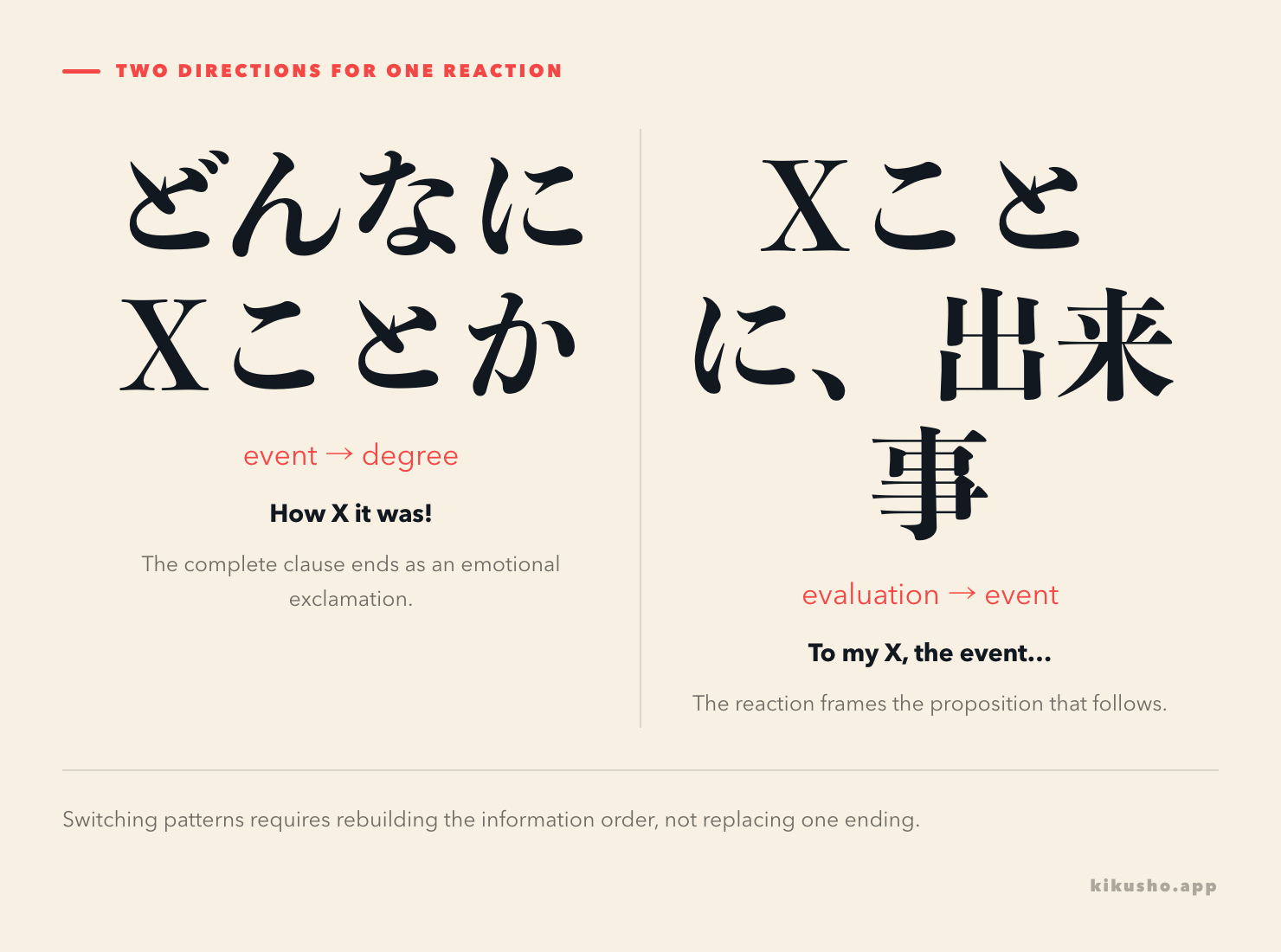
Both patterns add the speaker's response. ことか makes the complete clause an exclamation; ことに makes the reaction an introductory lens through which the following event is reported.
The direction of the sentence decides
Read from the reaction toward the event:
| Pattern | Order of information | Natural English shape |
|---|---|---|
| …どんなに X ことか | event and degree → emotional exclamation | How X it was! |
| X ことに、event | evaluation → event that caused it | To my X, event… |
The same good news can travel in either direction:
第一希望の会社に決まって、どんなに安心したことか。
だいいちきぼうのかいしゃにきまって、どんなにあんしんしたことか。
How relieved I was when I got the position at my first-choice company!
ありがたいことに、第一希望の会社に採用された。
ありがたいことに、だいいちきぼうのかいしゃにさいようされた。
Thankfully, I was hired by my first-choice company.
The first sentence dwells on the degree of relief. The second labels the outcome as welcome, then supplies the news.
ことか closes an emotional exclamation
In this use, ことか usually works with an interrogative degree or quantity expression:
- どんなに/どれほど: how greatly
- なんと/なんて: how; what a
- 何度/何回: how many times
- どれだけ: how much
留学したばかりの頃、どんなに心細かったことか。
りゅうがくしたばかりのころ、どんなにこころぼそかったことか。
How lonely and uncertain I felt when I had just begun studying abroad!
この日を何年待ったことか。
このひをなんねんまったことか。
How many years I waited for this day!
The final か does not request a number or answer. It leaves the degree rhetorically open because an ordinary value would not convey the speaker's feeling. The Japan Foundation's account of sentence-final こと groups ことか with expressions of surprise, admiration or sympathy.
Japanese NET's N2 explanation records ことか, ことだろう and ことでしょう as related emotional endings. It notes a tendency for ことか in writing and ことだろう/ことでしょう in speech. Treat that as a register tendency, not a ban: literary or reflective speech can still use ことか, and written prose can quote ことだろう.
Build the clause before ことか
The reaction belongs to a complete plain-form predicate:
| Predicate | Form before ことか | Example |
|---|---|---|
| verb | plain form | 何度練習したことか |
| い-adjective | plain form | どんなにうれしいことか |
| な-adjective | な | なんと静かなことか |
| noun | である in a full proposition | どれほど重要な機会であることか |
Past forms are frequent because the speaker reflects on an experienced event: どんなに苦しかったことか. The grammar is not restricted to the past, however. この支援がどれほど重要なことか can emphasize the current importance of support.
Do not confuse the ending with listing とか. 映画とか音楽 gives examples such as films and music. Exclamatory ことか contains the formal noun こと plus final か, and the preceding clause carries an emotional degree.
ことに places the evaluation first
The reaction pattern has two parts:
evaluation + ことに、event
驚いたことに、駅で十年ぶりに友人に会った。
おどろいたことに、えきでじゅうねんぶりにゆうじんにあった。
To my surprise, I met a friend at the station for the first time in ten years.
残念なことに、台風で明日の公演は中止になった。
ざんねんなことに、たいふうであしたのこうえんはちゅうしになった。
Regrettably, tomorrow's performance was cancelled because of the typhoon.
The phrase before the comma tells the reader how the speaker evaluates the proposition after it. This makes ことに useful in explanations and written narratives: the stance is visible before the facts arrive.
Japanese NET's ことに lesson stresses that the words used in this frame are limited and that the following clause normally reports a real or completed situation. It is not a free machine for turning any adjective into a sentence adverb.
Common forms include:
| Type | Form | Example |
|---|---|---|
| past reaction verb | Vた + ことに | 驚いたことに |
| い-adjective | い-adjective + ことに | うれしいことに |
| な-adjective | な-adjective + な + ことに | 残念なことに |
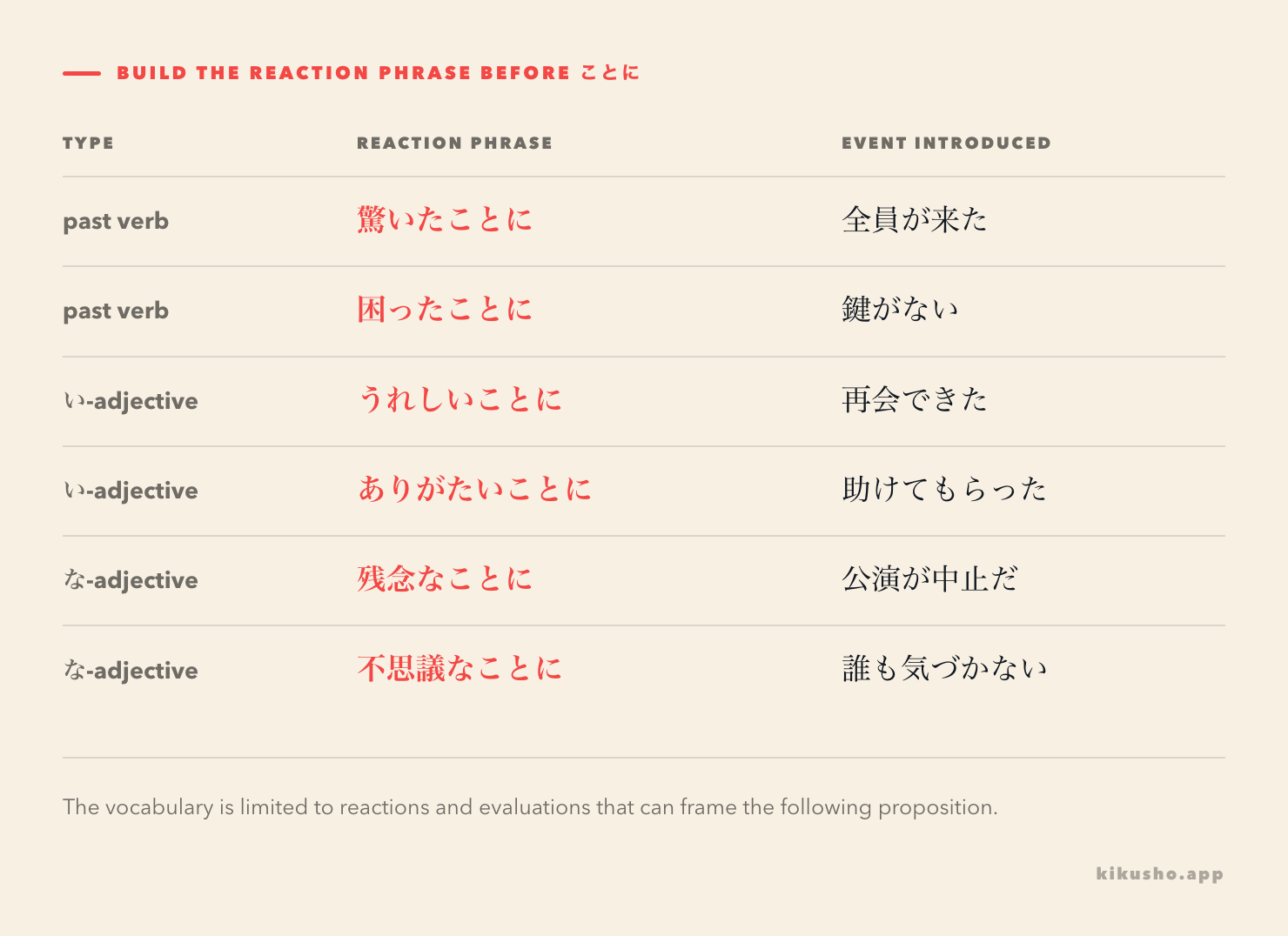
Useful combinations include 驚いたことに, 困ったことに, うれしいことに, ありがたいことに, 悲しいことに, 残念なことに and 不思議なことに. The Japan Foundation gives 驚いたことに as the sentence-initial counterpart of an emotional ことだ/ことか ending.
Not every ことに expresses a reaction
The boundary appears in the word after に:
日本語で電話することに慣れた。
にほんごででんわすることになれた。
I got used to speaking on the phone in Japanese.
Here 電話すること is a nominalized activity, and に marks the target of 慣れる. There is no sentence-initial evaluation. The lesson on に慣れる develops that structure.
Likewise, 行くことにした means “decided to go.” The に belongs to ことにする, not to the reaction frame. Reaction ことに is recognizable because the material before it is an evaluation and the following clause states what prompted that response.
What changes when you switch them
Compare a result no one expected:
彼が合格したと聞いて、どんなに驚いたことか。
How surprised I was to hear that he passed!
驚いたことに、彼は合格していた。
To my surprise, he had passed.
The first sentence centers the magnitude of the feeling. It can sound reflective, as though the speaker is reliving the reaction. The second centers the fact while marking the speaker's stance toward it.
You therefore cannot swap only the endings. どんなに驚いたことに leaves the reaction phrase malformed for this meaning, while 驚いたことか、彼は合格した does not produce the ordinary introductory evaluation. Rebuild the information order.
This differs from a tentative reaction such as ような気がする, which reports an uncertain impression. The impression lesson is about confidence in a perception; ことか and ことに assume the reaction itself and organize how it is expressed.
Kikusho's September 2026 inventory and JLPT Sensei place both target forms at N2. Bunpro currently places both at N3. Japanese NET teaches both at N2, while other series vary. These labels guide study order because the JLPT does not publish an exhaustive grammar list.
When saving either pattern in Kikusho, retain both the reaction and its cause. A card with only 驚いたことに = surprisingly cannot test what comes next; a card with only どんなに〜ことか = how…! cannot recover the predicate that carries the emotional degree.
Practice: choose the direction of the reaction
Answer all six questions before opening the shared explanation block.
Question 1
You are reflecting on the extreme relief you felt after finding a lost passport. Choose the ending.
パスポートが見つかった時、どんなに安心した( )。
A. ことか
B. ことに
C. ことから
D. ことになる
Question 2
Which line first marks surprise and then reports that every participant arrived early?
A. 驚いたことか、参加者は全員早く着いた。
B. 驚いたことに、参加者は全員早く着いた。
C. どんなに驚いたことに、参加者は全員早く着いた。
D. 参加者は驚いたことに慣れた。
Question 3
Supply the correct form of 残念 before ことに.
( )、雨で試合は中止になった。
Question 4
Is 日本語で話すことに慣れた an example of reaction ことに? Explain the role of に.
Question 5
Compose an exclamation meaning “How many times I read this letter!” Use この手紙, 何度, 読む, and ことか.
Question 6
Complete both blanks and identify the shift in focus.
十年ぶりに友人から連絡が来て、どんなにうれしかった( ① )。さらに、( ② )、友人は来月日本へ戻る予定だという。
A. ①ことか/②ありがたいことに
B. ①ことに/②ありがたいことか
C. ①ことから/②ありがたいことを
D. ①ことだ/②ありがたいことが
Check whether the first sentence measures the feeling and whether the second labels the news before reporting it.
Answers and explanations
Each explanation follows the direction in which the sentence reveals feeling and event.
Answer 1. A, ことか. どんなに安心したことか is a rhetorical exclamation about the degree of relief. ことに would need a reaction phrase before a following event, such as 安心したことに only in a different, much less natural setup.
Answer 2. B. 驚いたことに introduces the proposition that all participants arrived early. A incorrectly uses the clause-final exclamatory ending as an introductory phrase; C mixes the two frames; D uses nominalized こと as the target of 慣れた.
Answer 3. 残念なことに. A な-adjective keeps な before こと: 残念なことに、雨で試合は中止になった. The phrase evaluates the cancellation before reporting it.
Answer 4. No. 日本語で話すこと nominalizes the activity “speaking in Japanese,” and に marks that activity as the target of 慣れた. There is no evaluative word before こと and no following event introduced by a reaction.
Answer 5. この手紙を何度読んだことか。 The past verb completes the clause, 何度 supplies the rhetorically unbounded count, and ことか closes the emotional reflection.
Answer 6. A. どんなにうれしかったことか exclaims over the degree of happiness. ありがたいことに then evaluates the next proposition before reporting the friend's plan to return. The passage moves from reliving a feeling to framing a piece of news.
Common questions
What is the difference between ことか and ことに?
ことか closes a clause and exclaims how great a degree or number was. ことに turns a reaction such as 驚いた or 残念な into an introductory comment, then states the event that caused it.
Is ことか a real question?
In this pattern it is rhetorical. Words such as どんなに, どれほど, 何度 or なんと mark a degree too strong to give as an ordinary answer.
Which words can come before ことに?
A limited set of reactions and evaluations is common: 驚いた, 困った, 嬉しい, ありがたい, 残念な and 不思議な. Past verbs, い-adjectives and な-adjectives use their required forms.
Is every sequence of ことに this reaction pattern?
No. In 話すことに慣れる, こと nominalizes 話す and に belongs to 慣れる. The reaction pattern appears as an evaluative phrase such as 驚いたことに, followed by the event being evaluated.