On this page
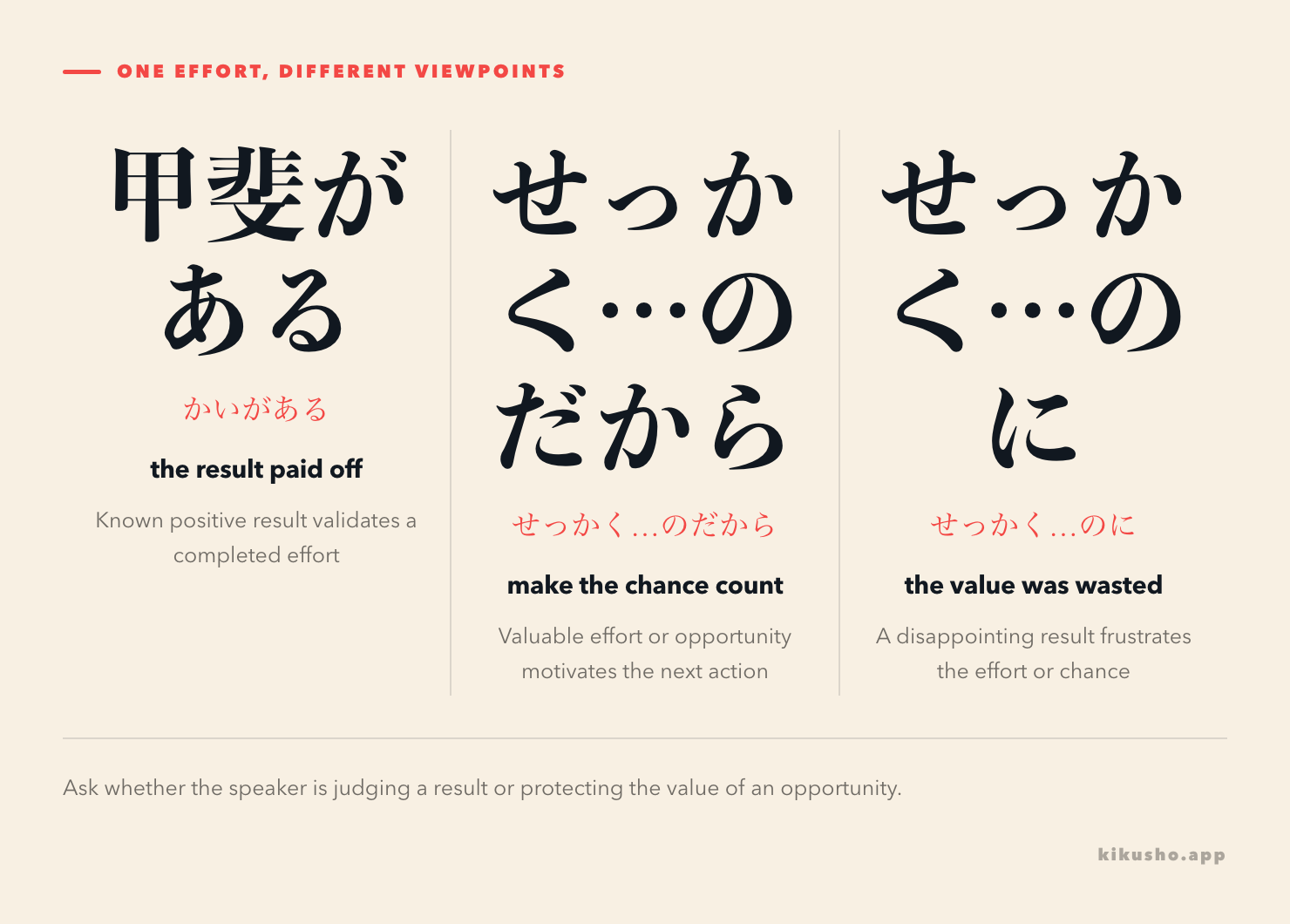
甲斐がある(かいがある) says that an effort produced a result worth the trouble. せっかく presents an effort or opportunity as valuable, then usually says how to use it or regrets that it was wasted.
早起きした甲斐があって、静かな寺を見られた。
はやおきしたかいがあって、しずかなてらをみられた。
Getting up early was worth it because I got to see the temple while it was quiet.
せっかく早起きしたのだから、朝市にも行こう。
せっかくはやおきしたのだから、あさいちにもいこう。
Since we made the effort to get up early, let us go to the morning market too.
The same early start appears in both sentences, but the speaker stands at a different point. The first has a positive result and judges the effort afterward. The second treats the effort as a reason to make the opportunity count.
Result or opportunity is the deciding question
Use this first test:
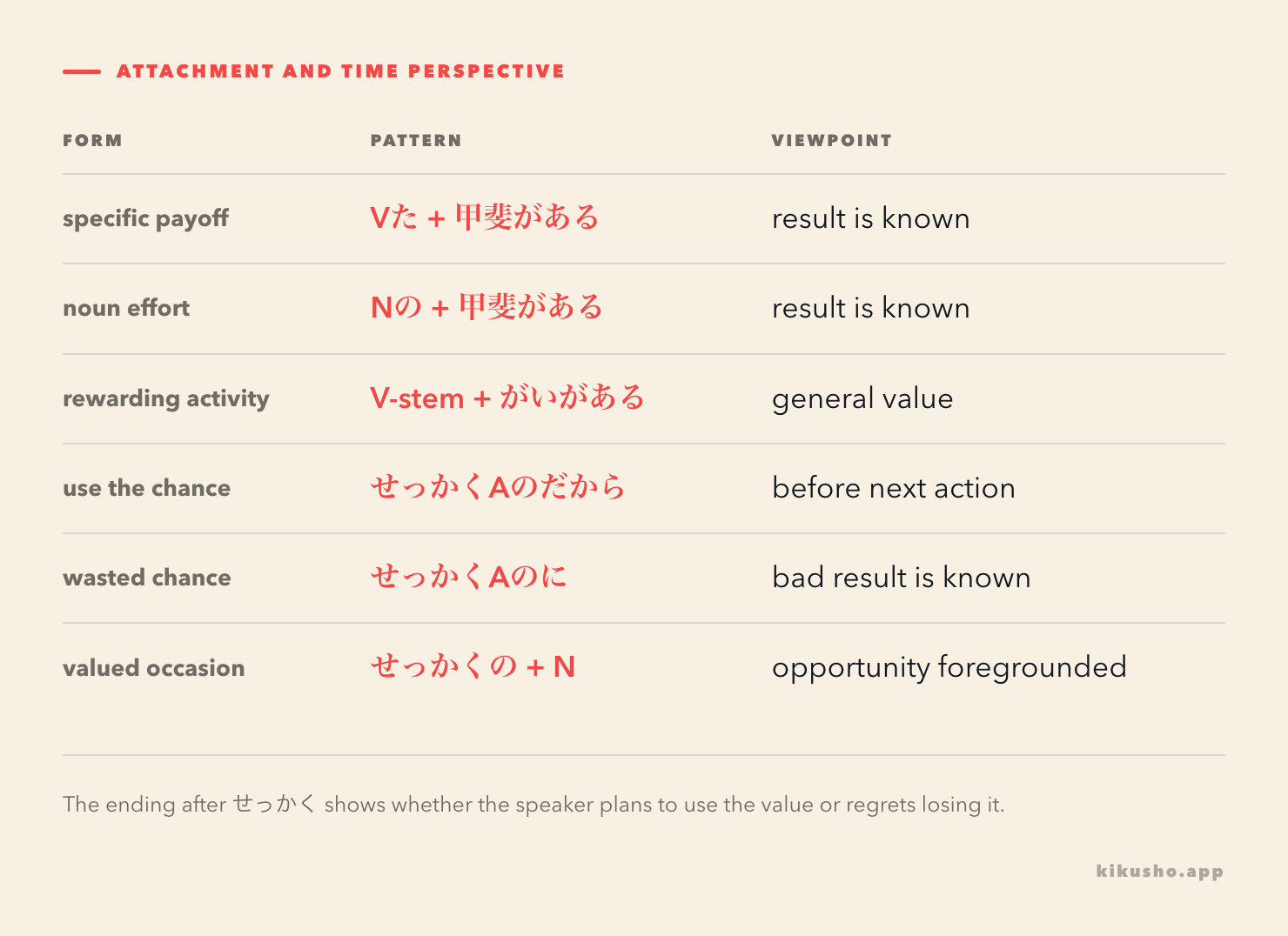
| What the speaker is doing | Dependable form | Time perspective |
|---|---|---|
| judging that effort A produced a worthwhile result B | Vた + 甲斐がある / Nの甲斐がある | result is known |
| identifying an activity as rewarding or worth doing | V-stem + がいがある | general or ongoing value |
| treating effort or opportunity A as too valuable to waste | せっかく + clause | before or around the outcome |
| lamenting that A was wasted | せっかく + clause + のに | disappointing outcome is known |
| valuing a particular occasion or thing | せっかくの + noun | opportunity is foregrounded |
This distinction is more reliable than translating both expressions with “worth.” 甲斐がある evaluates the relationship between effort and result. せっかく evaluates the effort or occasion itself and creates an expectation that it should be used well.
甲斐がある confirms that the effort paid off
The most dependable shape is Vた + 甲斐がある. The past verb names the effort already made, and the following clause often names the positive result that justifies it.
毎日練習した甲斐があって、試合で落ち着いて話せた。
まいにちれんしゅうしたかいがあって、しあいでおちついてはなせた。
Practising every day paid off, and I was able to speak calmly at the competition.
二時間並んだ甲斐があった。この店のラーメンは本当においしい。
にじかんならんだかいがあった。このみせのラーメンはほんとうにおいしい。
Waiting in line for two hours was worth it. This shop's ramen is really delicious.
With a noun, insert の:
長い準備の甲斐があって、発表は成功した。
ながいじゅんびのかいがあって、はっぴょうはせいこうした。
The long preparation paid off, and the presentation succeeded.
The effort need not be physically difficult, but it must be something whose value can be judged through an outcome: waiting, studying, saving, travelling, persuading or enduring. JLPT Sensei's N2 lesson and Bunpro's 甲斐がある entry both center the pattern on a positive return from an effort. Bunpro also notes that a dictionary-form verb can occur, although the past form gives learners the clearest default when a specific effort has already paid off.
甲斐がない reverses the judgment:
説明しても聞いてくれないなら、話した甲斐がない。
せつめいしてもきいてくれないなら、はなしたかいがない。
If they will not listen even after I explain, there was no point in talking.
The more literary-looking 甲斐もなく is often taught as a separate advanced frame. You can recognize it as “despite the effort, without a worthwhile result,” but it is not needed to produce the basic N2 contrast here.
Verb stem plus がい describes rewarding work
When 甲斐 attaches directly to a verb stem, its reading normally voices to がい:
この仕事は難しいが、やりがいがある。
このしごとはむずかしいが、やりがいがある。
This job is difficult, but it is rewarding.
質問の多い学生は教えがいがある。
しつもんのおおいがくせいはおしえがいがある。
A student who asks many questions is rewarding to teach.
Compare この仕事を続けた甲斐があった, “continuing this job proved worthwhile,” with この仕事はやりがいがある, “this job is rewarding to do.” The first judges a particular effort through a result. The second describes an activity's more general or ongoing value. やりがいのある仕事 places the whole expression before a noun.
N1et's 甲斐がある explanation treats past-verb and noun-plus-の forms separately from these stem-plus-がい compounds. Keep the reading difference on your card: 待った甲斐(かい) but 働きがい(がい).
せっかく protects effort or a rare opportunity
せっかく does not require a successful result. It marks what follows as valuable because it took trouble, was long awaited or may not happen again. The rest of the sentence tells you whether the speaker plans to use that value or regrets losing it.
せっかく京都まで来たのだから、もう一つ寺を見よう。
せっかくきょうとまできたのだから、もうひとつてらをみよう。
Since we came all the way to Kyoto, let us see one more temple.
せっかく早く来たのに、会議は中止になった。
せっかくはやくきたのに、かいぎはちゅうしになった。
Even though I made the effort to come early, the meeting was cancelled.
せっかくAのだから turns A into a reason to make good use of the situation. せっかくAのに says that the following result unfortunately wasted A. A casual sentence may use から instead of のだから, or finish with けど and leave the disappointment partly implicit.
With a noun, use せっかくの + N:
せっかくの休みだから、今日はゆっくりしよう。
せっかくのやすみだから、きょうはゆっくりしよう。
It is a precious day off, so let us take it easy today.
The polite expression せっかくですが acknowledges the other person's offer or effort before a regretful refusal:
せっかくですが、その日は参加できません。
せっかくですが、そのひはさんかできません。
I appreciate the invitation, but unfortunately I cannot attend that day.
This does not say the invitation produced a worthless result. It shows that the speaker recognizes its value while declining. Bunpro's せっかく account organizes these uses around effort or an occasion that should not be wasted. MIT OpenCourseWare's Tobira grammar lesson likewise presents the productive pair せっかく…のだから and せっかく…のに, as well as polite せっかくですが.
Compare both forms in one scene
Imagine that Mina studied for an interview and received an offer.
一週間準備した甲斐があって、採用された。
いっしゅうかんじゅんびしたかいがあって、さいようされた。
A week of preparation paid off, and she was hired.
The hiring result validates the preparation, so 甲斐があって fits.
Before the interview, a friend could say:
せっかく一週間準備したのだから、自信を持って話してね。
せっかくいっしゅうかんじゅんびしたのだから、じしんをもってはなしてね。
Since you spent a week preparing, speak with confidence.
If the train delay made her miss the interview, the friend might instead say:
せっかく一週間準備したのに、面接を受けられなかった。
せっかくいっしゅうかんじゅんびしたのに、めんせつをうけられなかった。
Although she spent a week preparing, she could not take the interview.
The last sentence cannot use 甲斐がある, because no positive result made the preparation worthwhile. It can use 甲斐がなかった if the speaker directly judges the preparation fruitless, but せっかく…のに gives more emotional weight to the lost value.
Do not confuse せっかく with わざわざ. わざわざ points to deliberate extra trouble compared with an easier route; せっかく points to the value that should be used. The わざと and わざわざ lesson develops that neighboring contrast.
Save enough context to preserve the timing
A card with only 甲斐 = worth loses the result that licenses the judgment. In Kikusho, save the complete pair: 練習した甲斐があって、合格した. Mark the effort and the positive result separately.
For せっかく, keep its clause ending. せっかく来たのだから predicts a proposal to use the opportunity; せっかく来たのに predicts disappointment. A card ending immediately after せっかく来た cannot test the decision you need in reading.
Practice: decide when the value is judged
Complete all six tasks before opening the answer panel.
Question 1 — worthwhile result. The speaker trained for months and finished the marathon. Choose the best completion.
毎朝走った__、最後まで完走できた。
- ア. せっかくのに
- イ. 甲斐があって
- ウ. やりがいの
- エ. わざわざ
Question 2 — wasted effort. Choose the form that presents the early trip as valuable effort followed by disappointment.
__朝早く駅まで来たのに、電車は運休だった。
- ア. 甲斐があって
- イ. せっかく
- ウ. やりがいが
- エ. きっかけで
Question 3 — noun attachment. Complete “The long practice paid off.”
長い練習__、本番では緊張しなかった。
- ア. が甲斐があって
- イ. にせっかく
- ウ. の甲斐があって
- エ. をがいがあって
Question 4 — sentence composition. Arrange the chunks into “Since we came all this way, let us see the exhibition too.” Use each once.
- せっかくここまで来た
- 展示も見よう
- のだから
Question 5 — payoff in context. Which claim follows from Mina's reflection?
三か月準備して、ようやく店を開くことができた。最初のお客様が笑顔で帰っていくのを見て、準備した甲斐があったと思った。
- ア. The preparation is presented as a rare future opportunity.
- イ. The customer's reaction made the speaker judge the preparation worthwhile.
- ウ. The speaker regrets that the preparation was wasted.
- エ. The shop is generally rewarding to prepare, regardless of any result.
Question 6 — one effort, two viewpoints. Choose the pair that preserves the change from using an opportunity to judging its result.
__旅行に来たのだから、地元の料理を食べてみよう。食堂まで歩いた__、すばらしい料理に出会えた。
- ア. 甲斐があって/せっかく
- イ. せっかく/せっかくの
- ウ. せっかく/甲斐があって
- エ. やりがいがあって/甲斐の
Answers and explanations
Answer 1. イ, 甲斐があって. Finishing the marathon is the positive result that makes the months of running worthwhile. せっかくのに has the wrong attachment, やりがいの would need a following noun, and わざわざ only marks notable extra trouble.
Answer 2. イ, せっかく. せっかく…のに foregrounds the trouble of coming early and then laments that the cancellation wasted it. 甲斐があって requires a worthwhile result; やりがい describes rewarding activity; きっかけで marks a trigger.
Answer 3. ウ, の甲斐があって. A noun connects to 甲斐 with の. The successful performance supplies the positive result. The other particles do not form this noun attachment.
Answer 4. せっかくここまで来たのだから、展示も見よう. The effort of coming this far becomes a reason to use the opportunity. のだから connects that valued circumstance to the proposal.
Answer 5. イ. Opening the shop and seeing the first customer's smile are known positive outcomes. The speaker looks back and decides that three months of preparation paid off.
Answer 6. ウ, せっかく/甲斐があって. In the first sentence, the trip is a valuable opportunity that motivates trying local food. In the second, the excellent meal is the known result that proves the walk was worthwhile.
Level and review note
The reference sources agree that 甲斐がある belongs in N2 study. They disagree on せっかく: JLPT Sensei and Tanos place it at N2, while Bunpro currently places it at N3. Kikusho keeps the assigned N2 curriculum placement and records the disagreement rather than presenting one provider's label as official.
The official JLPT FAQ explains that exhaustive grammar, vocabulary and kanji lists are not published. The practical target is therefore the contrast itself: identify whether a known result proves the effort worthwhile, or whether the speaker is protecting or regretting the value of an effort or opportunity.
OpenAI Codex reviewed the saved lesson as an AI agent. The check covered the two time perspectives, every original Japanese sentence and the uniqueness of the six practice answers; no human language review was performed.
Common questions
What does 甲斐がある mean in Japanese?
甲斐がある means that an effort, wait or sacrifice produced a worthwhile result. It commonly follows a past verb or a noun plus の: 待った甲斐がある and 練習の甲斐がある.
What is the difference between 甲斐がある and せっかく?
甲斐がある looks at a result and judges that the effort paid off. せっかく marks an effort or rare opportunity as valuable before saying how to use it or why it was unfortunately wasted.
How do you use せっかく with のだから and のに?
せっかくAのだから introduces a reason to make good use of A, while せっかくAのに introduces a disappointing result that wastes A. With a noun, use せっかくのN, as in せっかくの休み.
What is the difference between 甲斐 and がい?
After a past verb or noun plus の, 甲斐 is read かい and evaluates a specific effort. Attached to a verb stem, it is usually read がい and describes an activity or role as rewarding, as in やりがい or 教えがい.