On this page
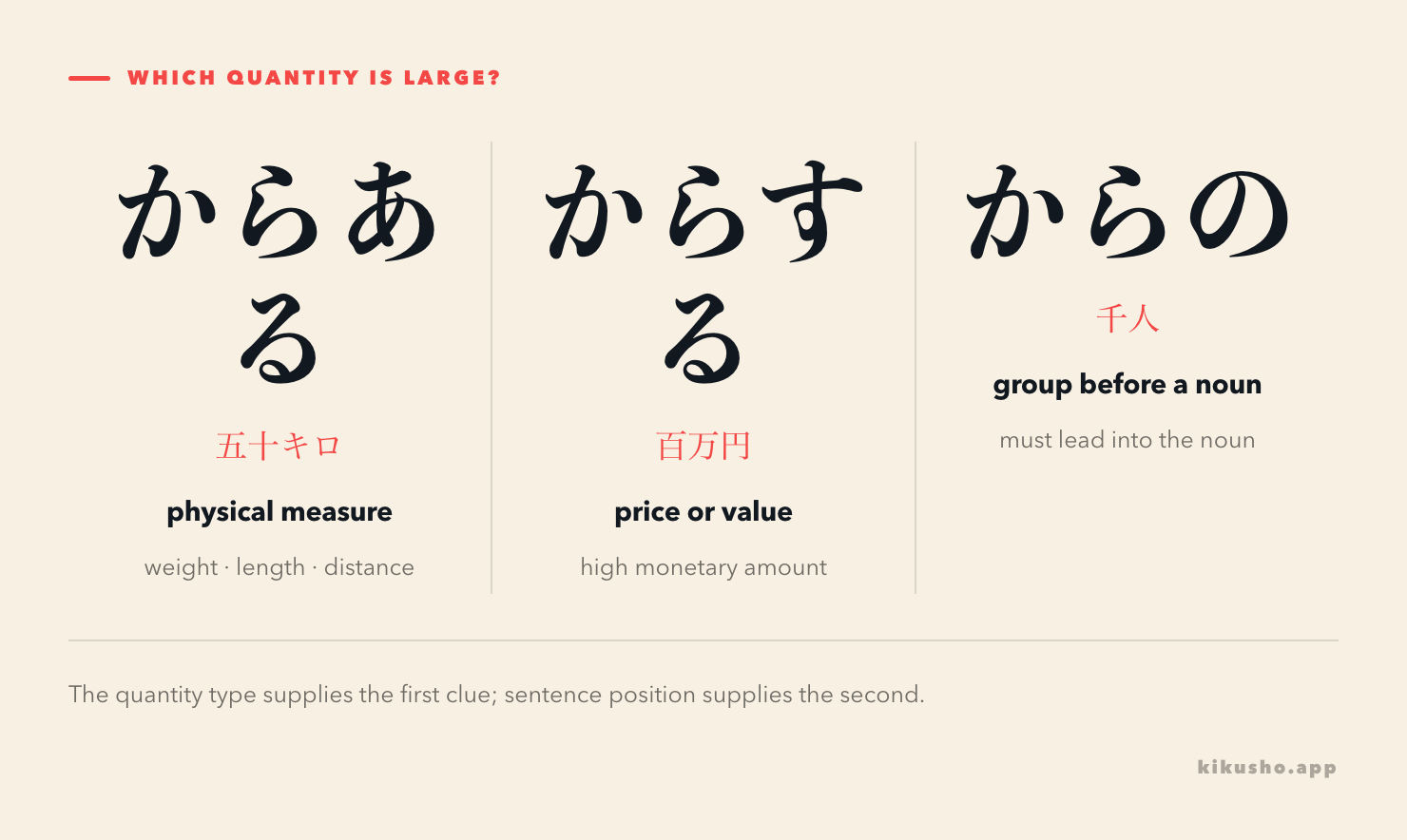
からある, からする and からの place a large quantity at the lower edge of an estimate and present its scale as striking. Use からある mainly for physical measurements, からする mainly for prices, and からの directly before a noun for large numbers of people or things.
五十キロからある荷物を、一人で運んだ。
ごじゅっキロからあるにもつを、ひとりではこんだ。
He carried luggage weighing as much as fifty kilograms by himself.
百万円からする時計が展示されている。
ひゃくまんえんからするとけいがてんじされている。
A watch worth at least one million yen is on display.
会場には千人からの観客が集まった。
かいじょうにはせんにんからのかんきゃくがあつまった。
A crowd of a thousand or more spectators gathered at the venue.
The number is not merely a neutral fact. The speaker chooses this family because the amount is large enough to deserve emphasis.
Choose the form from the kind of quantity
All three patterns follow a number or a number-plus-counter expression. The noun that follows tells you which member of the family is most dependable.
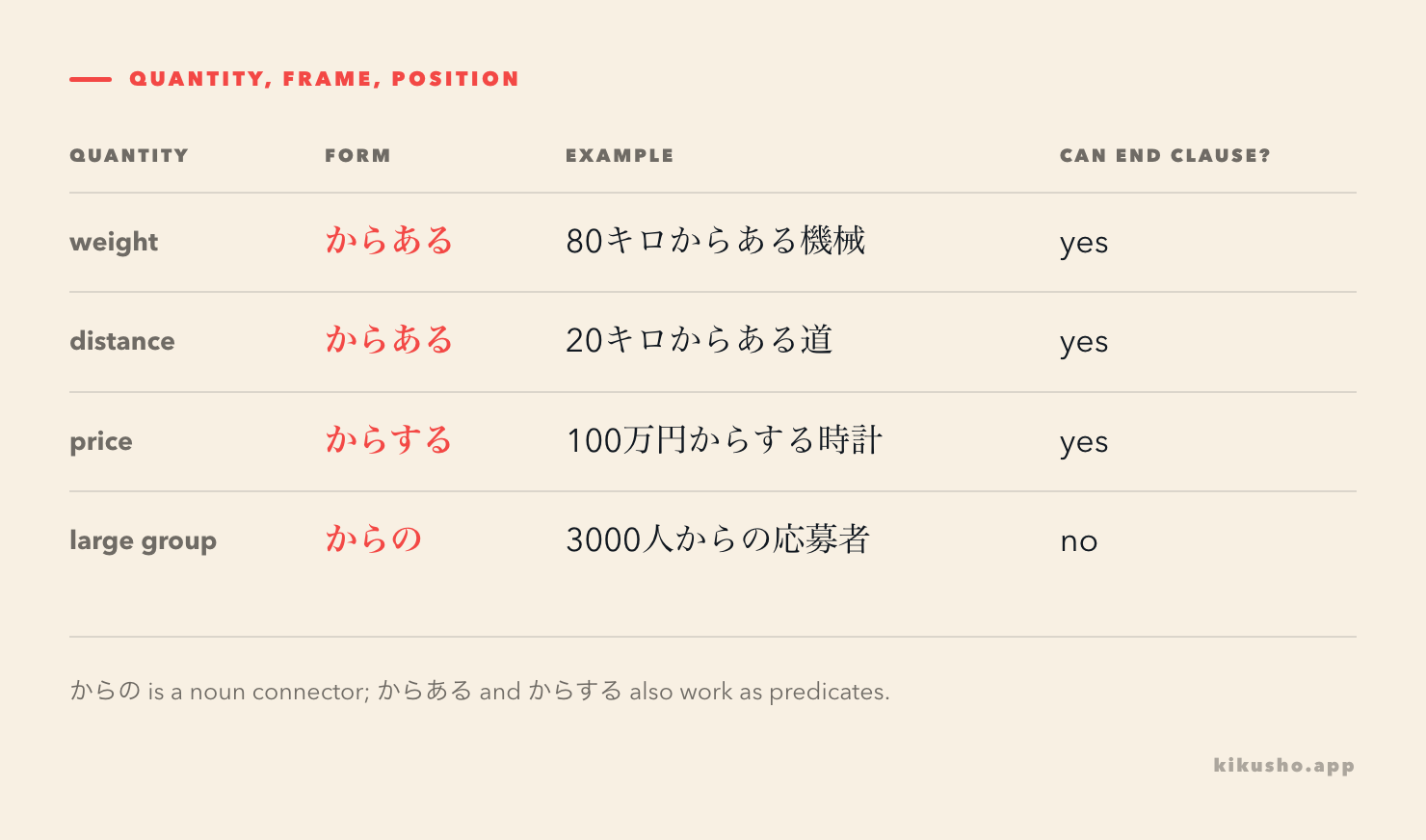
| Quantity being emphasized | Form | Example | Sentence role |
|---|---|---|---|
| weight, length, distance, size or physical amount | quantity + からある (+ noun) | 五十キロからある荷物 | predicate or noun modifier |
| price, cost or monetary value | amount + からする (+ noun) | 百万円からする時計 | predicate or noun modifier |
| people or a general large quantity before a noun | quantity + からの + noun | 千人からの観客 | noun modifier only |
This division is a strong exam default, though real usage has some overlap. からの is structurally the broadest attributive form, and writers sometimes use it with money or measurements. When the test gives you an unambiguous price, からする is the safest choice; with a weight or distance, choose からある; with a large group directly modifying a noun, expect からの.
からある makes a physical scale feel large
Use quantity + からある when the figure measures something that exists as a size, weight, length or distance.
倉庫から、八十キロからある機械が運び出された。
そうこから、はちじゅっキロからあるきかいがはこびだされた。
A machine weighing at least eighty kilograms was removed from the warehouse.
海岸まで二十キロからある道を歩いた。
かいがんまでにじゅっキロからあるみちをあるいた。
We walked a road stretching as much as twenty kilometers to the coast.
The figure comes immediately before からある. When a noun follows, the whole phrase modifies it: 八十キロからある機械. The pattern can also finish the predicate:
あの石は百キロからある。
あのいしはひゃくキロからある。
That stone weighs at least one hundred kilograms.
The sentence does not sound like a laboratory measurement. It gives the number as a minimum estimate or scale and asks the listener to register its magnitude. Bunpro's からある entry describes it as formal and especially common with static measurements such as distance, size and weight. J-nihongo's N1 lesson uses the same measurement-versus-price-versus-group distinction.
Small, ordinary figures usually resist this pattern because there is nothing remarkable to emphasize. 二百グラムからあるりんご could work only in a setting where a 200-gram apple is notably heavy. For a neutral label or recipe, simply say 二百グラムのりんご.
からする puts a high price on the scale
Use amount + からする for a price or value that feels high.
そのホテルには、一泊十万円からする部屋もある。
そのホテルには、いっぱくじゅうまんえんからするへやもある。
The hotel even has rooms costing at least 100,000 yen per night.
修理費だけで五十万円からするそうだ。
しゅうりひだけでごじゅうまんえんからするそうだ。
I hear the repair alone will cost around 500,000 yen or more.
Like からある, this form can modify a noun or end a clause. The money expression remains directly in front: 十万円からする部屋 and 修理費は五十万円からする.
Do not confuse this with inferential Nからすると, “judging from N.” In この傷からすると、古い品らしい, the noun before から is evidence and the following と introduces a conclusion. In 百万円からする品, the phrase before から is a monetary amount and する expresses the item's price. The から言うと, から見ると and からすると lesson covers the inference family.
日本語NET explicitly assigns prices to からする and describes the whole family as emphasizing a large quantity or degree. Bunpro likewise notes that からする is most frequent with money and tends to sound unnatural with an unremarkably small amount.
からの must lead into a noun
Quantity + からの + noun is the attributive member of the family. It commonly presents a large body of people, applicants, documents, assets or other countable material.
公募には三千人からの応募者が集まった。
こうぼにはさんぜんにんからのおうぼしゃがあつまった。
The open call attracted three thousand or more applicants.
調査では一万件からの回答を分析した。
ちょうさではいちまんけんからのかいとうをぶんせきした。
The survey analyzed as many as ten thousand responses.
The の connects the large quantity to the noun after it. That noun is therefore mandatory in this shape. 三千人からの応募者 works, while sentence-final 応募者は三千人からの is incomplete for this meaning.
The semantic categories are tendencies rather than walls. You may meet 百万円からの資金, where からの modifies 資金, or a large count with からある. On a tightly written exercise, use both clues: first identify the quantity type, then see whether the blank must finish a clause or modify a noun.
The number is a lower edge, not always an exact total
English translations vary among “at least,” “as much as,” “as many as,” “over” and “around.” The shared idea is more stable: the stated figure is the lower edge of a large estimate, and the exact total is not the point.
五百人からの列ができた。
ごひゃくにんからのれつができた。
A line of five hundred or more people formed.
The speaker locates the line at the scale of five hundred and presents that scale as impressive. This differs from a precise head count whose exactness matters. Context can make the figure sound like a clear minimum, a rough lower estimate or simply an emphatically large magnitude.
That flexibility is why blindly translating から as “from” produces awkward English. Here, から contributes the idea of a starting boundary on a scale. It does not mark a place of origin, a cause, or the beginning time of an event.
Keep exact も, objective 以上 and starting-price から separate
Three nearby patterns can contain the same number but make different commitments.
| Sentence | Main claim |
|---|---|
| 観客が千人も集まった。 | exactly or factually one thousand gathered, and that feels like a lot |
| 千人以上の観客が集まった。 | the attendance met the objective threshold of one thousand or more |
| 千人からの観客が集まった。 | the crowd was on the striking scale of a thousand or more |
Number + も reacts to the quantity reached. It does not open the number upward by itself. 以上 gives a clean inclusive lower bound and is suitable for requirements, statistics and neutral thresholds. The N1 から family combines a lower-edge reading with the speaker's sense that the scale is large.
The difference in register matters too. 百万円もする時計 is a natural conversational reaction to a million-yen watch. 百万円からする時計 sounds more formal and estimate-like. The existing quantity も lesson develops the exact-count emphasis in full.
Plain から can also mark the published starting price of a range:
宿泊料金は一万円からです。
しゅくはくりょうきんはいちまんえんからです。
Room rates start at 10,000 yen.
This may be an ordinary price list with no surprise at all. 一泊十万円からする部屋 instead characterizes the room through a high estimated cost. Look for both the sentence shape and the evaluative context.
Save the counter and the noun with the pattern
An isolated card reading からする = at least hides the choice you must make. In Kikusho, keep 十万円からする修理, then mark 十万円 as the price and 修理 as the thing valued. For からの, the following noun is indispensable, so keep 三千人からの応募者 as one unit.
Add a neutral neighbor to the card when the boundary matters: 三千人以上の応募者 states the floor; 三千人からの応募者 makes the scale rhetorically visible. The card's editable explanation can record why the writer chose one instead of leaving three English glosses to compete in memory.
Practice: let the quantity choose the frame
Complete all seven questions before opening the answer panel.
Question 1 — physical measurement. Choose the most dependable N1 form for a surprisingly heavy machine.
倉庫には百キロ__機械が置いてある。
- ア. からする
- イ. からすると
- ウ. からある
- エ. 以上する
Question 2 — price. Complete the sentence about a very expensive camera.
彼は二百万円__カメラを仕事で使っている。
- ア. からある
- イ. からする
- ウ. からいる
- エ. 以上ある
Question 3 — noun modification. A report received more than ten thousand responses. Choose the form that must connect the quantity directly to 回答.
一万件__回答が寄せられた。
- ア. からの
- イ. からして
- ウ. からすると
- エ. からだ
Question 4 — sentence composition. Arrange the chunks into “A line stretching as much as three kilometers formed.” Use each once.
- できた
- 三キロからある
- 列が
Question 5 — exact amount or scale. The speaker knows that exactly twenty guests came and reacts that twenty is a lot. Which sentence best preserves that claim?
- ア. 客が二十人も来た。
- イ. 二十人以上の客が来た。
- ウ. 二十人からの客が来た。
- エ. 客は二十人からした。
Question 6 — clause position. Which sentence is structurally complete and uses the price form as a predicate?
- ア. この修理は五十万円からの。
- イ. この修理は五十万円からする。
- ウ. この修理は五十万円からある人。
- エ. この修理は五十万円以上するの客。
Question 7 — connected text. Choose the pair that first describes a large group before a noun, then gives the high price of one object.
展示会には五千人__来場者が集まった。会場の中央には一億円__彫刻が飾られていた。
- ア. からある/からの
- イ. からの/からする
- ウ. からする/からある
- エ. 以上する/からして
Answers and explanations
Answer 1. ウ, からある. One hundred kilograms is a physical measurement, and the phrase modifies 機械. からする specializes in price, からいる counts living things in rare uses, and からすると belongs to the inference family.
Answer 2. イ, からする. Two million yen is the camera's striking price. The other forms either select a different quantity type or fail to form this N1 price expression.
Answer 3. ア, からの. The quantity directly modifies the following noun 回答, so the attributive connector の completes the frame. からすると would require a basis for an inference rather than a large count.
Answer 4. 三キロからある列ができた. 三キロ supplies the large physical length, からある lets that measurement modify 列, and できた completes the event.
Answer 5. ア, 客が二十人も来た. Quantity plus も preserves twenty as the reported count and marks it as unexpectedly large. 以上 and からの leave the scale open at or above twenty.
Answer 6. イ, この修理は五十万円からする. からする can end the predicate and state the high estimated cost. からの requires a noun after it, and the remaining options mix incompatible structures.
Answer 7. イ, からの/からする. The first blank sits between a large number of people and 来場者, so からの is the clear attributive form. The second describes the sculpture's high monetary value, which selects からする.
Common questions
What does からある mean in Japanese?
Number plus counter plus からある emphasizes a large measurement or amount, especially weight, length, distance or size. It often means “as much as” or “at least,” as in 五十キロからある荷物.
What is the difference between からある and からする?
からある is the usual choice for large physical measurements such as weight and distance. からする is used mainly for a strikingly high price or monetary value, as in 百万円からする時計.
How is からの used with quantities?
Quantity plus からの modifies a following noun and is common with large numbers of people or things: 千人からの応募者. Unlike からある and からする, it cannot finish the sentence by itself.
What is the difference between からある and 以上?
以上 states an objective lower boundary and works with ordinary thresholds. からある presents the amount as impressively or unexpectedly large and has a more formal, evaluative tone.