On this page
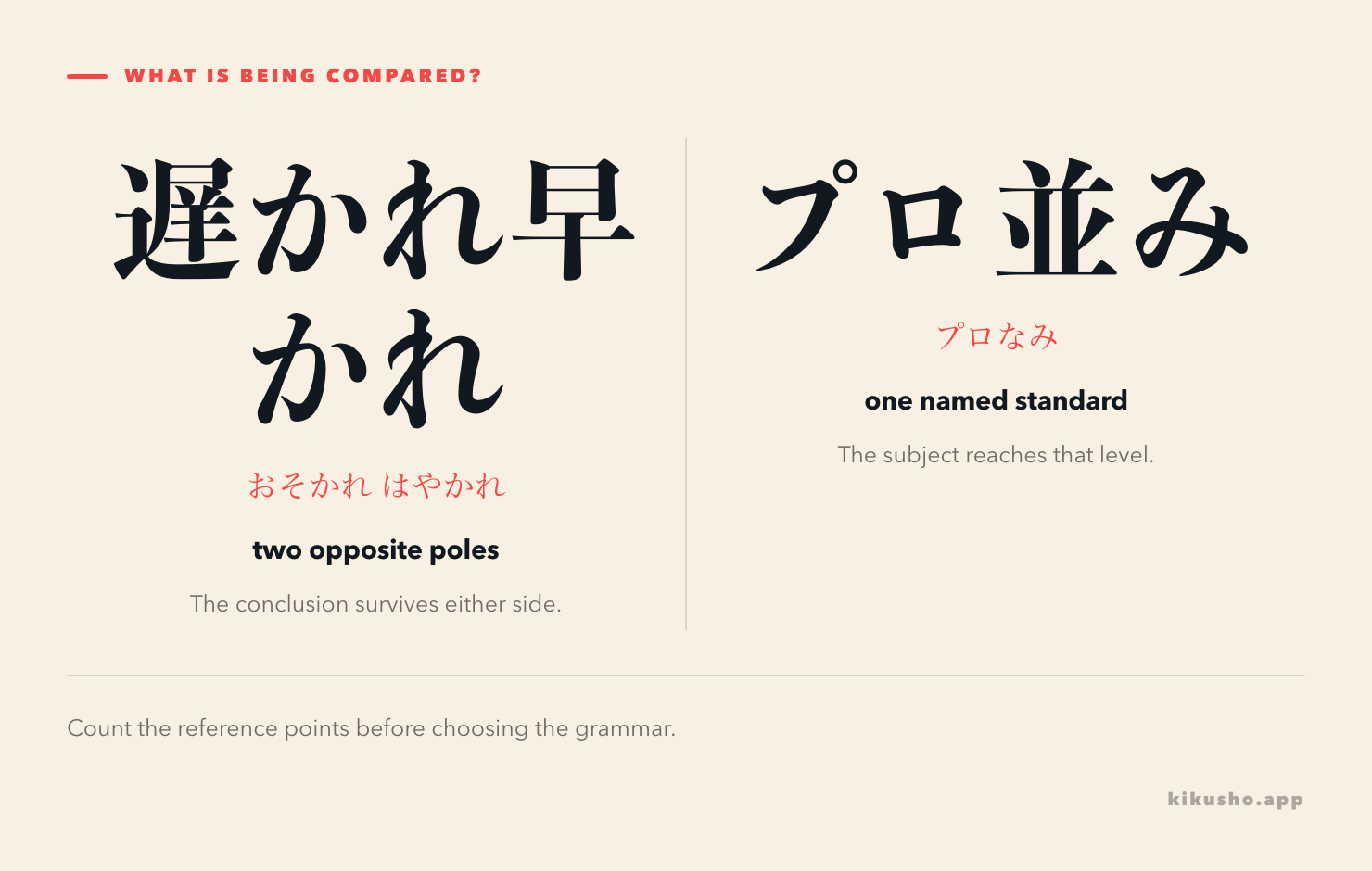
かれ~かれ says that one conclusion holds at either end of an adjective scale: sooner or later, more or less, for better or worse. 並み(なみ) performs a different comparison, placing someone or something on roughly the same level as a named standard.
遅かれ早かれ、この問題には向き合わなければならない。
おそかれはやかれ、このもんだいにはむきあわなければならない。
Sooner or later, we will have to face this problem.
彼女の判断力は、すでに専門家並みだ。
かのじょのはんだんりょくは、すでにせんもんかなみだ。
Her judgment is already on a professional level.
The first sentence spans two opposed possibilities and dismisses their difference as irrelevant to the conclusion. The second selects one benchmark, 専門家, and measures a person's ability against it.
Ask whether you see two poles or one benchmark
The surface idea of comparison is too broad. Count the reference points instead.
| Meaning structure | Form | Example | What remains true |
|---|---|---|---|
| two opposite poles, same conclusion | AかれBかれ、C | 多かれ少なかれ影響がある | C holds at either degree |
| one named standard, comparable level | N並みだ | 技術はプロ並みだ | subject reaches N's level |
| standard modifies a noun | N並みの + noun | プロ並みの技術 | following noun is at N's level |
| standard modifies a predicate | N並みに + verb/adjective | プロ並みに速い | action or quality matches N |
かれ~かれ organizes alternatives. 並み grades a subject against a standard. They cannot replace each other even when English uses a loose word such as “regardless” or “like.”
かれ~かれ joins opposite adjective stems
Form the pattern from two contrasting い-adjectives. Remove final い, then add かれ to each stem:
| Adjectives | Fixed pair | Natural reading |
|---|---|---|
| 遅い + 早い | 遅かれ早かれ | sooner or later |
| 多い + 少ない | 多かれ少なかれ | to a greater or lesser extent |
| 良い + 悪い | 良かれ悪しかれ | for better or worse |
多かれ少なかれ、全員が変更の影響を受ける。
おおかれすくなかれ、ぜんいんがへんこうのえいきょうをうける。
To a greater or lesser extent, everyone will be affected by the change.
良かれ悪しかれ、この決定は長く記憶されるだろう。
よかれあしかれ、このけっていはながくきおくされるだろう。
For better or worse, this decision will be remembered for a long time.
The pair normally comes before the main clause. Its job is concessive: differences in timing, amount or evaluation exist, yet the stated result survives either side.
Bunpro's かれ~かれ lesson gives the い-adjective stem attachment and the three common opposite pairs. NIHONGO NET independently describes the pattern as using opposite い-adjectives while the result remains unchanged.
Treat the common pairs as established expressions
The formation looks productive, but modern use is narrow. Learners should not invent pairs whenever two adjectives contrast. 高かれ安かれ may be mechanically imaginable, but it is not a dependable substitute for 高くても安くても.
Use the established forms as complete discourse units:
- 遅かれ早かれ closes debate about when.
- 多かれ少なかれ concedes variation in degree.
- 良かれ悪しかれ suspends judgment about value or consequence.
This restriction separates the pattern from freely productive AくてもBくても. It also differs from noun-based AであれBであれ, which can name almost any categories. The であれ~であれ and いずれにしても lesson explains how formal prose lists noun alternatives or refers back to known possibilities.
The spelling of the good/bad pair varies. 良かれ悪しかれ reflects the ordinary adjective 良い, while 善かれ悪しかれ is a conventional kanji spelling seen in formal writing. The reading remains よかれあしかれ; 悪し is the older adjective stem preserved in this expression.
並み names the level used for comparison
Attach 並み directly to a noun that supplies a standard. The subject need not literally belong to that class.
この小型端末には、パソコン並みの処理能力がある。
このこがたたんまつには、パソコンなみのしょりのうりょくがある。
This compact device has processing power comparable to a computer.
一年しか学んでいないのに、彼は母語話者並みに自然に話す。
いちねんしかまなんでいないのに、かれはぼごわしゃなみにしぜんにはなす。
Although he has studied for only a year, he speaks as naturally as a native speaker.
今日の暑さは真夏並みだ。
きょうのあつさはまなつなみだ。
Today's heat is comparable to midsummer.
The particle after 並み follows its sentence role:
- N並みだ finishes an evaluation.
- N並みの + noun modifies a noun.
- N並みに + predicate modifies a verb or adjective.
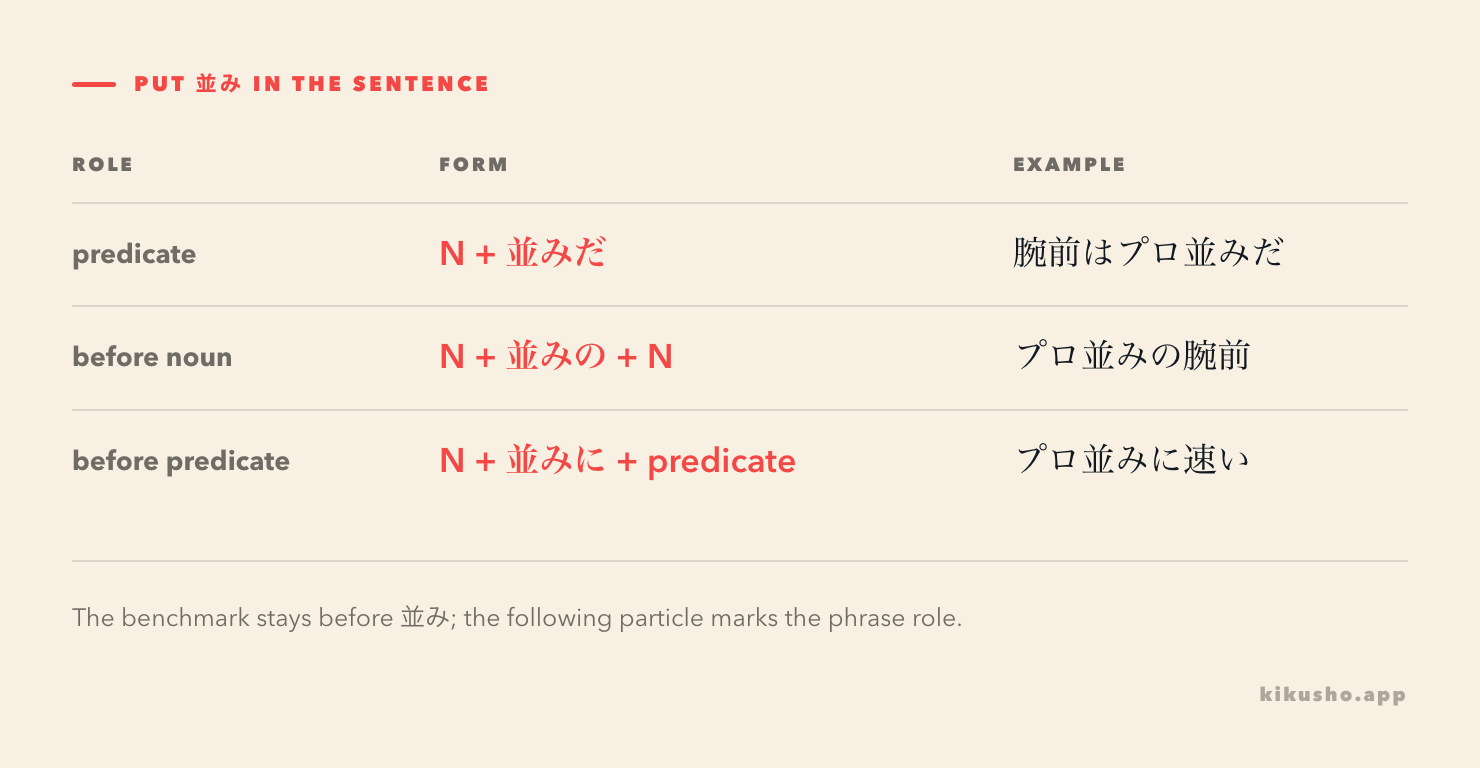
J-nihongo's 並み reference defines the pattern through equal degree or standard in age, ability, quality and scale, and records predicate and noun-modifying shapes. 日本の言葉と文化 independently supplies the same N + 並み attachment and includes adverbial 並みに.
The benchmark can be high, ordinary or seasonal
並み does not always praise. The effect depends on the noun chosen as the standard.
中学生なのに、大学生並みの知識がある。
ちゅうがくせいなのに、だいがくせいなみのちしきがある。
Although she is a middle-school student, she has university-student-level knowledge.
Here the comparison raises the subject above expectation. 例年並み and 世間並み, however, point toward an ordinary or customary level:
売上は例年並みに戻った。
うりあげはれいねんなみにもどった。
Sales returned to the usual yearly level.
The phrase says “comparable to the benchmark,” not automatically “excellent.” プロ並み sounds impressive because professional skill is a high standard. 例年並み sounds normal because the benchmark is an ordinary year.
Keep lexical compounds separate. 軒並み(のきなみ) means one after another or across the board, and 月並み(つきなみ) can mean commonplace or conventional. Their meanings are not built by freely choosing 軒 or 月 as a comparison target in the productive N並み pattern.
並みに, ほど and に匹敵する frame equality differently
N並みに is compact and evaluative. Nほど sets N as a degree benchmark and often appears in comparisons or negatives. Nに匹敵する explicitly states that something rivals or equals N, with a more formal and assertive tone.
彼はプロ並みに速く走る。
He runs at a professional level.
彼ほど速く走れる人はいない。
Nobody can run as fast as he can.
彼の記録はプロの記録に匹敵する。
His record rivals a professional record.
The three sentences do not package the comparison alike. 並み labels the attained standard, ほど organizes a degree comparison, and に匹敵する makes equivalence the predicate. For another formal comparison family, the ごとき, ごとく and ごとし lesson shows how a comparison changes shape according to its position in the sentence.
Store the whole comparison decision
For かれ~かれ, a useful Kikusho card keeps the fixed pair and its invariant conclusion: 多かれ少なかれ、全員が影響を受ける. Splitting it into two isolated adjective fragments hides the concession.
For 並み, keep both sides of the scale. プロ並み alone names a standard but not the ability being judged; プロ並みの腕前 preserves the relationship. Mark the benchmark and the evaluated quality separately so the next review asks you to rebuild the comparison rather than recall one English synonym.
Practice: locate the poles and the benchmark
Decide whether each prompt contains opposite poles or a named benchmark. Open the panel only after answering all seven.
Question 1 — fixed pair. Complete “Sooner or later, the truth will become clear.”
__、真実は明らかになる。
- ア. 遅かれ早かれ
- イ. 遅い並みに
- ウ. 早いかれ遅いかれ
- エ. 遅く並み
Question 2 — degree variation. Which expression means “to a greater or lesser extent”?
- ア. 高かれ低かれ
- イ. 良かれ悪しかれ
- ウ. 多かれ少なかれ
- エ. 長かれ短かれ
Question 3 — noun modification. Complete “professional-level technique.”
プロ__技術
- ア. 並みだ
- イ. 並みに
- ウ. 並みの
- エ. かれ
Question 4 — sentence composition. Arrange the chunks into “This small camera has professional-level performance.”
- 性能がある
- この小型カメラには
- プロ並みの
Question 5 — adverbial position. Choose the form that modifies 話せる.
彼女は母語話者__自然に話せる。
- ア. 並みだ
- イ. 並みの
- ウ. 並みに
- エ. かれ
Question 6 — meaning. What does 売上は例年並みに戻った say?
- ア. Sales surpassed every previous year.
- イ. Sales returned to roughly the usual yearly level.
- ウ. Sales were good or bad, but the result was unknown.
- エ. Sales will recover sooner or later.
Question 7 — connected text. Choose the pair that first concedes either evaluation and then compares ability with a professional standard.
__、新しい制度は社会を変えるだろう。設計者の説明は__分かりやすかった。
- ア. 良かれ悪しかれ/講師並みに
- イ. 多かれ少なかれ/専門家かれ
- ウ. プロ並みの/良かれ悪しかれ
- エ. 遅かれ早かれ/講師並みの
Answers and explanations
Answer 1. ア, 遅かれ早かれ. This established opposite pair means that the conclusion will hold regardless of whether the timing is earlier or later.
Answer 2. ウ, 多かれ少なかれ. 多い and 少ない supply the opposite ends of a quantity scale. The other choices either express a different fixed meaning or invent an unreliable pair.
Answer 3. ウ, 並みの. The comparison phrase modifies the following noun 技術, so の is required. 並みだ ends a predicate, while 並みに modifies a verb or adjective.
Answer 4. この小型カメラにはプロ並みの性能がある. プロ is the benchmark, 並みの connects that benchmark to 性能, and the final chunk states possession of that performance.
Answer 5. ウ, 並みに. The phrase works adverbially before 自然に話せる, so に marks the comparison level used by the predicate.
Answer 6. イ. 例年 is the benchmark and 並みに says sales returned to a comparable level. The sentence does not claim record growth or bracket opposite alternatives.
Answer 7. ア, 良かれ悪しかれ/講師並みに. The first form brackets positive and negative evaluation while preserving the prediction. The second uses 講師 as the standard and adverbially modifies 分かりやすかった.
Common questions
What does かれ~かれ mean in Japanese?
かれ~かれ joins two opposite い-adjective stems and means that the following conclusion holds whichever pole applies. Common fixed pairs include 遅かれ早かれ, 多かれ少なかれ and 良かれ悪しかれ.
How do you form かれ~かれ?
Remove い from two contrasting い-adjectives and add かれ to each stem: 遅い and 早い become 遅かれ早かれ. The pattern is limited to established opposite pairs rather than freely accepting any adjectives.
What does 並み mean after a noun?
N並み means on the same level as N or comparable to N. Use N並みだ as a predicate, N並みの before a noun and N並みに before a verb or adjective.
What is the difference between かれ~かれ and 並み?
かれ~かれ brackets two opposite possibilities and keeps one conclusion valid across them. 並み names one benchmark and says that another thing reaches roughly the same level.