On this page
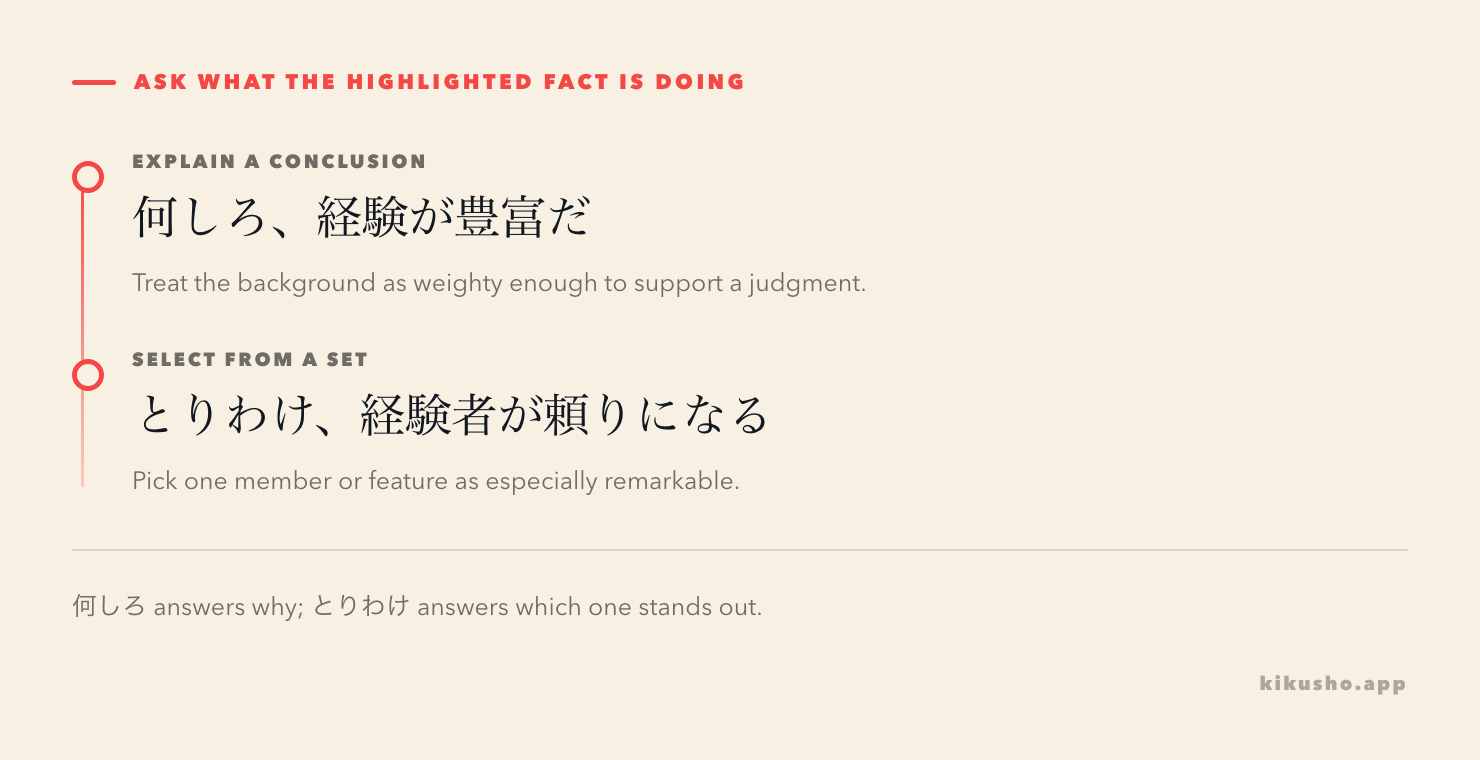
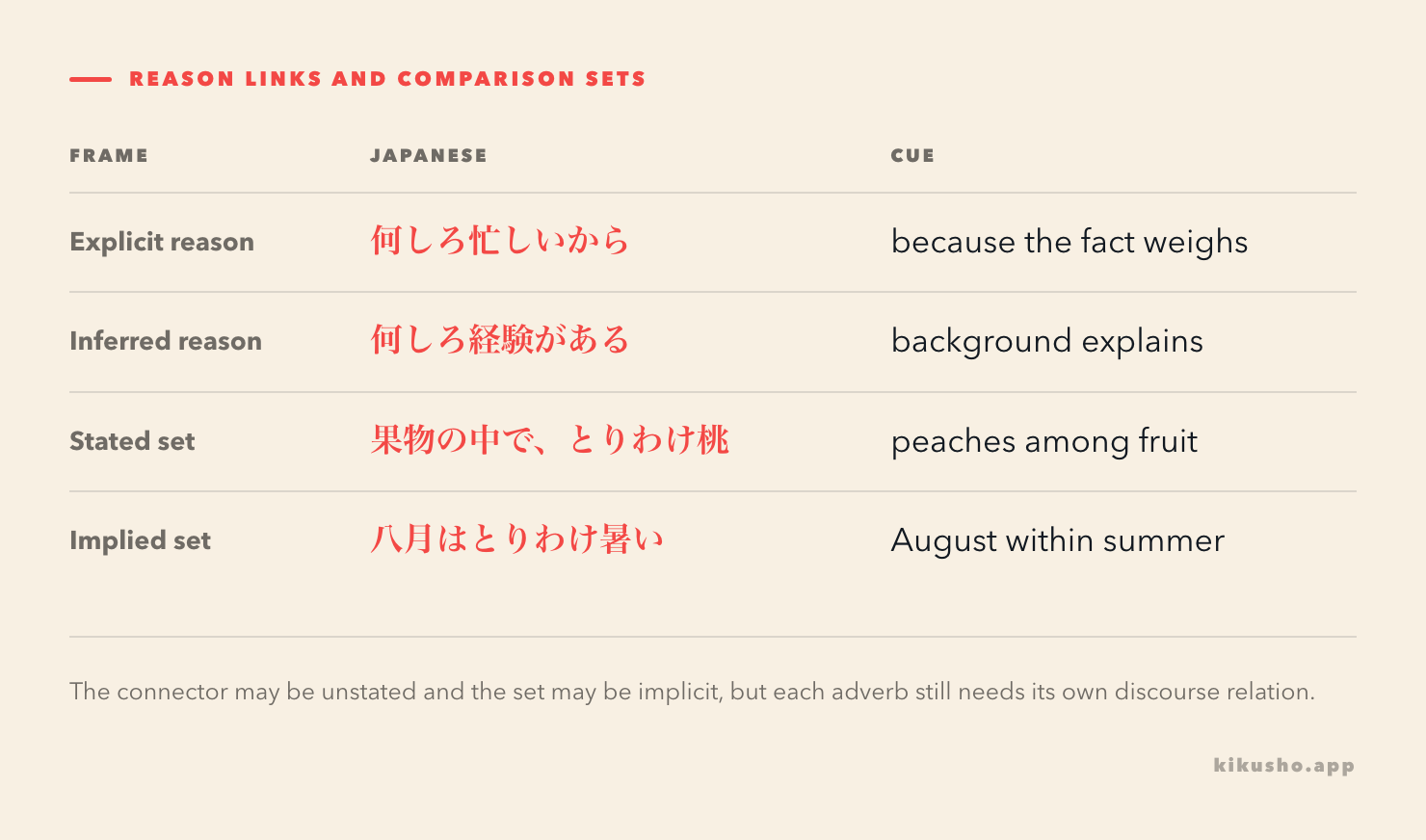
何しろ(なにしろ) foregrounds a fact whose weight explains a conclusion, reaction or excuse. とりわけ selects one member or feature as especially remarkable within a larger set. Ask whether the sentence is answering “why?” or “which one stands out?”
何しろ初めての海外出張だったので、三日前から準備していた。
なにしろ はじめての かいがい しゅっちょうだったので、みっかまえから じゅんびしていた。
After all, it was my first overseas business trip, so I had been preparing for three days.
出張には多くの準備が必要だったが、とりわけビザの手続きに時間がかかった。
しゅっちょうには おおくの じゅんびが ひつようだったが、とりわけ ビザの てつづきに じかんが かかった。
The trip required a great deal of preparation, but the visa procedure took especially long.
The first speaker offers a dominant background fact to explain the early preparation. The second surveys several tasks and singles out the visa procedure.
This lesson verifies inventory items g-3630ea0e8c84, 何しろ, and g-9a67efc7c1c7, とりわけ. コトバンク describes 何しろ as setting other matters aside and strengthening a judgment or assertion. Bunpro documents the common explanatory frame and teaches it at N2, while JLPT Sensei and Hane place it in N1 material. Tanos also lists 何しろ with N2. For とりわけ, goo’s dictionary defines the adverb as 特に or ことに, and Hane demonstrates selection from a broader set in N1 material. Kikusho keeps the assigned N1 route while disclosing the N1/N2 teaching-order disagreement for 何しろ.
Ask whether the sentence explains or selects
| Adverb | Hidden question | Discourse job | Useful paraphrase |
|---|---|---|---|
| 何しろ | Why is that conclusion reasonable? | foreground one weighty background fact | というのも/なぜなら |
| とりわけ | Which member stands out? | select one exceptional item or feature | 特に/中でも |
今日は早く帰りたい。何しろ、朝から何も食べていない。
きょうは はやく かえりたい。なにしろ、あさから なにも たべていない。
I want to go home early today. You see, I have not eaten anything since morning.
The second sentence explains the first. It does not compare several reasons and announce that hunger ranks first.
この地域は果物が豊富で、とりわけ桃が有名だ。
この ちいきは くだものが ほうふで、とりわけ ももが ゆうめいだ。
This region has abundant fruit, and peaches are especially famous.
Peaches are selected from the set of local fruit.
何しろ makes one fact hard to ignore
The form often appears at the start of the clause that supplies the explanation:
予定を変更するのは難しい。何しろ、参加者が百人を超えているからだ。
よていを へんこうするのは むずかしい。なにしろ、さんかしゃが ひゃくにんを こえているからだ。
Changing the schedule is difficult. After all, there are more than one hundred participants.
彼に任せれば安心だ。何しろ、この分野で二十年の経験がある。
かれに まかせれば あんしんだ。なにしろ、この ぶんやで にじゅうねんの けいけんが ある。
We can feel secure leaving it to him. He has twenty years of experience in this field, after all.
あの店はいつも混んでいる。何しろ、安くて量も多い。
あの みせは いつも こんでいる。なにしろ、やすくて りょうも おおい。
That restaurant is always crowded. You see, it is inexpensive and the portions are large.
The reason can follow から, ので or のだから, but an explicit causal ending is not required. Discourse order and context can supply the link.
何しろ may introduce more than one fact when the bundle acts as the explanation:
何しろ時間も人手も足りないので、今月中の完成は難しい。
なにしろ じかんも ひとでも たりないので、こんげつじゅうの かんせいは むずかしい。
With neither enough time nor enough staff, completing it this month will be difficult.
The adverb does not mean there is literally only one cause. It tells the listener to treat the following background as decisive enough to settle the judgment.
The casual variant 何せ keeps the same logic
何せ(なにせ) is a shorter, conversational form:
何せ急な話だったから、みんな驚いたよ。
なにせ きゅうな はなしだったから、みんな おどろいたよ。
It was so sudden, you see, so everyone was surprised.
何しろ急な話でしたので、十分な準備ができませんでした。
なにしろ きゅうな はなしでしたので、じゅうぶんな じゅんびが できませんでした。
Since it was a sudden matter, we could not prepare sufficiently.
Both foreground the explanation. 何しろ works in speech and prose; 何せ feels more conversational. Neither is the conditional pattern 何にしろ, “whatever it may be,” nor the concessive ~にしろ, “even if.”
とりわけ requires a comparison set
The set may be stated explicitly:
日本の伝統芸能の中では、とりわけ能に関心がある。
にほんの でんとう げいのうの なかでは、とりわけ のうに かんしんが ある。
Among Japan’s traditional performing arts, I am particularly interested in Noh.
今回の調査では若者の回答が増えた。とりわけ二十代の増加が目立つ。
こんかいの ちょうさでは わかものの かいとうが ふえた。とりわけ にじゅうだいの ぞうかが めだつ。
Responses from young people increased in this survey. The increase among people in their twenties is particularly noticeable.
Or the set may be recoverable:
今年の夏は暑かったが、八月はとりわけ厳しかった。
ことしの なつは あつかったが、はちがつは とりわけ きびしかった。
This summer was hot, but August was especially severe.
The implied set is the months or periods within the summer.
とりわけ can highlight a noun, a property or the degree of a predicate:
- とりわけ重要な課題: an especially important issue
- とりわけ子どもに人気がある: especially popular with children
- とりわけ慎重に検討する: examine especially carefully
- とりわけ大きく変化した: changed particularly greatly
It does not conjugate and does not require a particle of its own.
とりわけ is close to 特に, but often more selective
特に is the broad everyday choice for “especially” or “particularly”:
辛い料理が好きで、特にカレーをよく食べる。
I like spicy food, and I eat curry especially often.
とりわけ sounds somewhat more formal and often makes the selection structure clearer:
複数の案が検討されたが、とりわけ第三案への支持が強かった。
Several proposals were considered, but support for the third was especially strong.
Both are possible in many sentences. とりわけ is useful when prose has already established a group and now narrows attention to a notable member.
Do not confuse this with 何より, which can rank something as “more than anything”:
健康が何より大切だ。
Health is more important than anything.
多くの条件があるが、とりわけ安全性が重要だ。
There are many conditions, but safety is especially important.
The second selects safety from the conditions without necessarily declaring it absolutely supreme.
The two adverbs can cooperate
この計画は慎重に進めるべきだ。何しろ影響を受ける人が多く、とりわけ高齢者への負担が大きい。
この けいかくは しんちょうに すすめるべきだ。なにしろ えいきょうを うける ひとが おおく、とりわけ こうれいしゃへの ふたんが おおきい。
This plan should proceed cautiously. After all, many people will be affected, and the burden on older people is especially heavy.
The structure is layered:
- Conclusion: proceed cautiously.
- Decisive background: many people will be affected, introduced by 何しろ.
- Standout subgroup: older people, selected by とりわけ.
Because the jobs differ, using both is not repetitive.
The ことから and なぜなら lesson distinguishes evidence used to infer a conclusion from an explicit reason introduced afterward. 何しろ adds the speaker’s stance that the background is too weighty to overlook.
Do not swap the information structure
この町は観光客が多い。何しろ、世界遺産が三つある。
Natural: the World Heritage sites explain the visitor numbers.
この町は観光客が多い。とりわけ、世界遺産が三つある。
Unnatural for that intended meaning. Three sites are not selected from a set of tourists or attractions in the sentence; the clause is a reason.
Now reverse the task:
この町には見どころが多い。とりわけ、三つの世界遺産が人気だ。
Natural: the World Heritage sites stand out among the attractions.
この町には見どころが多い。何しろ、三つの世界遺産が人気だ。
Possible only if popularity of the sites is offered as the reason for the preceding judgment. It no longer merely highlights them.
The words do not describe the same fact differently. They connect the fact to the discourse differently.
Practice: explain or single out?
Question 1 — decisive background. Complete the excuse.
返事が遅れてすみません。( )、昨日まで出張していたものですから。
A. とりわけ
B. 何しろ
C. とっくに
D. かつて
Question 2 — standout member. Select the adverb that highlights winter within the four seasons.
この地域は一年中風が強いが、( )冬は厳しい。
A. 何しろ
B. なぜなら
C. とりわけ
D. それゆえ
Question 3 — no explicit から. Which sentence uses 何しろ naturally even without a causal ending?
- 何しろ彼は経験が豊富だ。任せても安心だ。
- 何しろ果物の中で桃が好きだ。
- とりわけ雨だったので、道がぬれた。
- とりわけ理由は時間がないことだ。
Question 4 — comparison set. In which sentence is the set clear enough for とりわけ?
- 遅刻した。とりわけ電車が止まった。
- この美術館には名作が多く、とりわけ近代絵画が充実している。
- 何しろ近代絵画の中で理由だ。
- とりわけ疲れたから、何しろ寝た。
Question 5 — level evidence. Which statement matches the reviewed sources?
A. Every publisher officially assigns 何しろ to N1.
B. The JLPT authority publishes 何しろ in an exhaustive N1 list.
C. Publishers disagree: some teach 何しろ at N1 and others at N2.
D. 何しろ is excluded from advanced reading.
Question 6 — two-layer passage. Choose the only pair that preserves reason first and subgroup emphasis second.
この制度は見直しが必要だ。( ① )手続きが複雑で、( ② )初めて申請する人には分かりにくい。
- ①とりわけ ②何しろ
- ①何しろ ②とりわけ
- ①かつて ②もはや
- ①やがて ②あらかじめ
Question 7 — write both layers. Create two linked sentences about an event that needs more staff. Use 何しろ for the number of visitors and とりわけ to highlight the entrance area.
Answers and explanations
1. The weighty excuse
B. 何しろ. Being away on a business trip is foregrounded as the background that explains the delayed reply.
2. One season selected
C. とりわけ. Winter is the standout member of the understood four-season set. The sentence does not ask why the region is windy.
3. Inferred causality
1. Experience is presented as the reason that delegation feels safe. The causal relationship is clear across the two sentences even without から or ので.
4. A visible set
2. Modern paintings are selected from the museum’s many notable works. The other options misuse an emphasizing adverb where a causal connector or ordinary predicate is needed.
5. Recorded placement disagreement
C. JLPT Sensei and Hane teach 何しろ with N1 material, while Bunpro and Tanos place it at N2. These are publisher study orders, not an exhaustive official syllabus.
6. Reason, then subgroup
2: ①何しろ, ②とりわけ. Complex procedures justify the need for review. First-time applicants are then selected as the group for whom the problem is especially severe.
7. One possible response
この催しにはもっと多くの係員が必要だ。何しろ一日に五千人以上が訪れる。
とりわけ入口付近は混雑するので、案内係を増やしたほうがいい。
The visitor count supports the staffing conclusion. The entrance area is selected from all locations as the part needing special attention.
Review the discourse job
Use one compact contrast card:
計画の変更は難しい。何しろ、関係者が百人いる。
関係者の中でも、とりわけ海外の参加者への連絡が難しい。
On review, do not translate first. Identify the claim that needs support, then the set from which one member is selected. 何しろ should point backward to the claim it explains; とりわけ should point outward to the alternatives it outranks.
Kikusho can schedule those cues separately: decisive reason, inferred causal link, explicit comparison set and recoverable comparison set. That keeps the English word “especially” from hiding the information structure that N1 reading questions actually test.
Common questions
What is the difference between 何しろ and とりわけ?
何しろ foregrounds a fact whose weight explains or justifies a judgment: “after all” or “you see.” とりわけ selects one member or feature that stands out from a broader set: “especially” or “above all.”
What does 何しろ mean?
何しろ means “after all,” “anyway” or “you see.” It asks the listener to treat the following background fact as the decisive reason for a conclusion, reaction or excuse.
Does 何しろ need から or ので?
No. 何しろ often appears with から or ので because it foregrounds a reason, but the causal link can be inferred without an explicit connector.
What does とりわけ mean?
とりわけ means “especially,” “particularly” or “above all.” It highlights one member, period, feature or degree as exceptional within a stated or understood comparison set.