On this page
The light was switched on, and then nobody changed that state: 電気をつけたまま寝ました means “I slept with the light on.” まま holds one condition in place while the rest of the sentence moves forward.
One model covers every attachment
Read what comes before まま as the state that remains. The attachment changes with the word class, but the unchanged-state relationship does not.
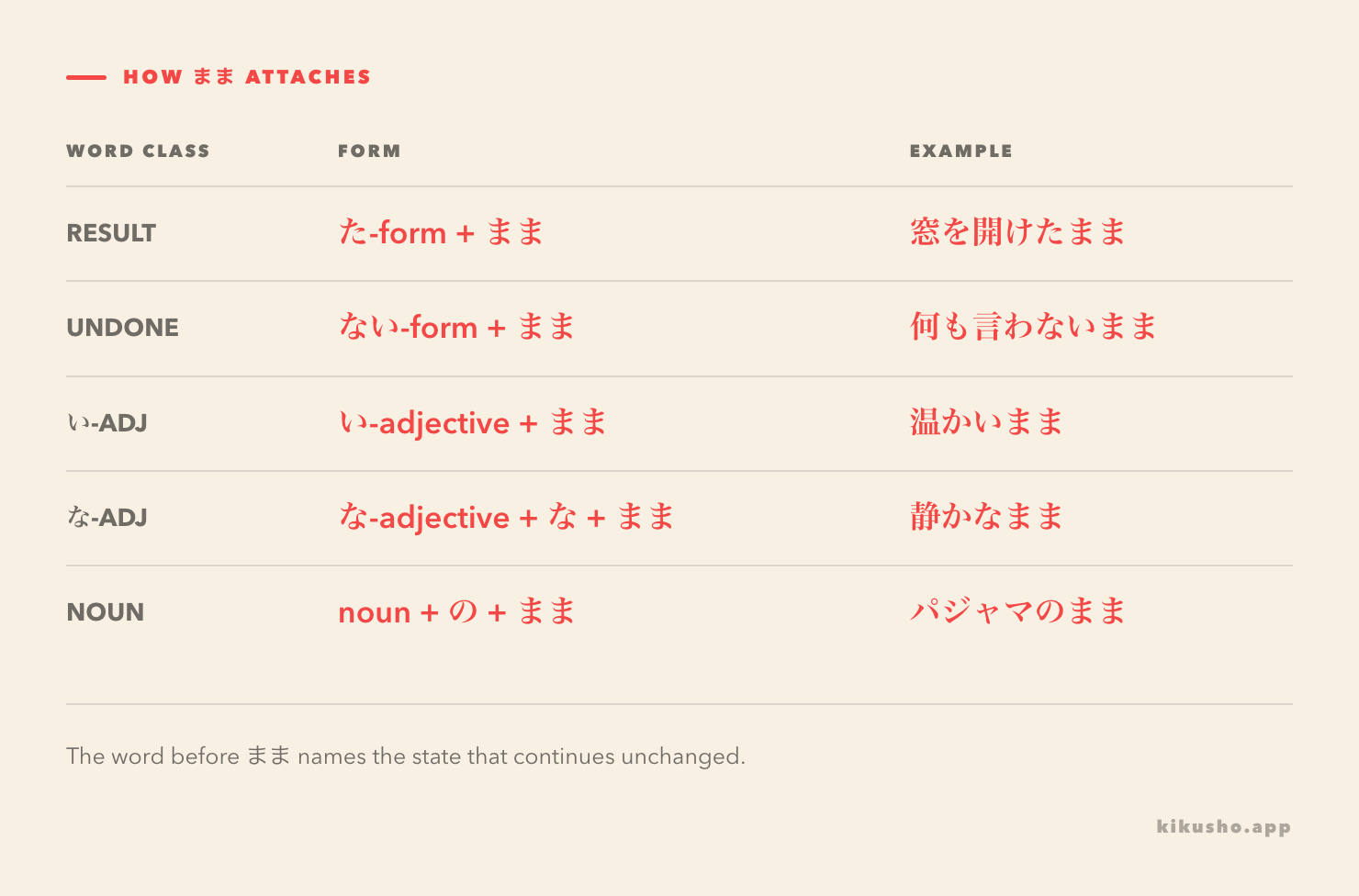
| What comes before まま | Form | Example | State retained |
|---|---|---|---|
| Verb, result present | た-form + まま | 窓を開けたまま | with the window left open |
| Verb, action undone | ない-form + まま | 朝ご飯を食べないまま | without eating breakfast |
| い-adjective | い-adjective + まま | 温かいまま | while still warm |
| な-adjective | な-adjective + な + まま | 静かなまま | remaining quiet |
| Noun | noun + の + まま | パジャマのまま | still in pajamas |
The final まま is normally written in hiragana. The kanji spellings 儘 and 侭 exist, but they are rare in ordinary learner-facing prose.
JLPT Sensei lists these five attachments and places the pattern at N4. 日本語NET independently gives the same formation and defines the pattern as one state continuing without change.
The た-form names a result, not merely past time
In 窓を開けたまま, opening happened first and its result remains: the window is open. The た-form creates the state that まま preserves.
窓を開けたまま、出かけてしまいました。
まどを あけたまま、でかけてしまいました。
I went out with the window left open.
The sentence does not say that opening and leaving happened simultaneously. Opening produced a result; leaving happened against that background. This is why translating た only as an English past tense misses the construction.
The state can be a posture rather than a changed object:
立ったまま話しました。
たったまま はなしました。
I spoke while remaining standing.
Standing is maintained while the speaking occurs. Context decides whether that is ordinary, uncomfortable or surprising. まま itself does not accuse anyone of carelessness.
The ない-form keeps an action undone
With a verb's ない-form, the missing action remains missing when the next event occurs.
何も言わないまま、部屋を出ました。
なにも いわないまま、へやを でました。
I left the room without saying anything.
朝ご飯を食べないまま、学校へ行きました。
あさごはんを たべないまま、がっこうへ いきました。
I went to school without eating breakfast.
The negative belongs before まま: 言わないまま, not 言ったままではない for this meaning. The main verb then reports what happened while the non-action continued.
This form does not automatically mean “never.” 返事をしないまま三日が過ぎました says three days passed with the reply still unsent. A later sentence may report that it was sent.
Nouns and adjectives preserve a quality or appearance
A noun takes の, and a な-adjective keeps な. An い-adjective keeps its full dictionary form.
パジャマのまま、コンビニへ行きました。
パジャマのまま、コンビニへ いきました。
I went to the convenience store still in my pajamas.
この料理は温かいまま食べてください。
この りょうりは あたたかいまま たべてください。
Please eat this dish while it is still warm.
会場はしばらく静かなままでした。
かいじょうは しばらく しずかなままでした。
The venue remained quiet for a while.
Do not replace the noun's の with な: パジャマのまま. Do not remove the な from a な-adjective: 静かなまま. Demonstratives attach directly in the familiar expressions このまま, そのまま and あのまま.
まま, ままで and ままにする divide different jobs
Bare まま can place the retained state before another event: 靴を履いたまま入る, enter with shoes on. ままで often packages that state as the circumstance for a predicate or ends with the copula.
このままで大丈夫です。
このままで だいじょうぶです。
It is fine as it is.
そのままで待ってください。
そのままで まってください。
Please wait just as you are.
With にする, the unchanged state becomes something a person chooses or maintains:
部屋はこのままにしてください。
へやは このままに してください。
Please leave the room as it is.
The ~ておく lesson treats the related このままにしておく, deliberately leaving the situation in place. In ままにする, に belongs to the larger にする construction; it is not an alternative adjective ending.
A background state is different from a second active action
Compare the roles of まま and ながら.
| Sentence | Relationship |
|---|---|
| 電気をつけたまま寝た | the light's resulting state continues while I sleep |
| 音楽を聞きながら勉強した | listening and studying proceed together |
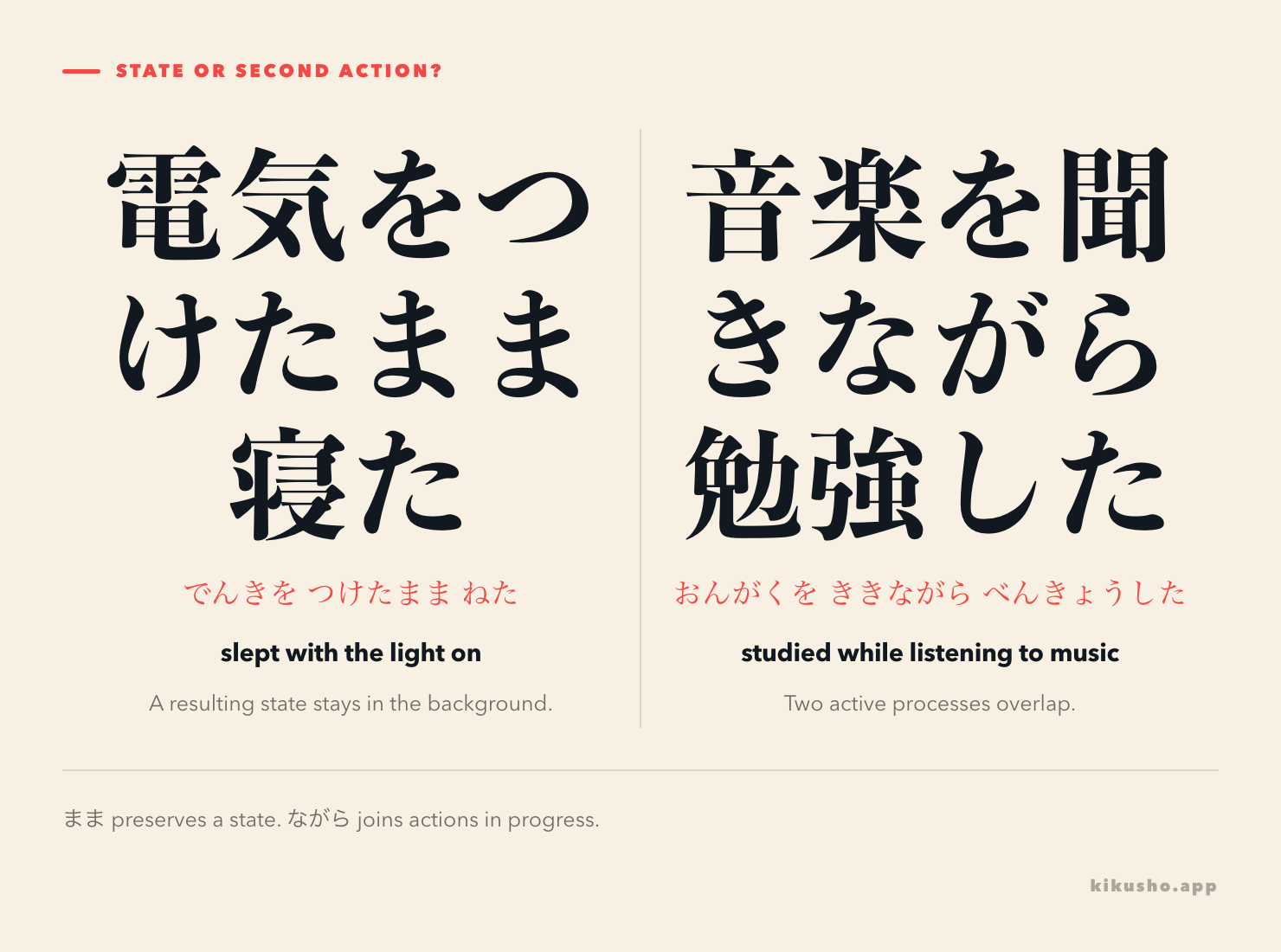
ながら joins two active processes performed by the same understood subject. まま supplies a condition that is left in place. The ~ながら lesson explains how the main action controls the sentence focus.
There can be overlap in real descriptions. 立ったまま話す focuses on the standing posture being maintained; 立ちながら話す is poor for the intended static posture because 立つ normally names the change into standing. The state-versus-action test explains the difference better than translating both forms as “while.”
Neutral まま stops before blame or intention
まま can describe an accident, a choice or a plain fact. Other constructions add meanings that are not built into it.
- テレビをつけたまま寝た states that the TV remained on while someone slept.
- テレビをつけっぱなしで寝た more readily suggests neglect: it was left running when it should have been turned off.
- 窓が開けてある presents an intentionally prepared result, such as a window opened for ventilation.
日本語教師のN1et contrasts neutral まま with the corrective or careless tendency of っぱなし. Bunpro's まま entry contrasts it with てある, whose continuing result implies purpose. The existing ている and てある comparison follows that intention directly.
The same Bunpro page places unchanged-state まま at N3, while JLPT Sensei, 日本語NET and The Japanese Page place it at N4. The Tanos comparison list also records plain まま at N3. These are study-publisher boundaries, not an official exhaustive JLPT list.
A separate advanced ままに can mean “as one likes” or “in accordance with,” as in 思うままに書く, write as one wishes. Bunpro files that reading at N1. It should not be imported into an N4 sentence such as 電気をつけたまま寝る, where まま simply keeps the light's state unchanged.
In casual speech, まま may be pronounced まんま. If a line passes too quickly to recognize, save the full phrase in Kikusho by voice and check the drafted example before keeping it. The surrounding verb tells you whether the speaker preserved a state, criticized neglect or used the separate advanced reading.
Try the distinctions
Keep your seven decisions together; the correction block begins only after the last one.
Question 1: form selection. Choose the sentence meaning “I fell asleep with the light on.”
- A. 電気をつくまま寝ました。
- B. 電気をつけたまま寝ました。
- C. 電気をつけないながら寝ました。
- D. 電気のままを寝ました。
Question 2: negative state. Complete “She left without saying her name”: 彼女は名前を__まま帰りました。
- A. 言った
- B. 言って
- C. 言わない
- D. 言います
Question 3: noun attachment. Which phrase means “still in pajamas”?
- A. パジャマなまま
- B. パジャマでまま
- C. パジャマのまま
- D. パジャマをまま
Question 4: build the sentence. Use 温かい, まま, 食べる, and ください to say “Please eat it while it is still warm.”
Question 5: choose the relationship. You studied while actively listening to music. Which sentence fits?
- A. 音楽を聞いたまま勉強しました。
- B. 音楽を聞きながら勉強しました。
Question 6: tone. Which statement is supported by 窓を開けたまま出かけました alone?
- A. The speaker left while the window remained open.
- B. The window was intentionally opened for ventilation.
- C. The speaker is necessarily blaming another person.
- D. The window had already been closed before departure.
Question 7: short passage. Read: 朝ご飯を食べないまま家を出て、コートを着たまま電車に乗りました。 Select the faithful account.
- A. The speaker ate breakfast, removed the coat and boarded.
- B. The speaker skipped breakfast and boarded while still wearing a coat.
- C. The speaker cooked breakfast while putting on a coat.
- D. The speaker stayed home because the coat was warm.
Answers and explanations
Answer 1. B, 電気をつけたまま寝ました. The た-form つけた supplies the resulting “on” state, and that state continues during sleep. A does not form the required verb, C mixes a negative with ながら, and D misattaches the noun particle.
Answer 2. C, 言わない. The ない-form keeps saying the name undone when 帰りました occurs. 言った would mean the saying happened and its result remained; the polite and て-forms do not fit this attachment.
Answer 3. C, パジャマのまま. A noun takes の before まま. The other particles do not build the noun attachment taught here.
Answer 4. 温かいまま食べてください。 The い-adjective remains complete before まま. 食べる changes to 食べて before ください; 温かなまま would use a different adjectival form and is not built from the supplied 温かい.
Answer 5. B, 音楽を聞きながら勉強しました. Listening and studying are both active processes. A would instead invite a context where a result or posture from 聞いた remains, which does not express the ordinary simultaneous listening requested.
Answer 6. A. The sentence presents the open-window state as continuing when the speaker leaves. Purpose, blame and the later state of the window require more context; まま supplies none of them by itself.
Answer 7. B. 食べないまま keeps breakfast uneaten when the speaker leaves. コートを着たまま keeps the coat-wearing state through boarding. Each まま phrase establishes the background for the following event.
When a sentence feels ambiguous, name the state before translating it. That step exposes the missing の or な, shows why a た-form can describe the present background, and keeps an active ながら action separate from something simply left unchanged.
Common questions
What does まま mean in Japanese grammar?
まま presents a state as continuing without change while another event happens or time passes. Depending on the sentence, it can mean as is, still in that state, with something left on, or without doing something.
What verb form comes before まま?
Use a verb's た-form for a resulting state that remains, as in 開けたまま, left open. Use the ない-form for an action that remains undone, as in 食べないまま, without eating.
Is まま always negative or careless?
No. It neutrally describes an unchanged state and can be intentional, accidental or simply factual. っぱなし more readily criticizes a state that someone should have ended.