On this page
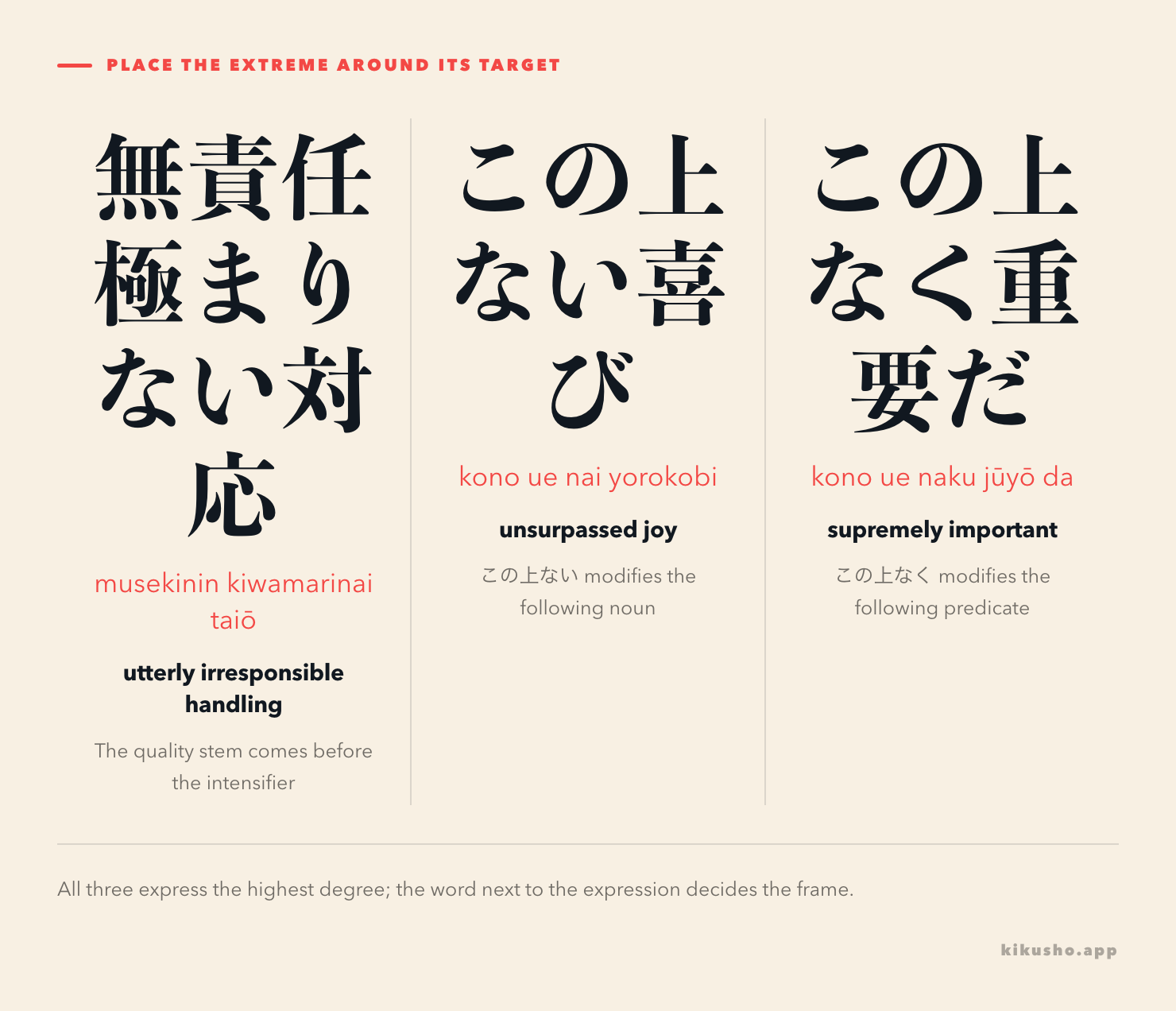
Use 極まる/極まりない after the quality you are judging, この上ない before a noun, この上なく before an adjective or predicate, and ことこの上ない after an adjective phrase. They all push a quality toward its highest degree, but their attachment and usual stance are different.
その会社の対応は無責任極まりないが、被害者への支援はこの上なく重要だ。解決の知らせを聞いた家族は、うれしいことこの上なかった。
その かいしゃの たいおうは むせきにん きわまりないが、ひがいしゃへの しえんは このうえなく じゅうようだ。かいけつの しらせを きいた かぞくは、うれしい こと このうえなかった。
The company's response was utterly irresponsible, but support for the victims is supremely important. The family was overjoyed to hear that the matter had been resolved.
The first expression delivers a sharp judgment. The second intensifies the predicate 重要だ. The third comes after うれしい and completes an emphatic evaluation. Translating every one as “extremely” hides the grammar that selects the form.
This lesson reviews inventory items g-d0130315fc89, 極まる/極まりない, and g-78459d8c7342, ことこの上ない/この上ない/この上なく. JLPT Sensei places both groups at N1, as does the Kikusho reference inventory, with no recorded level disagreement. The JLPT does not publish an exhaustive grammar syllabus. N1 here therefore reflects independent learning references; the exam authority does not certify individual grammar items.
Let sentence position make the first decision
| Position | Pattern | Example | Main effect |
|---|---|---|---|
| after a na-adjective or noun-like quality stem | stem + 極まる/極まりない | 無責任極まりない対応 | an emphatic judgment, often critical |
| after a full adjective description | A + こと + 極まる/極まりない | 危険なこと極まりない | the quality reaches an extreme |
| directly before a noun | この上ない + N | この上ない喜び | an unsurpassed N |
| before an adjective or predicate | この上なく + A/predicate | この上なく幸せだ | supremely A |
| after an adjective phrase | A + ことこの上ない | 嬉しいことこの上ない | it could not be more A |
Start with the word next to the expression. この上ない喜び needs a noun after it. この上なく重要だ needs an adjective or predicate after it. うれしいことこの上ない has already stated the quality and closes the sentence with an evaluation.
極まりない is not the negative of 極まる
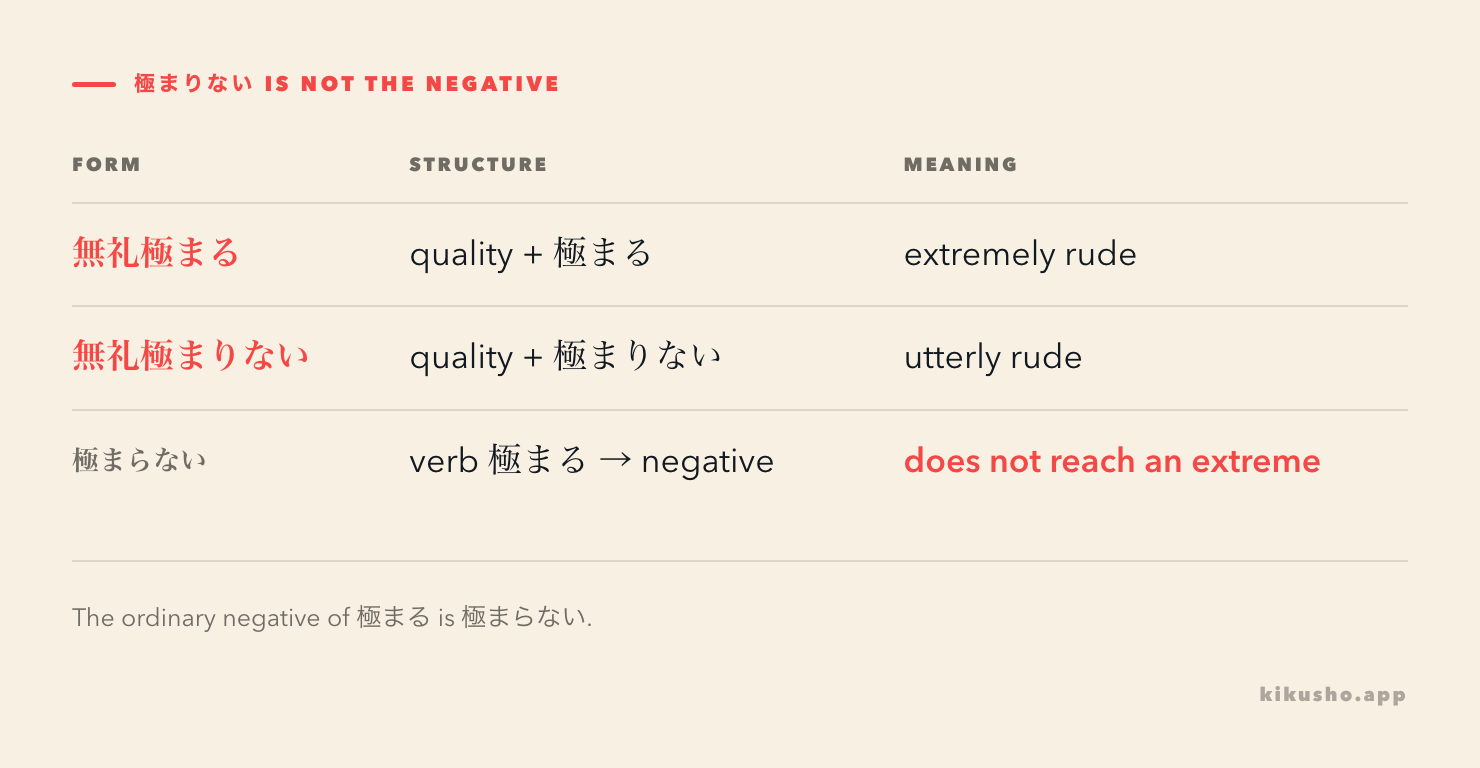
The most dangerous visual clue in this group is ない. In ordinary conjugation, the negative of the verb 極まる is 極まらない. The established intensifier 極まりない has a different structure and history: it can be understood as 極まり + ない, “there is no limit.” Its whole meaning is therefore emphatic, not negative.
| Form | Meaning in this lesson |
|---|---|
| 無礼極まる | extremely rude; the height of rudeness |
| 無礼極まりない | extremely rude; utterly rude |
| 極まらない | does not reach an extreme; ordinary verb negation |
顧客の情報を無断で公開するとは、無責任極まりない行為だ。
こきゃくの じょうほうを むだんで こうかいするとは、むせきにん きわまりない こういだ。
Publishing customer information without permission is utterly irresponsible conduct.
十分な装備もなく冬山に入るのは、危険なこと極まりない。
じゅうぶんな そうびも なく ふゆやまに はいるのは、きけんな こと きわまりない。
Entering the winter mountains without adequate equipment is extremely dangerous.
Mainichi Nonbiri's grammar account gives both 極まる and 極まりない the same extreme-degree force and records their written register. Bunpro's comparison also distinguishes intensifying 極まりない from the verbal negative 極まらない.
Both intensifiers occur in formal, literary or forceful prose. They readily follow a na-adjective stem such as 失礼, 無責任, 危険 or 残念. With a full adjective description, こと gives the quality a nominal frame: 危険なこと極まりない and 面白いこと極まりない.
Critical judgments are especially common. That tendency is useful for choosing a natural example, but it is not a rule that makes positive use impossible. Do not invent a degree distinction such as “極まりない is stronger than 極まる”; for production, treat both as reaching the extreme and learn the collocation that the sentence actually uses.
The この上ない family moves around the quality
The image behind この上ない is “there is nothing above this.” Unlike 極まりない, its three common shapes occupy three different slots.
この上ない goes before a noun
長年の夢が実現し、この上ない喜びを感じています。
ながねんの ゆめが じつげんし、このうえない よろこびを かんじています。
My long-held dream has come true, and I feel unsurpassed joy.
Here この上ない directly modifies 喜び. It works like a fixed adjective meaning “unsurpassed” or “the greatest possible.” Other natural noun partners include 幸せ, 光栄 and 機会.
この上なく goes before a predicate
静かな湖と澄んだ空が、この上なく美しかった。
しずかな みずうみと すんだ そらが、このうえなく うつくしかった。
The quiet lake and clear sky were supremely beautiful.
Changing ない to the adverbial なく lets the expression modify 美しい. The same frame works with a na-adjective predicate: この上なく合理的だ, “supremely rational.”
ことこの上ない goes after the adjective phrase
信頼していた相手に裏切られるのは、悲しいことこの上ない。
しんらいしていた あいてに うらぎられるのは、かなしい こと このうえない。
Being betrayed by someone you trusted is as sad as can be.
説明書なしでこの装置を組み立てるのは、複雑なことこの上ない。
せつめいしょ なしで この そうちを くみたてるのは、ふくざつな こと このうえない。
Assembling this device without instructions is exceedingly complicated.
An i-adjective keeps its plain form before こと. A na-adjective uses なこと; the more formal であること is also possible. Edewakaru's lesson shows both the sentence-final ことこの上ない and the adverbial この上なく conversion. It also records the hard, written flavor of the pattern.
The shared ceiling does not create free substitution
All the forms describe an upper extreme, yet the same noun or adjective cannot simply be dropped into every frame.
| Intended sentence | Natural choice | Why |
|---|---|---|
| utterly careless handling | ずさん極まりない対応 | a critical quality stem precedes the intensifier |
| an unsurpassed honor | この上ない光栄 | 光栄 is the following noun |
| supremely convenient | この上なく便利だ | 便利だ is the following predicate |
| as regrettable as can be | 残念なことこの上ない | the na-adjective phrase precedes こと |
極まる/極まりない often sounds like an authoritative evaluation of conduct or a state. The この上ない family is more flexible about positive and negative qualities: この上ない喜び is positive, while 複雑なことこの上ない is negative. These are tendencies in use, not polarity rules.
The earlier lesson on 限りだ, の至り and の極み covers three other ways to present a strong evaluation. Its の極み is a noun phrase built as N + の極み, while the productive intensifier here uses stem + 極まる/極まりない. Compare 無礼の極みだ with 無礼極まりない; both condemn extreme rudeness, but their attachment is different.
Keep lexical 極まる expressions separate
Not every 極まる is this productive intensifier. In 感極まる, emotion reaches a peak and overwhelms someone:
優勝が決まった瞬間、監督は感極まって涙を流した。
ゆうしょうが きまった しゅんかん、かんとくは かんきわまって なみだを ながした。
When the championship was decided, the coach was overcome with emotion and cried.
Treat 感極まる as a lexical expression. The same caution applies to fixed compounds and older expressions in which 極まる is an ordinary verb. They do not prove that every noun can become an intensifier by adding 極まる.
These forms are also marked choices. In casual conversation, 本当に, すごく, とても or ものすごく will often be more natural. Choosing 無責任極まりない makes the judgment sound deliberate and severe; choosing この上ない喜びです gives the line a formal, ceremonial weight.
Preserve the full frame when you review
A card with only この上ない = utmost does not tell you where the noun goes. Save この上ない喜び, この上なく重要だ and 嬉しいことこの上ない as separate frames. For 極まりない, keep both the quality and the evaluated noun, as in 無責任極まりない対応.
Kikusho can turn a full sentence captured from text, voice or a photo into an editable card. Check the generated reading and preserve enough context to reconstruct the attachment during review. The question to recall is not only “How do I say extremely?” but “Where is the quality, and what does this expression modify?”
Practice: locate the quality before choosing the form
Question 1 — grammar choice. Complete the noun-modifying frame: 長年の研究が認められたことは、研究者にとって__光栄だった。
① この上ない
② この上なく
③ 極まらない
④ ことこの上ない
Question 2 — grammar choice. Choose the form that directly intensifies the predicate: 被災地への迅速な支援は__重要だ。
① この上ない
② この上なく
③ この上のない
④ こと極まらない
Question 3 — text grammar. In 個人情報を放置するとは、無責任極まりない, does ない negate the judgment, or intensify it? Give the actual negative of the verb 極まる.
Question 4 — repair the sentence. Rewrite この上なく喜びを感じた so that 喜び remains the noun being modified.
Question 5 — grammar choice. Complete the na-adjective pattern: 手がかりもなく犯人を捜すのは、困難__。
① ことこの上ない
② なことこの上ない
③ にこの上ない
④ で極まらない
Question 6 — text grammar. Compare 無礼の極みだ and 無礼極まりない. Do they use the same attachment, and which earlier Kikusho lesson develops the noun-based expression?
Question 7 — production. Combine この上なく, 静かだ, and 過ごしやすい into a sentence describing a supremely quiet, comfortable hotel.
Answers and explanations
Walkthrough 1
① この上ない. 光栄 is the following noun, so the attributive form modifies it directly: この上ない光栄. この上なく would need a following adjective or predicate.
Walkthrough 2
② この上なく. The adverbial form modifies the predicate 重要だ: この上なく重要だ. この上ない would instead modify a noun, as in この上ない重要性.
Walkthrough 3
It intensifies the criticism: the handling is utterly irresponsible. The ordinary negative of 極まる is 極まらない. 極まりない is an established extreme-degree expression, not that negative conjugation.
Walkthrough 4
この上ない喜びを感じた。 Because 喜び remains a noun, use この上ない directly before it. A different repair, この上なく喜んだ, would change the noun into the verb 喜ぶ.
Walkthrough 5
② なことこの上ない. 困難 is a na-adjective, so its attributive な appears before こと. The expression then closes the evaluation: 困難なことこの上ない.
Walkthrough 6
No. 無礼の極みだ uses N + の極み, while 無礼極まりない attaches the intensifier directly to the quality stem. The linked lesson on 限りだ, の至り and の極み develops the noun-based expression.
Walkthrough 7
そのホテルはこの上なく静かで、過ごしやすかった。 この上なく works adverbially before 静かだ; the て-form 静かで then joins the second evaluation.
This lesson was reviewed for attachment, the non-negative meaning of 極まりない, register, polarity tendencies, the lexical boundary around 感極まる, and the answer logic of all seven exercises. AI-assisted comparison and editing were used; no human language review is claimed.
Common questions
Is 極まりない the negative form of 極まる?
No. In this intensifying construction, both 極まる and 極まりない mean that a quality reaches an extreme. The ordinary negative of the verb 極まる is 極まらない.
What is the difference between この上ない, この上なく and ことこの上ない?
Their position changes. この上ない modifies a following noun, この上なく works adverbially before an adjective or predicate, and ことこの上ない follows an adjective phrase to complete the evaluation.
Are 極まる and 極まりない always negative?
They strongly favor critical evaluations such as 無責任極まりない, but the grammar marks extreme degree rather than grammatical negativity. Context and the evaluated word determine the judgment.
Can ことこの上ない describe something negative?
Yes. It can intensify positive or negative evaluations. 嬉しいことこの上ない expresses supreme joy, while 複雑なことこの上ない describes something as exceedingly complicated.