On this page
説明を読んだものの、まだ操作できない means “Although I've read the instructions, I still can't operate it”: ものの (mono no) concedes the first fact while the second clause qualifies what it achieved. とはいえ (to wa ie) is closer to “even accepting that…” or “that said,” acknowledging a claim without accepting every conclusion someone might draw from it.
Both belong in your reading vocabulary for formal Japanese. This lesson sits in our N2 grammar sequence, but it compares N2 ものの with N1 とはいえ. You need plain verb forms and the difference between nouns, い-adjectives and な-adjectives. Read 説明 as せつめい, “explanation” or “instructions,” and 操作 as そうさ, “operation” of equipment.
Decide what the second clause qualifies
Concession means allowing one point to stand while explaining why it does not settle the matter. In the opening sentence, reading the instructions is real. Being able to use the equipment has not followed.
For Aものの、B, look for a fact being granted and a contrasting result, limitation or other side of the same situation. For Aとはいえ、B, try “Granted A; even so, B.” A can be a label such as “beginner,” an assessment such as “convenient,” or a whole event.
This is a guide to the writer's emphasis, not a rule dividing all facts from all descriptions. とはいえ can acknowledge a concrete event too. Bunpro's explanation of とはいえ makes that broader scope clear: accepting the first statement does not remove the force of the second.
A useful distinction is structural. If you want to finish one sentence and begin the next with “That said,” とはいえ can do that. Bare ものの cannot do the same job.
ものの grants a fact without granting the expected result
新しい道具を買ったものの、まだ使っていない。
あたらしいどうぐをかったものの、まだつかっていない。
“I bought a new tool, but I still haven't used it.”
Buying the tool might lead someone to expect that you are using it. ものの introduces the qualification. The second clause carries the point you want the reader to retain.
The first clause need not describe a completed action:
内容は分かるものの、うまく説明できない。
ないようはわかるものの、うまくせつめいできない。
“I understand the content, but I can't explain it well.”
分かる is nonpast. The sentence describes a current limitation, so changing it to 分かった merely because the construction often appears after a た-form would change the time perspective.
JLPT Sensei's ものの reference gives its verb and adjective connections and places it at N2. The Bunpro lesson also treats the expression as formal and more specific than a general-purpose “but.”
Change the connection after nouns and な-adjectives
These are dependable starting patterns for the comparison:
| Before the connector | With ものの | With とはいえ |
|---|---|---|
| Verb, plain form | 読んだものの | 読んだとはいえ |
| い-adjective | 高いものの | 高いとはいえ |
| な-adjective | 便利なものの | 便利とはいえ/便利だとはいえ |
| Noun | 学生であるものの | 学生とはいえ/学生だとはいえ |
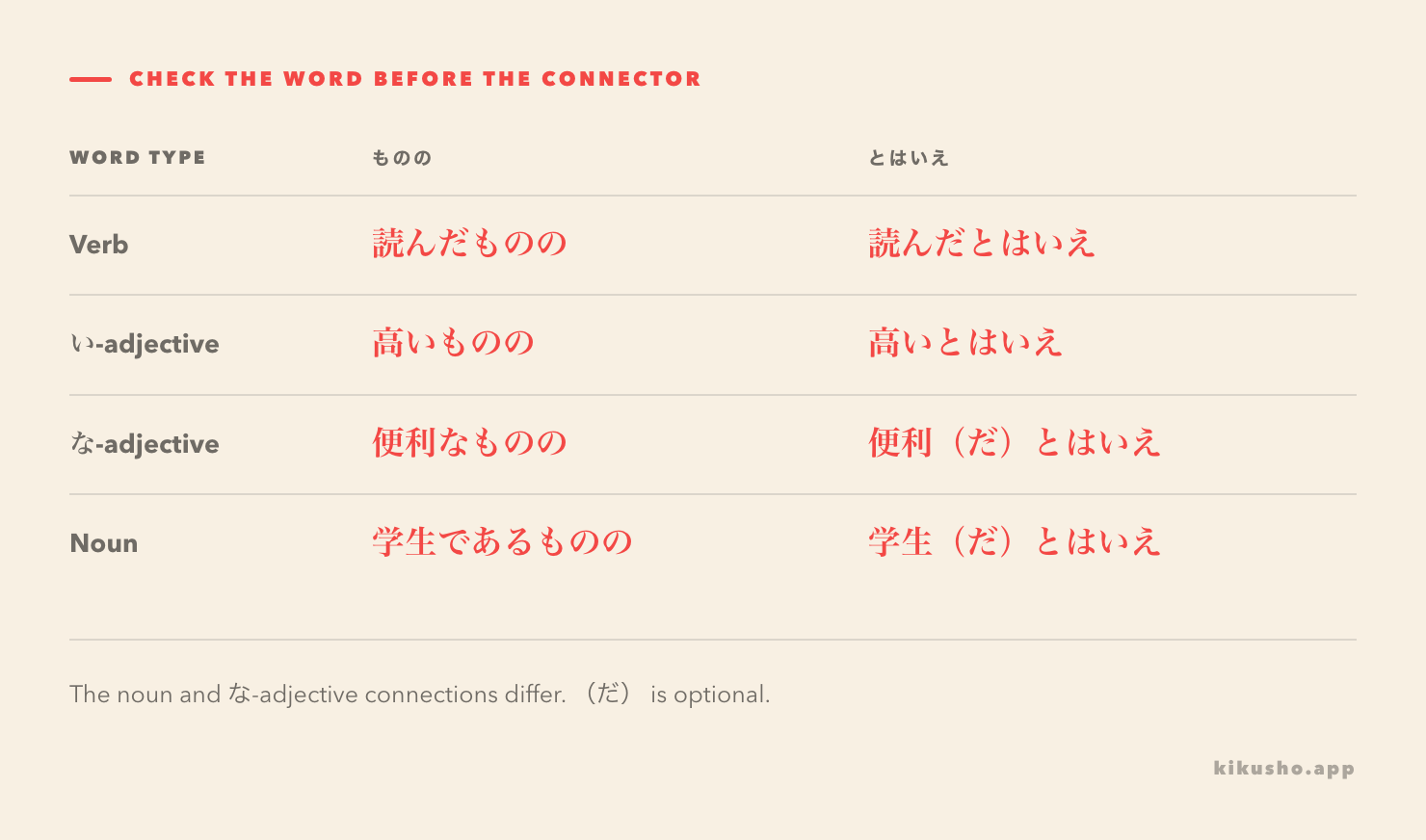
Read 便利 as べんり, “convenient,” and 学生 as がくせい, “student.” Keep な in 便利なものの. For a noun, the standard pattern here is であるものの, not 学生だものの. You will also meet ではあるものの, with a more explicit concessive は.
Past and negative forms carry their own endings: 便利だったものの, “although it was convenient”; 読まなかったものの, “although I did not read it.” Do not add another な after だった. For example, 便利だったものの、修理代が高すぎた means “It was convenient, but the repair cost was too high.” Read 修理代 as しゅうりだい.
The forms before とはいえ work differently. 便利だとはいえ and 便利とはいえ are both possible; so are 学生だとはいえ and 学生とはいえ. JLPT Sensei's とはいえ chart explicitly marks だ as optional after nouns and な-adjectives. Do not carry the な from 便利なものの across to make 便利なとはいえ.
とはいえ limits the conclusion a label invites
初心者とはいえ、説明はとても正確だった。
しょしんしゃとはいえ、せつめいはとてもせいかくだった。
“Although they were a beginner, their explanation was very accurate.”
The writer accepts the description 初心者, “beginner,” then resists the assumption that a beginner's explanation will be unreliable. とはいえ does not tell us that somebody literally spoke the word “beginner.” It can acknowledge a description already understood in the situation.
It also works with an event rather than a category:
一度会ったとはいえ、まだよく知らない。
いちどあったとはいえ、まだよくしらない。
“Although we've met once, I still don't know them well.”
Meeting once happened; familiarity remains limited. In her study of concessive expressions, 角田三枝 describes とはいえ as accepting a premise while maintaining the speaker's judgment or assertion. For reading, the practical question is: what inference from the first clause is the writer asking me to resist?
Treat とはいえ as a fixed connector. The いえ inside it is not an instruction to your reader to say something.
とはいえ can reach back across a full stop
Compare these three ways of describing a service:
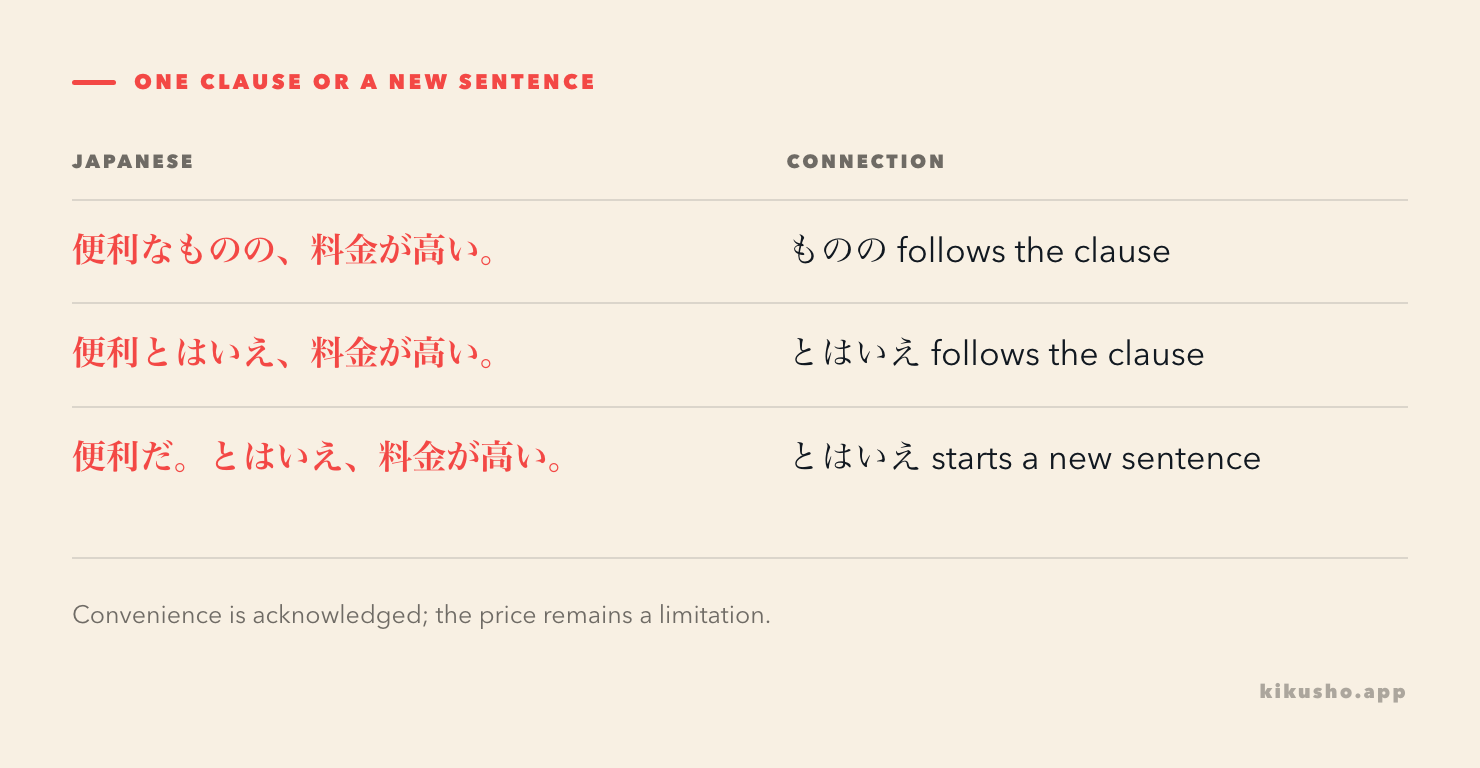
In selectable text, the forms are 便利なものの、料金が高い, 便利とはいえ、料金が高い, and 便利だ。とはいえ、料金が高い. Read 料金 as りょうきん, “charge” or “fee.” All three acknowledge convenience and raise the price as a limitation. The last version makes a separate statement first: “It's convenient. That said, the charges are high.”
Meguro Language Center's N1 handout explicitly records this sentence-initial use. It is useful in a review or an argument when the previous sentence has already established the favorable point.
Do not split 便利なものの in the same way and write 便利だ。ものの、料金が高い. The bare connector still needs the preceding clause. When choosing an answer, punctuation can settle a question that the translation “although” leaves open.
A negative ending is common, not compulsory
The two forms often introduce limitations, but the result can be favorable:
この箱は小さいものの、丈夫だ。
このはこはちいさいものの、じょうぶだ。
“This box is small, but sturdy.”
There is no negative verb ending. 小さい grants one feature and 丈夫 supplies another that matters more to the evaluation. Replacing ものの with とはいえ is also possible here: the size is acknowledged without allowing it to dismiss the box's usefulness.
Nor must ものの always describe a failed expectation. It can add a reservation inside a positive assessment. In 傷はあるものの、この机はまだ使える, “Although it has scratches, this desk is still usable,” the scratches qualify the main point about usefulness. Read 傷 as きず and 机 as つくえ.
松下光宏's corpus study of ものの explains this qualifying role and the close relationship between the topics of its two clauses. That is a better check than merely demanding the same visible subject word twice: keep both halves concerned with one coherent situation, including its features or parts.
Formal concession does more than make “but” sound grand
A plain background-setting が does not necessarily concede anything. 質問があるのですが can introduce a question politely. Substituting ものの would invite a contrasting continuation that was never intended.
For a real contrast in casual conversation, けど is often the more ordinary choice. ものの and とはいえ suit written explanation and formal discussion; “written” does not mean nobody says them aloud. The Self Taught Japanese discussion of ものの is useful for recognizing that literary tone. A polite ending on the main clause can coexist with a plain form before the connector.
Formal writing also needs words for when something happens. The neighboring N2 lesson on にあたって and に際して concerns occasions; the forms here organize a concession. A more formal expression should preserve the relationship you mean to express.
Level labels need the same care. Bunpro and JLPT Sensei both place ものの at N2 and とはいえ at N1; the MLC handout agrees on N1 for とはいえ. Our comparison deliberately reaches ahead. The official JLPT FAQ explains that the current test has no published exhaustive grammar syllabus.
When saving one of these phrases in Kikusho, include the clause after the comma in the text you paste. Check the generated example before keeping the card: if it loses the qualification, the exercise has lost its point. The broader lesson on keeping words in sentences explains why that surrounding language matters.
Five questions: attachment, order and connected text
These original exercises practise the constructions; they are not official JLPT questions. Finish the set before scrolling to the shared answer block.
Question 1: choose the な-adjective connection
この部屋は静か( )ものの、少し暗い。
A. だ
B. に
C. な
D. の
Question 2: keep the noun connection intact
Choose the form that completes the sentence without changing ものの.
私は学生( )ものの、すでに会社を経営している。
経営する(けいえいする)means to run a business.
A. である
B. な
C. だ
D. に
Question 3: put the four parts in order
Use every part once to make: “Although I checked it many times, I couldn't find the mistake.” Which part belongs in the ★ position?
何度も ___ ___ ★ ___ 。
A. 見つからなかった
B. 確認した
C. 間違いが
D. ものの
Read 確認 as かくにん and 間違い as まちがい.
Question 4: connect the two sentences
Read the whole update. Which connector makes the second sentence qualify the first?
新しい案は、前の案より費用が安い。( )、準備に時間がかかるので、すぐには始められない。
A. だから
B. とはいえ
C. 例えば
D. ものの
案(あん)means proposal, 費用(ひよう)means cost, and 準備(じゅんび)means preparation.
Question 5: identify what the writer concedes
Read this short review:
このかばんは軽いものの、丈夫で長く使えそうだ。持ち手も握りやすい。
Which interpretation fits the review?
A. The bag is light, but it seems sturdy and likely to last.
B. The bag is sturdy because it is light.
C. The reviewer has not decided whether the bag is light.
D. The bag used to be sturdy but is now damaged.
かばん means bag; 持ち手(もちて)means handle; 握りやすい(にぎりやすい)means easy to grip.
Answers and explanations
Answer 1
C, な. 静か is a な-adjective, giving 静かなものの: “Although this room is quiet, it's a little dark.” The room is the shared topic. だ, に and の do not supply the required connection in this sentence.
Answer 2
A, である. 学生 is a noun: 学生であるものの. The sentence means “Although I'm a student, I already run a company.” な belongs to the な-adjective pattern; bare だ and に do not connect this noun to ものの here. 学生とはいえ would be possible, but it would change the connector supplied by the question.
Answer 3
C, 間違いが, occupies ★. The complete order is B → D → C → A: 何度も確認したものの、間違いが見つからなかった. ものの follows the plain past 確認した; 間違いが is the subject of 見つからなかった. “Although I checked it many times, I couldn't find the mistake.” The hoped-for discovery did not follow from repeated checking.
Answer 4
B, とはいえ. “The new proposal costs less than the previous one. That said, preparation takes time, so we can't begin immediately.” The writer grants the lower cost but adds a practical obstacle. だから would introduce a consequence; 例えば would introduce an example. Neither describes this relationship. Bare ものの cannot start the independent second sentence in this position.
Answer 5
A. Lightness is accepted, while sturdiness and potential durability form the main evaluation. The next sentence adds that the handle is easy to grip, continuing the positive review. B turns concession into cause; C erases the accepted fact; D invents a change over time and damage. The favorable continuation also shows why a rule requiring a negative ending after ものの would fail.
Common questions
What is the difference between mono no and towa ie?
ものの attaches to a clause and concedes a fact before giving a contrasting result or qualification. とはいえ acknowledges a claim or description and limits what follows from it. Their meanings overlap, but とはいえ can also begin a new sentence meaning that said.
Can a noun come directly before ものの?
For the standard noun pattern taught here, use noun + であるものの, as in 学生であるものの. A な-adjective takes なものの, as in 便利なものの. Before とはいえ, nouns and な-adjectives can appear with or without だ.
Are ものの and とはいえ both N2 grammar?
JLPT Sensei and Bunpro place ものの at N2 and とはいえ at N1; Meguro Language Center also teaches とはいえ in its N1 material. This N2 comparison includes the later form to clarify the distinction. Those levels are study classifications, not an official exhaustive JLPT syllabus.