On this page
Use ことから when a fact leads forward to an inference, origin or result. Use なぜなら after stating the claim first, then open a new sentence to explain why: A。なぜなら、Bからだ.
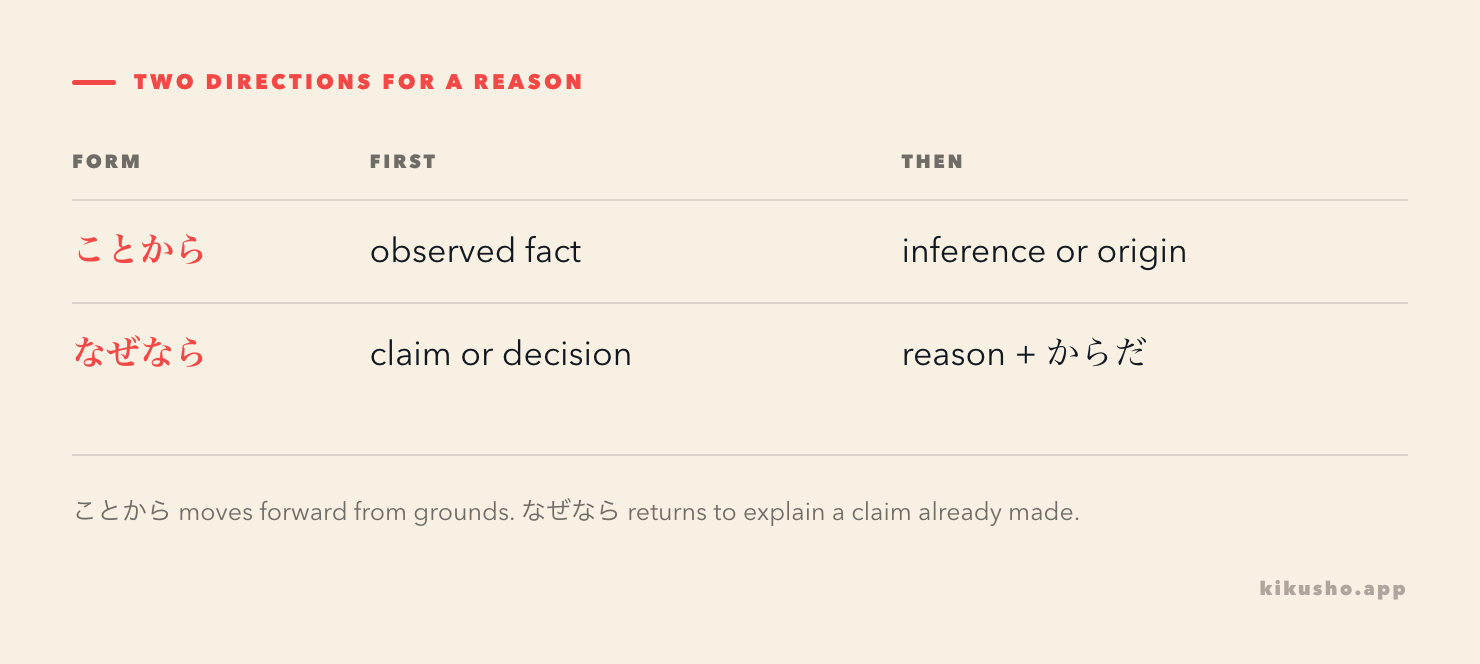
Both can translate as “because,” but they make the reader travel through the explanation in opposite directions. ことから begins with the grounds. なぜなら begins with what you want the reader to accept.
One begins with evidence; the other begins with the claim
Compare two reports built from the same information:
費用が予算を超えていることから、この案は実現が難しいと判断された。
ひようが よさんを こえていることから、この あんは じつげんが むずかしいと はんだんされた。
From the fact that the cost exceeds the budget, the plan was judged difficult to realize.
この案は実現が難しい。なぜなら、費用が予算を超えているからだ。
この あんは じつげんが むずかしい。なぜなら、ひようが よさんを こえているからだ。
This plan is difficult to realize. The reason is that the cost exceeds the budget.
The facts do not change. The first sentence presents 費用が予算を超えている as evidence and moves toward a judgment. The second states the judgment, stops, then uses なぜなら to tell the reader that its reason follows.
| Form | Information order | Typical job |
|---|---|---|
| fact + ことから、conclusion | grounds → conclusion | inference, origin, explanatory cause |
| claim。なぜなら、reason + からだ | claim → grounds | explicit justification of a prior statement |
JLPT Sensei and Bunpro place ことから at N3 and describe its “from the fact that” logic. Bunpro also treats factual inference and the reason behind a name as central uses.
Build ことから from a complete plain predicate
For verbs and い-adjectives, place ことから after the plain predicate. A な-adjective can use な or the more formal である before ことから. A noun uses である in the present affirmative. Past noun and な-adjective predicates can use だった.
| Predicate type | Attachment | Example |
|---|---|---|
| verb | plain verb + ことから | 窓が割れていることから |
| い-adjective | い-adjective + ことから | 値段が安いことから |
| な-adjective | な-adjective + な/である + ことから | 交通が便利なことから |
| noun | noun + である + ことから | 木造であることから |
| noun or な-adjective, past | だった + ことから | 学生だったことから |
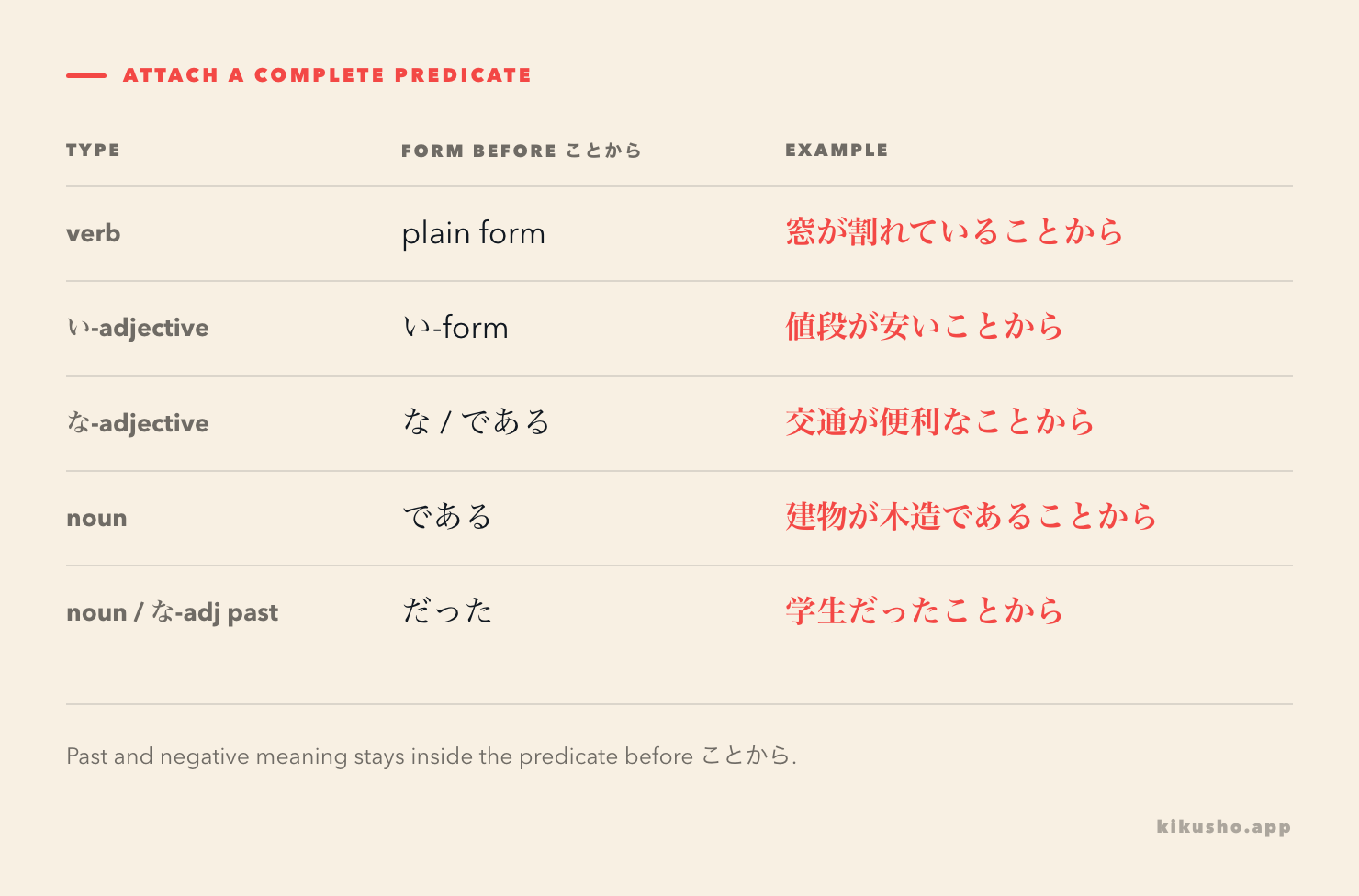
The verb can also be negative or past. 足跡が残っていないことから means “from the fact that no footprints remain,” while 席が隣だったことから means “because our seats were next to each other.” The tense and polarity belong inside the clause before ことから.
窓が割れていることから、誰かが侵入したと判断された。
まどが われていることから、だれかが しんにゅうしたと はんだんされた。
From the fact that the window is broken, it was concluded that someone had entered.
毛が白いことから、その犬はシロと名づけられた。
けが しろいことから、その いぬは シロと なづけられた。
Because its fur was white, the dog was named Shiro.
The first observation supports an inference. The second explains the origin of a name. This is more analytical than giving your everyday motive for an action. Tanosuke's N3 explanation likewise frames ことから as a way to explain why something happened or why someone reached a judgment.
Do not attach a present noun directly: 木造ことから is incomplete. Use 木造であることから. With a な-adjective, 便利なことから is common, while 便利であることから gives the predicate a more formal written shape.
なぜなら announces a reason after the claim
なぜなら is a conjunction. State the fact, opinion or decision first. Then begin the explanation with なぜなら or なぜならば and normally close the reason with からだ or からです.
私はこの提案に賛成できません。なぜなら、費用が高すぎるからです。
わたしは この ていあんに さんせいできません。なぜなら、ひようが たかすぎるからです。
I cannot support this proposal. The reason is that the cost is too high.
今日は早く帰ります。なぜなら、家族と約束があるからです。
きょうは はやく かえります。なぜなら、かぞくと やくそくが あるからです。
I will go home early today because I have plans with my family.
The pairing can look repetitive if you translate both なぜなら and から as “because.” Their jobs differ in Japanese. なぜなら points forward and marks the new sentence as an explanation; final からです marks the preceding clause as the reason.
Noun and な-adjective reasons still need だ before causal から:
この方法を選びました。なぜなら、安全だからです。
この ほうほうを えらびました。なぜなら、あんぜんだからです。
We chose this method because it is safe.
Here 安全 is a な-adjective. The reason closes with 安全だ + からです → 安全だからです. For a verb, attach から directly: 時間がかかるからです, “because it takes time.”
JLPT Sensei's なぜなら entry places the connector at N3 and gives the same result-first order. Bunpro's N3 treatment explains how the full なぜなら~から frame calls attention to an important reason.
Choose the architecture, not the English translation
Simple causal から and ので join a reason directly to what follows. They are usually enough for an everyday explanation:
雨だから、出かけません。
It is raining, so I will not go out.
The から and ので lesson compares how those basic connectors present a reason. The N3 forms here solve different reading problems.
Use ことから when the first clause itself is treated as a fact from which the writer derives something. Verbs such as 分かる, 判断する, 考える and 名づける often make that relationship visible in the second clause. Use なぜなら when the writer has already stated a claim and wants to pause before supplying its justification.
Do not confuse ことから with ことだから. The extra だ changes the structure. 真面目な田中さんのことだから、時間どおりに来るだろう predicts behavior from what the speaker knows about Tanaka's character. 電車が時間どおりに到着したことから、運行は正常だと分かった draws a conclusion from an observed fact.
The two target forms also point in the opposite direction from そのため. なぜなら looks backward and gives the reason for a prior claim; そのため carries an earlier reason forward into its consequence.
Keep both sides when you study the connector
A card containing only ことから = because cannot test the distinction. Keep the grounds and the conclusion together, such as 窓が割れていることから、侵入があったと判断された. For なぜなら, keep the full two-sentence movement from claim to reason.
Kikusho lets you paste that complete line, keep its register note and edit the generated example before saving it. The surrounding sentence is essential here: without it, you cannot see whether the writer began from evidence or returned to justify a claim.
Practice
Question 1 — choose the evidence connector
Complete the report: “From the fact that the lights are off, we concluded that no one is inside.”
明かりが消えている( )、中には誰もいないと判断した。
A. なぜなら
B. ことから
C. ことだから
Question 2 — complete the reason frame
Choose the natural ending:
この案には反対です。なぜなら、費用が高すぎる( )。
A. ことからです
B. からです
C. なぜならです
Question 3 — attach a noun
Complete the formal fact clause with 木造, “wooden construction”:
この建物は( )ことから、火の使用は禁止されている。
A. 木造
B. 木造な
C. 木造である
Question 4 — sentence composition
Reorder the pieces into two sentences that state the conclusion first and then explain it:
この方法は使えない / なぜなら / 安全ではない / からだ
Question 5 — choose the information order
You are writing how investigators inferred that someone entered from a broken window. Which pattern fits the intended evidence-to-conclusion movement?
A. 窓が割れていることから、誰かが侵入したと判断した。
B. 誰かが侵入したことから、窓が割れていると判断した。
Question 6 — text grammar
Read the passage:
この地域では冬の事故が多い。なぜなら、道路が凍る日が多いからだ。同じ傾向が毎年続いていることから、市は新しい対策が必要だと判断した。
Which form introduces the writer's explicit reason for the first claim, and which form presents the records as evidence for the city's judgment?
Question 7 — distinguish ことから from ことだから
Which sentence bases a prediction on a person's known character?
A. 彼が毎日練習していることから、上達した理由が分かる。
B. 努力家の彼のことだから、最後まで続けるだろう。
Answers and explanations
Answer 1. B. 明かりが消えていることから presents the lights being off as an observed fact that supports 誰もいないと判断した. A would need the conclusion first and a separate reason sentence. C is the different ことだから pattern.
Answer 2. B. The full frame is なぜなら、費用が高すぎるからです. なぜなら announces the explanation, and からです closes the reason clause. ことからです changes the structure, while なぜならです cannot close this reason.
Answer 3. C. A present affirmative noun uses である before ことから: 木造であることから. Bare 木造ことから is incomplete, and nouns do not take the な used with a な-adjective.
Answer 4. この方法は使えない。なぜなら、安全ではないからだ。 The claim comes first. なぜなら opens the second sentence, and negative な-adjective predicate 安全ではない takes からだ directly.
Answer 5. A. The broken window is the evidence; the inference is that someone entered. B reverses that logic and claims the entry is evidence for deciding the window is broken.
Answer 6. なぜなら~からだ introduces the reason for the first claim: icy-road days explain the high number of winter accidents. ことから then marks the same trend continuing every year as evidence from which the city concludes that new measures are needed.
Answer 7. B. 彼のことだから uses knowledge of his character as the basis for a prediction, 続けるだろう. A uses the observed fact of daily practice as grounds for understanding a reason, so it is the target ことから pattern.
Common questions
What is the difference between ことから and なぜなら?
ことから places a fact or observation before the conclusion, origin or result drawn from it. なぜなら follows a claim already stated and announces the reason in a new sentence, usually ending that reason with からだ or からです.
How do you attach ことから to nouns and adjectives?
Verbs and い-adjectives use their plain forms before ことから. A な-adjective commonly uses な or である, while a noun uses である; past noun and な-adjective predicates can use だった.
Does なぜなら need から at the end?
In the core N3 pattern, use claim + なぜなら(ば) + reason + からだ or からです. なぜなら signals that an explanation is coming, and the final から completes the stated reason.
Are ことから and なぜなら N3 grammar?
JLPT Sensei and Bunpro place both at N3, and Tanosuke independently teaches ことから at N3. These are study-guide placements because the JLPT does not publish an exhaustive official grammar list.