On this page
から (kara) explicitly presents your reason; ので (node) more often frames it as an explanation of circumstances, which can sound less assertive. Thus 寒いから、家にいます and 寒いので、家にいます both mean “It is cold, so I am staying home,” while differing in how the speaker offers the explanation.
Here 寒い(さむい) means “cold” and 家(いえ) means “home.” Nothing about the weather became more factual when the connector changed. The choice concerns how you present the reason, together with the register and the person you are addressing.
The test: an asserted reason or a considerate explanation?
Ask what you are doing with the sentence. Are you putting forward a reason for your decision or advice? から is a useful starting point. Are you explaining the situation behind a refusal, inconvenience or polite request? ので often makes that explanation easier to offer without pressing your own case.
This is a guide to a tendency, not a machine that sorts every sentence into one correct answer. Ordinary explanations have substantial overlap. First get the attachment right; then consider the listener and what follows the reason.
Both use this order:
reason + から / ので、result or response
English may put because in the middle of the translated sentence. Japanese puts the reason before the connector in this construction.
から puts your reason forward
You can use から to explain a personal decision:
今日は図書館が休みだから、家で勉強します。
きょうはとしょかんがやすみだから、いえでべんきょうします。
The library is closed today, so I will study at home.
The library closure is a real circumstance, but the speaker presents it as the reason for studying at home. Calling から “subjective” does not mean the reason must be an emotion or an unverified opinion.
It also works when you offer advice or ask someone to act:
道が暗いから、気をつけてください。
みちがくらいから、きをつけてください。
The road is dark, so please be careful.
道(みち) is “road” and 暗い(くらい) is “dark.” This is a reason for the advice, rather than a report that the darkness physically caused someone to be careful. For the request ending, see how ~てください works.
The directness can be useful. It can also sound insistent if you use the explanation to push someone into doing what you want. A polite ending such as ください does not settle that social question by itself.
ので explains the circumstances
ので gives you another way to connect a reason to what follows:
今日は仕事があるので、家に帰るのが遅くなります。
きょうはしごとがあるので、いえにかえるのがおそくなります。
I have work today, so I will get home late.
仕事(しごと) means “work,” and 遅くなります(おそくなります) means “will become late.” The speaker supplies a circumstance that explains the late return. The listener does not have to have known about the work beforehand: ので can introduce new information.
It is often useful before a considerate request:
後ろの席から見えませんので、少し右に動いてください。
うしろのせきからみえませんので、すこしみぎにうごいてください。
I cannot see from the seat at the back, so please move a little to the right.
Here 席(せき) is “seat,” 見えません(みえません) is “cannot see,” and 動いて(うごいて) is the て-form of “move.” 見えませんので is a polite reason clause. The explanation still concerns the speaker's own difficulty; that does not force a switch to から.
The TUFS reason-clause lesson describes から as making the reason more explicit and warns that it can sound one-sided when giving your own reasons for a request. It also shows ので before an invitation and an instruction. A rule saying “requests always require から” would miss those uses.
The overlap: hold the rest of the sentence still
Compare the same reason and the same decision:
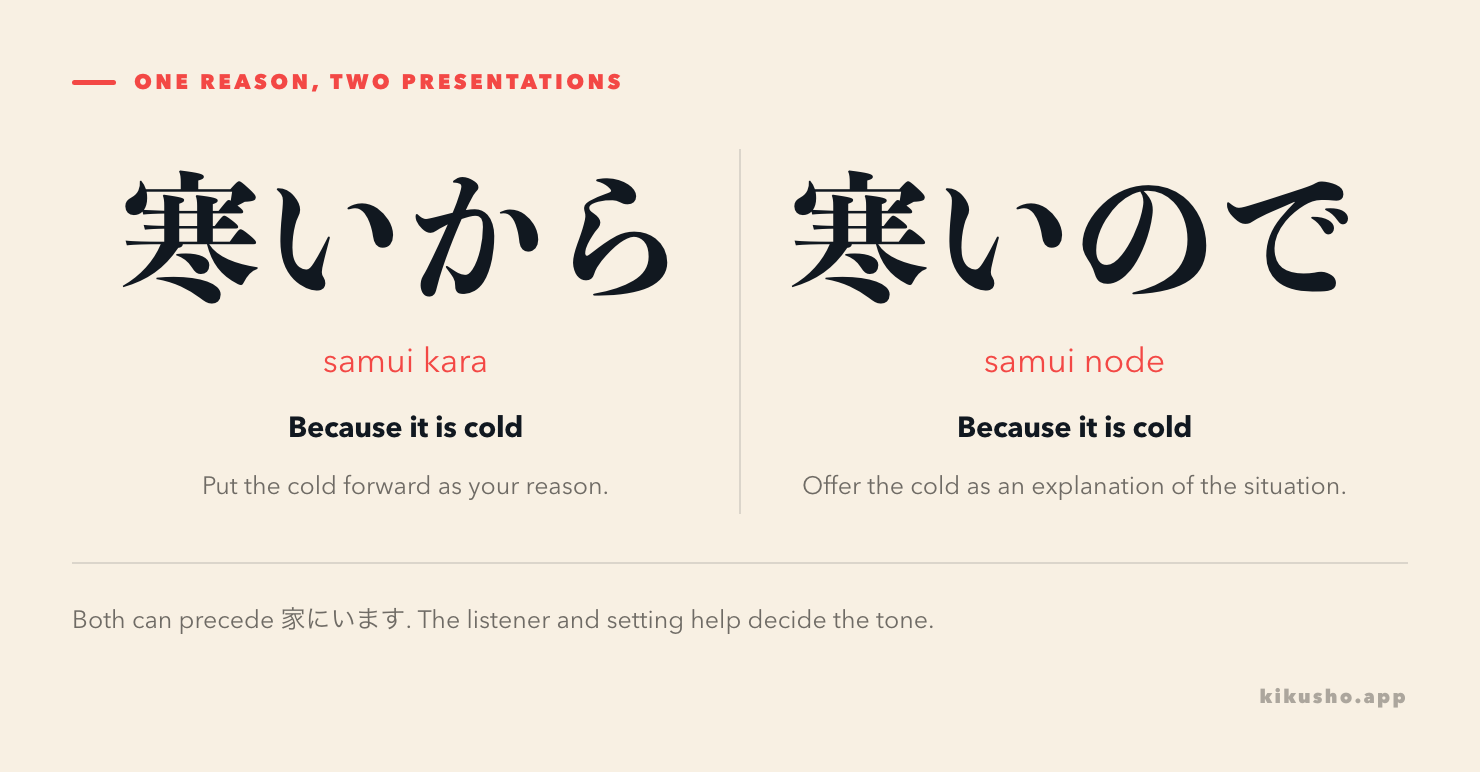
| Sentence | Shared meaning | Possible effect in context |
|---|---|---|
| 寒いから、家にいます。 | It is cold, so I am staying home. | Puts the cold forward as my reason for staying home. |
| 寒いので、家にいます。 | It is cold, so I am staying home. | Offers the cold as an explanation of the decision; can sound less assertive. |
Both are grammatical. Neither sentence identifies whether you are speaking to a friend, a colleague or a host expecting your visit. Those details affect which explanation fits. Tone can make から warm and ordinary, or make either version sound like an excuse.
Avoid comparisons that change 行きません (“will not go”) into 行けません (“cannot go”) at the same time as changing the connector. The new verb already changes the message, so it cannot show you what から or ので contributed.
The attachment changes at だ and な
With verbs and い-adjectives, append the connector to the predicate. With a present affirmative plain noun or な-adjective, use だ + から, but な + ので.
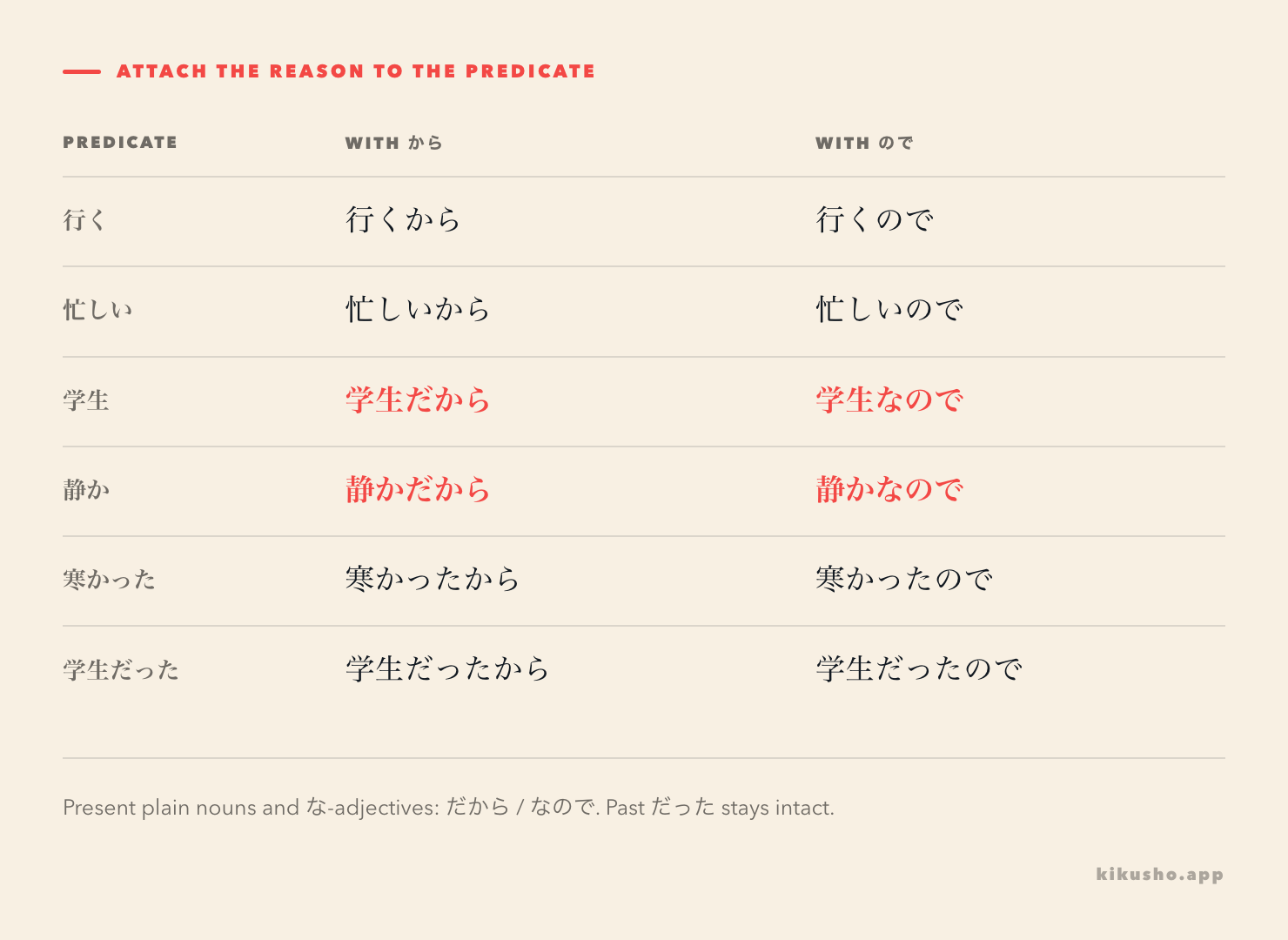
| Predicate | With から | With ので |
|---|---|---|
| 行く(いく), go | 行くから | 行くので |
| 忙しい(いそがしい), busy | 忙しいから | 忙しいので |
| 学生(がくせい), student | 学生だから | 学生なので |
| 静か(しずか), quiet | 静かだから | 静かなので |
| 寒かった(さむかった), was cold | 寒かったから | 寒かったので |
| 学生だった(がくせいだった), was a student | 学生だったから | 学生だったので |
The present noun pattern is not 学生から when you mean “because I am a student,” and standard ので attachment is not 学生だので. The same distinction applies to 静か. For the predicate forms themselves, use the lessons on です and だ and い- and な-adjectives.
Do not replace every だ sound with な. Past だった stays だった before both connectives. Negative predicates also keep their completed form: 忙しくないから / 忙しくないので mean “because [someone] is not busy.” You can review those changes in the negative and past-form lesson.
Polite predicates work with both
ので is not restricted to plain forms. These attachments are valid:
| Polite predicate | With から | With ので |
|---|---|---|
| 行きます, will go | 行きますから | 行きますので |
| 学生です, am/is a student | 学生ですから | 学生ですので |
| 静かです, is quiet | 静かですから | 静かですので |
| 忙しかったです, was busy | 忙しかったですから | 忙しかったですので |
Bunpro's ので guide explicitly notes attachment to ます, and TUFS permits both plain and polite predicates for both connectors. 学生なので uses a plain reason predicate; 学生ですので makes that predicate polite. Either can precede a politely ended result clause.
Register still matters. The abstract of Hanae Koiso's study of everyday conversation reports more ので in more formal settings and with polite endings, and a preference for から in family conversation. That supports treating formality and relationships as part of the choice, rather than reducing everything to facts versus feelings.
For a considerate explanation to someone you do not know well, ので is often a useful choice. This does not make から categorically forbidden with a teacher or manager, or make ので a guarantee that an unreasonable request sounds considerate.
Watch the boundary between because and from
The から in 駅から歩きます (えきからあるきます, “I walk from the station”) marks a starting point. It is not a reason clause, and substituting ので would not preserve the meaning.
The だから in 雨だから、歩きません (あめだから、あるきません, “It is raining, so I will not walk”) is noun + だ + causal から. A separate sentence beginning だから、… can instead mean “So…”; the sentence-connector lesson explains that discourse use. This page concentrates on joining a reason predicate to its result.
Bunpro and JLPT Sensei place the basic causal connectives at N5. That classification is a study estimate, consistent with this curriculum's source records. The JLPT FAQ explains why an exhaustive vocabulary and grammar list is no longer published.
When you save words from a notice or a page in Kikusho, keep a useful reason phrase together in an editable card: 休みなので (やすみなので, “because it is a day off”) teaches a connection that 休み alone does not. Photograph or capture the text, check the generated card, then practise producing the phrase from its meaning. Alternate a plain noun with a verb so that recalling the connector also trains the attachment.
Seven questions before the answers
These are original exercises. The JLPT test-item table includes grammar-form selection, sentence composition and text grammar at N5; the exercises below borrow those task categories, not official questions. A short set checks this lesson's distinctions rather than measuring readiness for the whole exam.
Question 1. Complete the plain noun reason: 私は学生(_____)、この本を安く買えます。 (“I am a student, so I can buy this book cheaply.”)
A. から B. だから C. なから D. だので
Question 2. Use ので after the plain present な-adjective: この部屋は静か(_____)、ここで本を読みます。 (“This room is quiet, so I will read here.”)
A. ので B. だので C. なので D. なから
Question 3. Which attachment correctly uses から with 忙しい?
A. 忙しいだから B. 忙しいなから C. 忙しから D. 忙しいから
Question 4. Put these four pieces into one sentence, with the reason first: 家に / なので / います / 雨. Meaning: “It is raining, so I am staying home.”
Question 5. Complete the explanation in this exchange. Keep the reason predicate explicitly polite, rather than using its plain form.
A:土曜日のパーティーに来ますか。
B:すみません。土曜日は仕事(_____)、行けません。
Read 土曜日 as どようび. A asks, “Will you come to the party on Saturday?” B replies, “Sorry. I have work on Saturday, so I cannot go.” 行けません(いけません) means “cannot go”; you are choosing the reason-clause attachment.
A. なので B. だので C. ですので D. でので
Question 6. Which statement is correct about 寒いから、家にいます and 寒いので、家にいます?
A. Only the first is grammatical because cold is a feeling.
B. Only the second is grammatical because weather is factual.
C. Neither can end with います after a plain reason.
D. Both are grammatical; context affects the presentation of the reason.
Question 7. Which sentence uses から to state a cause rather than a starting point or source?
A. 駅から歩きます。 (“I walk from the station.”)
B. 三時から勉強します。 (“I study from three o'clock.”)
C. 雨だから、歩きません。 (“It is raining, so I will not walk.”)
D. 友達から本をもらいました。 (“I received a book from a friend.”)
Read 三時 as さんじ and 友達 as ともだち. Finish all seven before moving to the answer block.
Answers and explanations
Answer 1. B — だから. The reason ends in the plain present noun predicate 学生だ, followed by から. Bare 学生から does not express the intended “because I am a student.” なから is the wrong attachment, and standard ので would require 学生なので, which is not an offered option. 安く買えます(やすくかえます) means “can buy cheaply.”
Answer 2. C — なので. A plain present affirmative な-adjective takes な before ので: 静かなので. Neither bare 静かので nor 静かだので is the standard construction. 静かなから does not correctly attach causal から either. 部屋(へや) means “room.”
Answer 3. D — 忙しいから. An い-adjective already supplies the predicate, so append から directly. Do not insert だ or な, or remove the adjective's final い. The complete negative version would be 忙しくないから, not a shortened 忙しから.
Answer 4. 雨なので、家にいます。 The sequence is 雨 → なので → 家に → います. The noun reason uses なので, followed by the location and the stay-at-home response. No extra だ is needed. Reordering the result first would not follow the question's required frame.
Answer 5. C — ですので. 仕事ですので is a polite noun predicate followed by ので, explaining the refusal in the exchange. 仕事なので is also grammatical and can precede 行けません, but it would use a plain reason predicate and would not satisfy this question's explicit register instruction. だので and でので are incorrect here. The exercise does not imply that polite refusals require polite morphology in every clause.
Answer 6. D — both are grammatical. The reason need not be sorted into a factual or emotional box. から makes the reason explicit; ので can offer it less assertively. Plain reason predicates can appear before the polite います. A listener and a situation would help you choose a tone, but their absence does not make one of these forms invalid.
Answer 7. C — 雨だから、歩きません. Here rain explains the decision not to walk: 雨 + だ + から. The other three examples identify where walking begins, when studying begins, or who supplied the book. Those are uses of “from,” outside the causal pair practised here.
Now give a partner one reason you will be home tonight. Use から for a straightforward explanation, then try ので when explaining the same plan to a host who had expected you. Keep the decision unchanged and listen for how the explanation lands.
Common questions
What is the difference between kara and node?
Both give a reason before its result. から explicitly presents that reason; ので often frames it as an explanation of circumstances and can sound less assertive. Register and the relationship also affect the choice. Neither connector is restricted to facts or feelings alone.
Is masu form allowed before node?
Yes. Both plain and polite predicates can precede ので: 行くので and 行きますので are valid. With present affirmative nouns and な-adjectives, plain speech uses なので, while a polite predicate uses ですので. 学生だので is not the standard attachment taught here.
Can kara and node both appear before a request?
Yes, but the tone differs. から makes the reason explicit and can sound insistent when it presses your own needs on the listener. ので is often useful for a considerate explanation before a polite request. The request itself, the setting and your tone still matter.
Are kara and node N5 grammar?
Bunpro and JLPT Sensei place causal から and ので at N5, matching this curriculum's classification. These are editorial study labels. The JLPT does not publish an exhaustive grammar syllabus, and this lesson covers the two basic causal connectives rather than every expression containing the same sounds.