On this page
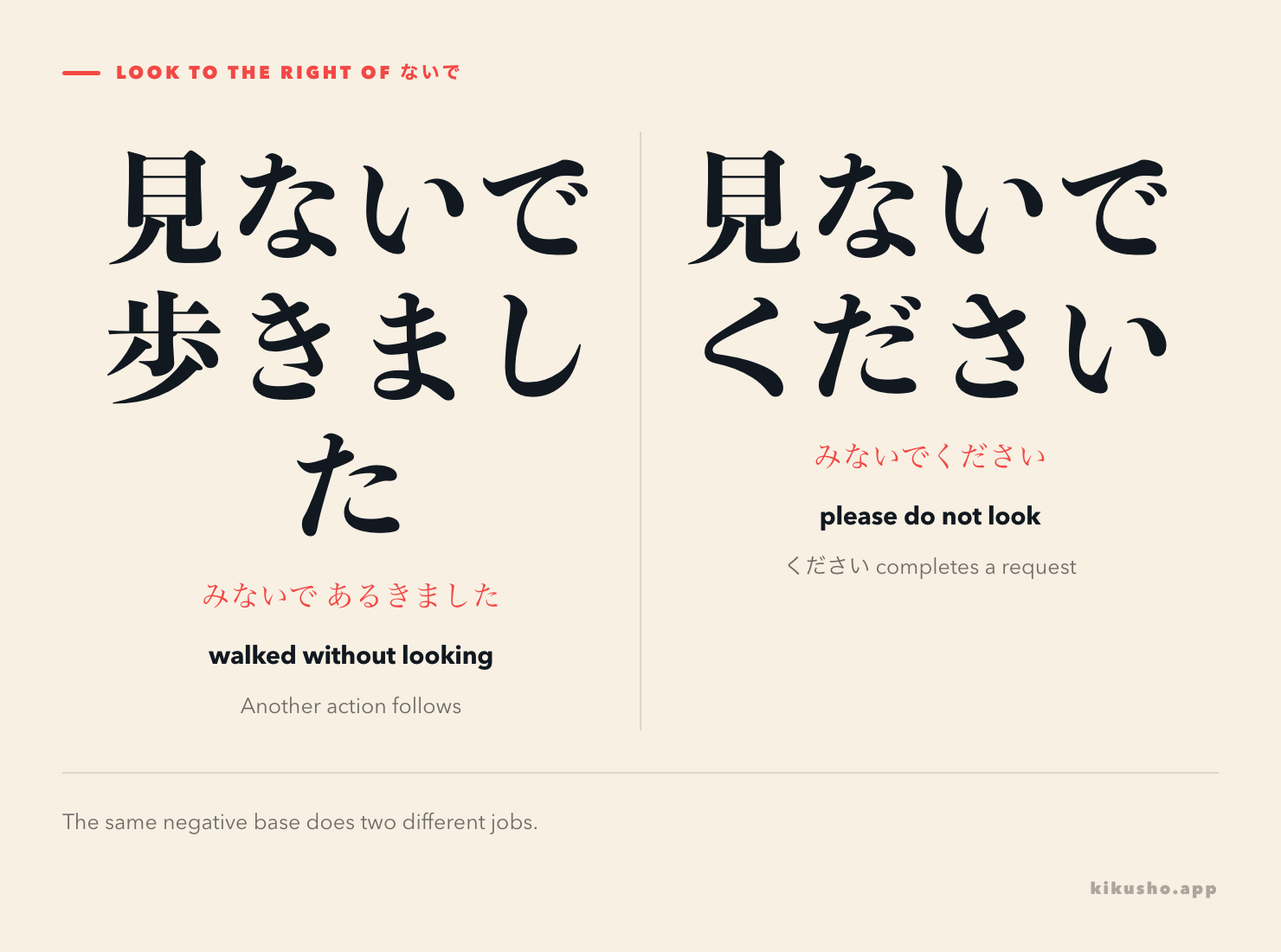
Use Vないで + another action when that later action happens without the first one. Use Vないでください when you politely and directly ask the listener not to do the action; a turn ending in Vないで can make the same request casually.
The two patterns begin with the same negative verb, so their difference is easy to miss on a word list. The deciding evidence usually comes after ないで: another event gives the “without doing” reading, while ください makes a negative request.
Ask what follows ないで
Compare these two sentences:
地図を見ないで駅まで歩きました。
ちずを みないで えきまで あるきました。
I walked to the station without looking at a map.
この地図を見ないでください。
この ちずを みないでください。
Please do not look at this map.
In the first sentence, 歩きました is the main action. 見ないで tells you what the speaker omitted while walking. In the second, ください completes a request addressed to the listener.
| Shape | What follows | Main job | Example |
|---|---|---|---|
| Vないで + V | another action or clause | do B without doing A | メモを見ないで名前を書きました |
| Vないでください | ください | politely ask someone not to do A | ここに名前を書かないでください |
| Vないで | end of a conversational turn | casually ask someone not to do A | それ、触らないで |
The short final request depends on context and tone. 触らないで can sound caring, urgent or sharp. It does not become a neutral description simply because ください is absent.
Both start from the complete ない-form
Build the plain negative first, then add で. Keep the final い of ない: 書かない + で, not 書かなで. The verb group has already done its work before で arrives.
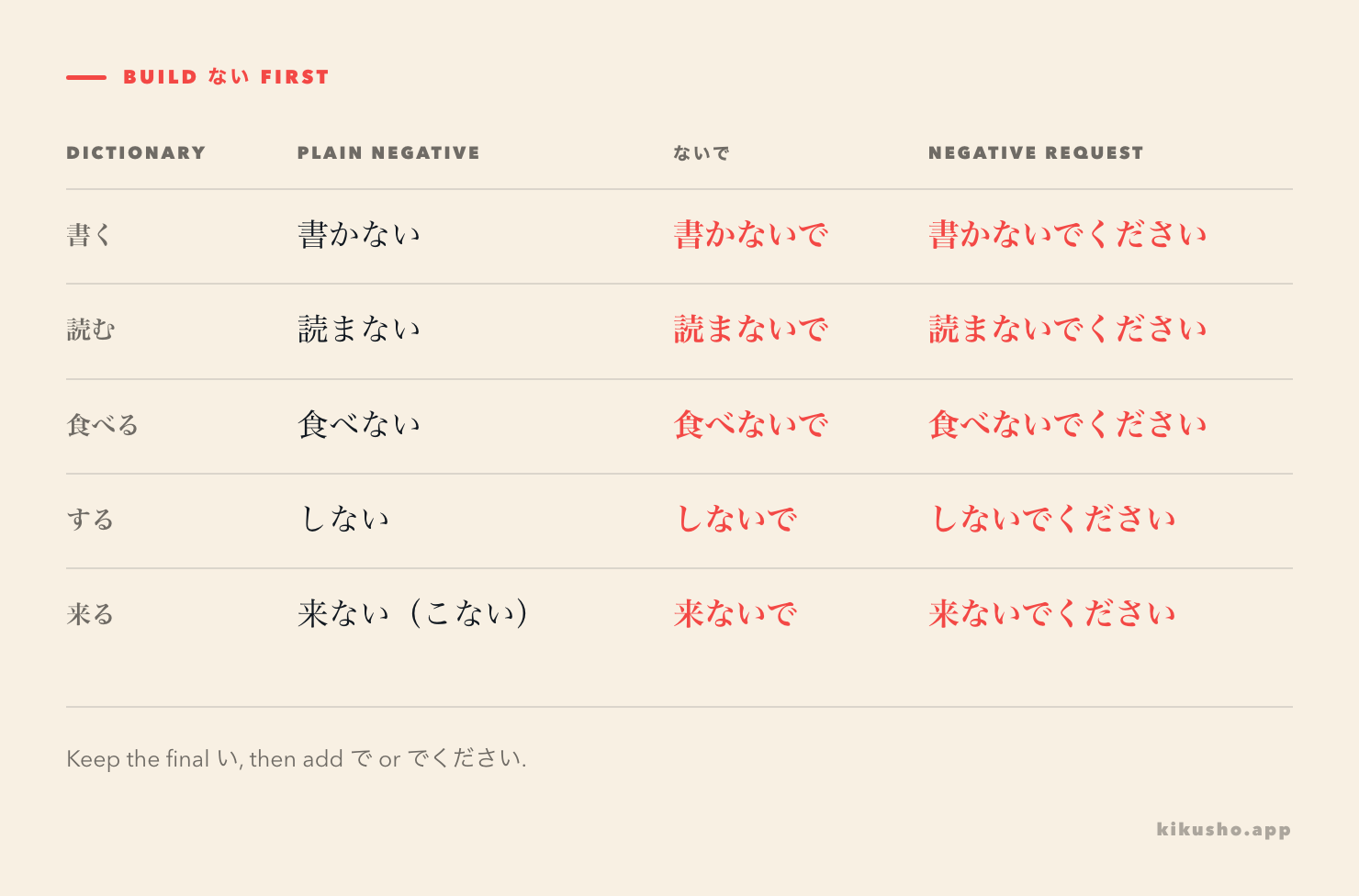
| Dictionary form | Plain negative | ないで form | Polite negative request |
|---|---|---|---|
| 書く(かく) | 書かない | 書かないで | 書かないでください |
| 読む(よむ) | 読まない | 読まないで | 読まないでください |
| 食べる(たべる) | 食べない | 食べないで | 食べないでください |
| する | しない | しないで | しないでください |
| 来る(くる) | 来ない(こない) | 来ないで(こないで) | 来ないでください(こないでください) |
The plain-negative lesson gives the full godan, ichidan and irregular formation rules. This lesson begins after that step. Do not start from 書きません or the ます-stem: × 書きないでください and × 書きませんでください mix two different negative systems.
Tokyo University of Foreign Studies likewise analyzes the request as the plain non-past negative plus で and ください. Its examples also show that this request can give an instruction, express a strong plea, or show consideration. Formation alone does not settle the social force.
ないで leaves one action undone while another happens
In the “without doing” pattern, the omitted action sets the condition for the main event. The second verb carries the sentence's tense and politeness.
薬を飲まないで寝ました。
くすりを のまないで ねました。
I went to sleep without taking the medicine.
辞書を使わないでこの文を読みます。
じしょを つかわないで この ぶんを よみます。
I will read this sentence without using a dictionary.
飲まないで does not itself say past or polite. 寝ました closes the first sentence and supplies both. In the second, 読みます supplies polite non-past time.
The omission may be deliberate, but context can also present it as a mistake or accident. 電気を消さないで寝てしまいました means the speaker went to sleep without turning off the light and adds てしまいました to frame the outcome. The safe rule is that A remains undone while B happens; do not force an intention that the sentence has not stated.
JLPT Sensei's ないで reference and Nihongo Net's independently written lesson both give the A-without-B structure and place it at N5. Bunpro places this use at N4. That disagreement changes a study label, not the attachment or meaning.
ないでください asks the listener to refrain
Vないでください points toward the listener. It can appear on a notice, in an instruction, in a practical request or in words of care.
このボタンを押さないでください。
この ボタンを おさないでください。
Please do not press this button.
今日は無理をしないでください。
きょうは むりを しないでください。
Please do not overdo it today.
The first protects a rule or a machine. The second can express concern for the listener. English please don't covers both, but it does not reveal whether the Japanese turn feels like an instruction, a plea or consideration.
ください makes the wording polite; it does not make every demand suitable for every relationship. TUFS notes ordinary directive settings such as a doctor speaking to a patient or a teacher instructing a student, while also recording strong requests and considerate uses. Bunpro's ないでください entry contrasts it with the brusquer dictionary-form prohibition Vるな. The Japan Foundation's Irodori grammar notes make the same strength distinction between 来ないで and a firm command such as 走るな.
For a positive request, change the verb to its affirmative て-form instead: 押してください, “please press,” versus 押さないでください, “please do not press.” The ~てください lesson covers that affirmative side in full.
ないで and なくて connect different relationships
Both contain a negative, but swapping them can change the relationship between the clauses.
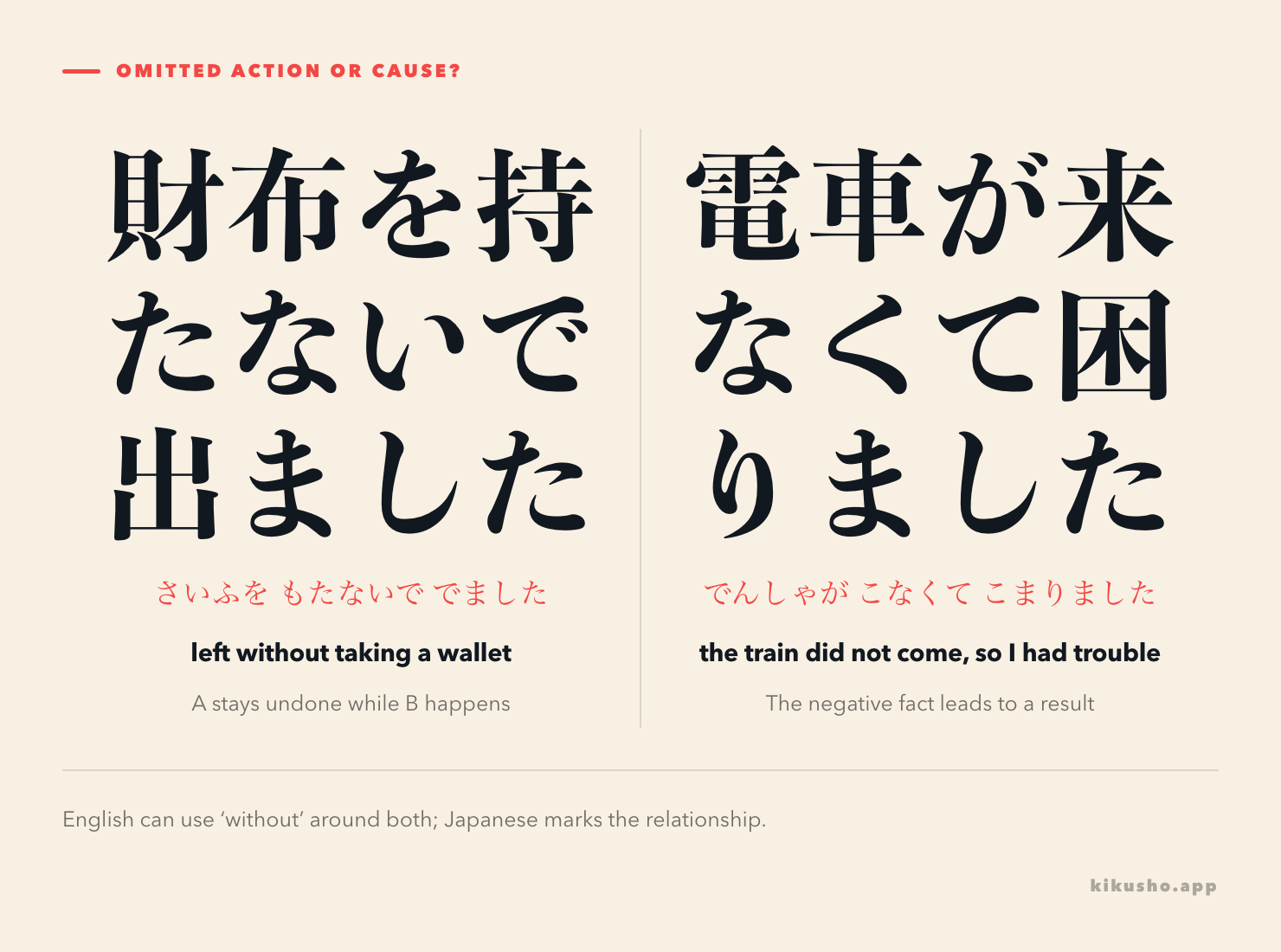
| Pattern | Relationship | Example | Reading |
|---|---|---|---|
| Vないで + action | A is left undone while B happens | 財布を持たないで家を出ました | さいふを もたないで いえを でました |
| Vなくて + result | the negative fact leads to B | 電車が来なくて困りました | でんしゃが こなくて こまりました |
The first means “I left home without taking my wallet.” The second means “The train did not come, so I had a problem.” The second clause is a result of the non-arrival, rather than an action performed while intentionally omitting another.
Adjectives and noun predicates also use the なくて/ではなくて family: 高くなくてよかった, “I am glad it was not expensive,” and 学生ではなくて先生です, “not a student but a teacher.” This lesson's ないで construction attaches to verbs. Bunpro's なくて comparison checks the cause-and-state boundary, while warning that translations with English “without” can blur it.
The level label has a real disagreement
JLPT Sensei and Nihongo Net classify both assigned targets as N5. Bunpro classifies ないでください as N5 but places the standalone “without doing” use of ないで at N4. The curriculum therefore teaches the pair together as a beginner attachment contrast and records the split rather than hiding it.
The JLPT itself does not publish an exhaustive grammar list. Treat N5 and N4 labels as sequencing advice from independent teaching sources. For this lesson, you should already know how to make the plain ない-form; the new work is reading what follows it.
If you capture a notice such as ここに荷物を置かないでください in Kikusho, keep the whole instruction on the card. Its editable meaning and register note can preserve who is expected to refrain and where the rule applies. Saving only ください would erase the negative action that makes the notice useful.
Practice: decide whether the turn continues
Work through the seven situations in order. Decide whether each turn continues before you read the explanations below them.
Question 1
Choose the form that means “I wrote the composition without looking at a dictionary.”
辞書を__作文を書きました。
- か: 見ないで
- き: 見なくて
- く: 見ないでください
- け: 見ません
Question 2
A museum employee politely asks a visitor not to take photographs. Complete the instruction.
写真を__。
- か: 撮らないでください
- き: 撮らなくて
- く: 撮りません
- け: 撮るないでください
Question 3
Which choice correctly says “Please do not come here,” including the reading of 来ない?
- か: ここに来ないでください(ここに きないでください)
- き: ここに来ないでください(ここに こないでください)
- く: ここに来ないでください(ここに くないでください)
- け: ここに来ませんでください(ここに きませんでください)
Question 4
Arrange every chunk once to say “I studied without listening to music.”
勉強しました / 音楽を / 聞かないで
Question 5
Read the exchange and choose the form that fits the staff member's instruction.
図書館員:ここでは電話を__。
利用者:わかりました。外に出ます。
- か: 使わないでください
- き: 使わなくて
- く: 使わないで帰りました
- け: 使いないでください
Question 6
Choose the connector that presents the train's non-arrival as the reason for the problem.
電車が__、困りました。
- か: 来ないで
- き: 来なくて
- く: 来ないでください
- け: 来ません
Question 7
Explain the two readings below. Identify which line is a casual request and which describes an omitted action during another activity.
それ、触らないで。
それに触らないで作業しました。
Answers and explanations
Answer 1
か: 見ないで. 辞書を見ないで作文を書きました places the main completed action in 書きました and leaves dictionary use undone. 見なくて would normally lead to a consequence or linked negative state. 見ないでください addresses a listener, and 見ません closes a polite negative statement instead of connecting the clauses.
Answer 2
か: 撮らないでください. The employee asks the visitor to refrain, so the plain negative 撮らない takes でください. 撮らなくて needs a following result or connection. 撮りません says someone does not take photographs. 撮るないでください fails because the dictionary form must first become 撮らない.
Answer 3
き: ここに来ないでください(ここに こないでください). The negative of 来る(くる) is 来ない(こない). The written form remains 来ない in the first three options, but only き gives its correct reading. Choice け incorrectly starts from 来ません.
Answer 4
音楽を聞かないで勉強しました is the complete sentence. 聞かないで leaves listening undone while 勉強しました supplies the past polite main action. The natural translation is “I studied without listening to music.”
Answer 5
か: 使わないでください. The reply 外に出ます, “I will go outside,” shows that the library user accepts a rule against phone use in that place. Choice き does not complete the cause or connection. Choice く changes the turn into a past report, and け uses the wrong negative base.
Answer 6
き: 来なくて. 電車が来なくて、困りました links the train's non-arrival to the resulting trouble. 来ないで would normally set up another action done without coming or make a casual negative request at the end of a turn. 来ないでください asks a listener not to come. 来ません is a complete polite negative and cannot fill this connector slot as written.
Answer 7
それ、触らないで ends the turn after ないで, so it is a casual request: “Don't touch that.” それに触らないで作業しました continues to 作業しました, so it means “I worked without touching it.” The words after ないで change who the sentence is aimed at and where its main action sits.
A sign, a request and a report can share the same four kana. The part after them tells you whether another event is coming or another person is being asked to stop.
Common questions
What is the difference between ないで and ないでください?
Verb ないで followed by another action means that the later action happens without the first one: 地図を見ないで歩きました means “I walked without looking at a map.” At the end of a turn, ないで can be a casual request not to act. Adding ください makes that negative request polite and direct.
How do I form ないでください?
Make the verb's plain non-past negative, keep its final い and add でください. 書く becomes 書かないでください, 食べる becomes 食べないでください, する becomes しないでください and 来る becomes 来ないでください, read こないでください.
What is the difference between ないで and なくて?
With verbs, ないで commonly presents an action left undone while another action happens. なくて commonly links a negative fact to a result or reason, as in 電車が来なくて困りました, “The train did not come, so I had a problem.” Adjective and noun negatives also connect with なくて or ではなくて, not this verb ないで pattern.
Is ないで N5 or N4 grammar?
JLPT Sensei and Nihongo Net list the “without doing” use at N5, while Bunpro lists it at N4. All three and TUFS treat ないでください as beginner grammar. These are study estimates because the JLPT does not publish an exhaustive grammar list.