On this page
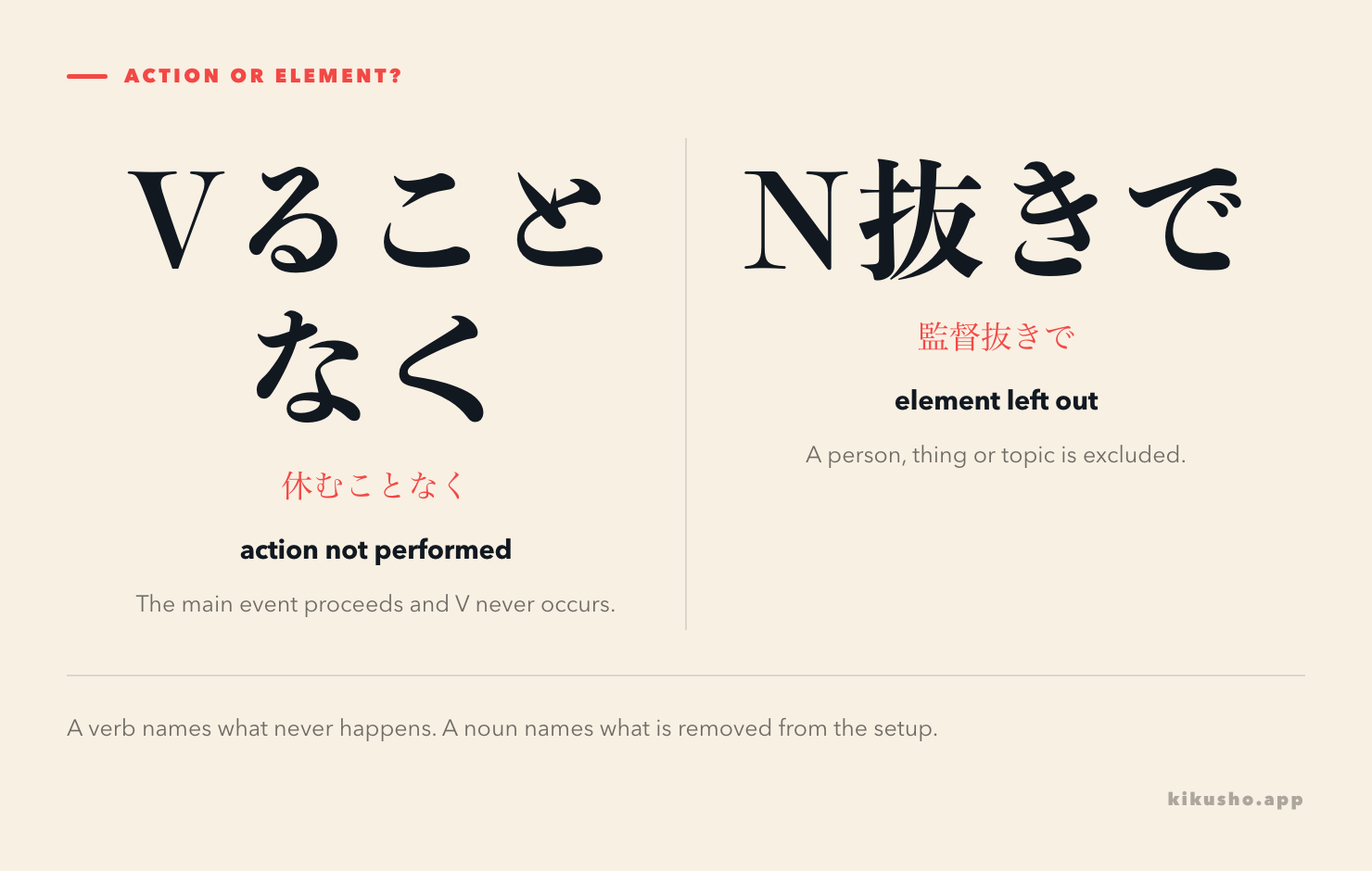
Use Vることなく when an action does not happen before or during the main event. Use N抜きで/N抜きにして when a noun, such as an ingredient, person or topic, is removed from the situation.
選手は一度も振り返ることなく、ゴールまで走った。
せんしゅはいちどもふりかえることなく、ごーるまではしった。
The athlete ran to the finish line without looking back even once.
今日は監督抜きで練習した。
きょうはかんとくぬきでれんしゅうした。
Today we practised without the coach.
English uses “without” for both. Japanese asks what is absent: 振り返る, an action, takes ことなく; 監督, a person treated as an excluded element, takes 抜きで.
The grammatical category decides
| What is absent? | Pattern | Example | Core picture |
|---|---|---|---|
| an action or change | V dictionary form + ことなく | 休むことなく働いた | B proceeds and V never occurs |
| a person, thing, topic or condition | N + 抜きで/抜きにして | 冗談抜きで話した | N is taken out of the setup |
The contrast is clearest when the English translation barely changes:
朝食を食べることなく、会議に出た。
I attended the meeting without eating breakfast.
朝食抜きで、会議に出た。
I attended the meeting without breakfast.
The first sentence explicitly presents 食べる as the action that did not occur. The second packages 朝食 as an omitted item. Both can describe the same morning, but they organize it differently.
ことなく keeps an action from occurring
Attach ことなく to the dictionary form, including irregular verbs:
| Verb | Correct form | Meaning in context |
|---|---|---|
| 休む | 休むことなく | without resting |
| あきらめる | あきらめることなく | without giving up |
| する | することなく | without doing |
| 来る(くる) | 来ることなく | without coming |
The verb is affirmative in shape even though the clause has a negative meaning. Write 休むことなく, not ×休まないことなく. JLPT Sensei lists the same dictionary-form attachment and classifies it as N2.
The form often highlights continuity, resolve or a notable omission:
雨は止むことなく、三日間降り続いた。
あめはやむことなく、みっかかんふりつづいた。
The rain continued for three days without stopping.
彼女は誰にも相談することなく、会社を辞めた。
かのじょはだれにもそうだんすることなく、かいしゃをやめた。
She left the company without consulting anyone.
The main predicate supplies tense and politeness. In the second sentence, 辞めた puts the whole event in the past; 相談することなく does not change.
This pattern is formal and common in careful narration and writing. Japanese NET warns that it can sound stiff in an ordinary routine such as describing how you take your coffee. Bunpro likewise marks it formal and contrasts it with the more broadly conversational ずに.
Compare these three versions:
| Form | Typical impression |
|---|---|
| 何も言わないで帰った | ordinary conversational “left without saying anything” |
| 何も言わずに帰った | compact, neutral to formal |
| 何も言うことなく帰った | more formal; the complete absence can feel highlighted |
The ~ずに lesson covers its special forms せずに and 来ずに. Do not import those conjugations into ことなく: it stays することなく and 来ることなく.
抜き removes a noun from the setup
With 抜き, name the element first. It may be concrete, social or abstract:
わさび抜きでお願いします。
わさびぬきでおねがいします。
No wasabi, please.
今度は田中さん抜きで会議を始めよう。
こんどはたなかさんぬきでかいぎをはじめよう。
This time, let us start the meeting without Ms Tanaka.
冗談は抜きにして、本題に入りましょう。
じょうだんはぬきにして、ほんだいにはいりましょう。
Joking aside, let us get to the main topic.
Benri Japan describes the form as intentionally excluding something normally present or relevant. That deliberate exclusion helps distinguish 抜き from a neutral report that something simply does not exist.
The main variants divide the remaining sentence in useful ways:
| Form | Job | Example |
|---|---|---|
| N抜きで + action | perform the action with N omitted | 朝食抜きで働いた |
| Nは抜きにして + clause | set N aside, then move on | 挨拶は抜きにして始めよう |
| N抜きの + noun | modify a following noun | 砂糖抜きのコーヒー |
| N抜きでは + negative result | without N, the result cannot hold | 彼抜きでは決められない |
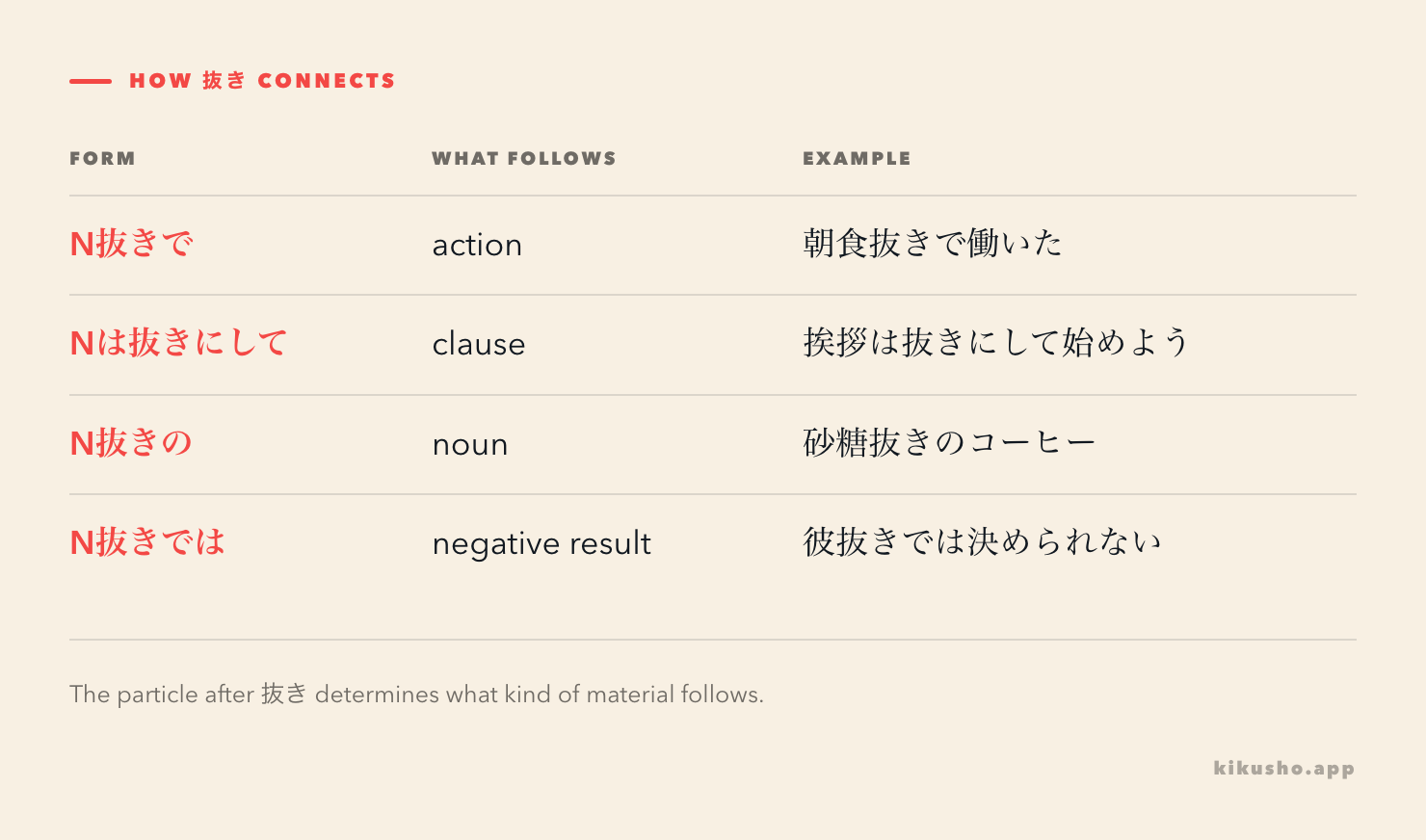
抜きで and 抜きにして overlap, but the shorter 抜きで is especially natural for an omitted ingredient or participant. The fuller は抜きにして often sounds like an explicit instruction to set a topic or consideration aside. These are tendencies rather than a concrete-versus-abstract rule: 冗談抜きで is common even though a joke is abstract.
Watch the result after では:
この資料抜きでは、正確な判断はできない。
このしりょうぬきでは、せいかくなはんだんはできない。
Without this material, an accurate judgment is impossible.
Here the material is indispensable. The sentence does not say that a judgment actually proceeded with the material removed. It says what cannot happen if that material is absent.
Why direct swaps fail
The word before the pattern must match its grammar.
一度も立ち止まることなく歩き続けた。
I kept walking without stopping even once.
立ち止まる is a verb, so ことなく fits. ×立ち止まる抜きで incorrectly asks 抜き to attach directly to a verb.
部長抜きで話し合った。
We discussed it without the department head.
部長 is a noun, so 抜きで fits. ×部長ことなく cannot attach ことなく to a noun. You could rebuild the idea with a verb, but the meaning becomes more explicit: 部長が参加することなく、話し合いが進んだ, “the discussion proceeded without the department head participating.”
That rebuild also shows a subject difference. In 彼は休むことなく働いた, the same person naturally controls resting and working. With an inanimate change such as 雨は止むことなく降り続いた, the same event continues without the change occurring. 抜き expressions do not require the excluded noun to perform anything; it is simply outside the selected arrangement.
Separate 抜き from なし and 除いて
Nなしで often reports absence as a condition. N抜きで more readily suggests that someone has removed or deliberately left N out. 辞書なしで読める says you can read without a dictionary; 辞書抜きで試験を受けた presents the dictionary as excluded from the test setup.
Nを除いて means “except for N” and works well for neutral membership or schedules:
日曜日を除いて、毎日営業しています。
We are open every day except Sunday.
Replacing it with 日曜日抜きで would reframe Sunday as an element deliberately removed, which is not the ordinary schedule statement. Japanese with Hikari makes this same distinction between factual 除いて and more intentional 抜き.
JLPT Sensei, Japanese NET and Benri Japan all place the two target patterns at N2. These are study estimates, since the JLPT does not publish an exhaustive grammar list.
In Kikusho, save enough of the sentence to preserve the contrast. A card containing only “without” cannot tell you whether to retrieve a verb frame or a noun frame. Pair 相談することなく決めた with 相談抜きで決めた, or save 冗談は抜きにして、本題に入ろう as one complete move from the excluded topic to the main action.
Practice: identify what is missing
Work through the six contrasts first. The keyed reasoning stays folded beneath the final prompt.
Question 1
Which construction completes this account of uninterrupted effort?
選手は最後まで一度もあきらめる( )、走り続けた。
- 抜きで\
- ことなく\
- 抜きの\
- ことでは
Question 2
Your customer wants coffee with no sugar. Complete the request.
砂糖( )コーヒーをお願いします。
- ことなく\
- 抜きの\
- 抜きでは\
- ないことに
Question 3
Which sentence means “Joking aside, let us discuss the budget seriously”?
- 冗談することなく、予算を真剣に話し合おう。\
- 冗談は抜きにして、予算を真剣に話し合おう。\
- 冗談抜きでは、予算を真剣に話し合おう。\
- 冗談ことなく、予算を真剣に話し合おう。
Question 4
Complete the sentence with the dictionary form of 迷う and the target pattern.
彼女は少しも( )、申し込みを決めた。
She decided to apply without hesitating at all.
Question 5
Explain the difference in focus between these sentences.
朝食を食べることなく出かけた。
朝食抜きで出かけた。
Question 6
Choose the pair that makes the passage coherent.
担当者は資料を確認する( ① )、発表を始めた。しかし、この資料( ② )正確な説明はできない。
- ①抜きで/②ことなく\
- ①ことなく/②抜きでは\
- ①抜きの/②ことなく\
- ①ことでは/②抜きで
Test the grammatical category in the first blank, then read the polarity of the result in the second.
Answers and explanations
Each solution begins by identifying whether the blank expects a verb frame or a noun frame.
Answer 1. Choice 2, ことなく. あきらめる is a dictionary-form verb. あきらめることなく says the athlete kept running while the action of giving up never occurred.
Answer 2. Choice 2, 抜きの. Sugar is a noun treated as an omitted ingredient, and 砂糖抜きの modifies the following noun コーヒー. 抜きで would fit a different shape such as コーヒーは砂糖抜きでお願いします.
Answer 3. Choice 2. 冗談は抜きにして explicitly sets jokes aside before moving to the serious topic. Choice 1 tries to use an unnatural 冗談する collocation; choice 3 normally needs a negative result; choice 4 attaches ことなく to a noun.
Answer 4. 迷うことなく. The complete sentence is 彼女は少しも迷うことなく、申し込みを決めた. ことなく attaches to the dictionary form 迷う and highlights that hesitation never occurred.
Answer 5. 朝食を食べることなく出かけた explicitly presents eating as the action that did not happen. 朝食抜きで出かけた packages breakfast as an omitted element. The event may be the same, but the first uses a verb frame and the second a noun frame.
Answer 6. Choice 2. 確認することなく attaches to the verb and says the person began without checking. 資料抜きでは正確な説明はできない treats the material as indispensable and leads naturally to the negative result できない.
The final language pass was completed by OpenAI Codex. It compared every attachment, Japanese sentence, translation and distractor with the linked references; this records AI review only.
Common questions
What is the difference between ことなく and 抜きで?
ことなく follows a dictionary-form verb and says that action A never occurs while event B proceeds. 抜きで follows a noun and presents that person, thing or topic as excluded from the situation.
How do you form ことなく?
Put ことなく directly after the dictionary form of a verb: 休むことなく, 振り返ることなく and 迷うことなく. It is a formal or written alternative to many uses of ないで and ずに.
What can come before 抜きで or 抜きにして?
A noun comes before the 抜き forms: わさび抜きで, 彼抜きで and 冗談は抜きにして. The noun identifies the ingredient, person, topic or consideration being left out.
What is the difference between 抜きで and 抜きでは?
N抜きで describes doing something with N omitted. N抜きでは often sets up a negative result and means that without N, the result cannot hold, as in 彼女抜きでは完成できない.