On this page
AというかBというか sounds out two possible descriptions: “A, or perhaps B.” Xというところだ/Xといったところだ places a restrained boundary around an answer: “roughly X,” “at most about X,” or “something like X.”
彼の提案は大胆というか、無謀というか、すぐには賛成できない。
かれの ていあんは だいたんというか、むぼうというか、すぐには さんせいできない。
His proposal is bold, or perhaps reckless; I cannot agree to it immediately.
参加者は多くても三十人といったところだ。
さんかしゃは おおくても さんじゅうにんといったところだ。
There will be about thirty participants at most.
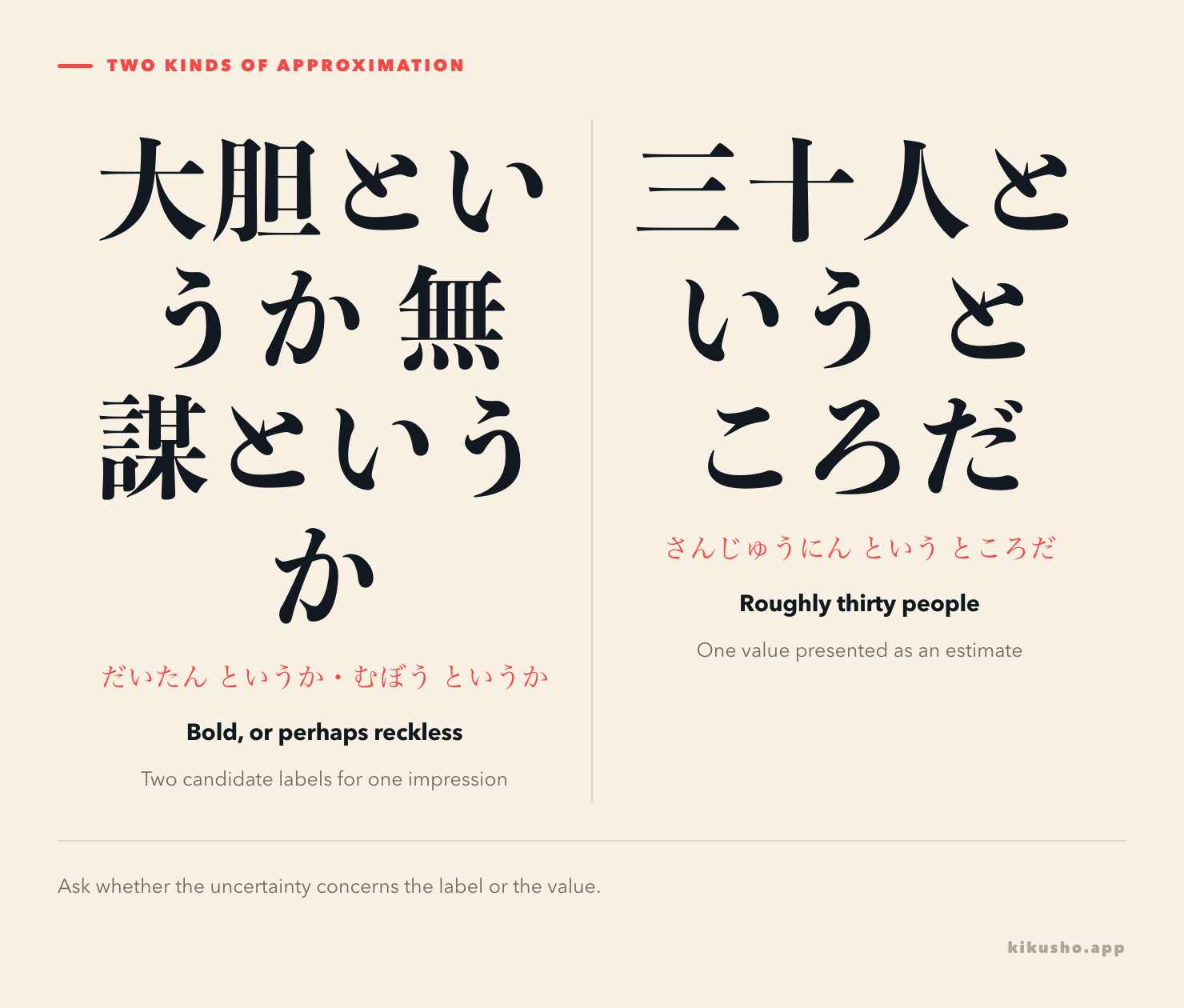
The first speaker hesitates between 大胆 and 無謀 as labels for one proposal. The second speaker has already chosen the kind of answer needed, a number, and softens its precision. Both can look approximate in English, but only the first is a search for wording.
This lesson reviews inventory items g-4c81e2daffa6, というか~というか, and g-9138f3fe17dd, というところだ/といったところだ. The inventory assigns both to N1 and records no internal disagreement. Independent references differ on the first family: JLPT Sensei and Mainichi Nonbiri teach the paired form at N1, while N1et groups a broader というか lesson at N2. The official JLPT FAQ explains why no exhaustive official grammar list can settle that editorial boundary.
Ask whether the uncertainty concerns the word or the value
| Speaker's unresolved question | Pattern | Result |
|---|---|---|
| “Which description fits?” | AというかBというか | two candidate labels for one subject |
| “About how much, how good, or what kind?” | Xというところだ/といったところだ | one approximate value or assessment |
大胆というか無謀というか keeps two descriptions in view. 三十人といったところだ does not compare competing words; it gives thirty as a reasonable estimate. This question separates the patterns before you translate either one.
というか~というか tests two descriptions aloud
The paired pattern presents A and B as words that both catch part of the speaker's impression. A and B may be close, contrasting, or emotionally mixed, but they must describe the same subject or reaction. A conclusion such as とにかく, 複雑な気持ちだ, うまく説明できない or a final judgment often follows.
Mainichi Nonbiri's explanation describes the form as a way to state and evaluate an impression while avoiding an overly direct single label. Its attachment table uses plain verbs and i-adjectives, plus na-adjective stems and nouns without だ.
| Input | Paired frame | Example |
|---|---|---|
| plain verb | VというかVというか | 褒めるというか励ますというか |
| i-adjective | AいというかAいというか | 寂しいというか悲しいというか |
| na-adjective stem | AなというかAなというか | 大胆というか無謀というか |
| noun | NというかNというか | 驚きというか怒りというか |
新しい上司は部下を褒めるというか励ますというか、やる気を引き出すのが上手だ。
あたらしい じょうしは ぶかを ほめるというか はげますというか、やるきを ひきだすのが じょうずだ。
The new manager praises people, or perhaps encourages them; either way, she is good at motivating her team.
結果を見た瞬間は驚きというか怒りというか、自分でも整理できない気持ちだった。
けっかを みた しゅんかんは おどろきというか いかりというか、じぶんでも せいりできない きもちだった。
When I saw the result, I felt shock, or perhaps anger; it was an emotion I could not sort out myself.
The pattern is not an ordinary list. 大胆で無謀だ asserts both qualities. 大胆というか無謀というか dramatizes the difficulty of deciding what to call the proposal. Likewise, コーヒーか紅茶 offers alternatives to choose from, while 安心というか諦めというか offers competing descriptions of one feeling.
One というか performs another conversational move
A single というか often revises, redirects or sharpens what came before:
行きたくない。というか、今日は時間がない。
いきたくない。というか、きょうは じかんが ない。
I do not want to go. Or rather, I do not have time today.
That self-correction is common, but it is not the paired AというかBというか target. The earlier lesson on といっても and というより compares two other ways to revise a listener's interpretation. Keep the full repeated frame when testing the N1 inventory item here.
というところだ gives one deliberately rough answer
With というところだ/といったところだ, the speaker has a value or category in mind but does not present it as exact. The expression follows a quantity, noun, assessment or short plain-form phrase. Edewakaru gives both forms the same core meanings, “roughly about” and “something like,” and shows the conversational contraction ってとこだ.
| What precedes the pattern | Example | Reading of the estimate |
|---|---|---|
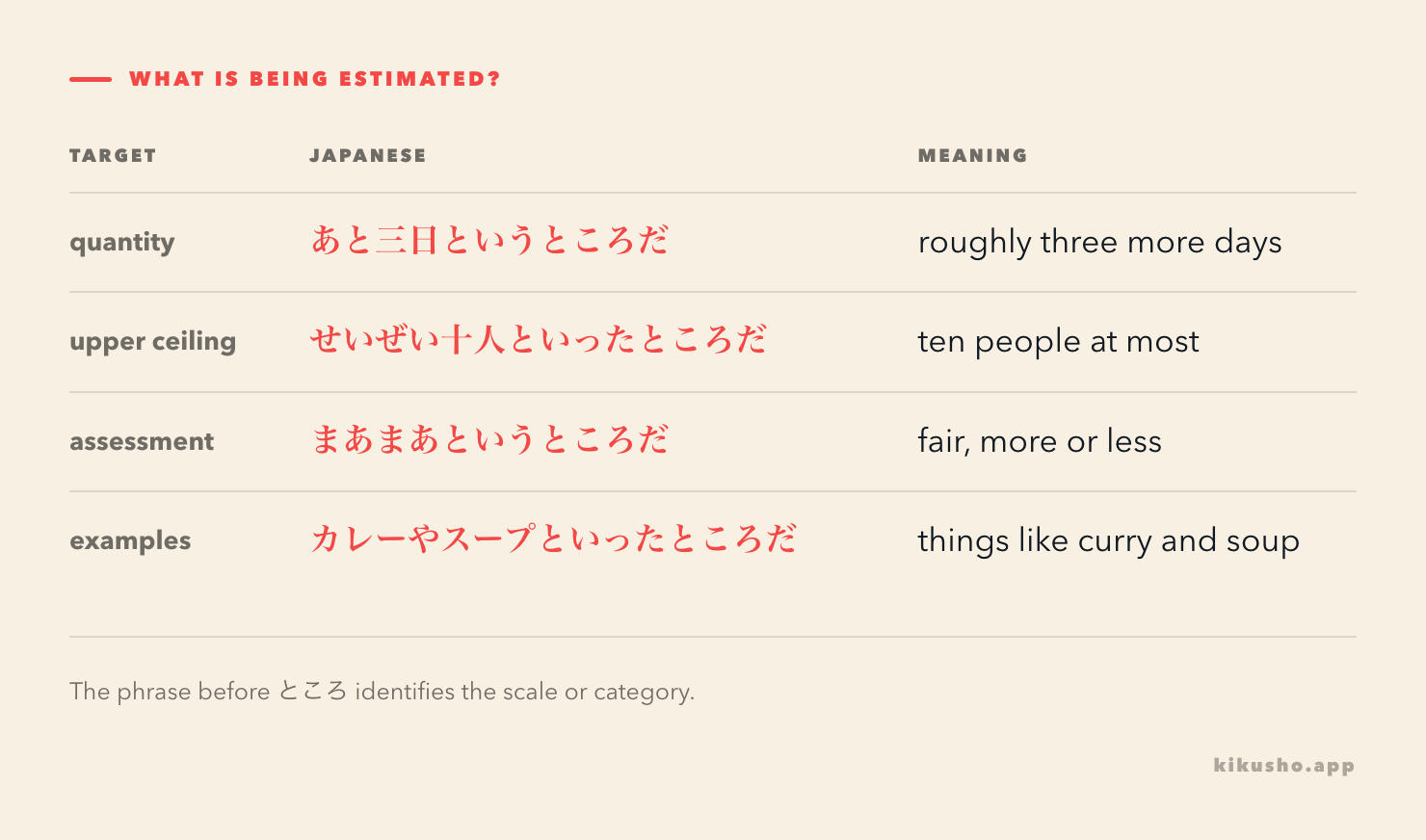
| quantity | あと三日というところだ | roughly three more days |
| quantity with an upper-bound cue | せいぜい十人といったところだ | ten people at most |
| restrained assessment | 出来はまあまあというところだ | fair, more or less |
| representative examples | 作れるのはカレーやスープといったところだ | things such as curry and soup |
修理が終わるまで、あと二日というところでしょう。
しゅうりが おわるまで、あと ふつかというところでしょう。
It will probably be about two more days before the repair is finished.
今回の発表は、成功とは言えないが、まずまずといったところだ。
こんかいの はっぴょうは、せいこうとは いえないが、まずまずといったところだ。
I would describe this presentation as fair: not quite a success, but acceptable.
私が一人で作れる料理は、カレーやスープといったところです。
わたしが ひとりで つくれる りょうりは、カレーや スープといったところです。
The dishes I can make on my own are things like curry and soup.
With quantities, 多くても, 長くても and せいぜい make an upper ceiling explicit. MLC's N1 practice sheet focuses on that bounded quantity use. Without one of those cues, context may simply make the number approximate. Do not force every example to mean a strict maximum.
Teaching references usually present というところだ and といったところだ as interchangeable variants in this use. They do not support a dependable exam rule that one is always more exact or always more formal. Learn both, and let the surrounding estimate carry the nuance. The colloquial ってとこだ belongs to casual speech.
Do not mistake an estimate for temporal ところだ
The familiar Vるところだ, Vているところだ and Vたところだ locate an action immediately before, during or after its occurrence:
今、家を出るところだ。
いま、いえを でる ところだ。
I am just about to leave home.
The N1 estimate inserts という/といった before ところだ:
駅まであと十分というところだ。
えきまで あと じゅっぷんというところだ。
It is about ten more minutes to the station.
The first sentence answers “At what stage is the action?” The second answers “What is a reasonable estimate?” The lesson on verb plus ところ develops the temporal pattern.
Similar words expose the different logic
One project can produce both constructions:
この企画は独創的というか、奇抜というか、評価が難しい。
この きかくは どくそうてきというか、きばつというか、ひょうかが むずかしい。
This project is original, or perhaps eccentric; it is hard to evaluate.
この企画の完成度は七割といったところだ。
この きかくの かんせいどは ななわりといったところだ。
The project is roughly seventy percent complete.
The first line lets 独創的 and 奇抜 compete as descriptions. The second selects one scale, completion, then marks 七割 as approximate. Replacing one with the other would change the question the sentence answers.
For upper estimates, compare the fuller treatment of せいぜい and quantity boundaries. せいぜい三十人 itself sets a maximum; adding といったところだ presents that maximum as the speaker's restrained estimate.
Save the uncertainty that the sentence preserves
The best review prompt does not translate both patterns as “approximately.” For AというかBというか, retain the two candidate labels and ask why neither is sufficient alone. For というところだ, retain the quantity or assessment and ask what kind of precision the speaker withholds.
In Kikusho, record the whole contrast you encountered and edit its nuance field to “label search” or “bounded estimate.” If the source was spoken, keeping the final とにかく, せいぜい or でしょう gives the card the clue that originally made the interpretation clear.
Practice: identify what remains undecided
Question 1 — grammar choice. The speaker cannot choose between two labels: 彼の態度は慎重__、消極的__、判断しにくい。
① というか/というか
② というところか/というところか
③ といっても/といっても
④ ところだ/ところだ
Question 2 — estimate. Complete the restrained forecast: 作業が終わるまで、あと三時間__。
① というか三時間というか
② というところだろう
③ といったらない
④ というより三時間だ
Question 3 — meaning. In 参加者は多くても二十人といったところだ, is twenty presented as a minimum, an exact count, or an approximate upper limit?
Question 4 — attachment repair. Remove the unnecessary copulas from 彼は無口だというか、慎重だというか、よく分からない to make the standard stem attachment taught here.
Question 5 — distinguish ところ. Which sentence places an action just before it happens, and which estimates a duration: 今から出発するところだ / 到着まで一時間というところだ?
Question 6 — connected text. Read 味は悪くないが、特別おいしくもない。評価はまあまあといったところだ. What does the final pattern contribute beyond simply saying まあまあだ?
Question 7 — production. Describe one unfinished project twice: first with two competing adjective labels using というか~というか, then with a numerical progress estimate using というところだ.
Answers and explanations
Reasoning 1
Choose ① というか/というか: 彼の態度は慎重というか、消極的というか、判断しにくい. Both na-adjective stems describe the same attitude, and the speaker refuses to settle on either label.
Reasoning 2
Choose ② というところだろう. The speaker gives three hours as a rough forecast: 作業が終わるまで、あと三時間というところだろう. There are no two labels to compare.
Reasoning 3
Twenty is an approximate upper limit. 多くても explicitly rules out a higher plausible count, while といったところだ frames twenty as the speaker's restrained estimate rather than a confirmed total.
Reasoning 4
Use 彼は無口というか、慎重というか、よく分からない. In this paired pattern, na-adjectives attach with their stems; the copular だ is omitted before each というか.
Reasoning 5
今から出発するところだ locates the action immediately before departure. 到着まで一時間というところだ estimates the remaining duration at roughly one hour. The presence of という and the kind of answer supplied separate them.
Reasoning 6
The final pattern makes まあまあ a measured, approximate assessment, close to “fair, more or less.” The preceding contrast supplies the evidence for that restrained placement; the speaker avoids presenting the rating as a sharp or objective grade.
Reasoning 7
One possible pair is この企画は意欲的というか、複雑というか、まだ方向が定まっていない and 完成度は六割というところだ. The first searches between two descriptions of the plan. The second chooses a percentage scale and gives sixty percent as an estimate.
The saved lesson received an AI-assisted language and curriculum review covering both attachment systems, the external level disagreement, estimate limits, the temporal ところ boundary, every example and the seven exercise explanations. No human Japanese review is claimed.
Common questions
What is the difference between というか~というか and というところだ?
AというかBというか presents two possible descriptions because the speaker cannot settle on one label. Xというところだ gives X as an approximate amount, degree, state or representative example.
What comes before というか in AというかBというか?
Plain verbs, i-adjectives, na-adjective stems and nouns can appear directly before each というか. The two sides should describe the same subject or reaction.
Do というところだ and といったところだ have different meanings?
Teaching references generally treat them as interchangeable in this estimate pattern. Both can mean roughly, at most around, or something like, depending on whether the preceding expression is a quantity, assessment or example.
Is というところだ the same as verb plus ところだ?
No. 今出るところだ locates an action in time and means someone is about to leave. あと三日というところだ quotes an estimate and means roughly three more days.