On this page
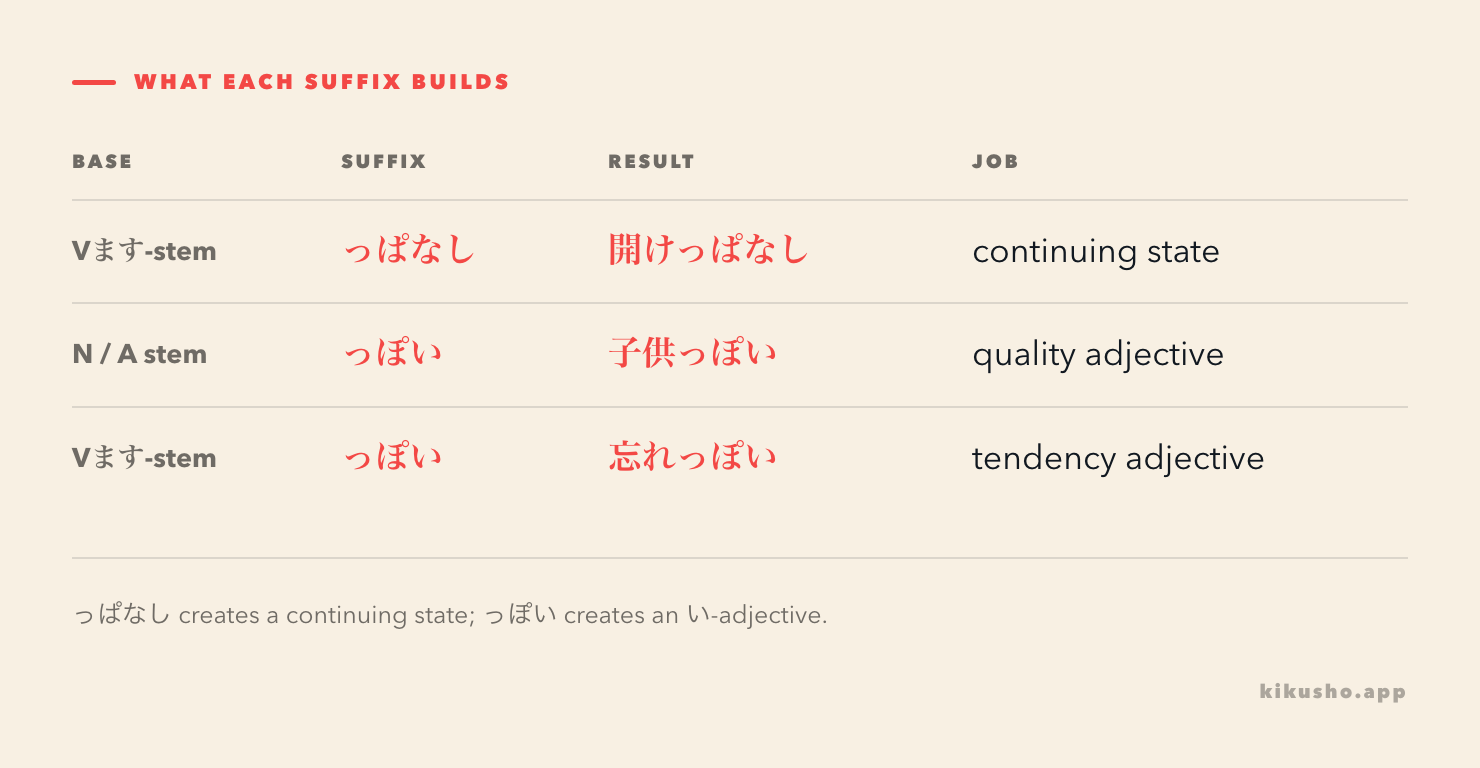
Use verb-stem + っぱなし when an action or its result keeps going; use っぽい when something gives an impression or repeatedly shows a tendency. Their doubled consonants sound similar, but the first builds a continuing state while the second builds an い-adjective.
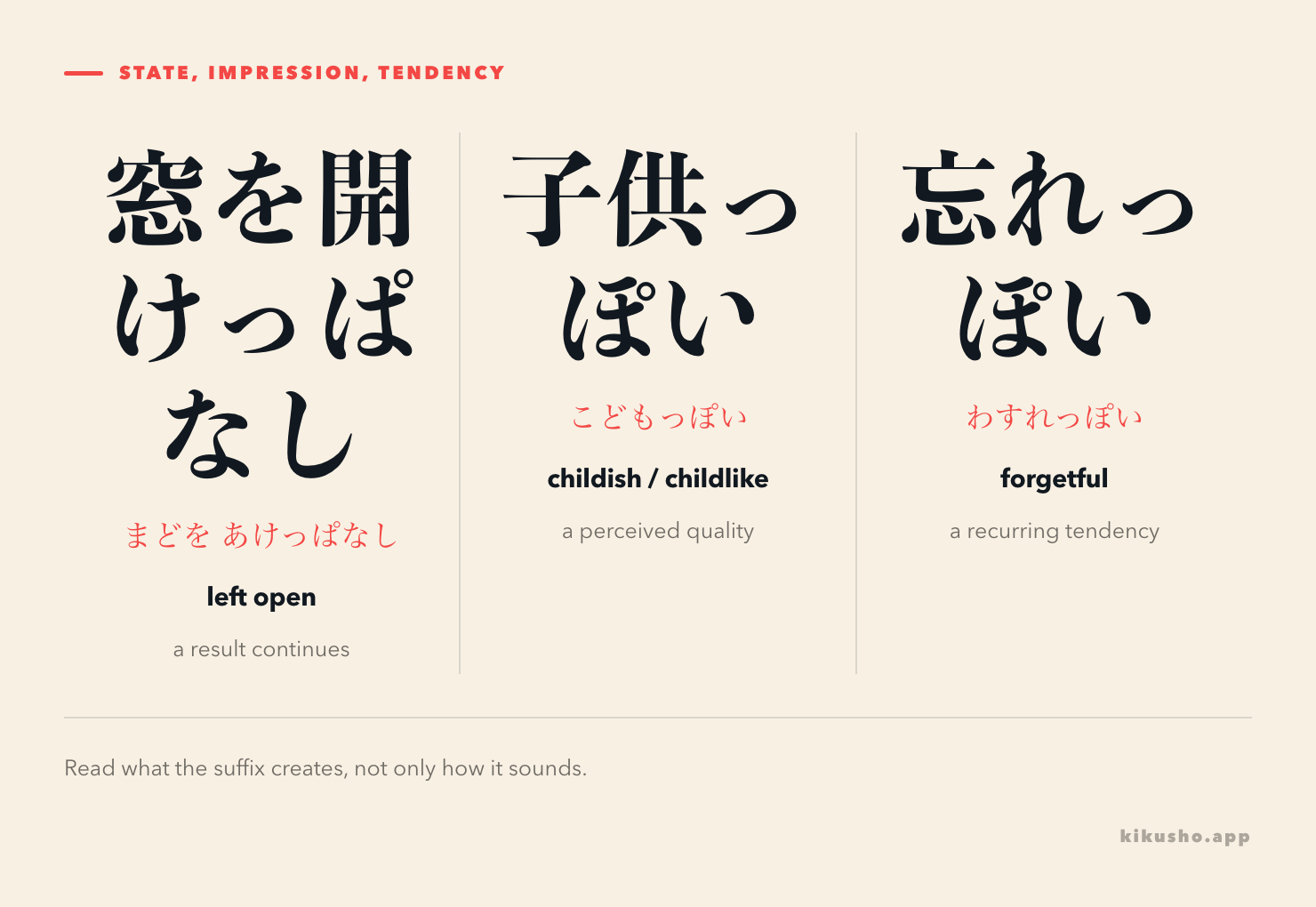
Compare 窓を開けっぱなしにした, “I left the window open,” with 子供っぽい話し方だ, “It is a childish way of speaking.” The first asks what was allowed to remain. The second asks what quality the speaker perceives.
The test that decides
Before choosing a form, identify the evidence in the sentence.
| Question to ask | Choose | Core result |
|---|---|---|
| Was an action or resulting state allowed to continue? | verb ます-stem + っぱなし | 開けっぱなし, left open |
| Does something have the flavor, look or noticeable quality of X? | noun or adjective stem + っぽい | 子供っぽい, childlike or childish |
| Does someone readily repeat an action? | verb ます-stem + っぽい | 忘れっぽい, forgetful |
The two patterns do not compete for the same grammatical slot. っぱなし needs a verb stem and is followed by forms such as だ, で, にする, or の. っぽい becomes the adjective itself and changes like any other い-adjective.
っぱなし leaves a result without correction
Attach っぱなし to the stem before ます:
| Dictionary form | ます-form | Stem + っぱなし | Meaning in context |
|---|---|---|---|
| 開ける | 開けます | 開けっぱなし | left open |
| つける | つけます | つけっぱなし | left switched on |
| 出す | 出します | 出しっぱなし | left out or left running |
| 借りる | 借ります | 借りっぱなし | kept on loan without returning |
窓を開けっぱなしにして出かけました。
まどを あけっぱなしにして でかけました。
I went out leaving the window open.
Opening has finished, but its result has not been reversed. Nobody closed the window. This use often suggests neglect because a normal follow-up action was expected.
借りた本を一か月も借りっぱなしにしていた。
かりた ほんを いっかげつも かりっぱなしにしていた。
I had kept the borrowed book for a whole month without returning it.
The pattern does not contain a negative verb. The なし here belongs to っぱなし; it does not mean that the borrowing failed to happen. Bunpro's っぱなし entry traces the form to 放す and describes the action or state as continuing unchecked. Tanosuke's teacher guide independently gives the stem attachment and distinguishes a result left unattended from continuous activity.
っぱなし can also keep the activity itself going
With an activity that occupies time, っぱなし can mean “keep doing” rather than “do it and fail to tidy up.”
今日は朝から立ちっぱなしで、足が痛い。
きょうは あさから たちっぱなしで、あしが いたい。
I have been standing since this morning, and my legs hurt.
会議で二時間しゃべりっぱなしだった。
かいぎで にじかん しゃべりっぱなしだった。
I talked continuously for two hours in the meeting.
Nothing has been left open in these sentences. The action itself fills the interval with no meaningful break. Context chooses between the two readings: 窓を開けっぱなし points to an unchanged result, while 立ちっぱなし points to sustained activity.
The tone is often unfavorable because the duration is tiring, excessive or unchecked. It need not accuse anyone. A performer can say 一時間歌いっぱなしだった simply to explain the physical strain of singing for an hour.
The surrounding grammar shows the role of the phrase:
- つけっぱなしだ ends the sentence with the continuing state.
- つけっぱなしで寝た makes that state the circumstance for sleeping.
- つけっぱなしにする deliberately or carelessly leaves it that way.
- つけっぱなしのテレビ uses the expression before a noun.
っぽい turns an impression into an い-adjective
っぽい attaches to several kinds of stem. The resulting word conjugates as an い-adjective.
| Base | Attachment | Example | Reading of the evidence |
|---|---|---|---|
| noun | noun + っぽい | 子供っぽい | has childlike or childish traits |
| noun | noun + っぽい | 水っぽい | noticeably watery |
| い-adjective | remove い + っぽい | 白っぽい | whitish |
| verb | ます-stem + っぽい | 忘れっぽい | prone to forgetting |
このかばんは少し安っぽく見える。
この かばんは すこし やすっぽく みえる。
This bag looks a little cheap.
春っぽい色のシャツを選びました。
はるっぽい いろの シャツを えらびました。
I chose a shirt in a spring-like color.
The first sentence contains a negative evaluation. The second can be appreciative and simply identifies a seasonal impression. The common thread is a subjective, readily noticed quality rather than membership in a strict category.
With verbs, the evidence is repeated behavior:
私は最近、忘れっぽくなった。
わたしは さいきん、わすれっぽく なった。
I have become forgetful lately.
This does not describe one forgotten appointment. It characterizes the person as readily falling into the action. Tanosuke's っぽい guide separates the “has the feel of” reading from the “readily does” reading and notes the frequent negative coloring in descriptions of people. Bunpro confirms the noun, adjective-stem and verb-stem attachments, as well as い-adjective behavior.
Once formed, っぽい changes normally:
| Function | Form | Example |
|---|---|---|
| present | っぽい | 子供っぽい |
| negative | っぽくない | 子供っぽくない |
| past | っぽかった | 子供っぽかった |
| adverbial | っぽく | 子供っぽく話す |
| noun modifier | っぽい + noun | 子供っぽい話し方 |
Do not add な: 子供っぽい話し方, not 子供っぽいな話し方.
Similar judgments still point to different structures
A neglected habit can make both ideas relevant, but each form says something different.
彼は電気をつけっぱなしにする。
かれは でんきを つけっぱなしにする。
He leaves the light on.
彼は忘れっぽい。
かれは わすれっぽい。
He is forgetful.
The first sentence names the unchecked state produced on a particular occasion or as a repeated behavior. The second assigns a tendency to the person. You cannot exchange the endings: つけっぽい would not mean “leaves switched on,” and 忘れっぱなし would mean that forgetting continues unchecked, not simply “forgetful.”
This also separates っぽい from the nearby N3 pattern がち. Both can describe a tendency, but っぽい readily builds a characteristic from a common combination such as 忘れっぽい or 飽きっぽい. がち presents repeated events as a recognized tendency, often in more analytical wording. The だらけ, がち and 気味 lesson compares that repeated-event view with accumulation and a mild current state.
For an unchanged result, っぱなし and まま can describe the same scene from different attitudes. 窓を開けたまま出かけた neutrally keeps the open state in the background. 窓を開けっぱなしで出かけた more readily notices that nobody closed it. The まま lesson gives the full attachment system for the neutral form.
N3 is the useful study placement
JLPT Sensei, Bunpro and both Tanosuke teacher pages place these constructions at N3. The Kikusho reference inventory also records an older Tanos comparison list that files っぱなし under N1, creating a source-level disagreement. The sources agree on the form and core uses taught here; the disagreement concerns study-list placement rather than the Japanese itself.
The exam authority does not publish an exhaustive grammar syllabus. Treat N3 as the best-supported point to learn these forms, with verb stems and ordinary い-adjective conjugation as prerequisites.
Practice the structural choice
Keep every answer covered until you have finished all six questions.
Question 1: continuing state. Complete “Please do not leave the water running”: 水を出し__にしないでください。
- A. っぽい
- B. っぱなし
- C. っぽく
- D. っぱなしい
Question 2: impression. Which phrase means “a somewhat bluish shirt”?
- A. 青っぱなしのシャツ
- B. 青っぽいシャツ
- C. 青っぽいなシャツ
- D. 青いっぱなしシャツ
Question 3: tendency. Complete the natural description of someone who readily gets bored: 弟は飽き__ので、趣味が長く続かない。
- A. っぱなしだ
- B. っぽい
- C. っぽく
- D. っぱなしな
Question 4: sustained action. Arrange 朝から, 立つ, っぱなし, and 疲れました into “I was on my feet continuously from this morning, so I got tired.” Conjugate as needed.
Question 5: change the adjective. Rewrite このデザインは子供っぽいです in the past negative: “This design was not childish.”
Question 6: short passage. Read: 兄は忘れっぽくて、昨日も窓を開けっぱなしで出かけた。 Which statement is supported?
- A. The brother has a tendency to forget, and yesterday he left the window open.
- B. The brother kept opening windows continuously, but he remembers everything.
- C. The window merely looked open, and nobody went out.
- D. The brother left because the window had a childlike appearance.
Answers and explanations
Answer 1. B, 水を出しっぱなしにしないでください. 出します → 出し supplies the verb stem; っぱなし presents the running water as a state that would continue unchecked. っぽい would create an adjective and cannot express “leave running” here.
Answer 2. B, 青っぽいシャツ. Remove the final い from 青い and add っぽい. The completed expression is already an い-adjective, so it modifies シャツ directly without な.
Answer 3. B, 飽きっぽい. The stem of 飽きます is 飽き, and っぽい describes a tendency to lose interest readily. C is adverbial and would need another predicate; the っぱなし choices would describe uninterrupted continuation rather than a disposition.
Answer 4. One natural answer is 朝から立ちっぱなしで、疲れました. 立ち is the ます-stem of 立つ, and っぱなし presents standing as filling the interval. で connects that circumstance to the resulting tiredness.
Answer 5. このデザインは子供っぽくなかったです or the more formal 子供っぽくありませんでした. Because っぽい forms an い-adjective, its past negative uses くなかった. Do not treat it as a な-adjective.
Answer 6. A. 忘れっぽくて gives the brother a recurring tendency to forget. 開けっぱなしで then reports the unchanged open-window state on yesterday's particular occasion. The two suffixes divide character from consequence in one sentence.
A doubled consonant is not enough to identify the grammar. Follow the completed expression instead: if the sentence manages a state with だ, で, or にする, you are reading っぱなし; if it inflects and modifies like an い-adjective, you are reading っぽい.
Common questions
What is the difference between っぱなし and っぽい?
Verb-stem + っぱなし presents an action or its result as continuing without interruption or correction. っぽい forms an い-adjective describing an impression, a noticeable quality, or a tendency to do something.
What form comes before っぱなし?
Use the verb's ます-stem: 開けます becomes 開けっぱなし, and 立ちます becomes 立ちっぱなし. The form can describe something left as it is or an action continuing for a stretch of time.
How does っぽい conjugate?
The whole expression behaves as an い-adjective: 子供っぽい, 子供っぽくない, 子供っぽかった, and 子供っぽく見える. It can also modify a noun directly, as in 子供っぽい話し方.
Are っぱなし and っぽい always negative?
Both often carry an unfavorable judgment, but the judgment is not absolute. っぱなし can simply report sustained activity, and っぽい can neutrally describe an approximate color or seasonal impression.