On this page
も同然だ makes two states practically equivalent; もさることながら keeps two factors distinct and shifts the spotlight from A to B. 勝ったも同然だ says the evidence makes victory as good as certain. 実力もさることながら、判断力が優れている concedes that ability matters, then highlights judgment even more.
The forms share も, but that particle does not give them one meaning. In も同然だ, it helps build a strong comparison with 同然, “practically the same.” In もさることながら, the full fixed expression organizes two points in a formal argument.
First identify the logic, then the attachment
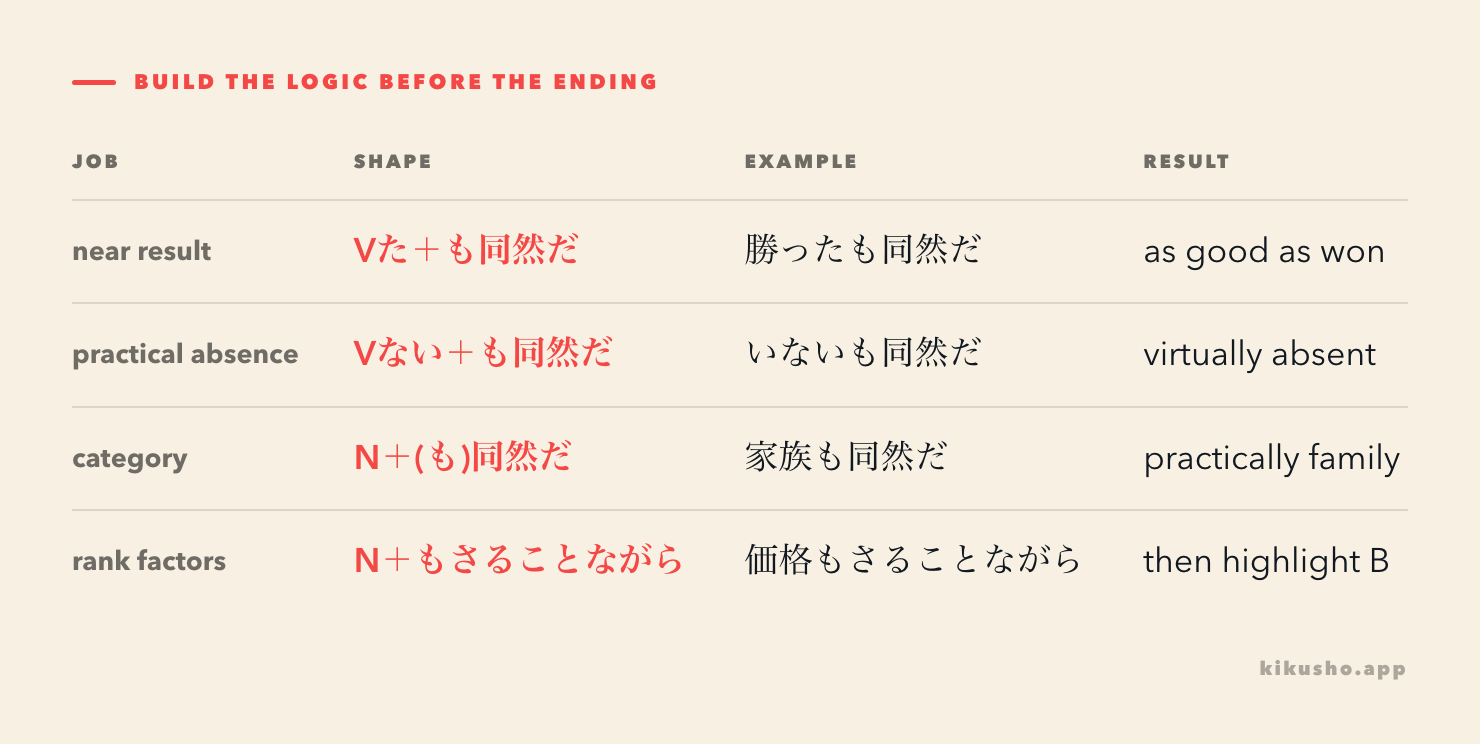
| Pattern | Logic | Reliable attachment | Natural English cue |
|---|---|---|---|
| Vた/Vない + も同然だ | X is practically equivalent to a result | 勝ったも同然だ, いないも同然だ | as good as; virtually |
| N + (も)同然だ | X is practically in a category | 家族も同然だ, 初心者同然だ | practically; just like |
| Aもさることながら、B | A is acknowledged; B receives stronger focus | 名詞 + もさることながら | A is notable, but even more B |
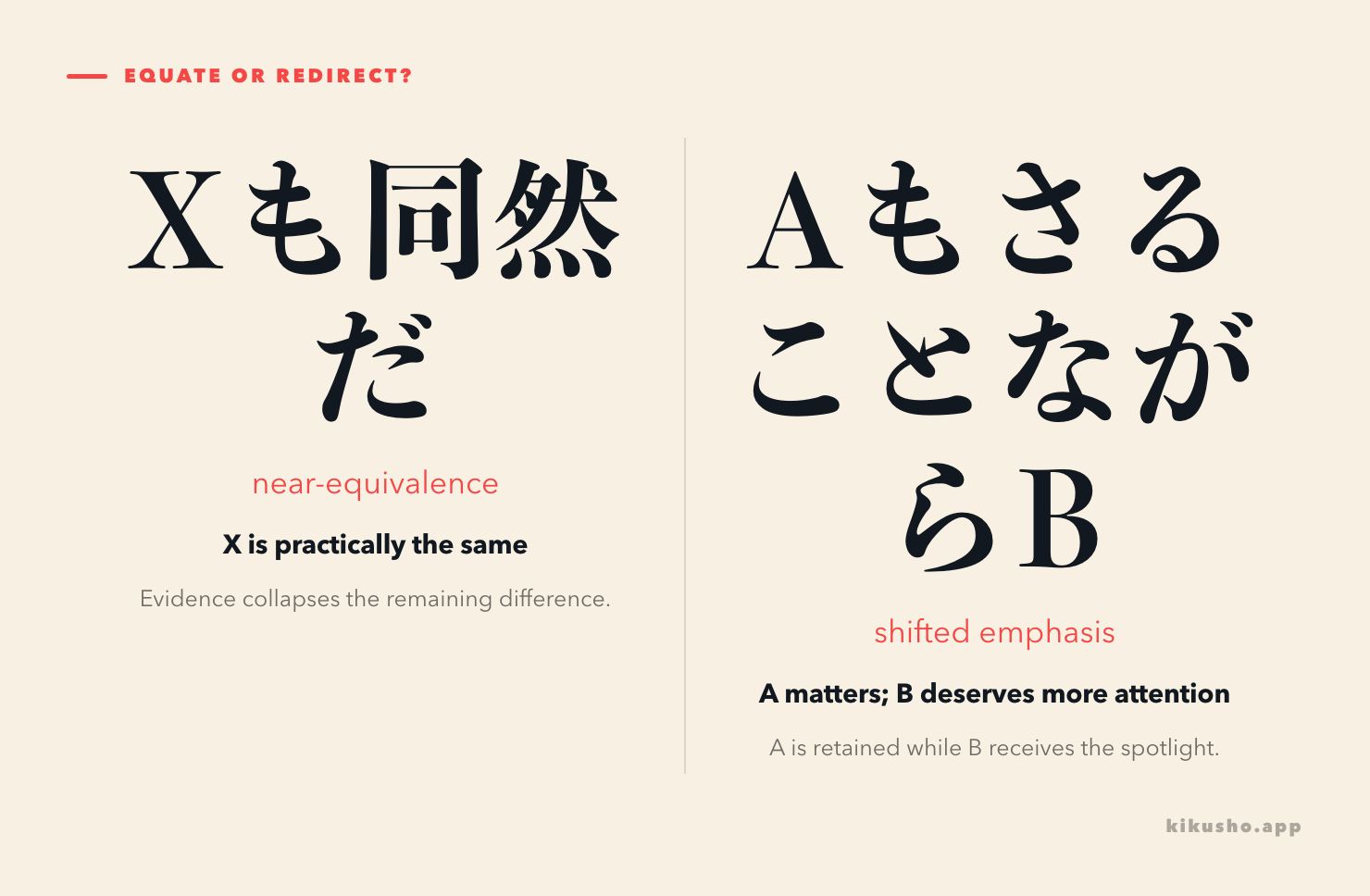
The contrast is visible in two original examples:
残り一分で三点差なら、勝ったも同然だ。
のこりいっぷんでさんてんさなら、かったもどうぜんだ。
With one minute left and a three-point lead, victory is virtually secured.
この選手は速さもさることながら、状況判断がすばらしい。
このせんしゅははやさもさることながら、じょうきょうはんだんがすばらしい。
This athlete's speed is impressive, but their situational judgment is even more remarkable.
The first sentence maps the present evidence to one practical outcome. The second builds a ranked two-part evaluation. Exchanging the expressions would destroy those relationships.
も同然だ asserts near-equivalence, not literal identity
Use も同然だ when reality has not fully reached state X but, for the speaker's purpose, the difference is negligible. 日本語NET defines the core as a state that is not literally identical but is almost the same.
返事をしないなら、提案を断ったも同然です。
へんじをしないなら、ていあんをことわったもどうぜんです。
If you do not reply, it is practically the same as rejecting the proposal.
No explicit rejection has occurred. The speaker judges silence by its practical effect. This is stronger than 断ったようなものだ, which can offer a looser analogy. も同然だ tends to collapse the remaining distance and present the conclusion confidently.
Past verbs often name a result that evidence makes almost certain:
必要な署名が全部そろったので、申請は通ったも同然だ。
ひつようなしょめいがぜんぶそろったので、しんせいはとおったもどうぜんだ。
All the required signatures are in, so the application is as good as approved.
A negative verb can present practical absence or nonexistence:
会議で一言も発言しなければ、参加していないも同然だ。
かいぎでひとこともはつげんしなければ、さんかしていないもどうぜんだ。
If you do not say a word in the meeting, it is practically as if you did not participate.
With a noun, も may appear or be omitted. 家族も同然だ and 家族同然だ both mean “practically family.” Tanosuke documents this optionality with nouns and the practical-equivalence meaning.
長年一緒に働いた彼は、家族も同然です。
ながねんいっしょにはたらいたかれは、かぞくもどうぜんです。
After working together for years, he is practically family.
Before another noun, use 同然の:
これは命令も同然の依頼だった。
これはめいれいもどうぜんのいらいだった。
This was a request that was practically an order.
The speaker needs a basis for such a strong equation. Scores, completed requirements, identical consequences or a relationship built over years can support it. Without evidence, 成功したも同然だ may sound overconfident.
もさることながら acknowledges A and foregrounds B
The frame Aもさることながら、B first grants A its importance, then presents B as especially worthy of attention.
この宿は立地もさることながら、細やかな接客が魅力だ。
このやどはりっちもさることながら、こまやかなせっきゃくがみりょくだ。
The inn's location is certainly a strength, but its attentive service is an even greater attraction.
日本語教師のまる得 gives the fixed attachment as N + もさることながら and describes it as literary or formal. In speech it fits presentations, speeches and deliberate evaluations better than casual chat.
The first point is not dismissed. 立地もさることながら means that location deserves recognition. The speaker then guides the reader toward 細やかな接客, which is newer, less obvious or more important to the argument. Benri Japan calls this a shift of emphasis after acknowledging the first factor.
製品の価格もさることながら、安全性を慎重に検討すべきだ。
せいひんのかかくもさることながら、あんぜんせいをしんちょうにけんとうすべきだ。
The product's price certainly matters, but its safety deserves even more careful consideration.
Positive praise is common, but the construction's core is not “two good things.” It ranks attention on a shared evaluative scale. Concerns, causes and requirements can also fill the frame when A is conceded and B becomes the main point.
The noun restriction matters. Use デザインもさることながら, not a finite clause such as デザインが優れているもさることながら. Recast a proposition into a noun phrase if necessary: 使いやすさもさることながら rather than directly attaching the expression to 使いやすい.
はもちろん adds B without the same ranking
Aはもちろん、Bも also acknowledges A and adds B. It does not inherently make B more important than A.
この店は味はもちろん、値段も魅力的だ。
At this restaurant, the taste is of course appealing, and so is the price.
この店は味もさることながら、接客の温かさが印象に残る。
The taste is certainly notable, but the warmth of the service leaves the stronger impression.
The first sentence expands the list of attractive features. The second steers attention toward service after conceding taste. Our はもちろん lesson teaches its productive attachment to nouns and nominalized clauses. By contrast, もさることながら is noun-based, formal and rhetorically weighted toward what follows.
Do not confuse 同然 with 当然(とうぜん), “natural, expected or deserved.” 負けたも同然だ means the situation is practically a loss. 負けて当然だ means losing is the expected or justified result. The first compares states; the second judges an outcome as unsurprising.
The study-level disagreement is real
JLPT Sensei and 日本語NET place も同然だ at N1. Tanosuke and Pass Japanese place the same practical-equivalence use at N2. The disagreement concerns study-list placement, not the central meaning or the main attachments taught here. もさることながら is consistently placed at N1 by the dedicated references inspected, including Bunpro, Benri Japan and 日本語教師のまる得.
Kikusho keeps this comparison in the planned N1 sequence and records the N2 estimate rather than turning an unofficial preparation list into a certainty. Past and negative verb forms, noun modification with の, and the basic はもちろん addition frame are useful prerequisites.
When making a card, preserve the evidence or ranking. 残り一分だから、勝ったも同然だ explains why the equivalence is licensed. 価格もさることながら、安全性が重要だ keeps both A and the emphasized B. A card with only “virtually” or “not only” cannot reconstruct the argument.
Practice
Complete all seven items before revealing the shared explanation block.
Question 1
The result is not official, but every requirement has been met. Choose the completion.
必要な条件をすべて満たしたので、審査には通った____。
ア. もさることながら
イ. も同然だ
ウ. はもちろん
エ. て当然だ
Question 2
The writer acknowledges the design and then highlights durability. Choose the completion.
この鞄はデザイン____、丈夫さが最大の魅力だ。
ア. も同然で
イ. もさることながら
ウ. を同然に
エ. たも同然だ
Question 3
Select the only phrase that can stand before 存在.
ア. 家族も同然な存在
イ. 家族も同然で存在
ウ. 家族も同然の存在
エ. 家族もさる存在
Question 4
Read 返事をしないなら、断ったも同然だ. Which interpretation matches the speaker's judgment?
ア. The refusal was formally recorded.
イ. Silence has practically the same effect as refusal.
ウ. Replying is more important than refusing.
エ. Refusal is a natural moral duty.
Question 5
Arrange the fragments to say “The location is notable, but the quiet atmosphere is an even greater attraction.”
__ __、__ __。
- 静かな雰囲気が魅力だ
- 立地
- もさることながら
- それ以上に
Question 6
Rewrite with a natural noun phrase before もさることながら:
この道具は使いやすいもさることながら、軽さも魅力だ。
Question 7
Choose the pair that preserves the near-equivalence and the shift of emphasis.
残り時間を考えれば、試合は終わった( ① )。選手の疲労( ② )、監督の判断ミスが敗因だ。
ア. ① も同然だ / ② もさることながら
イ. ① もさることながら / ② も同然だ
ウ. ① はもちろん / ② 同然の
エ. ① て当然だ / ② たも同然だ
Answers and explanations
Answer 1
Choose イ. も同然だ. 通った presents the nearly secured result, while も同然だ says the remaining difference from official approval is practically negligible. て当然だ would instead say passing is expected or deserved.
Answer 2
Choose イ. もさることながら. デザイン is a noun, and the following clause places the stronger spotlight on durability. も同然だ would equate design with another state rather than rank two attractions.
Answer 3
Choose ウ. 家族も同然の存在. The copular expression takes の before a following noun. 同然な is not the target attributive form.
Answer 4
Choose イ. Silence has practically the same effect as refusal. The sentence makes a pragmatic comparison. It does not claim that a formal refusal occurred or that refusing is morally expected.
Answer 5
2 → 3 → 4 → 1: 立地もさることながら、それ以上に静かな雰囲気が魅力だ。 The construction acknowledges location, and それ以上に makes the greater emphasis on the atmosphere explicit.
Answer 6
Use 使いやすさ: この道具は使いやすさもさることながら、軽さも魅力だ。 The suffix さ turns the adjective into a noun, which fits directly before もさることながら.
Answer 7
Choose ア. ① も同然だ / ② もさることながら. 終わったも同然だ treats the match as practically over. The second construction concedes player fatigue, then directs the main blame toward the manager's error.
Common questions
What does も同然だ mean?
It says that something is practically equivalent to another state even though the two are not literally identical. It often follows a past or negative verb, or a noun.
What does もさることながら mean?
In AもさることながらB, the speaker accepts A as important or notable, then directs stronger attention to B. It is a formal expression and takes a noun directly before it.
Can もさることながら follow a verb?
The reliable pattern is noun plus もさることながら. Recast a verbal idea as a noun phrase rather than attaching the expression directly to a finite verb.
Is も同然だ N1 or N2?
Study resources disagree. JLPT Sensei and 日本語NET place it at N1, while Tanosuke and Pass Japanese place the same near-equivalence use at N2.