On this page
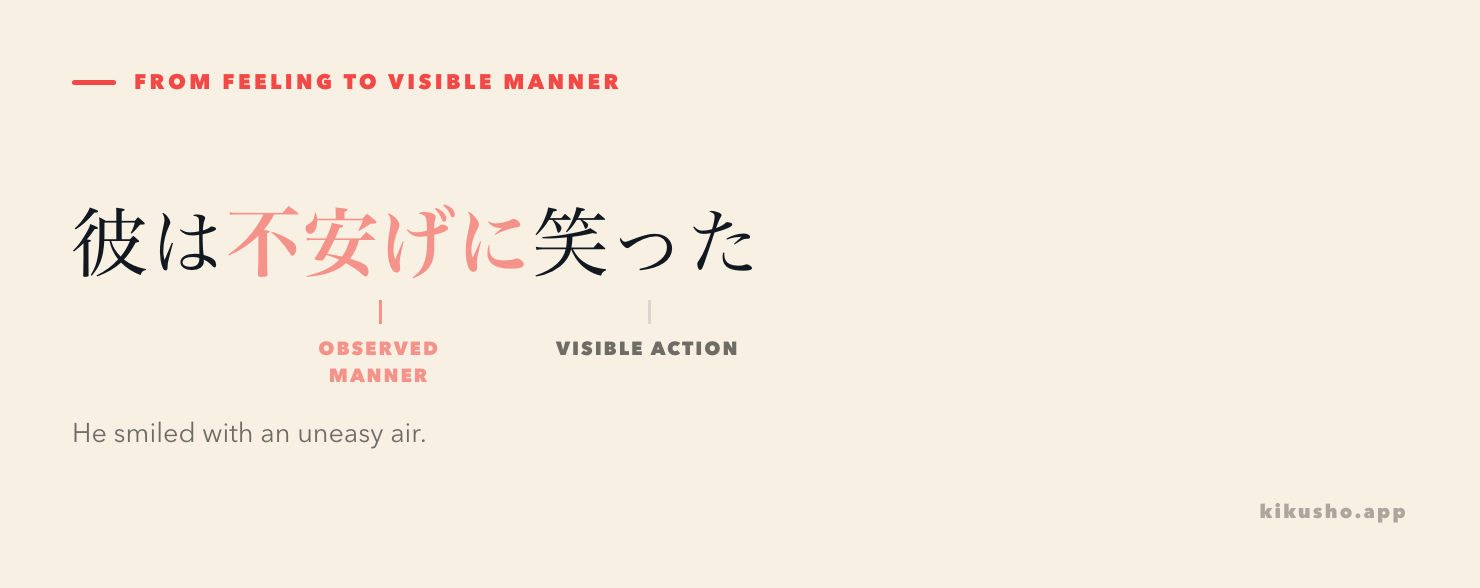
A person says 大丈夫です, “I’m fine,” but keeps looking at the clock and gives a strained smile. 彼は不安げに笑った describes that visible air: “He smiled anxiously” or “He smiled with an uneasy look.” The suffix ~げ does not open the person’s mind; it presents what an observer senses from the surface.
That observer stance is the center of the N2 pattern. ~げ joins a limited set of adjective stems and established expressions, then behaves like a な-adjective: 不安げだ, 不安げな表情, 不安げに話す. It is less productive than appearance ~そう, and its slightly descriptive tone suits narration as well as careful speech.
JLPT Sensei and Bunpro place ~げ at N2 and describe its attachment and appearance meaning. Kikusho’s reference inventory also records it in the Tanos N3 comparison, so the level boundary is not unanimous. The JLPT authority publishes no exhaustive grammar list; N2 here is a source-based study placement.
~げ creates a な-adjective from an outward clue
The completed expression takes the same three basic positions as a な-adjective. Use だ/です when it is the predicate, な before a noun and に before a verb.
| Position | Shape | Example | What follows |
|---|---|---|---|
| predicate | Xげだ/です | 彼は不安げだった | the sentence ends or continues |
| noun modifier | Xげな + noun | 不安げな表情 | a noun |
| adverbial | Xげに + verb | 不安げに笑った | an action |
This output is easier to remember than three English translations. げな does not mean one kind of appearance and げに another. The choice tells you what grammatical job the completed expression performs.
彼は不安げに時計を見た。
He looked at the clock with an uneasy air.
The common spelling is hiragana げ. Dictionaries also record the kanji form 気, which connects the suffix historically to a sensed air or presence. In ordinary modern examples, reading the ending as the suffix matters more than writing the kanji.
Attachment is restricted, so learn the combination
The most dependable combinations describe feelings, attitudes or qualities that can leave a visible trace. With an い-adjective, remove final い. With a な-adjective, use its base without な.
| Source | Formation | Established example |
|---|---|---|
| い-adjective | remove い + げ | 寂しい → 寂しげ, lonely-looking |
| い-adjective | remove い + げ | うれしい → うれしげ, looking pleased |
| な-adjective | base + げ | 不安 → 不安げ, looking uneasy |
| な-adjective | base + げ | 得意 → 得意げ, looking proud or pleased with oneself |
| desire in ~たい | remove final い + げ | 言いたい → 言いたげ, looking as if one wants to say something |
| established phrase | learn as a unit | 自信ありげ, apparently confident |
母は寂しげな目で、空になった部屋を見た。
My mother looked at the empty room with lonely eyes.
子どもは何か言いたげに先生を見上げた。
The child looked up at the teacher as if wanting to say something.
彼は自信ありげに答えたが、答えは間違っていた。
He answered with an air of confidence, but his answer was wrong.
The last example shows why ありげ is useful: the observed confidence and the truth can pull apart. Other familiar units include 意味ありげ, “suggestive or seemingly meaningful,” and 物欲しげ(ものほしげ), “looking desirous.” Treat them as combinations you have met, not proof that any adjective, noun or verb can freely take げ.
Fixed words also need separate care. 大人げない means childish or unbecoming of an adult, and 可愛げがある/ない describes the presence or absence of an endearing quality. They contain the same suffix historically, but their noun-like frames are lexical units. Do not derive a general rule such as 大人げだ from them.
The observer reports an impression, not an inner fact
The Kotobank dictionary entry for 気 defines suffix げ as creating the impression that something looks a certain way from outside. It also notes the frequent link with psychological meanings and the possibility that the appearance does not match the essence. Its entry for 寂しげ likewise describes someone who is perceived as feeling lonely.
That distance explains why a direct present-tense self-report is awkward:
私は不安だ。
I am anxious.
写真の私は不安げに見える。
I look uneasy in the photo.
In the first sentence, the speaker has direct access to the feeling. In the second, the speaker examines a visible version of themself as an observer would. The principle is perspective, not a ban on the grammatical first person. A novelist can also narrate an earlier self from outside, and a speaker can quote what somebody else thought they looked like.
Because ~げ leaves room between surface and reality, it works well with a later correction. 自信ありげだったが、実はよく分かっていなかった means the person looked confident but did not really understand. Without that contrast, ~げ still reports an appearance; it does not automatically accuse anyone of pretending.
~げ and ~そう overlap only in the appearance zone
Appearance ~そう is the ordinary, productive neighbor. Both endings can create a noun modifier with な and an adverbial expression with に:
悲しそうな顔/悲しげな顔
a sad-looking face / a face with a sorrowful air
うれしそうに話す/うれしげに話す
speak looking pleased / speak with a pleased air
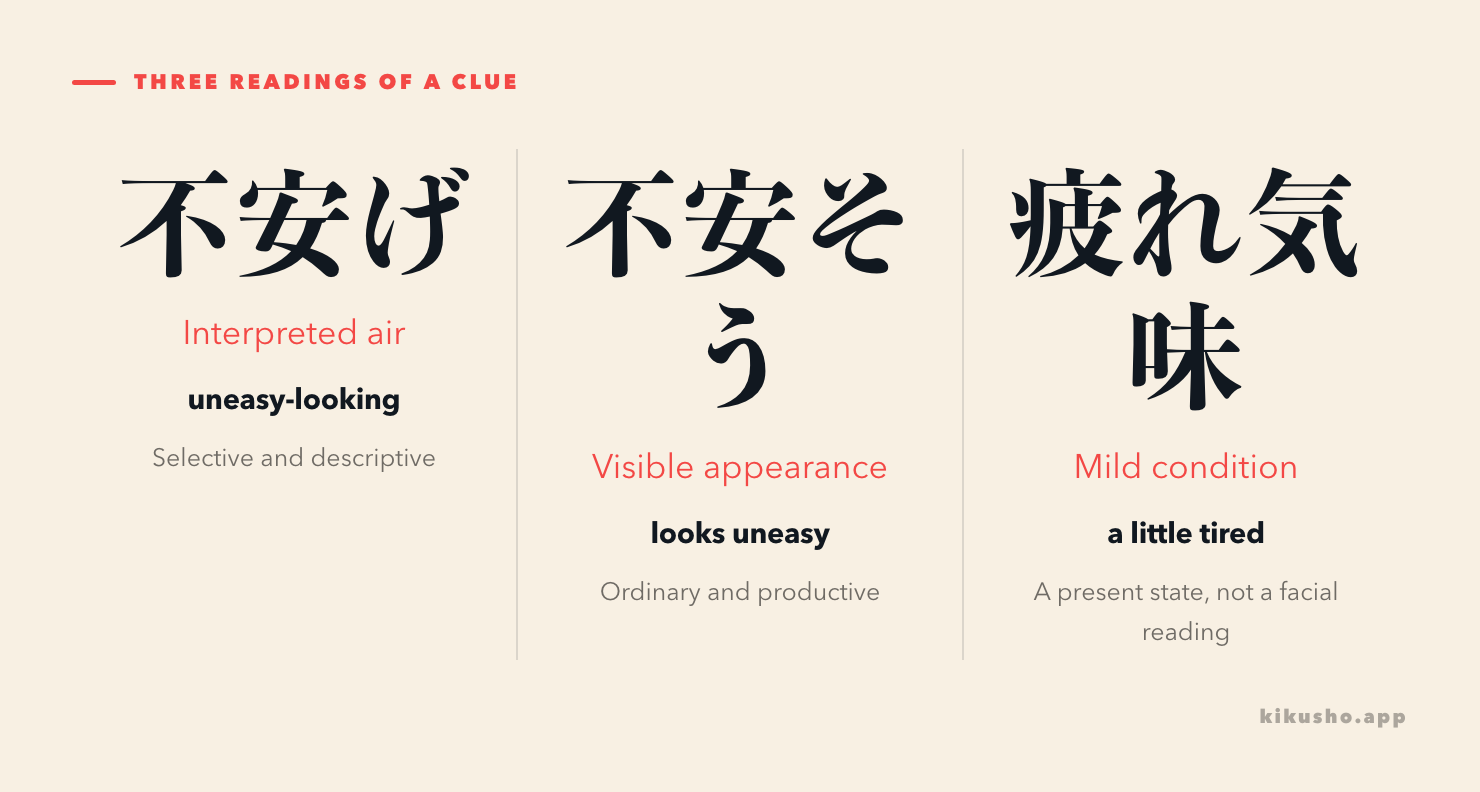
The ~そう versions are neutral and widely available. The ~げ versions feel more selective and descriptive, with the observer interpreting an emotional sign. They can refer to the same face without becoming identical in register or confidence.
The overlap stops when ~そう predicts an event or attaches productively to a sensory quality:
雨が降りそうだ。
It looks like it is going to rain.
この料理はおいしそうだ。
This dish looks delicious.
Neither 降りげだ nor おいしげだ is the normal replacement. The そう, よう, らしい and みたい comparison develops the wider evidence system. For ~げ, first ask whether you know an established combination for the perceived feeling or attitude.
~っぽい and ~気味 describe different evidence
~っぽい can build a broad characteristic or repeated tendency: 子どもっぽい is childish or childlike, while 忘れっぽい describes someone prone to forgetting. It behaves as an い-adjective. ~げ instead builds a な-adjective-like expression and often captures the air visible in one scene. The ~っぽい lesson gives its full attachment and inflection.
~気味(ぎみ) presents a slight state or tendency already present: 疲れ気味だ means “a little tired” and 遅れ気味だ means “running somewhat late.” A person can assess themself with 今日は疲れ気味だ. 疲れげだ is not the usual way to make that mild self-diagnosis. The だらけ, がち and 気味 comparison follows that present-state reading.
| What the speaker notices | Best starting point |
|---|---|
| an interpreted emotional air in an established expression | ~げ |
| a broadly visible quality or something about to happen | ~そう |
| a characteristic or repeated disposition | ~っぽい |
| a mild condition already present | ~気味 |
These are decision cues rather than translation slots. A tired person can look 疲れそう in a context where a task seems likely to tire them, be 疲れっぽい as a general disposition, or be 疲れ気味 today. The surrounding evidence decides the claim.
In Kikusho, keep the visible clue with the suffix. A card containing only 不安げ = anxious-looking hides the observer’s work. Save 時計を何度も見ながら、不安げに笑った and mark the strained action beside げ. The next review then asks you to recover both the form and the evidence that licensed it.
Practice: follow the suffix into the sentence
Answer all six prompts before opening the explanations.
Question 1 — grammar choice. Complete the observed action: 彼は不安__時計を見た。
- げに
- げな
- げを
- げの
Question 2 — grammar choice. Which form correctly modifies 声 using 寂しい + げ?
- 寂しいげな声
- 寂しげに声
- 寂しげな声
- 寂しげの声
Question 3 — text grammar. Read 写真の私は不安げに見える。 Why is first-person 私 possible here, and what does the sentence leave unconfirmed?
Question 4 — grammar choice. Which sentence naturally predicts rain from the present sky?
- 雨が降りげだ。
- 雨が降りそうだ。
- 雨が降り気味だ。
- 雨が降りっぽい。
Question 5 — build the form. Put 彼は/不安/げ/な/表情/で/答えた in order to say “He answered with an uneasy expression.”
Question 6 — text grammar. Read 美咲は少し疲れ気味だったが、発表の後は得意げに資料を見せた。 What does each suffix say, and why would exchanging them distort the sentence?
Answers and explanations
Answer 1: 1, げに. 不安げ is the completed appearance expression, and に makes it modify the action 時計を見た. な would need a following noun, while を and の do not give the expression its required adverbial role.
Answer 2: 3, 寂しげな声. Remove final い from 寂しい, add げ, then use な because 声 is a noun. 寂しげに would instead modify a verb, as in 寂しげに話した.
Answer 3. The speaker is viewing themself as a figure in a photograph, so the judgment comes from outward evidence rather than direct access to the feeling. The sentence confirms an uneasy appearance; it does not prove that the photographed speaker truly felt anxious.
Answer 4: 2, 雨が降りそうだ. Verb-stem 降り + そう predicts an event that looks imminent. ~げ is not a productive future-event ending, 気味 describes a mildly present condition, and っぽい cannot be attached here to make this prediction.
Answer 5. 彼は不安げな表情で答えた。 不安 + げ creates the appearance expression, な connects it to 表情, and で marks that expression as the manner or accompanying state of answering.
Answer 6. 疲れ気味 diagnoses a mild condition already present: Misaki was somewhat tired. 得意げに describes the proud or self-satisfied air visible in the way she showed the materials. Reversing them would force an unsupported emotional-appearance use of 疲れげ and would turn 得意気味 into an unnatural mild-condition label.
Common questions
What does ~げ mean in Japanese?
~げ means that someone or something gives an outward impression of a feeling, attitude or quality. It creates a な-adjective-like expression, such as 不安げだ, 不安げな表情 and 不安げに話す.
What is the difference between ~げ and ~そう?
Both can describe an appearance, but ~そう is more productive and can also predict an imminent event, as in 雨が降りそうだ. ~げ prefers established combinations describing a perceived emotion, attitude or air.
Can ~げ describe the speaker's own feelings?
It is unusual for a speaker to use ~げ as a direct report of an inner feeling. It can describe the speaker as an observed figure, as in a photo or remembered scene, because the claim then comes from outward evidence.