On this page
A writer who calls three survey replies 三件に過ぎない is limiting their number: “only three.” A writer who calls a change 改善にほかならない is insisting on its identity: “precisely an improvement.” These two N2 patterns can both become “nothing but” in English, yet they do different work in the claim.
に過ぎない limits a claim; にほかならない insists on it
Here are the two constructions taught in this lesson. 過ぎない is read すぎない; you will also see にすぎない written in kana. ほか may appear as 他, so に他ならない is another spelling of the second expression.
| Construction | Reading | What the speaker does | Original example |
|---|---|---|---|
| ~に過ぎない | ~にすぎない | Limits quantity, status or significance to the stated description | 回答は三件に過ぎない。 — There are only three replies. |
| ~にほかならない | ~にほかならない | Firmly identifies something as the named thing or cause | この変更は改善にほかならない。 — This change is precisely an improvement. |
Ask what the writer wants you to stop doing. With に過ぎない, stop treating the number or description as more than it is. With にほかならない, stop proposing a different identity or explanation. The first restricts the scope of a claim; the second commits to that claim.
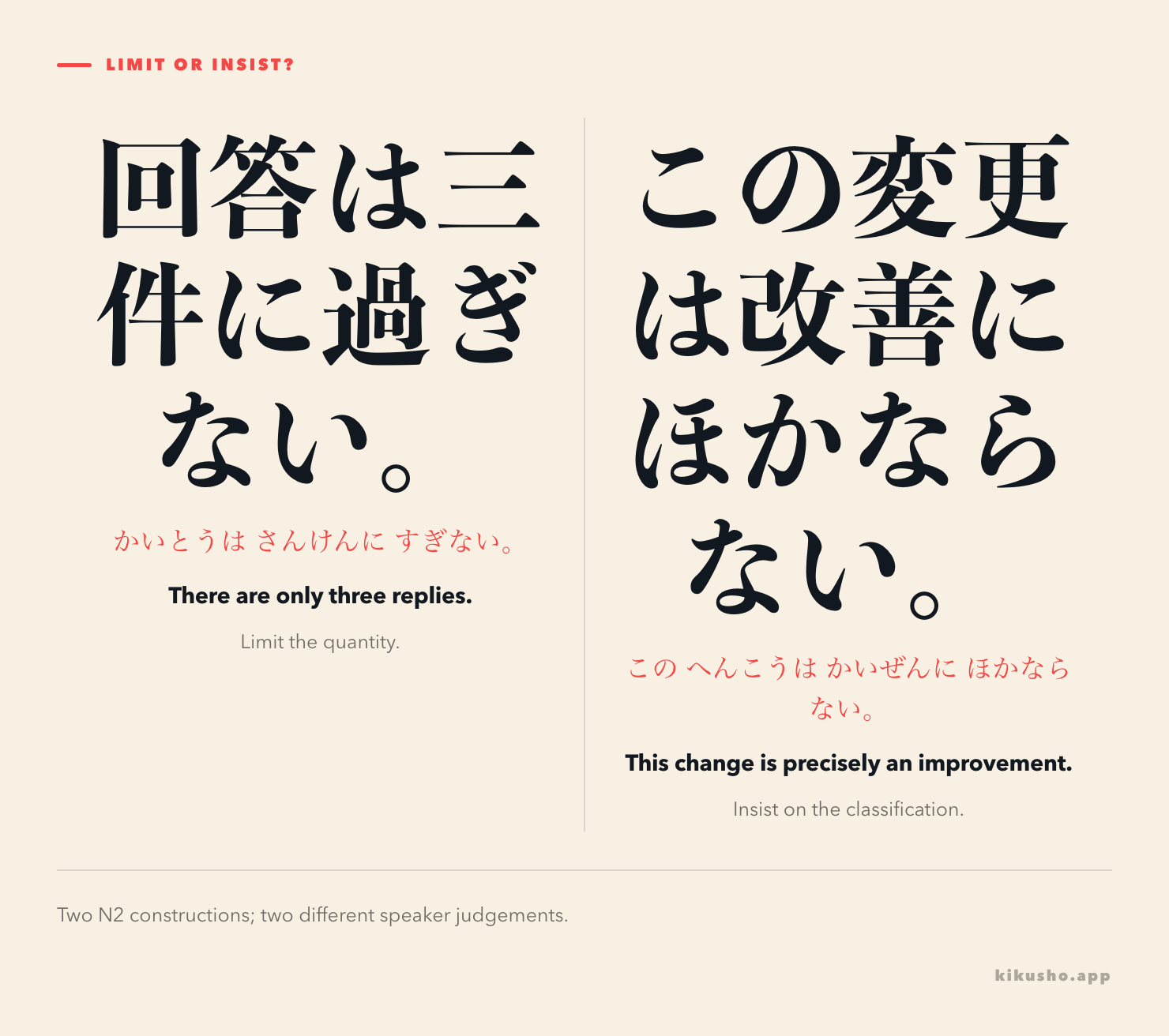
Bunpro's comparison explicitly distinguishes the two evaluations. The distinction concerns what the speaker makes of the situation. It does not mean the first statement is always uncertain, or the second objectively proven.
に過ぎない can limit a number without calling the people worthless
説明会に来たのは五人に過ぎなかった。
せつめいかいに きたのは ごにんに すぎなかった。
Only five people came to the information session.
The count is presented as limited, perhaps against a much larger expectation. It does not follow that those five people are unimportant. A speaker can be certain about the count and still use に過ぎない. Small quantity and low confidence are different judgements.
A noun can instead limit the status of some information:
この数字は一例に過ぎない。
この すうじは いちれいに すぎない。
This number is only one example.
You are warning the reader against making it stand for the whole collection. The sentence does not by itself claim that the example is false. Likewise, describing something as a guess rather than a fact is a limitation on its status, not an assertion that the guess must be wrong.
Japanese NET's lesson covers quantity and degree, including noun and verb attachment. The same construction can sound dismissive when you apply it to someone's achievements or position. Check the noun you are limiting, not just the negative ending.
にほかならない names the identity or cause the speaker insists on
この変更は改善にほかならない。
この へんこうは かいぜんに ほかならない。
This change is precisely an improvement.
Here 改善 is the writer's firm classification. A reader may disagree with it. The grammar supplies the insistence; evidence elsewhere must support the evaluation. It is stronger in stance than simply saying この変更は改善です.
To identify a cause, a reason clause can end in からにほかならない:
案を修正したのは、参加者の声を聞いたからにほかならない。
あんを しゅうせいしたのは、さんかしゃの こえを きいたからに ほかならない。
The plan was revised precisely because we listened to the participants.
The subject of 聞いた is omitted; “we” supplies a plausible participant in this invented context. The sentence singles out that reason. It does not describe a lack of possible actions or an obligation to revise.
Both Japanese NET and Nihongo no Sato's paired lesson illustrate this cause pattern. Neither the word から nor the emphatic ending makes a writer's causal argument automatically sound.
Keep the form before に intact
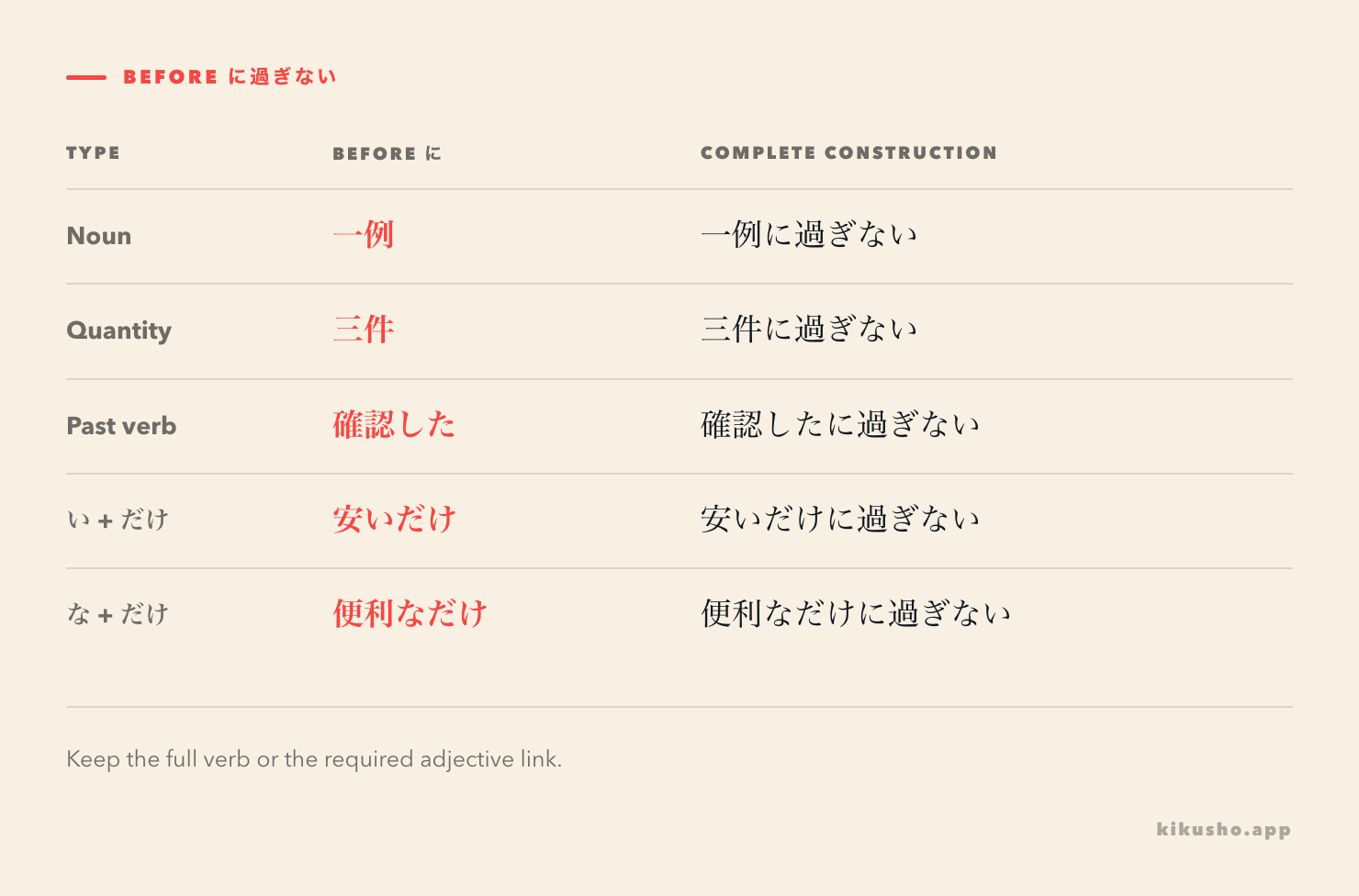
The selectable table gives the main attachments. The examples are fresh illustrations; だけ is shown where it makes the adjective pattern easier to use.
| Material before the construction | に過ぎない | にほかならない |
|---|---|---|
| Noun or quantity | 一例に過ぎない / 三件に過ぎない | 改善にほかならない |
| Plain-form verb | 確認したに過ぎない | Use a noun phrase: 確認することにほかならない |
| い-adjective with だけ | 安いだけに過ぎない | Do not transfer this attachment mechanically |
| な-adjective with だけ | 便利なだけに過ぎない | Choose a noun description or a properly formed reason clause |
| Formal な-adjective predicate | 有名であるに過ぎない | Not the core noun pattern taught here |
| Reason clause ending in から | Not needed for the limiting examples here | 参加者の声を聞いたからにほかならない |
私は資料を確認したに過ぎない。
わたしは しりょうを かくにんしたに すぎない。
I merely checked the materials.
Keep the full past form 確認した. This is not 確認しすぎない, the different structure built from a verb stem plus すぎる. That would concern excessive checking, rather than limiting what you did to checking.
For the adjective route, この道具は便利なだけに過ぎない means the tool is merely convenient. The な belongs before だけ. It is not 便利だだけ. Bunpro's attachment notes explain this route; Nihongo no Sato also gives the formal である predicate route. These are alternative constructions, not a reason to insert だ before every に.
For にほかならない, a bare 確認するにほかならない is not the attachment offered by the core pattern. 確認することにほかならない identifies the act of checking. A reason in から identifies why something happened. Nominalisation and a reason clause solve different problems.
A shared noun can support either ending with a different evaluation
その説明は言い換えに過ぎない。
その せつめいは いいかえに すぎない。
That explanation is merely a rephrasing.
その説明は言い換えにほかならない。
その せつめいは いいかえに ほかならない。
That explanation is precisely a rephrasing.
Both sentences are grammatical. In the first, the writer discounts the explanation as offering no more than a rephrasing. In the second, the writer emphatically classifies it as rephrasing. That classification can itself be critical. にほかならない does not turn a negative noun into praise.
This is why a bare gap followed by two grammatically possible endings makes a poor exercise. A fair question must specify the evaluation being sought or provide enough surrounding text. A phrase such as “nothing but a rephrasing” leaves the same problem in English.
The firm tone is discussed in Tanosuke's teaching notes, alongside the limiting evaluation of にすぎない. The contrast is one of stance, not a simple positive-versus-negative mood switch.
Formality does not make the forms interchangeable
The references consulted place both constructions at N2. The inventory brief assigns these exact two grammar units to N2; it records no level disagreement for them. This is agreement among teaching references, not an exhaustive official JLPT syllabus.
Bunpro labels にほかならない formal, while Japanese NET describes it as written language. Argumentative prose and formal speech are sensible places to meet its insistence. に過ぎない is also somewhat formal, but Bunpro notes that it occurs in everyday speech. Do not infer that a N2 construction is prohibited in conversation.
Polite forms retain the distinction: 一例に過ぎません still limits something to an example; 改善にほかなりません still firmly identifies an improvement. Changing the ending's politeness does not reverse the claim.
In an opinion paragraph, you may also meet ものの or とはいえ, which qualify an earlier statement. They express concession, rather than either of the evaluations here. For refusal or the possibility of an unwanted outcome, かねる and かねない illustrate another pair whose similar shapes cannot settle their meanings.
When a noun such as 言い換え or 改善 is new to you, Kikusho's text capture gives you a place to build its vocabulary card. Check the proposed example against the writer's use before saving: a sentence that limits 言い換え and one that insists on it provide different cues. Keep that distinction while you learn the word with its sentence.
Practice
Attempt all six questions before opening the answer block. For the composition questions, put every fragment into the four slots and choose the fragment at ★. Examples and contexts are original.
Question 1
Choose the ending that presents the number as only five, below a much larger expectation.
百人を招待したが、来たのは五人( )。
A. にほかならない
B. に違いない
C. に過ぎない
D. に加えて
Question 2
The speaker intends to insist, “It is precisely because we listened to the participants.” Choose that ending.
案を修正したのは、参加者の声を聞いたから( )。
A. にほかならない
B. にかかわらず
C. に過ぎない
D. に先立って
Question 3
Compose the sentence meaning “The new plan is precisely a simple rephrasing.” Which fragment belongs at ★?
新しい案は _ _ ★ _。
A. ほかならない
B. 単なる
C. 言い換え
D. に
Question 4
Compose the sentence meaning “I merely checked.” Which fragment belongs at ★?
私は _ _ ★ _。
A. 確認
B. に
C. した
D. 過ぎない
Question 5
Read the paragraph. Choose the ending that matches the writer's decision to treat the responses as a limited sample.
説明会の後、百人にアンケートを送った。しかし、回答は三件( )。この数だけで、参加者全体の意見を判断することはできない。
A. に過ぎない
B. にほかならない
C. に加えて
D. に先立って
Question 6
Read the paragraph. Choose the ending that insists on the stated cause, rather than minimising it.
会場の場所について、同じ要望が何度も届いた。主催者は次回の会場を変更した。「場所を変えたのは、参加者から同じ要望が何度も出たから( )」と、変更の理由を強調して説明した。
A. に過ぎない
B. に先立って
C. にほかならない
D. にかかわらず
Write one reason for each choice before checking the explanations.
Answers and explanations
Answer 1. C. 五人に過ぎない limits the count to five. A would insist on their identification as five, without expressing the requested low-count evaluation. B states confident inference, “must be five”; it does not mean “only five.” D means “in addition to” and would need a continuation. The invitation to a hundred people supplies the expectation against which five is small.
Answer 2. A. 聞いたからにほかならない singles out listening as precisely the reason. C is the limiting expression and does not supply the requested emphatic causal identification; the question specifies the stance, rather than claiming every alternative is impossible in every context. B means “regardless of,” while D means “prior to”; neither completes the intended causal assertion.
Answer 3. D. The order is 単なる → 言い換え → に → ほかならない: 新しい案は単なる言い換えにほかならない。単なる modifies the noun 言い換え, and に connects that noun phrase to ほかならない. D occupies the third, starred slot. A completes the predicate, B starts the noun phrase, and C occupies its noun position.
Answer 4. B. The order is 確認 → した → に → 過ぎない: 私は確認したに過ぎない。確認した is the intact past verb form, followed by に過ぎない. B is in the third slot. A and C form the verb before it; D finishes the construction. Moving 過ぎない directly after 確認 would not preserve the requested pattern.
Answer 5. A. The next sentence refuses to generalise from the three replies, so に過ぎない expresses the limited sample size. B emphasises the identity or number rather than that limitation. C would add something to the replies and D would mark a prior point; both leave this sentence without the intended completed judgement. The paragraph says the sample is insufficient for this conclusion, not that every response lacks value.
Answer 6. C. The quotation and 強調して説明した frame the repeated requests as exactly the reason for changing the venue. A downplays the stated description and is not the specified insistence. B introduces a prior relationship; D introduces disregard for a circumstance. Neither produces this causal conclusion. The organiser's confident explanation is still an assertion whose evidence the reader can examine.
Common questions
What is the difference between に過ぎない and にほかならない?
に過ぎない limits something to a quantity, status or description, often translated as only or merely. にほかならない insists that something is precisely the named identity or cause. Both can look like nothing but in English, so that translation alone cannot choose between them.
Can にほかならない follow a verb directly?
The core pattern is noun plus にほかならない. To identify an action, nominalise it with こと; to insist on a cause, use a reason clause ending in から plus にほかならない. Do not simply attach にほかならない to a bare dictionary-form verb.
Are these N2 forms only used in writing?
The consulted teaching references place both forms at N2. にほかならない has a firm, formal tone and is characteristic of argumentative writing or formal speech. に過ぎない is also somewhat formal but can occur in ordinary speech. Context and the intended evaluation matter more than a blanket ban on speaking either form.