On this page
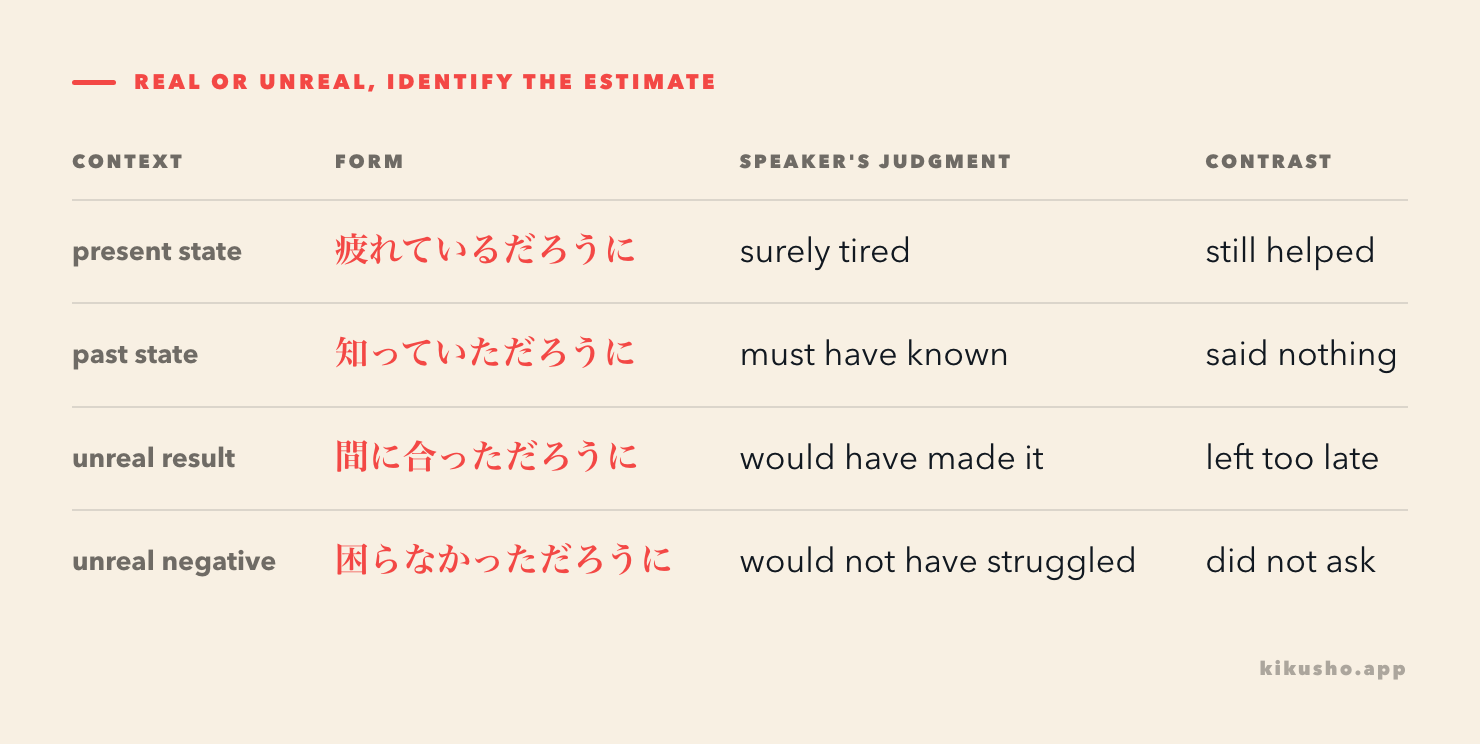
ものを looks back at a better course that was not taken; だろうに states what the speaker judges likely or possible, then sets reality against it. Both can carry regret, but only だろうに contains the conjectural だろう. That is why it also works when nothing was “missed”: 疲れているだろうに、最後まで手伝ってくれた means “Although she must be tired, she helped until the end.”
In counterfactual sentences, the forms can come close. Compare 相談してくれれば、手伝えたものを with 相談してくれれば、手伝えただろうに. The first deplores an unrealized chance to help. The second judges that help would probably have been possible.
Ask whether the sentence mourns a route or revises an expectation
| Form | Core operation | Reliable attachment | What the speaker supplies |
|---|---|---|---|
| Aものを | A was the preferable or expected course, but reality went elsewhere | V plain; い-adjective plain; な-adjective + な | regret, frustration or reproach |
| Aだろうに、B | A is probably true or would probably have happened, yet B conflicts | plain proposition + だろうに | conjecture plus contrast |
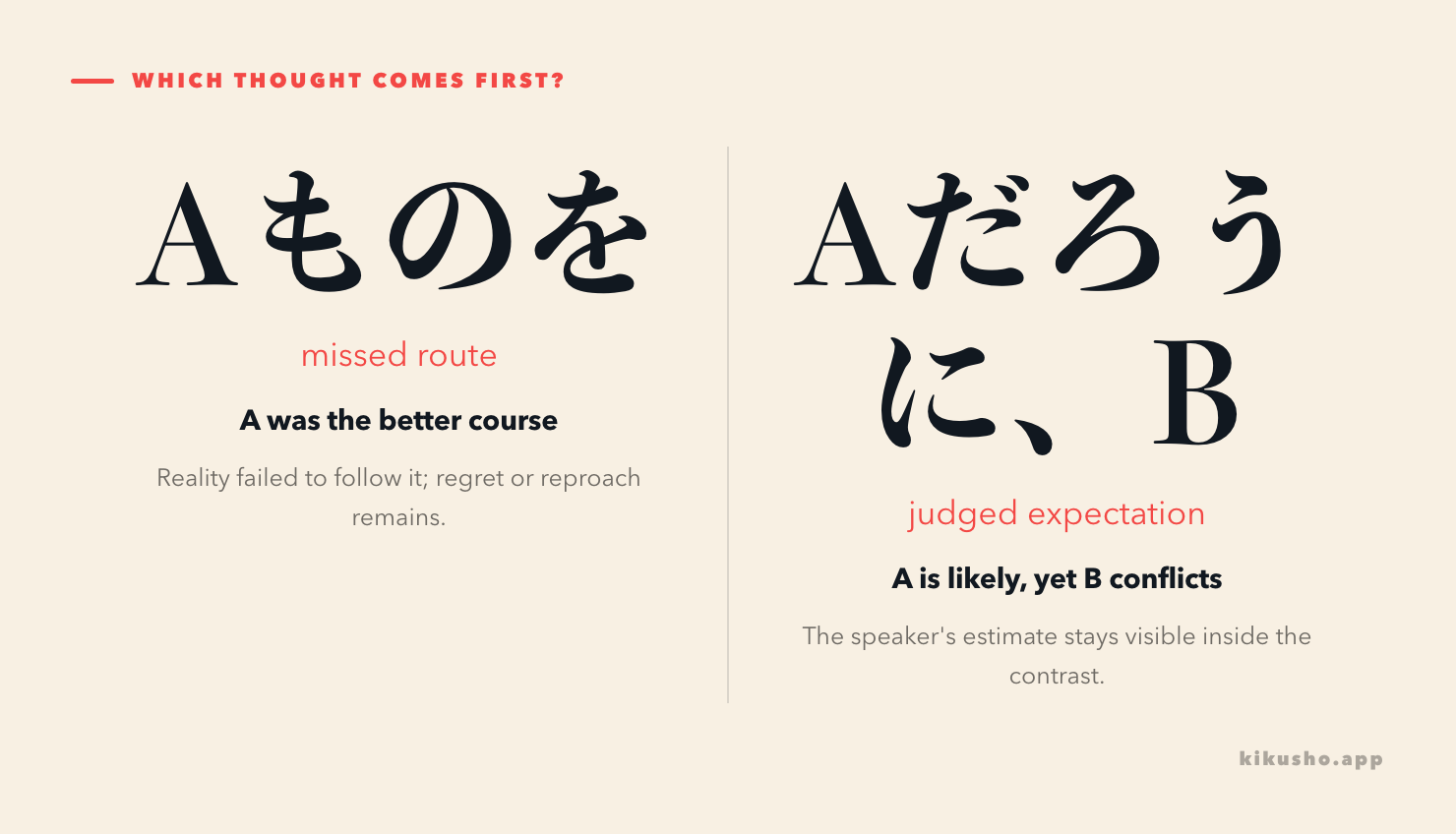
The English words “although” and “would have” fit both columns in some contexts. They do not choose the Japanese form for you. Find the speaker's mental move. Is the sentence accusing reality of missing a better route? Choose ものを. Is it first estimating what is true or what would follow? Choose だろうに.
ものを exposes the better alternative that reality missed
ものを follows a clause and marks a contrast between an ideal, expected or preferable possibility and what occurred instead.
一言相談してくれれば、別の方法を提案できたものを。
ひとことそうだんしてくれれば、べつのほうほうをていあんできたものを。
If only you had consulted me, I could have suggested another method.
The actual outcome is absent after ものを, but it is easy to recover: the person did not consult the speaker, so the alternative was lost. Sentence-final ものを often leaves that disappointing half unsaid. 日本語NET records both the regret or dissatisfaction and the possible omission of what follows.
The contrast may also continue explicitly:
少し直せばまだ使えるものを、彼は時計を捨ててしまった。
すこしなおせばまだつかえるものを、かれはとけいをすててしまった。
Although the watch could still be used after a small repair, he threw it away.
The speaker sees repair as the sensible route and criticizes the decision to discard the watch. A neutral けれど would report a contrast without necessarily carrying that disappointed judgment.
The forms before ものを behave like plain modifiers:
| Before ものを | Form | Original example fragment |
|---|---|---|
| verb | plain form | 確認すれば防げたものを |
| い-adjective | plain form | もっと安ければ買えたものを |
| な-adjective | な | 十分安全なものを |
Bunpro's ものを reference connects the form with an outcome that should have occurred but did not, and notes how often a conditional such as ば, たら or と prepares that unrealized alternative. The condition is common because it makes the lost route explicit; it is not a detachable part of the ending.
だろうに keeps the speaker's estimate inside the contrast
Break だろうに into its work: だろう presents the speaker's estimate, while concessive に leaves a conflicting fact or reaction hanging over it.
初めての発表で緊張していただろうに、彼女は落ち着いて話した。
はじめてのはっぴょうできんちょうしていただろうに、かのじょはおちついてはなした。
She must have been nervous during her first presentation, yet she spoke calmly.
No better action was ignored. The speaker infers nervousness, then expresses surprise or admiration at the calm performance. 絵でわかる日本語 describes this use as きっと/たぶん〜のに and shows that the surrounding attitude may be sympathy, criticism, surprise or admiration.
The same structure can criticize a choice:
危険だと分かっていただろうに、なぜ一人で入ったのだろう。
きけんだとわかっていただろうに、なぜひとりではいったのだろう。
He must have known it was dangerous, so why did he go in alone?
Here the speaker infers prior knowledge. The real action conflicts with that expectation. ものを would require a preferable course to be framed instead, such as 誰かを呼べばよかったものを, “If only he had called someone.”
Counterfactual だろうに predicts the result that never arrived
With an unreal condition, だろうに evaluates a result in the world that did not happen.
あと十分早く出ていれば、最終電車に間に合っただろうに。
あとじゅっぷんはやくでていれば、さいしゅうでんしゃにまにあっただろうに。
If we had left ten minutes earlier, we would probably have caught the last train.
This use naturally conveys regret. 絵でわかる日本語's counterfactual lesson describes the pattern as regretting what would have happened under a different condition. The clause before だろうに can itself be past, negative or potential because the unit is a full proposition: 間に合っただろうに, 困らなかっただろうに, 説明できただろうに.
The JLPT Sensei reference groups the same two families: a likely state contrasted with reality, and a counterfactual result viewed with regret. Both retain the speaker's judgment. だろうに is therefore not merely a more advanced spelling of のに.
In the overlap, listen for complaint versus estimation
Consider a single missed departure:
もう少し早く出れば、間に合ったものを。
If only you had left a little earlier; you could have made it.
もう少し早く出れば、間に合っただろうに。
If you had left a little earlier, you probably would have made it.
The event facts can be identical. ものを makes the discarded alternative the emotional center and can sound reproachful, literary or dramatic. だろうに presents the unreal result as the speaker's conclusion. Its regret may be strong, but the grammar still displays an estimate.
This also explains a boundary. 疲れているだろうに、手伝ってくれた is natural because the speaker can infer tiredness. 疲れているものを、手伝ってくれた would force a different reading and does not simply substitute for that sympathetic inference.
The nearby ものの is more neutral. 疲れているものの、作業を続けた concedes the fact of being tired and supplies a contrasting fact. It need not express a missed better course. Our ものの and とはいえ lesson teaches that factual concession. For the earlier contrast between a forecast and a duty, see はず and べき.
Both target forms suit deliberate narration, commentary and emotionally marked speech better than an everyday neutral のに. They become natural when the sentence needs the speaker's stance, not merely a logical “but.”
Preserve the missing route or the judged expectation on a card
A card containing only “although” erases the choice this lesson teaches. Keep the condition and the actual outcome together. 連絡してくれれば迎えに行けたものを needs the missed call; 疲れていただろうに最後まで残った needs both the inferred fatigue and the surprising decision to stay.
When you capture a sentence like that in Kikusho, keep the whole contrast as the example and put “missed route” or “judged expectation” in the nuance field. The next review then asks you to reconstruct the relationship, rather than match either form to the same loose English gloss.
Practice
Work through Questions 1–7, then reveal the explanations together.
Question 1
The speaker criticizes someone for wasting an easily repairable chair. Choose the completion.
少し直せばまだ使えた____、捨ててしまったの?
ア. だろうに
イ. ものを
ウ. ものの
エ. べきだ
Question 2
The speaker infers that a colleague was busy and is grateful for the help.
忙しかった____、丁寧に確認してくれてありがとう。
ア. ものを
イ. ものの
ウ. だろうに
エ. べきで
Question 3
Which sentence uses ものを as an unfinished expression of a missed opportunity?
ア. 早く知らせてくれれば、準備できたものを。
イ. 忙しいものを、会議に出た。
ウ. 明日は晴れるものを。
エ. 学生だものを、よく知っている。
Question 4
Arrange the fragments to express the judgment “If the map had been checked, we probably would not have got lost.”
__ __ __ __。
- 迷わなかった
- 地図を
- だろうに
- 確認していれば
Question 5
The following two lines share one condition. What does the ending change?
相談してくれれば、助けられたものを。
相談してくれれば、助けられただろうに。
ア. The first reports a neutral fact; the second gives an order.
イ. The first deplores the missed route; the second judges the unreal result as probable.
ウ. The first is present tense; the second is future tense.
エ. The two sentences differ only in politeness.
Question 6
Rewrite the following idea with だろうに: “She was probably anxious, yet she answered every question calmly.”
Question 7
Complete both gaps without changing either speaker stance.
もっと早く相談すれば解決できた( ① )。彼も事情を知っていた( ② )、何も言わなかった。
ア. ① ものを / ② だろうに
イ. ① だろうに / ② ものを
ウ. ① ものの / ② べきで
エ. ① だろうに / ② ものの
Answers and explanations
Answer 1
Choose イ. ものを. The speaker presents repair as the preferable route and reproaches the decision to throw the chair away. だろうに would need the sentence to frame a judgment or likely result rather than this direct complaint about a missed option.
Answer 2
Choose ウ. だろうに. 忙しかっただろう is the speaker's estimate, and に introduces the contrasting, appreciated act of careful checking. ものを does not supply this sympathetic inference.
Answer 3
Choose ア. The conditional gives the lost possibility, and sentence-final ものを leaves “but you did not tell me, so I could not prepare” unstated. The other choices do not establish a preferable unrealized route with a valid attachment.
Answer 4
2 → 4 → 1 → 3: 地図を確認していれば、迷わなかっただろうに。 The condition did not occur, and 迷わなかっただろうに evaluates the unreal result that would probably have followed.
Answer 5
Choose イ. Both sentences concern the same unreal condition. ものを foregrounds frustration over the consultation that never happened; だろうに foregrounds the speaker's conclusion that help would have been possible.
Answer 6
One natural answer is 不安だっただろうに、彼女はどの質問にも落ち着いて答えた。 不安だっただろう is an inference about her state, while the calm answers run against that expectation.
Answer 7
Choose ア. ① ものを / ② だろうに. The first sentence mourns an available route to a solution. In the second, the speaker judges that he knew the circumstances and contrasts that inferred knowledge with his silence.
Common questions
What is the difference between ものを and だろうに?
ものを presents a preferable course or result that reality failed to follow, often with regret or reproach. だろうに adds the speaker's conjecture or judgment with だろう before contrasting it with reality.
Can ものを end a sentence?
Yes. Sentence-final ものを leaves the disappointing actual result unstated because the context already supplies it. This often makes the speaker's frustration or regret especially audible.
Does だろうに only describe regret?
No. It can mean that something is surely or probably the case despite a contrasting fact, and can express sympathy, criticism or surprise. In a counterfactual sentence it can also express what would have happened.
Are ものを and だろうに N1 grammar?
The independent references checked for this lesson place both forms at N1. The JLPT itself does not publish an exhaustive official grammar list.