On this page
Clause + もので gives a reason: “because,” “since” or “given that.” It often explains the speaker's conduct or an inconvenient result by presenting the first clause as a circumstance the listener should take into account.
電車が遅れたもので、会議に間に合いませんでした。
でんしゃが おくれた もので、かいぎに まにあいませんでした。
The train was delayed, so I did not make it to the meeting in time.
The delay is an actual cause, not a hypothetical condition. Compared with plain から, もので makes the sentence sound more like an account of how the unwelcome result came about. That is why it appears often in apologies, refusals and explanations, although it does not automatically mean that the speaker is making a dishonest excuse.
This lesson verifies inventory item g-de19fea73b5c. The assigned JLPT Sensei page lists causal もので at N1 and gives the plain-form attachment. The Japan Foundation's teaching article on subordinate uses of もの explains why the related ものだから often adds the sense that a circumstance made the result understandable or unavoidable. 日本語NET and Bunpro group もので with ものだから / ものですから and place that family in N2 material. The N1 label here therefore follows this curriculum's source row; publisher boundaries vary, and the official test maker publishes no complete item-by-item grammar syllabus.
Put the circumstance before もので
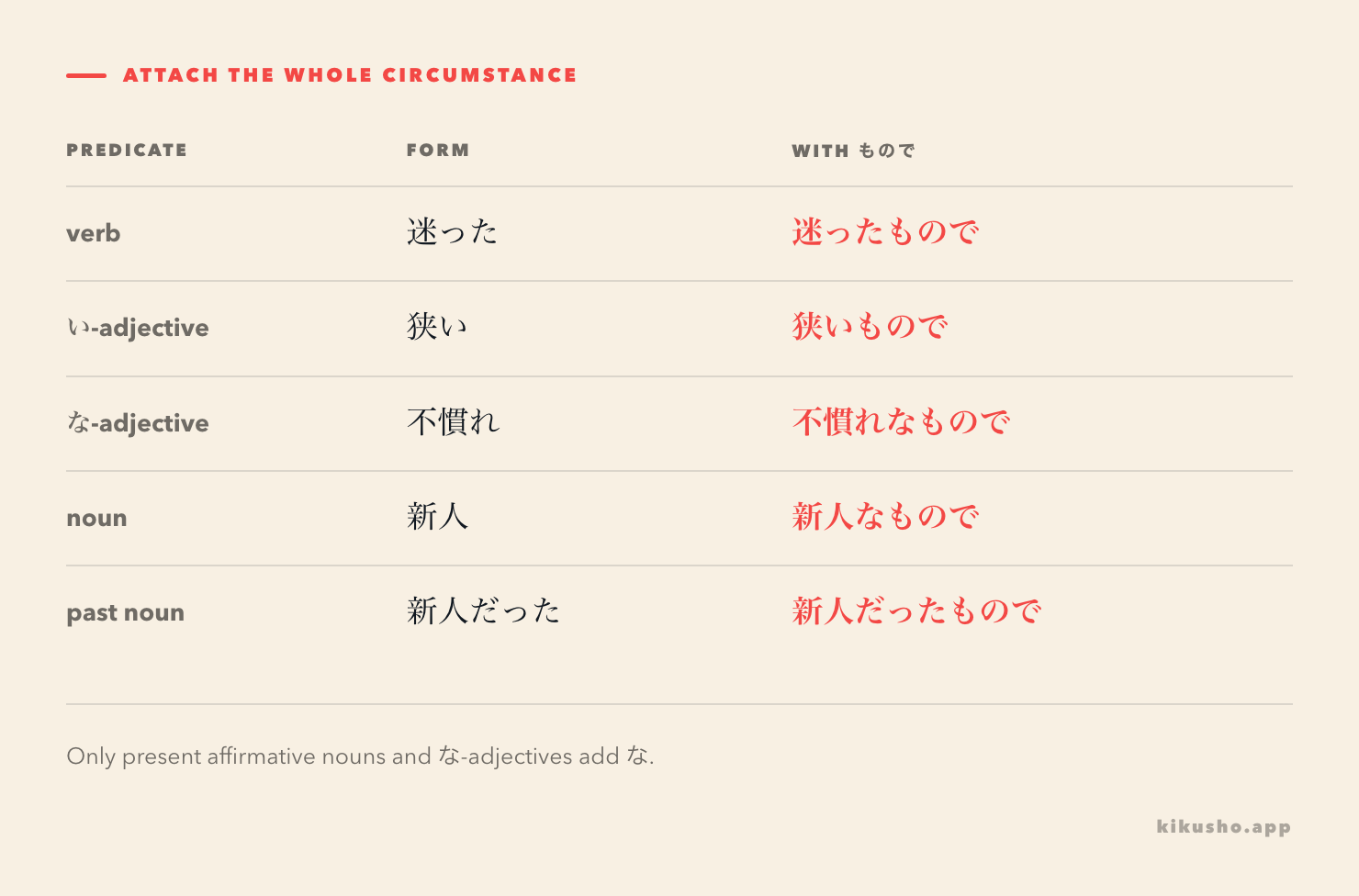
Verbs and い-adjectives use their plain forms. Present affirmative nouns and な-adjectives add な before もので.
| Word before the pattern | Build the reason clause | Finished phrase |
|---|---|---|
| Action: 迷う | complete plain predicate | 道に迷ったもので |
| い-quality: 狭い | keep the plain predicate | 道が狭いもので |
| な-quality: 不慣れ | insert な | 操作に不慣れなもので |
| Person/status: 新人 | insert な | まだ新人なもので |
まだ新人なもので、詳しいことは分かりません。
まだ しんじん な もので、くわしい ことは わかりません。
Since I am still new, I do not know the details.
Do not insert だ in the present noun pattern: 新人だもので is not the standard attachment taught here. The linking form is 新人なもので.
Completed predicate forms remain complete before もので:
- 新人だったもので — because I was new
- 忙しくなかったもので — because I was not busy
- 使っていないもので — because I have not been using it
- 道に迷ってしまったもので — because I got lost
最近この機能を使っていないもので、操作を忘れてしまいました。
さいきん この きのうを つかっていない もので、そうさを わすれてしまいました。
I have not used this feature recently, so I have forgotten how to operate it.
The negative and aspect belong to 使う; もので then connects that entire circumstance to the result.
The speaker asks you to take the reason into account
Ordinary ので can neutrally explain why one event follows another. もので more strongly packages the reason as background that accounts for the speaker's action, limitation or unfortunate result.
初めてなもので、少し緊張しています。
はじめて な もので、すこし きんちょうしています。
Since this is my first time, I am a little nervous.
The speaker is not necessarily accused of anything. They offer inexperience as context that makes the nervousness understandable.
The apologetic effect becomes clearer when the result causes trouble:
申し訳ありません。電車が遅れたもので、到着が遅くなりました。
もうしわけ ありません。でんしゃが おくれた もので、とうちゃくが おそく なりました。
I am sorry. The train was delayed, so I arrived late.
The form can sound self-protective if the speaker appears to shift responsibility onto the circumstance. Context determines whether the explanation feels reasonable or like an excuse. A useful translation may be “you see,” but that English phrase is only a clue to the stance, not a word contained inside もので.
Compare から, ので and もので
All three can translate as “because,” but they present the relation differently.
| Form | Main effect | Natural example |
|---|---|---|
| から | states the speaker's reason directly | 寒いから、窓を閉めます |
| ので | explains circumstances relatively neutrally | 電車が遅れたので、遅刻しました |
| もので | accounts for conduct or a result through a personal circumstance | 電車が遅れたもので、遅刻しました |
The difference is a tendency rather than a change in physical causality. Both 遅れたので and 遅れたもので can report the same train delay. The latter more clearly invites the listener to view the delay as an explanation for the speaker's lateness. Review the broad beginner contrast in から or ので: two ways to say because.
Unlike direct から, explanatory もので does not normally supply the reason for a bare command or invitation:
雨が降っているから、傘を持っていってください。
あめが ふっている から、かさを もっていって ください。
It is raining, so please take an umbrella.
Forcing ものだから / もので into this sentence would make an instruction follow a form designed to account for a result or the speaker's situation. Keep から for this direct reason behind a request. A polite refusal, by contrast, describes what the speaker cannot do and suits the explanatory family:
今日は先約があるものですから、参加できません。
きょうは せんやくが ある ものですから、さんか できません。
I have a prior engagement today, so I cannot attend.
Choose a form that fits the relationship
もので is a linking form and has an explanatory, somewhat careful sound. In polite speech, ものですから is especially common:
不慣れなものですから、確認に少し時間をいただけますか。
ふなれな ものですから、かくにんに すこし じかんを いただけますか。
Since I am not familiar with this, could I have a little time to check?
Casual speech can contract もの to もん:
昨日は忙しかったもんで、返事できなかった。
きのうは いそがしかった もんで、へんじ できなかった。
I was busy yesterday, so I could not reply.
Use もんで where an informal voice fits. It can sound too relaxed in a formal apology. Conversely, inserting ものですから into relaxed conversation may sound unusually careful or defensive.
The following result is sometimes left unsaid when the context supplies it:
A:どうしてもっと早く連絡しなかったんですか。
B:電話番号が分からなかったもので……。
A: Why did you not contact me sooner?
B: I did not know the phone number, you see…
The trailing explanation implies “so I could not contact you.” This is ellipsis, not a different meaning of もので. The unfinished delivery can soften the answer by allowing the listener to infer the result.
Causal もので is not always “thing + で”
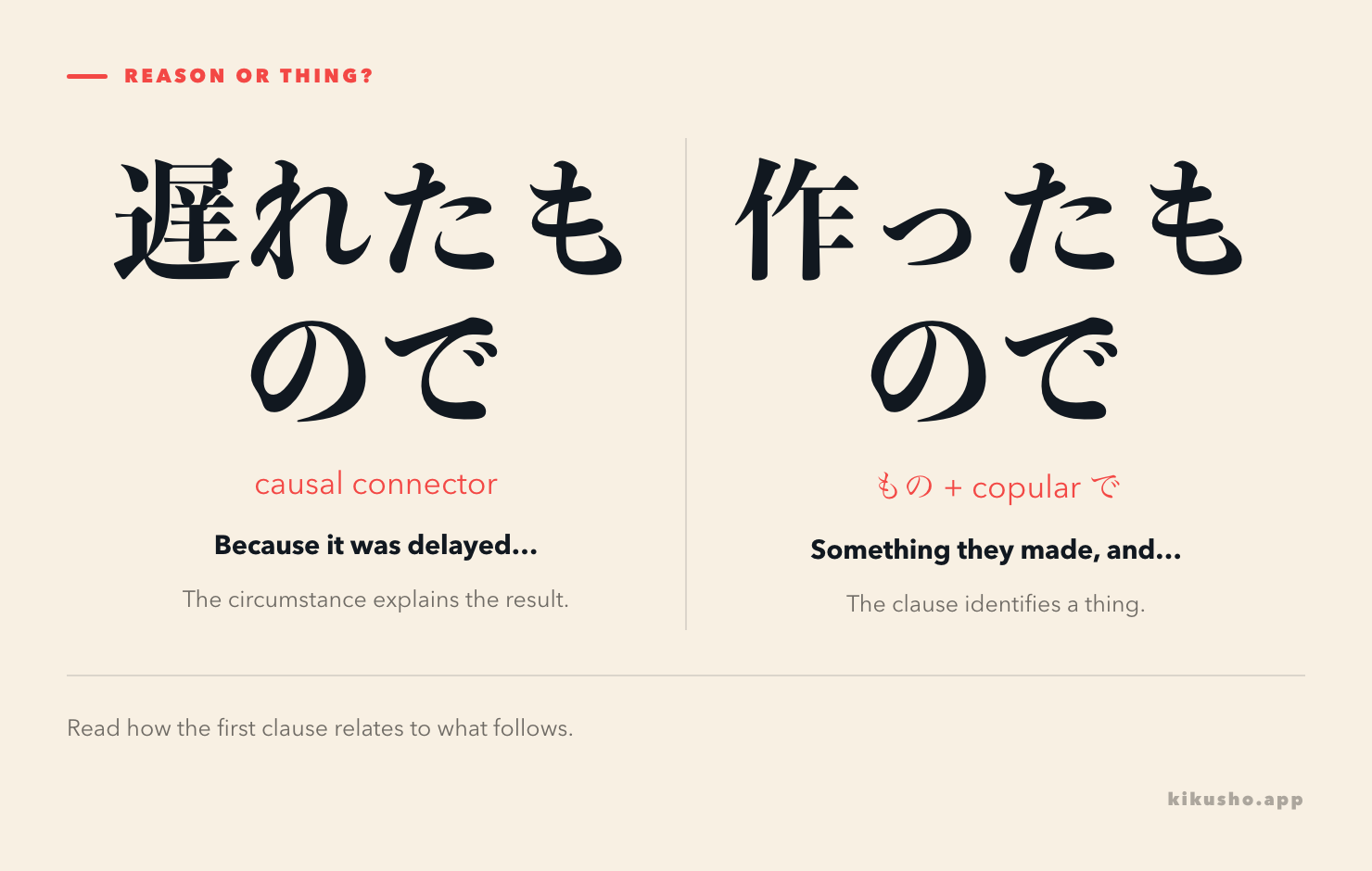
The same written sequence can arise when もの is an ordinary or formal noun and で is the connective form of the copula.
これは祖父が作ったもので、今も大切に使っています。
これは そふが つくった もので、いまも たいせつに つかっています。
This is something my grandfather made, and I still use it with care.
Here 祖父が作ったもの means “something my grandfather made.” The phrase identifies これ, and で links that description to what follows. It does not mean “because my grandfather made it” by itself.
Compare the causal construction:
祖父が作ってくれたもので、大切に使っています。
そふが つくってくれた もので、たいせつに つかっています。
Because my grandfather made it for me, I use it with care.
The second sentence presents the grandfather's action as the reason for the speaker's care. The omitted object is recoverable from context. Ask whether the first clause identifies a thing or explains a result.
Do not confuse this lesson with ものの, which marks concession, or with sentence-final ものだ, which can express a general tendency, recollection or emotional reaction. The ~ものなら and ~ものだから lesson also shows why an unlikely condition and an explanatory reason cannot exchange endings.
When you save this pattern in Kikusho, keep both the circumstance and its result on the card. 電車が遅れたもので alone does not show whether the speaker arrived late, missed a meeting or changed plans. A complete pair trains the pragmatic connection as well as the form.
Practice: read every question before opening the explanations
Question 1. Complete the explanatory reason: 道に( )、到着が遅くなりました。
A. 迷ったもので B. 迷ったなもので C. 迷うだもので D. 迷いもので
Question 2. Which form correctly follows the present noun 新人?
A. 新人だもので B. 新人なもので C. 新人のもので D. 新人にもので
Question 3. Which sentence most clearly gives a personal circumstance that accounts for an unwanted result?
A. 電車が遅れたもので、会議に遅刻しました。 B. 電車が遅れたら、連絡してください。 C. 電車が遅れたものの、間に合いました。 D. 電車が遅れるものです。
Question 4. In これは父が作ったもので、十年間使っています, what is the most natural analysis of もので?
A. Causal もので: the making is an excuse B. ものなら: an unlikely condition C. もの “thing” + connective で: it identifies what これ is D. ものの: a concession
Question 5. Choose the form that best fits a careful refusal to a colleague: 今日は先約がある( )、参加できません。
A. もんで B. ものですから C. ものなら D. ものの
Question 6. Complete the reply while leaving the consequence politely understood.
A:なぜ昨日は来なかったんですか。 B:子どもが急に熱を出した( )……。
A. ものなら B. ものの C. もので D. ものか
Question 7. Write two versions of this explanation: “Since I am still inexperienced, checking takes time.” Use 不慣れなもので first, then rewrite it with polite 不慣れなものですから.
Reveal how the circumstance controls each answer
Question 1: A. 迷った is the plain past of 迷う and attaches directly to もので. Verbs do not take な or だ before this pattern, and the ます-stem 迷い is not the required form.
Question 2: B. A present affirmative noun takes な + もので, producing 新人なもので. A past noun predicate would keep だった, as in 新人だったもので.
Question 3: A. The train delay is a circumstance offered to account for an actual late arrival. B is a condition followed by a request, C is concessive “although,” and D states a general expectation with ものだ.
Question 4: C. 父が作ったもの means “something my father made” and identifies これ. Connective で then links that description to the following statement. The sentence does not use the target causal construction.
Question 5: B. ものですから gives a careful explanatory reason and fits the colleague-facing refusal. Casual もんで could express a similar relation among close speakers but mismatches the requested register.
Question 6: C. 熱を出したもので…… gives the child's sudden fever as the reason. The listener can infer “so I could not come” from the question, and the trailing form avoids repeating that result.
Question 7 — sample answer: まだ不慣れなもので、確認に時間がかかります。まだ不慣れなものですから、確認に時間がかかります。 Both explain the same limitation. The second uses the careful polite form ものですから.
Look for an actual circumstance followed by a result that it helps the listener understand. Then check the predicate immediately before もので: verbs and い-adjectives attach directly, while present nouns and な-adjectives need な.
Common questions
What does もので mean in Japanese grammar?
After a plain clause, causal もので means “because” or “since.” It presents a personal or circumstantial reason as background for a result, often in an apology, refusal or explanation of an unwanted outcome.
How do nouns and な-adjectives attach to もので?
In the present affirmative, add な: 新人なもので and 不慣れなもので. Verbs and い-adjectives attach in their plain form, while completed forms stay intact, as in 新人だったもので and 忙しくなかったもので.
How is もので different from ので?
ので is a broad, relatively neutral way to explain a reason. もので more strongly frames the circumstance as accounting for the speaker's conduct or an unfortunate result, so it can sound apologetic or self-justifying.
Are もので, ものですから and もんで related?
Yes. They share the explanatory-reason use. ものですから is a polite form often heard in careful explanations, while もんで is a casual contraction suited to conversation with people close to the speaker.