On this page
~ようとする puts an action at the point where it is attempted or just about to begin. Its negative ~ようとしない says that someone does not even make that move, often with the observer's judgment that they are unwilling: 子どもが薬を飲もうとしない means “The child will not try to take the medicine.”
Both patterns use a verb's volitional form. The deciding question is what happens at the threshold: does the subject move toward the action, stand on the verge of it, or refuse to engage at all?
Build both patterns from the volitional form
The structure is plain volitional + とする. Conjugate the final する for tense, aspect, politeness or negation.
| Verb group | Dictionary form | Volitional | Attempt | No attempt or willingness |
|---|---|---|---|---|
| Godan: 書く | 書く | 書こう | 書こうとする | 書こうとしない |
| Godan: 読む | 読む | 読もう | 読もうとする | 読もうとしない |
| Ichidan: 食べる | 食べる | 食べよう | 食べようとする | 食べようとしない |
| Irregular: する | する | しよう | しようとする | しようとしない |
| Irregular: 来る | 来る | 来よう(こよう) | 来ようとする | 来ようとしない |
Godan verbs move their final kana to the お-row and add う: 書く becomes 書こう, 飲む becomes 飲もう, and 帰る becomes 帰ろう. Ichidan verbs drop る and add よう. The volitional-form lesson gives the complete conjugation rules.
Do not attach とする to the dictionary form. 食べるとする has other possible analyses in other contexts; it is not the N3 attempt pattern. For “try to eat,” use 食べようとする.
ようとする reaches the threshold of an action
With an intentional subject, ようとする describes an effort or movement toward doing something. The construction does not guarantee that the action succeeds.
重い箱を持ち上げようとしたが、動かなかった。
おもい はこを もちあげようと したが、うごかなかった。
I tried to lift the heavy box, but it did not move.
持ち上げようとした tells you that an attempt began. The second clause tells you the outcome. Without that clause, the pattern alone does not logically prove success or failure, although past ようとした often appears with a blocked or interrupted result.
The same threshold can be described as imminence: the subject was just about to act when something else happened.
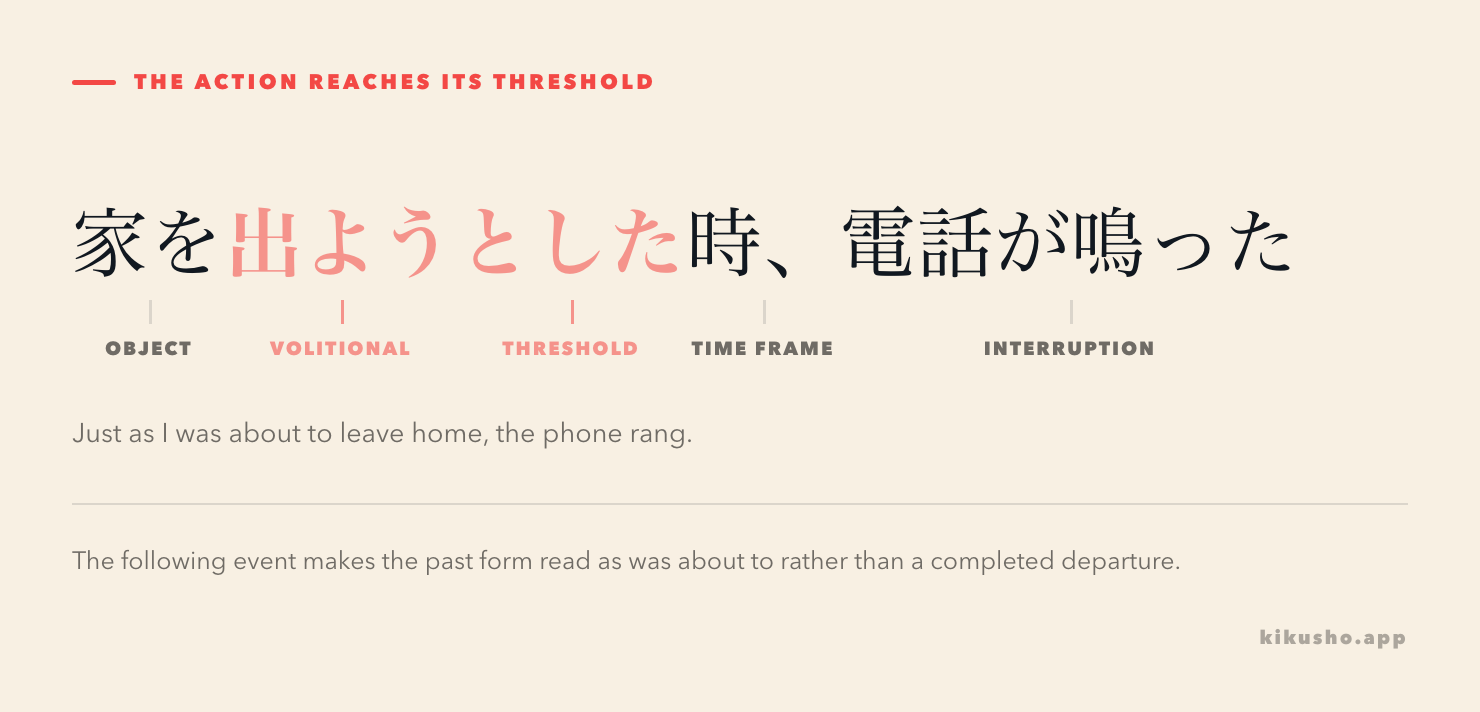
家を出ようとした時、電話が鳴った。
いえを でようと した とき、でんわが なった。
Just as I was about to leave home, the phone rang.
Here the point is timing. The phone rings at the edge of departure. English prefers “was about to,” while a resistance context such as the heavy box prefers “tried to.” Japanese uses the same form because both scenes stop at the boundary between intention and completed action.
Natural processes can also stand at that boundary even though they have no intention:
日が沈もうとしている。
ひが しずもうと している。
The sun is about to set.
This use shows why “try to” cannot be the only translation. With an inanimate subject, the progressive usually describes a change visibly approaching its start or completion.
Aspect and tense change the scene
The final する carries the grammar of the full expression:
| Form | Typical view | Example |
|---|---|---|
| ~ようとする | an attempt or tendency at the threshold | 赤ちゃんが立とうとする。 |
| ~ようとしている | an attempt or imminent change in progress | 赤ちゃんが立とうとしている。 |
| ~ようとした | a past attempt or “was about to” scene | 赤ちゃんが立とうとした。 |
| ~ようとしました | the same past scene, politely | 赤ちゃんが立とうとしました。 |
~ようとしている lets you watch the movement unfold: 赤ちゃんが立とうとしている means that the baby is currently trying to stand. ~ようとした places that threshold in a completed past scene. A clause with 時, ところ, が or けど often supplies the interruption or obstacle.
MIT OpenCourseWare's Japanese V notes explicitly give volitional + とした before が, けど, たら and 時 for “tried to” or “was going to.” JLPT Sensei records the broader set とする, とした, としたら and としていた at N3.
ようとしない judges the missing effort
Negating する gives ~ようとしない: “does not try,” “will not make an effort,” or “is unwilling to.” It usually presents a person or animal from an observer's point of view.
弟は私の説明を聞こうとしない。
おとうとは わたしの せつめいを きこうと しない。
My younger brother will not listen to my explanation.
The sentence does more than report silence. The speaker expected the brother to engage and sees no willingness to do so. Bunpro's N3 explanation notes that the form emphasizes missing effort or willingness and therefore commonly refers to someone other than the speaker.
That stance makes ようとしない stronger than a plain negative:
| Sentence | What it says |
|---|---|
| 子どもが薬を飲まない。 | The child does not take the medicine. |
| 子どもは薬を飲みたくない。 | The child does not want to take it. |
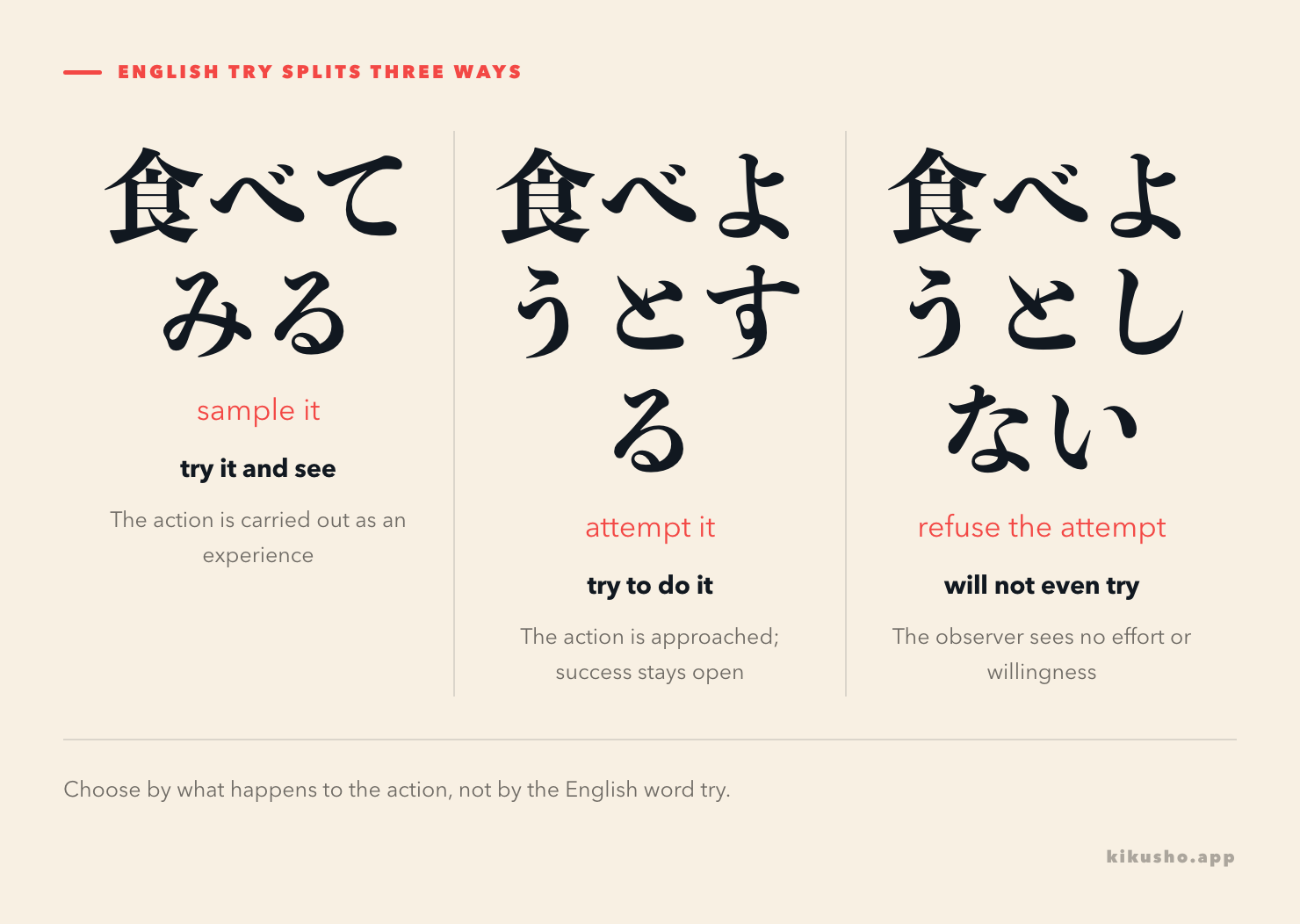
| 子どもが薬を飲もうとしない。 | The child will not even try to take it. |
The plain negative reports non-occurrence. ~たくない reports the subject's desire. ~ようとしない is the observer's reading of the subject's absent attempt, so it can sound frustrated, accusatory or critical.
Use care when making yourself the subject. 私は謝ろうとしない can sound like a blunt declaration that you refuse to apologize. If you simply mean “I do not want to apologize,” 謝りたくない states that desire directly. A speaker can use ようとしない about their own repeated behaviour in self-analysis, but the judgmental viewpoint remains.
The past ~ようとしなかった reports refusal or absent effort in a past situation:
何度説明しても、彼は間違いを認めようとしなかった。
なんど せつめいしても、かれは まちがいを みとめようと しなかった。
No matter how many times I explained, he would not admit the mistake.
With an inanimate subject, the same negative shape can lose the moral judgment: ドアが開こうとしない means that the door will not open or shows no sign of opening. Context tells you whether there is a will to criticize.
Keep it separate from three nearby patterns
English “try,” “intend” and “make an effort” overlap. Japanese separates the kind of action involved.
~てみる means do it and see
~てみる presents an action as an experiment or experience. 新しい料理を食べてみた says you ate the dish to see what it was like. 食べようとした says you attempted to eat it; whether you managed to do so needs context. The ~てみる lesson develops this boundary with completed and blocked actions.
~ようにする manages a habit or result
Dictionary/plain verb + ようにする means making an effort so that a condition holds, often as a repeated practice: 毎日、野菜を食べるようにしている, “I make a point of eating vegetables every day.” Volitional + とする focuses on one attempt or one approaching action: 今、野菜を食べようとしている, “I am trying to eat the vegetables now.” The ようにする lesson compares deliberate management with change and decision patterns.
~ようと思う states an intention
Volitional + と思う announces or reports an intention: 来年、日本へ行こうと思う, “I am thinking of going to Japan next year.” 行こうとする moves into the attempt itself or the moment just before going. A plan can exist for months; ようとする places the camera at the threshold.
Save the obstacle with the pattern in Kikusho
Capture the full two-clause scene rather than a bare translation of “try.” In 電車に乗ろうとしたが、ドアが閉まった, the closing door tells you that 乗ろうとした is a blocked attempt. That detail will help you recover the Japanese form instead of reaching for ~てみる.
Keep a second card for the negative stance, such as 彼は話を聞こうとしない. Mark the speaker's frustration in the nuance field. On review, changing only the last する gives a useful miniature set: 聞こうとしている, 聞こうとした, 聞こうとしない and 聞こうとしなかった.
Six questions at the action threshold
Answer all six before opening the shared answer block.
Question 1: form the attempt
Which sentence correctly means “I tried to open the window”?
A. 窓を開けるとした。
B. 窓を開けてみようとした。
C. 窓を開けようとした。
D. 窓を開けるようとした。
Question 2: choose the imminent event
The sun is low and is about to set. Complete: 日が( )。
A. 沈もうとしている
B. 沈んでみている
C. 沈みたくない
D. 沈むようにしている
Question 3: express unwillingness
You have explained the mistake several times, but Ken will not even try to admit it. Which ending fits?
A. 認めてみる
B. 認めようとしない
C. 認めると思う
D. 認めようと思う
Question 4: arrange the chunks
Order these chunks to say “Just as I was about to leave home, the phone rang”: 電話が / 家を / 時 / 出ようとした / 鳴った.
Question 5: distinguish two kinds of try
You tasted natto for the first time to see whether you liked it, and you did eat it. Which sentence matches?
A. 納豆を食べようとしない。
B. 納豆を食べようとした。
C. 納豆を食べるようにした。
D. 納豆を食べてみた。
Question 6: interpret the interrupted trip
Choose the best form for the blank: 駅に着いて、電車に乗ろうとした。ところが、目の前でドアが閉まって( )。
A. 乗ってみた
B. 乗ろうとしない
C. 乗れなかった
D. 乗るようにした
Fix your six choices now; the explanations below separate the verb form from the result supplied by its context.
Answers and explanations
The first contrast turns on the volitional stem; the later ones turn on what happens at the action boundary.
Answer 1: C. 開ける is an ichidan verb, so its volitional is 開けよう. Add とした for the past attempt. A and D attach the attempt pattern to the dictionary form. B contains both てみる and ようとした and does not express the simple target meaning.
Answer 2: A, 沈もうとしている. An inanimate natural process can use ようとしている for an imminent change. The sun has no desire, so C is unsuitable; B and D describe different constructions and do not mean “is about to set.”
Answer 3: B, 認めようとしない. The volitional 認めよう plus としない presents Ken as unwilling to make the attempt. D states an intention to admit it, A suggests trying it as an experience, and C states a belief with the wrong content.
Answer 4: 家を出ようとした時、電話が鳴った。 The object and volitional action form 家を出よう, とした marks the past threshold, and 時 connects it to the interrupting event 電話が鳴った.
Answer 5: D, 納豆を食べてみた. The action was completed to sample the experience, which is the job of てみる. B only reports an attempt and leaves success open. A expresses refusal to try; C presents a deliberate policy or change of practice.
Answer 6: C, 乗れなかった. The first sentence places the passenger at the point of trying to board. The doors then close, and the potential negative gives the blocked outcome: “I could not get on.” A contradicts the closed doors, B changes the subject into someone unwilling to board, and D introduces a managed practice.
Level and source note
The Kikusho inventory assigns both ようとする and ようとしない to N3, with no stored level disagreement. JLPT Sensei places both at N3, and Bunpro independently places ようとしない at N3. These labels are editorial estimates: the official JLPT level summary describes broad abilities but does not publish an exhaustive grammar syllabus.
The volitional form is a prerequisite rather than a new N3 item here. The two assigned constructions are the positive threshold pattern and its negative willingness reading. Uses such as ~てみる, ~ようにする and ~ようと思う appear only to establish their boundaries. The examples and exercises in this lesson are original.
Common questions
What does ようとする mean in Japanese?
A volitional verb plus とする presents an action at its threshold. With an intentional subject it often means try or attempt to do something; in a timed scene it can mean be just about to do it.
How do you form ようとする?
Put the verb in its plain volitional form and add とする: 書く becomes 書こうとする, 食べる becomes 食べようとする, and する becomes しようとする.
What is the difference between ない and ようとしない?
A plain negative says the action does not happen. ようとしない presents the subject as not even making the attempt or as unwilling to act, so it often carries the observer's frustration or criticism.
Is ようとする N3 grammar?
JLPT Sensei places ようとする and ようとしない at N3, and Bunpro places ようとしない at N3. These are study-resource estimates because the JLPT publishes no exhaustive official grammar list.