On this page
雨のおかげで credits the rain for a welcome result; 雨のせいで holds the rain responsible for trouble. おかげで (okage de) usually means “thanks to,” while せいで (sei de) usually carries “because of” with a negative judgment attached.
The rain itself did not become good or bad. Someone grateful for watered vegetables and someone upset about a soaked notebook can describe the same weather with different words. The construction tells you how the speaker views its consequences.
The test: is the cause receiving credit or responsibility?
Read the result and the speaker's attitude together. Are they presenting the cause as helpful? Start with おかげで. Are they identifying what went wrong? Start with せいで.
| Cause | Result being described | Usual choice |
|---|---|---|
| Rain | Vegetables grew well | 雨のおかげで |
| Rain | A notebook got wet | 雨のせいで |
| A friend's explanation | You found the address | 説明のおかげで |
| Your own mistake | You lost a file | ミスのせいで |
These are not emotionally neutral substitutes for English “because.” The Japan Foundation's explanation of reason expressions distinguishes the evaluation carried by おかげで and せいで from more neutral reason-giving. It also describes おかげで used ironically, so the basic contrast is a starting point rather than an absolute ban on other readings.
This is an N3 grammar lesson. Bunpro's おかげで guide, JLPT Sensei's せいで guide and MLC's comparison use that study level. The JLPT publishes no exhaustive official grammar syllabus. Basic noun modification and plain verb forms are prerequisites.
おかげで presents the cause as a benefit
Use おかげで to attribute a welcome result to someone's help, a circumstance or something you did:
地図のおかげで、入口をすぐに見つけられました。
ちずの おかげで、いりぐちを すぐに みつけられました。
Thanks to the map, I could find the entrance straight away.
The map receives credit. You are not thanking a person directly, but you are presenting the map as helpful. おかげで does not require a human cause.
早く出発したおかげで、座ることができました。
はやく しゅっぱつした おかげで、すわることが できました。
Thanks to leaving early, I was able to get a seat.
Here your own early departure brought the benefit. There is no need to invent an outside helper. If the cause is another person's action, the sentence can express appreciation:
友だちが住所を書いてくれたおかげで、迷わずにすみました。
ともだちが じゅうしょを かいてくれた おかげで、まよわずに すみました。
Thanks to my friend writing down the address, I avoided getting lost.
Notice the last example's negative idea: not getting lost is welcome. A negative predicate does not automatically make the result undesirable.
せいで identifies the source of a problem
せいで normally attributes an unwelcome consequence to its cause:
雨のせいで、ノートがぬれてしまいました。
あめの せいで、ノートが ぬれてしまいました。
Because of the rain, my notebook got wet.
The weather is being held responsible for the inconvenience. It has no intention and cannot literally be guilty, but the speaker still evaluates its effect negatively.
私が数字を間違えたせいで、もう一度計算しました。
わたしが すうじを まちがえた せいで、もういちど けいさんしました。
Because I got a number wrong, I calculated it again.
You can blame your own mistake. Bunpro's せいで lesson treats the expression as attribution of negative consequences, and the Japan Foundation includes self-criticism among its uses. It is not restricted to accusing somebody else.
A sentence about a person can nevertheless sound direct. Compare “Your message helped me” with “Your message caused this problem.” Both give a cause, but they make different social moves. Adding ました makes the ending polite; it does not erase responsibility from せいで. The politeness guide separates those endings from the rest of what a reply communicates.
Both follow the pattern for modifying a noun
おかげ and せい behave as nouns here. Put the cause before them using the ordinary noun-modifying connection, then let で connect to the result.
| Cause type | Before おかげで | Before せいで |
|---|---|---|
| Noun | 雨のおかげで | 雨のせいで |
| Plain verb | 手伝ったおかげで | 手伝ったせいで |
| い-adjective | 安いおかげで | 安いせいで |
| Present な-adjective | 静かなおかげで | 静かなせいで |
| Past な-adjective | 静かだったおかげで | 静かだったせいで |
| Negative plain verb | 忘れなかったおかげで | 忘れなかったせいで |
The last two columns show formation, not two interchangeable meanings. 静かなせいで needs a situation in which quietness caused trouble; the quiet is not being praised. 忘れなかったせいで likewise needs an unwelcome consequence of not forgetting. Do not choose a form solely because a table permits the attachment.
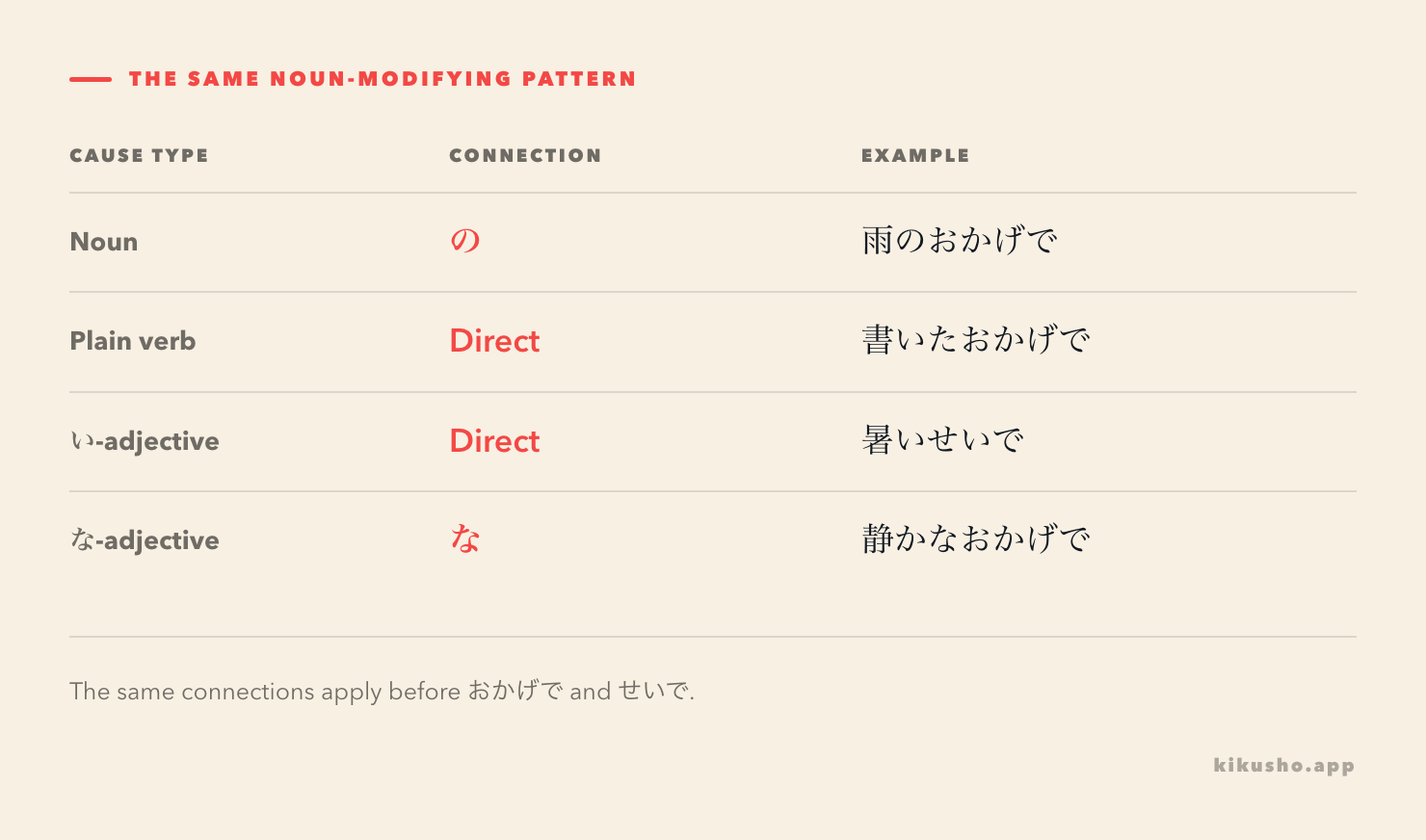
A noun takes の: 雨のおかげで, not 雨だおかげで. An affirmative present な-adjective takes な: 静かなおかげで. Past 静かだった stays intact before either expression. See the adjective lesson if the stem and the attributive な are still hard to separate.
A completed verb already modifies the noun: 書いたおかげで. Do not insert の to make 書いたのおかげで. JLPT Sensei's おかげで formation table gives the basic connections; MLC likewise explains them through noun modification.
Keep the cause in its plain modifying form while making the result polite: 早く出発したおかげで、座ることができました. The polite できました does not turn 出発した into 出発しました before おかげで.
The overlap is a change in evaluation, not a change in facts
Hold the cause still and examine what followed:
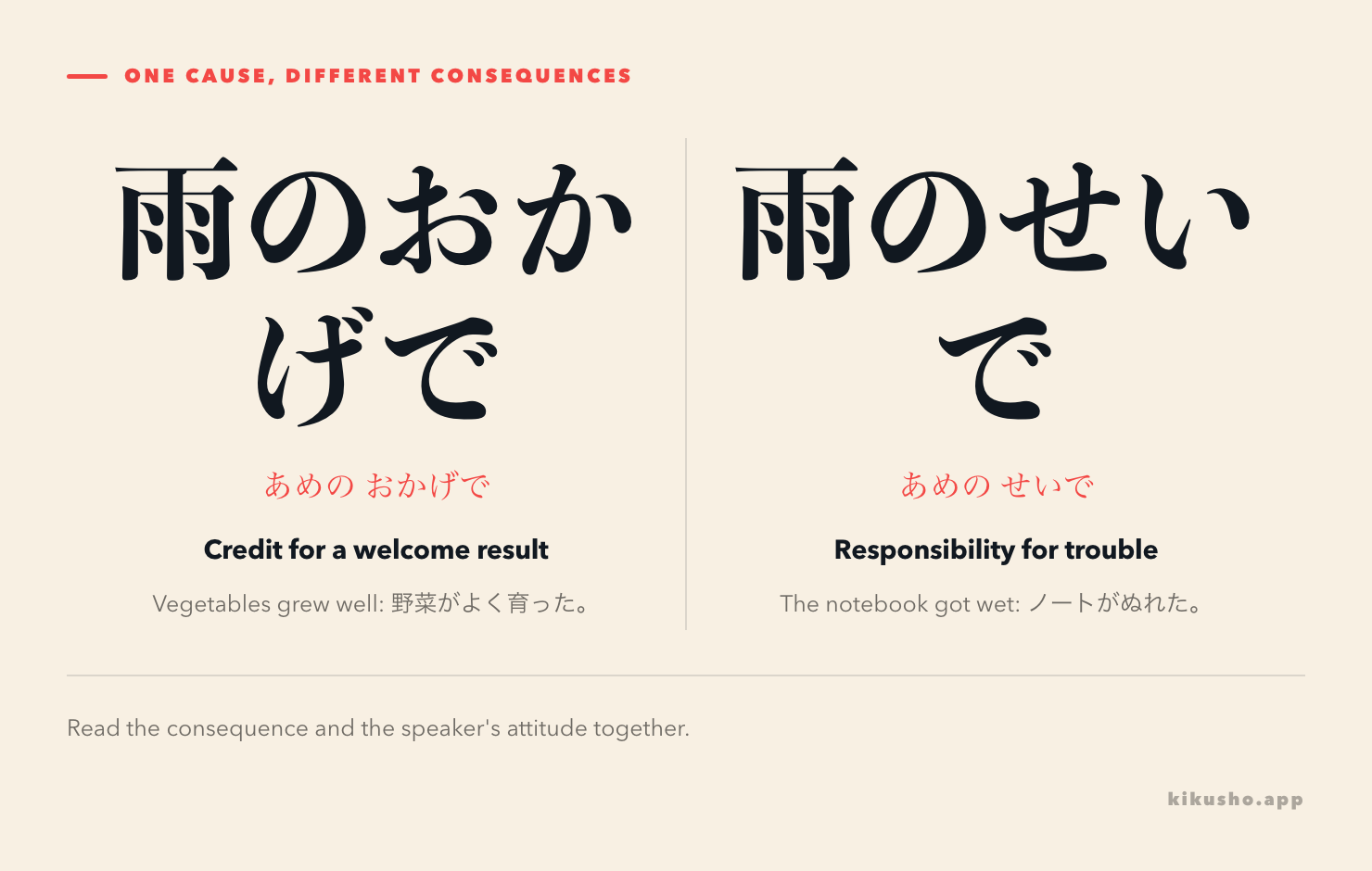
A negative event can bring a benefit, and an affirmative event can create a problem. Not raining may let an outdoor event proceed. Receiving many messages may interrupt someone's work. The verb's positive or negative form does not supply the speaker's evaluation for you. Rapid Japanese Training's comparison also stresses the speaker's feelings about the result.
When you need to explain a circumstance without this explicit credit or blame, から and ので offer basic reason constructions. They have their own differences in presentation. This does not mean that every use of から or ので is emotionally detached.
These examples attribute a result to something that caused it. For a goal you want to bring about, the ように and ために comparison teaches purpose clauses. おかげで is not an alternative way to say “in order to.”
When “thanks to you” is a complaint
おかげで can introduce an unwelcome result when the apparent thanks are sarcastic. Imagine someone gave misleading advice about a departure time. You missed the train, are annoyed, and say:
君のおかげで、電車に乗り遅れたよ。
きみの おかげで、でんしゃに のりおくれたよ。
Thanks to you, I missed the train.
You are not expressing sincere appreciation. The mismatch between the supposed credit and the unwanted result, together with the situation and tone, creates the irony. Bunpro explicitly records this sarcastic use. Treat it as something to recognize; it is not a safer or kinder replacement for せいで.
Some references also describe uses of せい beyond straightforward blame. That does not make it a good default for sincere thanks. This lesson's ordinary production contrast is welcome credit versus unwelcome responsibility; context can override a mechanical good/bad reading.
When capturing a line in Kikusho, put the consequence in the editable example and note who benefited or suffered. A card containing only 雨 and “rain” loses the contrast between the garden and the wet notebook. If おかげで came from an irritated reply, its register note should preserve that irritation rather than label the sentence grateful.
Questions
Question 1
You sincerely welcome a new station near your house because commuting became easier. Choose the correctly attached expression that credits this helpful change; no irony is intended.
家の近くに駅ができた__、通勤が楽になりました。
A. のせいで
B. おかげで
C. なおかげで
D. せいで
Question 2
A friend explained the route, and you sincerely appreciate avoiding getting lost. Complete the sentence with the ordinary expression of credit.
友だちの説明__、道に迷わずにすみました。
A. せいで
B. おかげで
C. のおかげで
D. のせいで
Question 3
Join the four fragments into the reason clause, starting with この部屋が. The room’s quietness helped you work effectively.
- おかげで\
- 静か\
- この部屋が\
- な
____、仕事がはかどりました。
Question 4
Your computer lost power before you saved what you wrote. Arrange the pieces to attribute the lost text to your failure to save. Use every piece once and begin with ファイルを.
- せいで\
- 保存\
- しなかった\
- ファイルを
____、書いた文章が消えてしまいました。
Question 5
Read the account. Choose the expression that explicitly credits the welcome weather, rather than merely stating a reason. The writer is sincerely pleased.
雨が降らなかった__、屋外のイベントを予定どおり開けました。来てくれた人も喜んでいました。
A. おかげで
B. せいで
C. ので
D. から
Question 6
Read the exchange. Missing the train caused a problem, and the reply is spoken in an annoyed tone.
友だち:「急がなくていいよ、と言ったのは僕だけど、電車に間に合った?」
私:「君のおかげで、乗り遅れたよ。」
What does the reply communicate here?
A. Sincere appreciation for avoiding an unwanted train.
B. A neutral explanation that carries no criticism.
C. A purpose the speaker intends to achieve later.
D. A complaint phrased as sarcastic thanks.
Answers and explanations
Answer 1
B, おかげで. The plain past verb できた connects directly, and the station receives credit for easier commuting. A inserts の after the verb; C inserts な in the wrong word class. D is correctly attached but ordinarily presents an unwelcome consequence. It conflicts with the stated sincere appreciation.
Answer 2
C, のおかげで. 説明 (せつめい), “explanation,” is a noun, so it needs の. Avoiding getting lost is beneficial despite the negative idea in 迷わずにすみました. A and B omit the noun connection. D supplies の but assigns responsibility for trouble rather than offering the sincere credit requested.
Answer 3
3–2–4–1: この部屋が静かなおかげで、仕事がはかどりました。\
このへやが しずかな おかげで、しごとが はかどりました。
静か is a な-adjective, with な before おかげ. はかどりました means the work progressed effectively. The room's quietness is credited for helping it along. The question's required first piece fixes the clause's starting point.
Answer 4
4–2–3–1: ファイルを保存しなかったせいで、書いた文章が消えてしまいました。\
ファイルを ほぞんしなかった せいで、かいた ぶんしょうが きえてしまいました。
保存する (ほぞんする), “save,” becomes the negative past 保存しなかった. The complete plain verb attaches directly to せいで. The writer treats losing the written text as an unwelcome consequence of their own omission. No の or な belongs after しなかった.
Answer 5
A, おかげで. The writer welcomes holding the outdoor event as planned and credits the absence of rain. 降らなかった is negative, but the outcome is beneficial. B would ordinarily frame the weather as causing trouble. C and D are grammatical causal alternatives, but neither explicitly adds the credit this question requests. 屋外 (おくがい) means “outdoors”; 開けました here is the potential of event-holding 開く (ひらく), read ひらけました.
Answer 6
D. The friend asks whether the speaker caught the train after suggesting there was no need to hurry. The annoyed reply blames that advice through sarcastic おかげで. A contradicts the unwanted result and tone. B misses the criticism. C misreads attribution of a past consequence as a future goal. Keep this exchange, including its tone, if you save the phrase: the apparent thanks alone would teach the wrong reading.
Common questions
What is the difference between おかげで and せいで?
Both attribute a result to a cause. おかげで normally credits a cause for a welcome result, often with appreciation; せいで normally assigns responsibility for an unwelcome result. The speaker evaluates the outcome. おかげで can also be sarcastic when context makes the supposed thanks clearly insincere.
Do nouns need の before おかげで and せいで?
Yes: 雨のおかげで or 雨のせいで. Plain verbs and い-adjectives attach directly, as in 降ったおかげで or 暑いせいで. Present affirmative な-adjectives take な, as in 静かなおかげで. Past predicates keep their inflection: 静かだったせいで is possible, with だった rather than な.
Does a negative verb require せいで?
No. Grammatical negation and an unwelcome result are different things. A sentence reporting that pain disappeared or that you avoided a problem can express a benefit despite its negative verb. Use おかげで when crediting the cause for that benefit; choose by the evaluation, not by counting ない endings.
Are these expressions polite or N3 grammar?
Bunpro, JLPT Sensei and MLC teach this comparison at N3, which is an editorial study estimate rather than an official exhaustive syllabus. Both expressions can precede a polite result clause. A polite ending does not remove blame from せいで or sarcasm from an ironic おかげで.