On this page
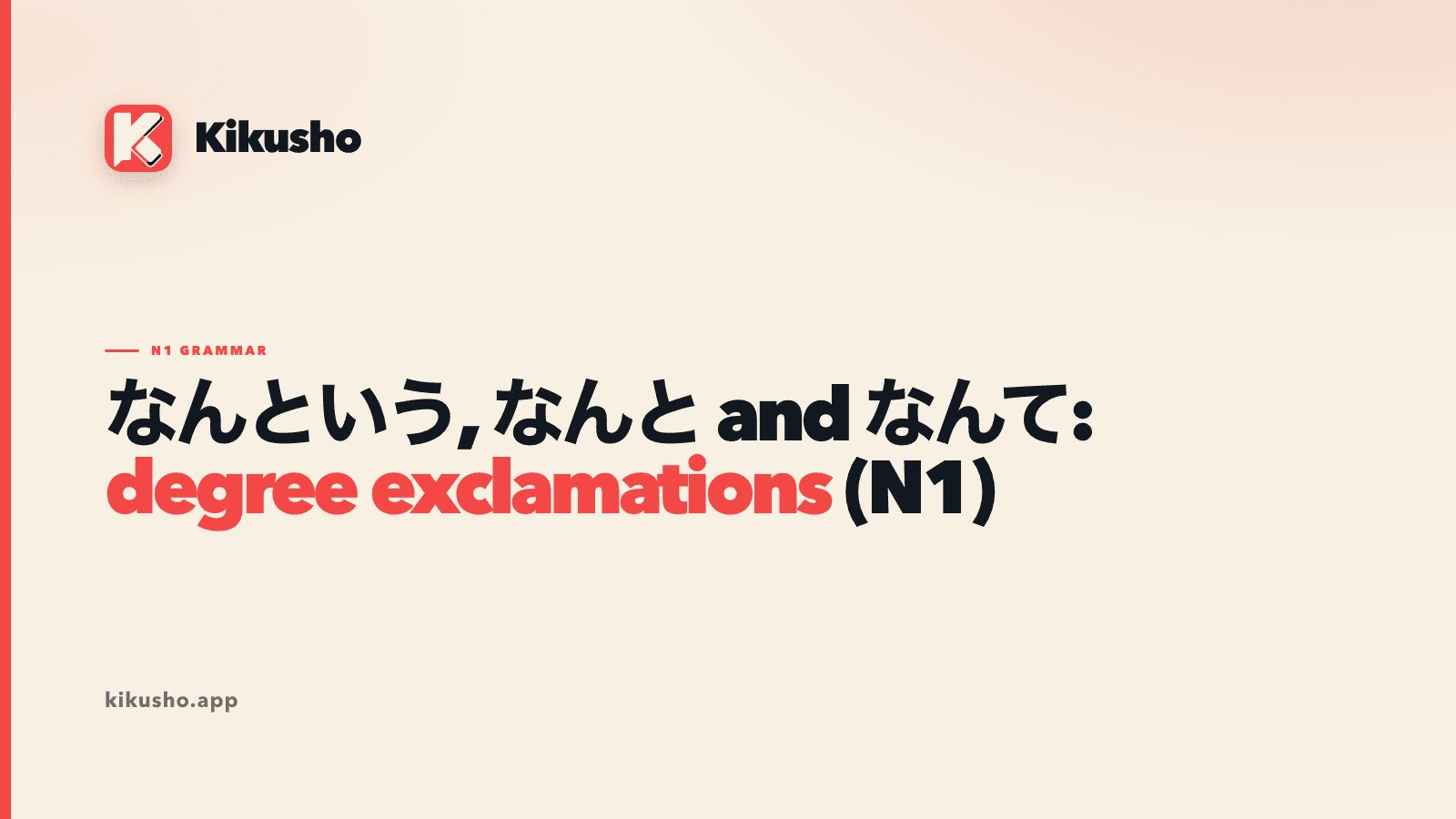
Use なんという, なんと or なんて when a quality, degree or category strikes you as remarkable: “what a…” or “how…!” The reaction can be admiration, shock, delight, anger or disappointment.
ここで先生に会うとは、なんという偶然だ。
ここで せんせいに あうとは、なんという ぐうぜんだ。
What a coincidence to meet my teacher here.
山頂からの景色は、なんて美しいんだろう。
さんちょうからの けしきは、なんて うつくしいんだろう。
How beautiful the view from the summit is!
The first reaction classifies the meeting as an extraordinary 偶然, “coincidence.” The second reacts to the high degree of beauty. Neither sentence asks the listener to identify something called なん.
This lesson verifies inventory item g-4f427825ca5b. The assigned JLPT Sensei entry groups the three forms at N1 and describes both favourable and unfavourable exclamations. Bunpro's 何という reference independently records the strong-emotion use and its other dictionary senses. A 2026 Waseda corpus study of なんと separates degree exclamations from questions, independent interjections and event-modifying narrative surprise. These distinctions matter more than treating every matching sound as one grammar point.
なんという builds an exclamatory noun phrase
The full form is especially clear before a noun:
なんという静けさだ。
なんという しずけさだ。
What stillness!
なんという無責任な態度だ。
なんという むせきにんな たいどだ。
What an irresponsible attitude!
The noun can name an event or category, such as 偶然, 悲劇, 幸運 or 失敗. It can also be modified by an adjective: 美しい景色, “beautiful view,” or 無責任な態度, “irresponsible attitude.” The whole noun phrase receives the exclamatory evaluation.
| Frame | Example | What is evaluated |
|---|---|---|
| なんという + noun + だ | なんという偶然だ | the event as an extraordinary coincidence |
| なんという + い-adjective + noun + だ | なんという美しい景色だ | the remarkable beauty of the view |
| なんという + な-adjective + な + noun + だ | なんという静かな夜だ | the remarkable quiet of the night |
The な in the final row belongs to the な-adjective modifying the noun. It is not supplied by なんという. Thus 静かな夜 stays intact inside なんという静かな夜だ.
An exclamatory ending can be だ, なんだ, だろう, なんだろう or a polite counterpart, depending on the predicate:
なんという立派な建物なんでしょう。
なんという りっぱな たてもの なんでしょう。
What a magnificent building!
Here なんでしょう follows the noun predicate 立派な建物. It makes a reflective, politely phrased exclamation; it does not turn the reaction into a request for information.
なんと and なんて foreground the degree
なんと and なんて readily stand before the quality that surprises the speaker:
なんと難しい問題だろう。
なんと むずかしい もんだいだろう。
What a difficult problem!
なんて静かな町なんだろう。
なんて しずかな まち なんだろう。
What a quiet town!
この湖はなんて深いんだろう。
この みずうみは なんて ふかいんだろう。
How deep this lake is!
The first two examples put the quality inside a noun phrase. The third uses 深い as the predicate and adds explanatory のだろう, contracted to んだろう. A な-adjective predicate likewise uses なのだろう, commonly contracted:
夜の駅はなんと静かなんだろう。
よるの えきは なんと しずかなんだろう。
How quiet the station is at night!
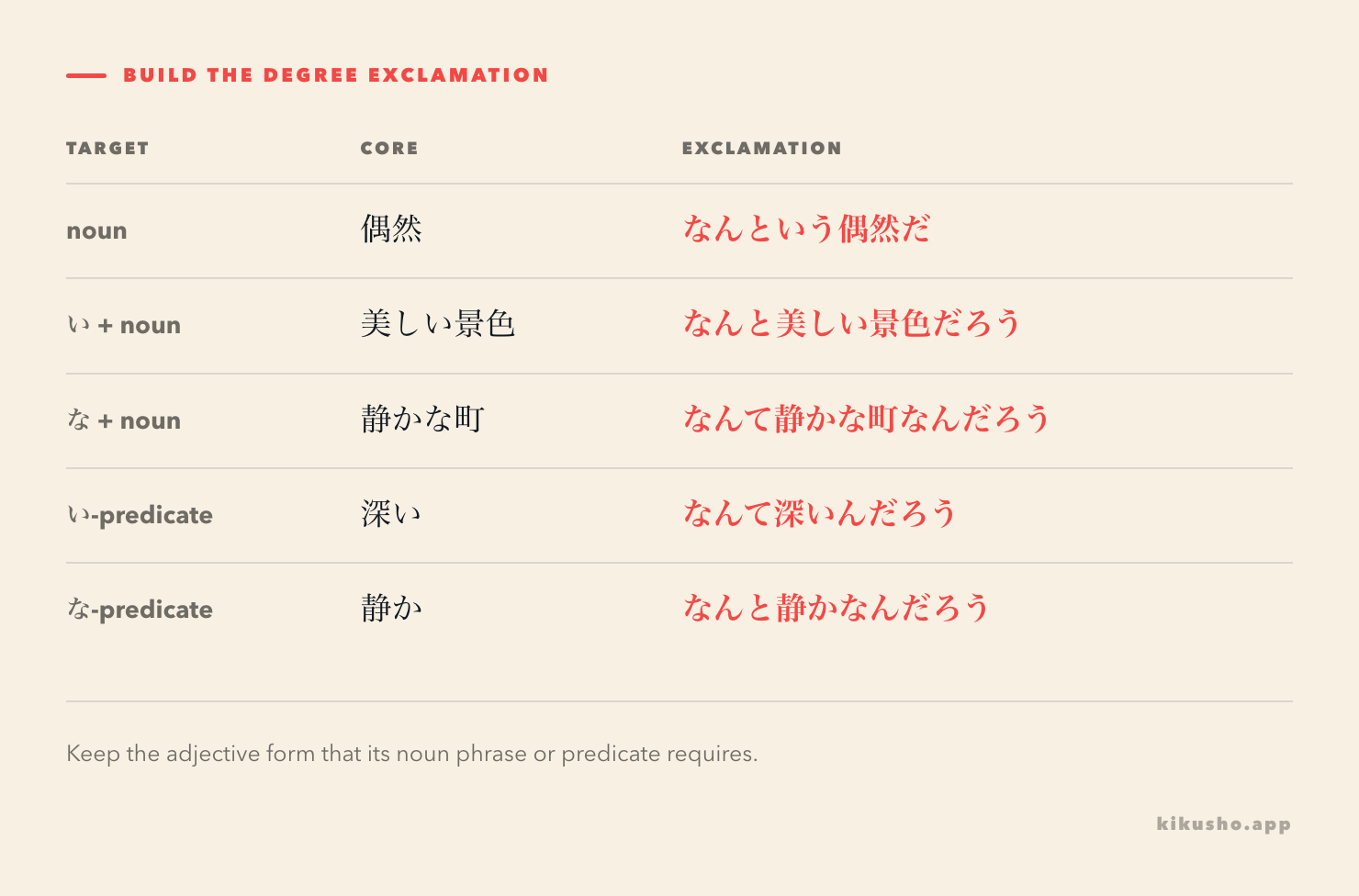
The pattern concerns a degree that exceeds a relevant expectation. Academic work on Japanese degree exclamatives distinguishes 太郎がおいしいデザートを作るなんて, which reacts to the event of Taro making a delicious dessert, from 太郎はなんておいしいデザートを作るのだろう, which exclaims over how delicious the dessert is. The Japanese Grammatical Studies research volume describes this in-sentence なんて as degree-oriented.
Positive and negative judgments use the same frame
Do not assign なんと to praise and なんて to criticism. Either can introduce a positive or negative evaluation:
なんと心強い言葉だろう。
なんと こころづよい ことばだろう。
What reassuring words!
なんてひどい扱いなんだ。
なんて ひどい あつかい なんだ。
What terrible treatment!
The adjective and context determine the judgment. 心強い is favourable; ひどい is strongly negative. The introductory form contributes heightened degree and emotion, not a fixed attitude.
The ending だろう / でしょう often loses its ordinary “probably” force in this frame. The speaker of なんて美しいんだろう is not uncertain about whether the thing is beautiful. They contemplate the degree as too striking for a plain assertion. A question mark or rising intonation can create another reading, so preserve the exclamatory context rather than memorising the ending in isolation.
Choose register, not emotional direction
The three forms overlap, but their typical voices differ:
| Form | Typical effect | Example |
|---|---|---|
| なんという | full, explicit and rhetorically weighty | なんという悲劇だ |
| なんと | concise, careful or literary | なんと美しいことか |
| なんて | conversational and immediate | なんてきれいなんだろう |
This is not a rigid formality scale. なんという偶然! can occur in lively speech, and なんて can appear in written dialogue. Still, a formal address or reflective essay is more likely to choose なんという / なんと, while spontaneous conversation often prefers なんて.
この研究成果は、なんと意義深いことだろう。
この けんきゅうせいかは、なんと いぎぶかい ことだろう。
How significant this research result is!
このケーキ、なんておいしいんだろう。
この ケーキ、なんて おいしいんだろう。
This cake is so delicious!
Both reactions can be sincere. The first suits a deliberate public evaluation; the second sounds natural as an immediate spoken response.
Three similar surfaces belong outside this pattern
First, ordinary 何 + と + 言う asks about wording or a name:
この道具は日本語で何と言いますか。
この どうぐは にほんごで なんと いいますか。
What do you call this tool in Japanese?
This is a real question with 言います as its verb. An answer such as 「缶切り」と言います supplies the missing name. Exclamatory なんという偶然だ requests no label.
Second, なんと can reveal a surprising event in narration:
ドアを開けると、なんと社長が立っていた。
ドアを あけると、なんと しゃちょうが たっていた。
When I opened the door, to my surprise, the company president was standing there.
Here なんと modifies the presentation of the whole discovery. It does not measure how president-like the person was. The Waseda corpus study calls this an event-modifying use and finds it alongside the degree use.
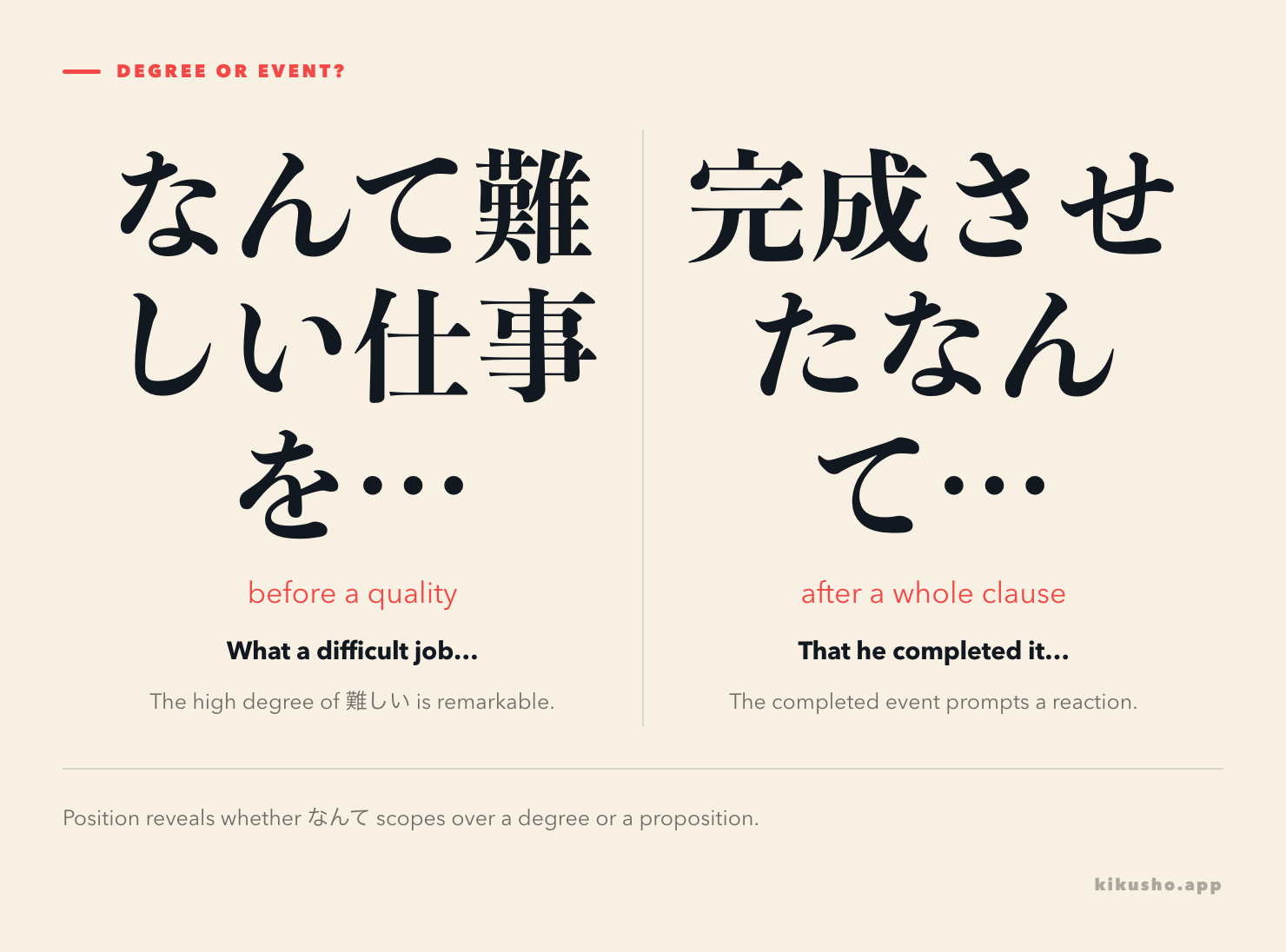
Third, clause + なんて reacts to a proposition:
彼が一人で完成させたなんて驚いた。
かれが ひとりで かんせいさせた なんて おどろいた。
I was surprised that he completed it by himself.
Compare a degree exclamation:
彼はなんて難しい仕事を完成させたんだろう。
かれは なんて むずかしい しごとを かんせいさせたんだろう。
What a difficult job he completed!
The first reacts to the truth of the completed event. The second evaluates the high difficulty of 仕事. The position of なんて tells you what falls inside its scope.
Noun + なんて can also downplay or dismiss something: 私なんてまだ初心者です, “Someone like me is still a beginner.” The comparison of なんて, なんか, など and とか teaches that evaluative marker. Identical spelling does not make the attachment or social effect identical.
When you save an exclamation in Kikusho, keep the evaluated quality and the ending: なんて静かな町なんだろう. A card containing only なんて cannot tell you whether it preceded a degree, followed a surprising proposition or downplayed a noun.
Practice: locate the remarkable degree
Commit to seven responses, then reveal how each sentence locates its remarkable degree.
Question 1. Complete “What a coincidence!” with the full noun-phrase form: ( )偶然だ。
A. なんという B. なんていうか C. なんとか D. なんとも
Question 2. Which attachment correctly exclaims over a quiet town?
A. なんて静か町なんだろう B. なんて静かな町なんだろう C. なんて静かだ町なんだろう D. なんて静かの町なんだろう
Question 3. Which statement about emotional direction is accurate?
A. なんと is only positive. B. なんて is only negative. C. All three forms can introduce praise or criticism. D. なんという cannot modify an adjective plus noun.
Question 4. What is なんと doing in この道具は日本語で何と言いますか?
A. Exclaiming over an extreme degree B. Asking what the tool is called C. Dismissing the tool D. Revealing a surprising narrator
Question 5. Which sentence exclaims over the degree of difficulty rather than reacting to the mere fact of completion?
A. 彼が完成させたなんて驚いた。 B. 彼はなんて難しい仕事を完成させたんだろう。 C. 彼なんて完成できない。 D. なんと、彼が完成させた。
Question 6. Choose the most conversational immediate reaction to tasting a cake.
A. このケーキ、なんておいしいんだろう。 B. このケーキはおいしいかと言います。 C. このケーキなんて食べません。 D. このケーキをなんとか食べます。
Question 7. Arrange the pieces into “What a beautiful view this is!”: 景色 / なんという / だろう / 美しい.
Reveal the reasoning for the seven degree judgments
Question 1: A. なんという偶然だ places the full exclamatory form before the noun 偶然. なんていうか is a hesitation such as “how should I put it,” while なんとか and なんとも belong to other expressions.
Question 2: B. 静か is a な-adjective, so it takes な when it modifies 町: 静かな町. The complete exclamation is なんて静かな町なんだろう.
Question 3: C. The evaluated word and context supply praise or criticism. なんと心強い言葉だろう is favourable, while なんてひどい扱いなんだ is negative; the introductory forms themselves do not divide by emotional direction.
Question 4: B. The sentence contains interrogative 何, quotative と and the real verb 言います. It asks for the Japanese name of the tool and expects an answer.
Question 5: B. なんて appears before 難しい仕事, so the high degree of difficulty is central. A reacts to the proposition “he completed it,” C downplays 彼, and D uses narrative なんと to reveal a surprising event.
Question 6: A. なんておいしいんだろう is a natural conversational degree exclamation. B asks no well-formed naming question in this context, C dismisses cake as a category, and D means managing to eat it somehow.
Question 7 — completed sentence: なんという美しい景色だろう。 美しい modifies 景色 inside the noun phrase, and だろう gives the whole reaction a reflective exclamatory ending.
First identify what is remarkable. If it is the degree of a quality or the force of a noun category, place なんという, なんと or なんて before that material. If the form asks for wording, follows a complete proposition or simply unveils a surprising event, parse it separately.
Common questions
What do なんという, なんと and なんて mean in exclamations?
They express that a quality or category reaches a remarkable degree: “how beautiful,” “what a coincidence” or “what terrible conduct.” The evaluation can be positive or negative.
What is the difference between なんと and なんて in this pattern?
Both can introduce a degree exclamation. なんと often sounds careful, rhetorical or literary, while なんて is common in emotional conversation. This is a register tendency rather than a difference between positive and negative reactions.
Does だろう express uncertainty in an exclamation?
Usually not. In なんて美しい景色なんだろう, だろう helps present a reflective exclamation. The speaker is reacting to the view's beauty, not guessing whether the view is beautiful.
Is every なんて an example of this N1 pattern?
No. Clause + なんて can react to a surprising event, and noun + なんて can downplay or dismiss the noun. The target pattern places なんて before a quality or noun phrase whose remarkable degree the speaker evaluates.