On this page
調査結果から、この制度は利用者の負担を減らしたと考えられる。 The writer uses と考えられる to present “the system reduced the burden on users” as a conclusion supported by the survey results, while leaving the individual thinker in the background.
Natural translations include “it is considered that,” “it can be inferred that” and “it is reasonable to think that.” The central question is not which English passive sounds best. Ask whether the Japanese sentence packages a complete claim after evidence and presents it as an analytical judgment.
JLPT Sensei and Bunpro both place と考えられる at N2. Rikkyo University's report-writing guide distinguishes an author's subjective と考える from と考えられる, which presents a conclusion reached through analysis of facts or reliable information. These sources support the formal, evidence-linked use taught here. The level remains study guidance because official JLPT materials do not enumerate every grammar form.
Quote a complete proposition before 考えられる
The particle と marks the content being considered. Build the clause as a complete plain-form statement, then add と考えられる.
| Proposition ending | Pattern before the judgment | Model phrase |
|---|---|---|
| an action or event | plain-form verb + と考えられる | 負担が減ったと考えられる |
| an い-adjective claim | dictionary or past い-adjective + と考えられる | 影響が大きいと考えられる |
| a な-adjective claim | な-adjective + だ/である + と考えられる | 有効だと考えられる |
| an identifying noun phrase | noun + だ/である + と考えられる | 主な原因だと考えられる |
調査結果から、この制度は利用者の負担を減らしたと考えられる。
ちょうさけっかから、この せいどは りようしゃの ふたんを へらしたと かんがえられる。
From the survey results, it can be inferred that this system reduced the burden on users.
記録が同じ時期に集中していることから、作業は短期間に行われたと考えられる。
きろくが おなじ じきに しゅうちゅうしていることから、さぎょうは たんきかんに おこなわれたと かんがえられる。
From the fact that the records are concentrated in the same period, the work is thought to have been carried out in a short time.
Tense and voice belong inside the quoted proposition. In the second example, 行われた is past passive because that is the claim under analysis. 考えられる then presents that whole claim as a reasoned conclusion.
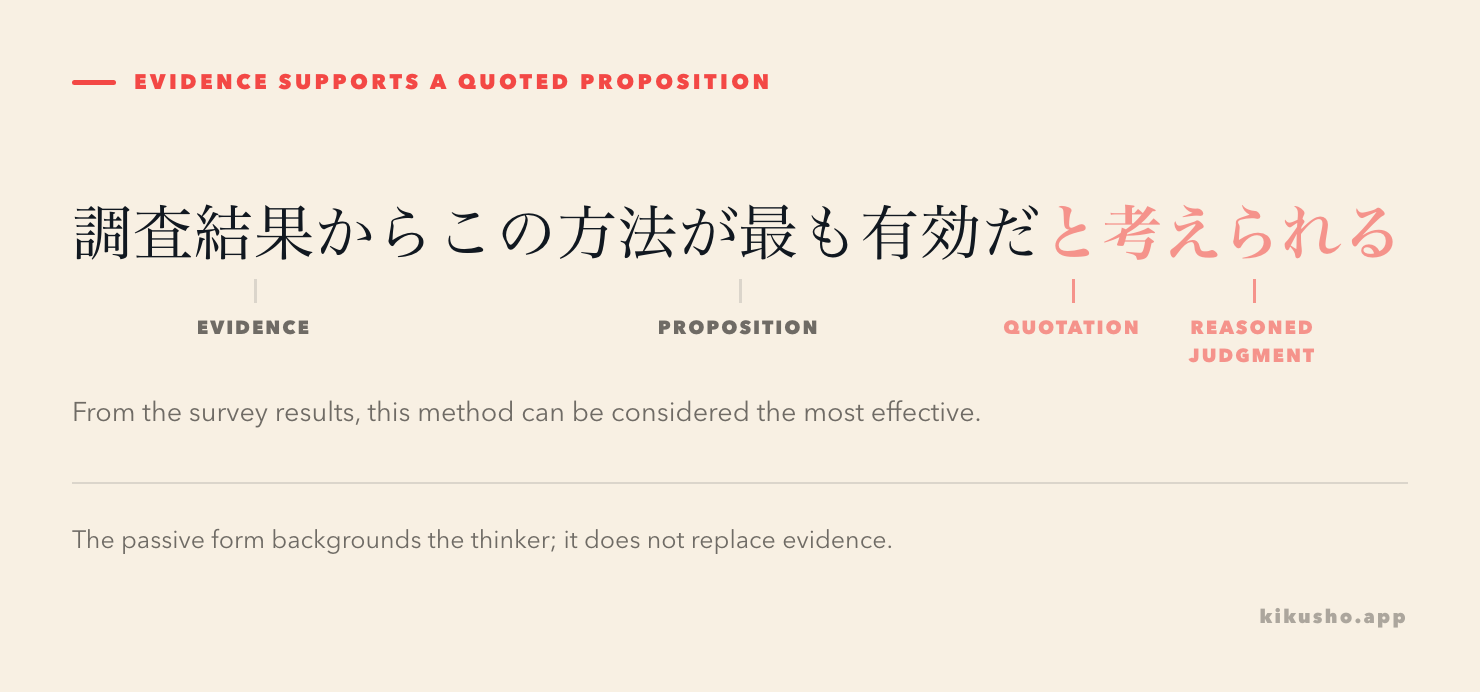
With nouns and な-adjectives, だと考えられる is a clear standard form. Formal prose also uses であると考えられる. You may encounter a noun directly before と考えられる, as in 原因は設備の故障と考えられる; this compressed formal wording is natural. Learn 故障だと and 故障であると first because they make the internal proposition visible.
The construction backgrounds the thinker
Compare three versions of the same claim:
私は、この方法が最も有効だと考える。
I consider this method the most effective.
調査結果から、この方法が最も有効だと考えられる。
From the survey results, this method can be considered the most effective.
この分野では、この方法が最も有効だと考えられている。
In this field, this method is generally considered the most effective.
と考える has an explicit thinker, 私, and directly states that person's judgment. と考えられる removes that agent from the centre and presents the conclusion as available through reasoning. と考えられている describes a view that continues to be held in a field or community.
This does not make the middle sentence automatically objective or true. A writer can hide a weak opinion behind passive wording. Strong use still provides a basis such as 調査結果から, データによると, 記録を見ると or このことから. Rikkyo's guide ties the expression to rational judgment based on facts or reliable information; the evidence, not the passive shape alone, earns that force.
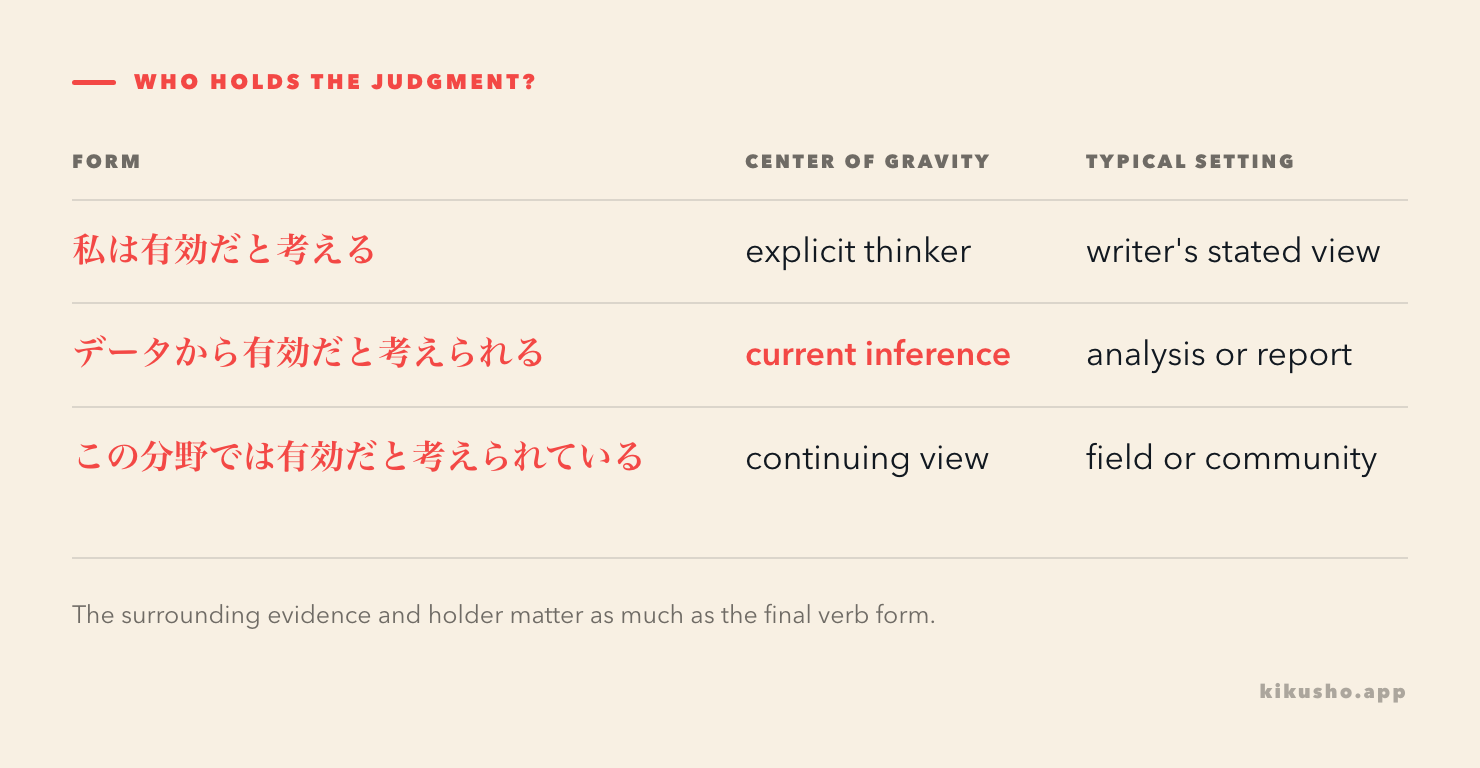
と考えられる presents a judgment; と考えられている presents a held view
The difference between the simple and progressive passive matters in reading.
今回の減少は、一時的な変化だと考えられる。
こんかいの げんしょうは、いちじてきな へんかだと かんがえられる。
This decline can be considered a temporary change.
The sentence advances an analysis of the current evidence.
この遺跡は、約二千年前に造られたと考えられている。
この いせきは、やく にせんねんまえに つくられたと かんがえられている。
This site is thought to have been built about two thousand years ago.
The ている form describes an ongoing accepted view. Bunpro draws this contrast explicitly: と考えられる focuses on a judgment supported by reasoning, while と考えられている presents a generally held belief or consensus.
The boundary is contextual rather than mechanical. A published paper can use と考えられる for its own inference, and another paper can later report that result with と考えられている. Look for holders such as 研究者の間では, 一般に or この分野では; they favor the continuing-view reading.
と考えられる and と思われる overlap without being identical
Both forms can soften a claim and keep an individual 私 out of the foreground.
データの変化は、制度の改正によるものだと考えられる。
The change in the data can be attributed, through analysis, to the policy revision.
空の様子から、午後は雨になると思われる。
Judging from the sky, it appears likely to rain this afternoon.
A useful tendency is that 考える evokes analysis and reasoning, while 思う readily covers an impression or estimate. Academic studies also examine both as ways of presenting a writer's judgment with reduced subjectivity. Do not turn the tendency into a rigid ban: real formal prose uses both, and evidence can support either one.
For a test question, inspect the surrounding nouns and verbs. 分析, 調査, 結果, 原因 and このことから strongly support と考えられる. A visible appearance or immediate impression may favor と思われる. If both could work grammatically, the intended distinction must come from the discourse setting, not from English “seems.”
The appearance and evidence comparison covers everyday markers with different evidence sources. と考えられる belongs more naturally to explanatory, academic and analytical prose.
Put the evidence before the conclusion
Useful evidence frames include:
| Evidence frame | Reading | Function |
|---|---|---|
| 調査結果から | ちょうさけっかから | from the survey results |
| データによると | データによると | according to the data |
| 記録を見ると | きろくをみると | looking at the records |
| このことから | このことから | from this fact |
| 以上の点から | いじょうのてんから | from the points above |
以上の点から、利用時間を短くする必要があると考えられる。
いじょうの てんから、りようじかんを みじかくする ひつようが あると かんがえられる。
From the points above, it is reasonable to conclude that usage time needs to be shortened.
The に基づいて and をもとに lesson explains how a source becomes the basis for an action or judgment. With と考えられる, the clause after that basis states the result of the reasoning.
The viewpoint lesson handles conclusions framed from a person's standpoint or a selected aspect. Here the focus is different: と考えられる shapes the status of the conclusion itself.
Formal tone does not erase responsibility
This expression is common in reports, essays, research writing and careful explanations. It is less natural for a simple personal preference:
私はこのケーキが好きだと思う。
I think I like this cake.
Changing this to このケーキが好きだと考えられる makes a private preference sound like an external analytical finding. It would need an unusual context, such as someone inferring the speaker's preference from repeated purchases.
Similarly, do not use と考えられる as a decoration on every paragraph ending. Ask which facts support the claim and whether the agent should truly be backgrounded. If the sentence states your chosen interpretation, 私は~と考える may be clearer. If it reports a community view, identify that community and consider と考えられている.
Negative と考えられない reverses the assessment:
この差が偶然だけで生じたとは考えられない。
この さが ぐうぜんだけで しょうじたとは かんがえられない。
It is difficult to believe that this difference arose by chance alone.
The contrastive は in とは strengthens the rejection of that quoted possibility. This negative is not the target meaning “can reasonably be considered,” so determine the polarity before assigning the gloss.
For a Kikusho card, capture the evidence as well as the conclusion. 有効だと考えられる alone practices formation; 調査結果から、この方法が有効だと考えられる also trains why the formal judgment is warranted. Keep the source phrase editable so a weak or missing basis remains visible during review.
Practice: connect evidence to a measured claim
Answer all six prompts before opening the explanations. Check the predicate inside the quotation, the evidence phrase and whether the sentence presents an individual view, a current inference or an ongoing consensus.
Question 1 — grammar choice. Complete the evidence-based report: 調査結果から、この方法が最も__と考えられる。
- 有効な
- 有効だ
- 有効で
- 有効に
Question 2 — quotation scope. In 記録が同じ時期に集中していることから、作業は短期間に行われたと考えられる, which complete claim does と quote?
- 記録が同じ時期に集中している
- 作業は短期間に行われた
- ことから only
- 考えられる only
Question 3 — contrast selection. A report introduces its own conclusion directly from newly analyzed survey data. Which ending best fits?
- と考えられる
- と考えられている
- と考えていた私
- と考えさせた
Question 4 — sentence composition. Use 以上の点から, 利用時間を短くする必要がある and と考えられる to write one formal conclusion.
Question 5 — text grammar. What difference does ている create in この遺跡は約二千年前に造られたと考えられている compared with と考えられる?
- It turns the sentence into a command.
- It presents the view as continuing or generally held.
- It makes 造られた present tense.
- It identifies the writer as 私.
Question 6 — error diagnosis. Why is 私は甘い物が好きだと考えられる odd as an ordinary statement of the speaker's own taste, and what is a natural repair?
Your final check is whether the sentence supplies a basis for a conclusion whose individual thinker can reasonably stay in the background.
Answers and explanations
Explanation 1. 2. 有効だ. 有効 is a な-adjective. Its complete plain affirmative predicate is 有効だ, and quotative と follows that proposition. Formal 有効であると考えられる would also be possible, but it is not among the choices.
Explanation 2. 2. 作業は短期間に行われた. That full past-passive proposition is the content judged reasonable. 記録が同じ時期に集中していることから supplies the evidence.
Explanation 3. 1. と考えられる. The report is drawing a current conclusion from its analysis. と考えられている would instead foreground an ongoing generally held view.
Explanation 4. 以上の点から、利用時間を短くする必要があると考えられる。 The evidence frame comes first, the complete proposition ends in ある, and と考えられる presents it as the resulting judgment.
Explanation 5. 2. It presents the view as continuing or generally held. The past inside 造られた dates the construction of the site. The outer 考えられている describes the present state of the belief.
Explanation 6. と考えられる backgrounds the thinker and suggests an externally supportable analysis, which is unnecessary for a direct report of one's own taste. A natural repair is 私は甘い物が好きだ or, if some uncertainty is intended, 私は甘い物が好きだと思う.
Common questions
What does と考えられる mean in Japanese?
と考えられる presents a proposition as a conclusion that can reasonably be drawn from evidence or analysis. Depending on context, it means “it is considered that,” “it can be inferred that,” or “it is reasonable to think.”
What is the difference between と考える and と考えられる?
と考える attributes the judgment to an explicit thinker, often the writer. と考えられる backgrounds the thinker and presents the judgment as a conclusion available from the evidence.
How is と考えられている different from と考えられる?
と考えられる commonly presents a reasoned judgment in the current argument. と考えられている describes an ongoing view or belief held by researchers, society or another relevant group.