On this page
ながらに keeps a state in force while the sentence continues; ながらの makes that same maintained state describe a noun. Compare 涙ながらに訴えた, “appealed in tears,” with 昔ながらの製法, “a traditional method preserved from the past.”
This is a limited, expression-heavy N1 use of ながら. It does not give you a free way to attach “unchanged” to any word. Learn the small set of combinations that Japanese repeatedly uses, then choose に or の by looking at what follows.
The following word decides between に and の
| Pattern | Sentence job | What follows | Model |
|---|---|---|---|
| A ながらに(して), B | keeps A as the state in which B holds | an action or predicate | 涙ながらに語った |
| A ながらの N | makes the maintained state A modify N | a noun | 昔ながらの町並み |
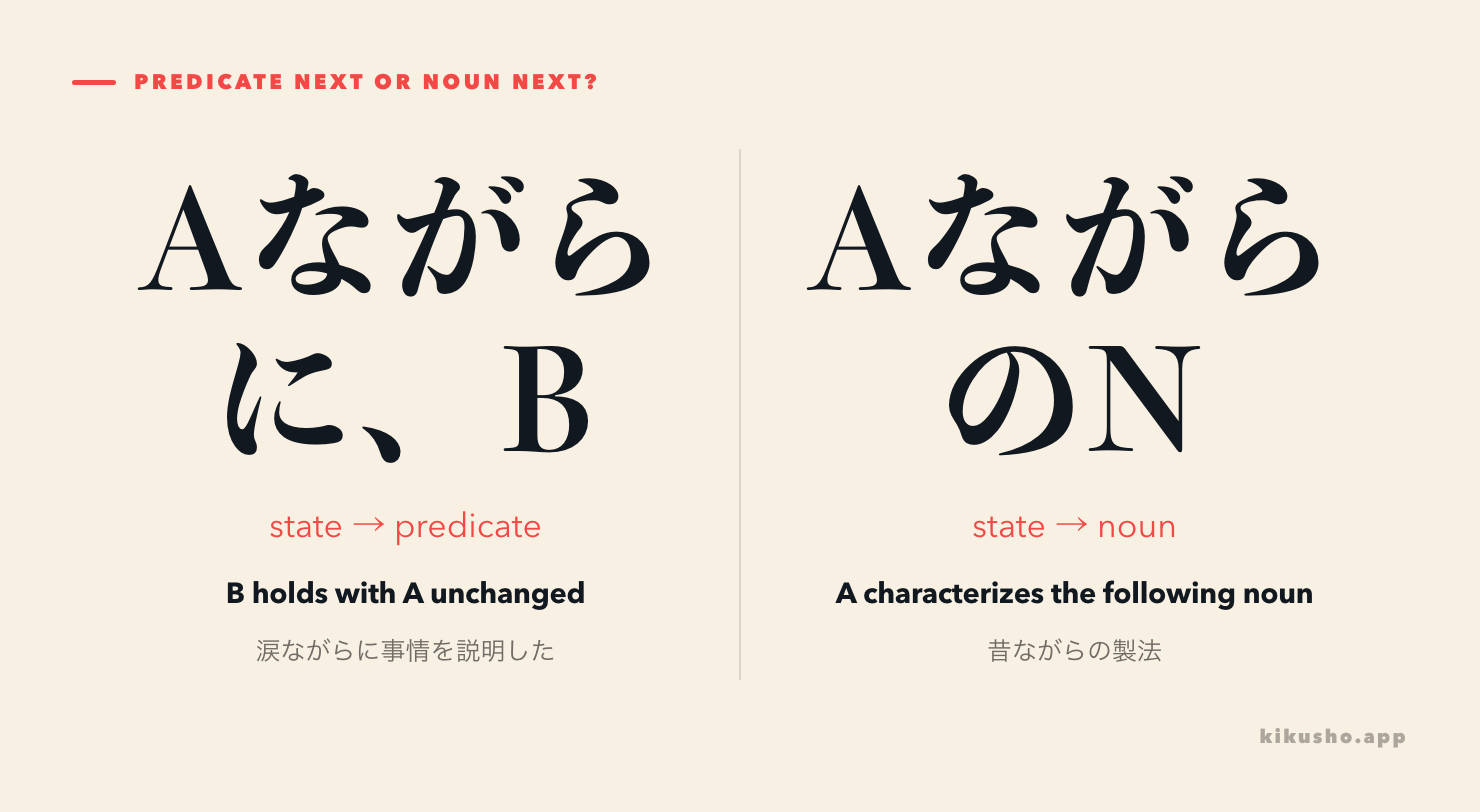
彼女は涙ながらに事情を説明した。
かのじょはなみだながらにじじょうをせつめいした。
She explained the circumstances in tears.
The maintained state is 涙, being in tears. に makes that state adverbial, so it describes how she explained.
この店は昔ながらの製法を守っている。
このみせはむかしながらのせいほうをまもっている。
This shop preserves its traditional production method.
Here の carries “as it was in the past” into the noun 製法. 日本語あれこれ makes the same distinction and notes that the pattern commonly combines with いる, 生きる, 涙, 昔, いつも and 生まれる.
Learn the established combinations before making new ones
The pattern is productive only within narrow bounds. Bunpro explicitly warns that ながらに tends to occur with a limited set of words. These are the combinations worth recognizing first:
| Expression | Reading | Core idea | Typical continuation |
|---|---|---|---|
| 生まれながらに(して) | うまれながらに(して) | present from birth | 才能がある, 権利を持つ |
| 居ながらにして | いながらにして | without leaving where one is | 参加できる, 情報を得る |
| 生きながらにして | いきながらにして | while still alive | 伝説となる, 葬られる |
| 涙ながらに | なみだながらに | in tears | 語る, 訴える |
| 昔ながらの | むかしながらの | preserved from earlier times | 製法, 味, 町並み |
| いつもながらの | いつもながらの | as on other occasions | 対応, 演奏, 丁寧さ |
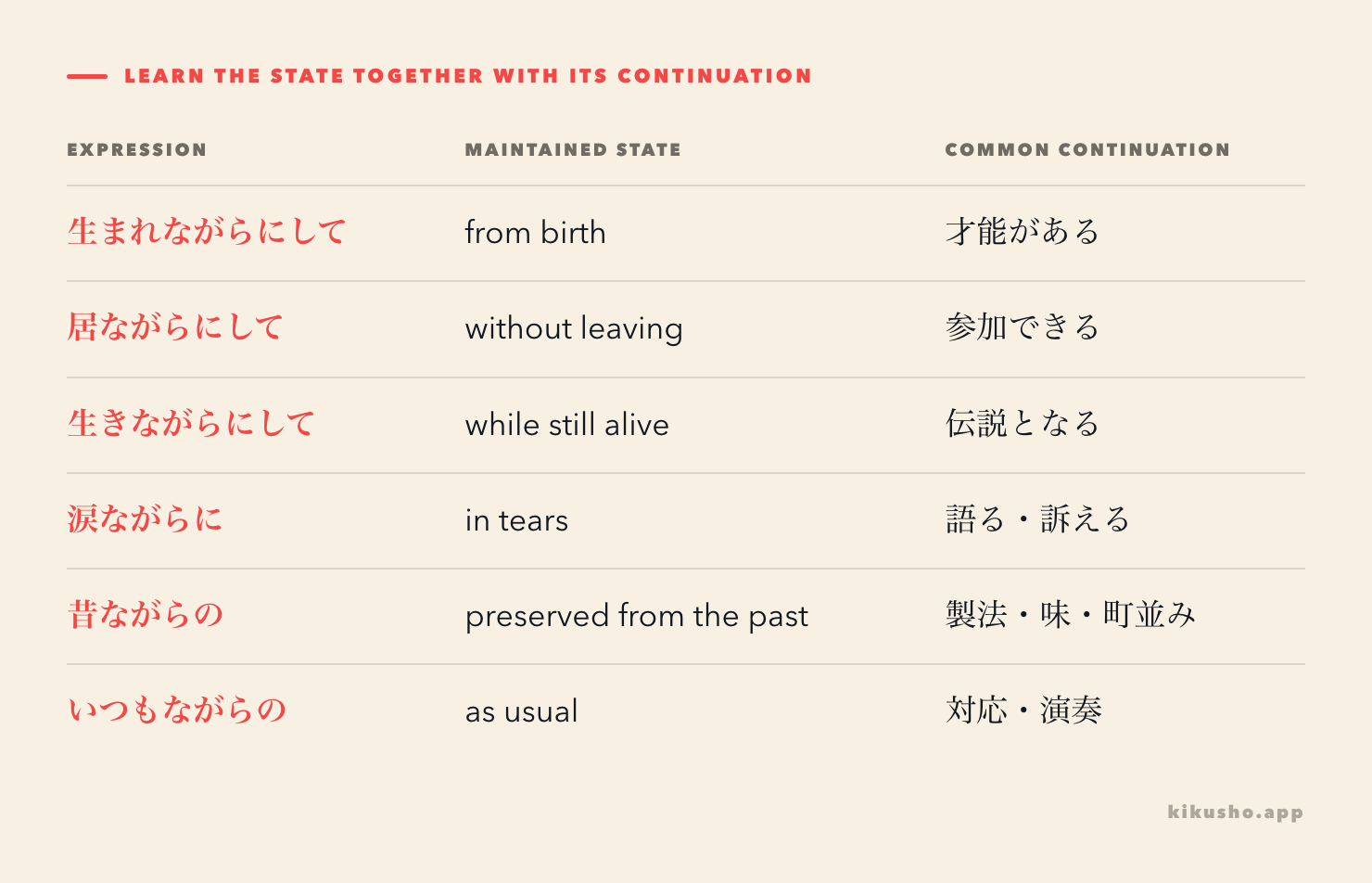
日本語NET summarizes the shared meaning as remaining in the same state and independently places this use at N1. The English translation changes from row to row because English does not package “from birth,” “in tears,” “without leaving,” and “traditional” with one construction. The Japanese relationship is more consistent than its translations: state A remains the frame for B.
生まれながらに and 居ながらにして preserve different starting points
生まれながらに(して) reaches back to birth. It characterizes an attribute or condition as innate rather than acquired later.
彼には生まれながらにして音を聞き分ける力があった。
かれにはうまれながらにしておとをききわけるちからがあった。
He had the ability to distinguish sounds from birth.
The sentence does not merely say that he was talented as a child. It presents the ability as already there from the starting point of his life.
居ながらにして holds the person’s physical location in place while access or action extends elsewhere.
自宅に居ながらにして、海外の講義を受けられる。
じたくにいながらにして、かいがいのこうぎをうけられる。
You can attend lectures overseas without leaving home.
The person stays at home; the opportunity crosses the distance. This is why 居ながらにして often appears with remote access, communication and services. It is denser and more formal than simply saying 自宅で海外の講義を受けられる.
にして strengthens the sense that the original state still holds
The extension ながらにして is common after 生まれる, 居る and 生きる. The added して does not introduce a new action by itself. It emphasizes the frame: B becomes true with A still intact.
その作家は生きながらにして伝説となった。
そのさっかはいきながらにしてでんせつとなった。
The writer became a legend while still alive.
The point is the coexistence that might otherwise seem unexpected. The writer reached legendary status without the state 生きている having ended.
Do not add して mechanically to every expression. 涙ながらに語った and 昔ながらの製法 are the established shapes. Treat ながらにして as part of the combinations in which you have seen it, not as a decoration that makes any sentence more formal.
ながらの carries the preserved state into a noun
With の, the construction becomes a noun modifier. Three common families cover much of what you will meet:
昔ながらの町並みが残っている。
むかしながらのまちなみがのこっている。
The traditional streetscape remains.
彼はいつもながらの丁寧な対応を見せた。
かれはいつもながらのていねいなたいおうをみせた。
He responded with his usual care.
彼女は生まれながらの音楽家だ。
かのじょはうまれながらのおんがくかだ。
She is a natural-born musician.
The noun after の names the thing characterized by continuity: a streetscape kept from the past, conduct matching the person’s usual standard, or a musician whose nature is presented as innate. JLPT Sensei lists both the predicate-linking and noun-modifying formations and places the grouped construction at N1.
Ordinary ながら joins actions; this form preserves a state
Compare three constructions that share the same spelling:
| Construction | Relationship | Example |
|---|---|---|
| V-stem + ながら, B | one actor performs overlapping actions | 音楽を聞きながら勉強する |
| A + ながらも, B | B contrasts with A | 狭いながらも快適だ |
| A + ながらに/ながらの | A remains the state framing B or N | 涙ながらに語る/昔ながらの味 |
In 音楽を聞きながら勉強する, listening and studying are two actions. In 涙ながらに語る, tears are the condition maintained during the telling. The N4 simultaneous-action lesson explains the shared actor and final-verb focus; the ながらも lesson handles concession.
Do not replace ordinary ながら with ながらに merely because the sentence is formal. 資料を読みながら会議に参加した means “attended the meeting while reading the materials.” 資料を読みながらに会議に参加した is not the advanced version of that sentence. The N1 construction requires the established maintained-state relationship.
The broader まま lesson is useful when you need a productive way to say that a concrete condition remains unchanged. 窓を開けたまま寝た freely describes sleeping with the window left open. ながらに is narrower and more lexical.
Keep the whole expression as the unit you review
Learning a bare definition such as “ながら = while” makes all three patterns collapse into one. Save 涙ながらに訴える, 居ながらにして参加する, or 昔ながらの製法 as a complete chunk. The following verb or noun tells you what role the ending plays.
When Kikusho turns a sentence you noticed into a card, keep that collocation in the example and label its maintained state: “in tears,” “without leaving,” “from birth,” or “preserved from the past.” During review, rebuild the whole expression before translating it.
Practice
Work through Questions 1–7 before revealing the explanations.
Question 1
Choose the completion for “a production method preserved from earlier times.”
この工房では、昔____製法を守っている。
ア. ながらに
イ. ながらの
ウ. ながらも
エ. ながらで
Question 2
Choose the established expression meaning “she appealed in tears.”
彼女は____訴えた。
ア. 涙ながらに
イ. 涙ながらの
ウ. 泣きながらの
エ. 涙ながらも
Question 3
Arrange the fragments to mean “You can participate in the meeting without leaving home.”
- 会議に参加できる
- 自宅に
- 居ながらにして
Question 4
Which sentence uses the everyday simultaneous-action pattern rather than the maintained-state N1 pattern?
ア. 彼女は涙ながらに経験を語った。
イ. 昔ながらの店が並んでいる。
ウ. 音楽を聞きながら資料を読んだ。
エ. 彼には生まれながらにして才能があった。
Question 5
Complete the phrase that presents an ability as innate.
彼には生まれ____音を聞き分ける力があった。
Question 6
Read the passage and choose the expression that fits the blank.
この町では新しい建物が増えている。それでも、中心部には木造の家と細い路地が残り、____町並みを見ることができる。
ア. 昔ながらの
イ. 昔ながらに
ウ. 昔でありながらも
エ. 昔にして
Question 7
Select one option for slots ① and ②.
彼女は自宅に居( ① )、海外の授業を受けた。職人は昔( ② )道具を使い続けた。
ア. ① ながらの / ② ながらに
イ. ① ながらにして / ② ながらの
ウ. ① ながらも / ② ながらにして
エ. ① ながらで / ② ながらも
Answers and explanations
Answer 1
The right completion is イ. ながらの: 昔ながらの製法. The preserved state directly modifies the noun 製法, so の is required. ながらに would need a following predicate rather than a noun in this structure.
Answer 2
Choose ア. 涙ながらに. This established expression makes being in tears the state in which 訴えた occurs. Choice イ would need a following noun, and エ would introduce concession rather than manner.
Answer 3
2 → 3 → 1: 自宅に居ながらにして、会議に参加できる。 The person remains at home while participation reaches beyond that location. 居る appears as the stem 居, followed by the established ながらにして.
Answer 4
Choose ウ. 聞きながら読んだ joins the overlapping actions of listening and reading by one actor. The other sentences use fixed or strongly established expressions in which birth, tears or the past remains the state framing what follows.
Answer 5
Use ながらにして: 彼には生まれながらにして音を聞き分ける力があった。 The ability is presented as existing from birth. 生まれながらに is also possible; して reinforces the maintained starting state.
Answer 6
Choose ア. 昔ながらの. The passage contrasts new construction with a streetscape that preserves an older form. Because 町並み is the following noun, the noun-modifying ending の fits.
Answer 7
Choose イ. ① ながらにして / ② ながらの. 自宅に居ながらにして keeps the person at home while the overseas class is accessed. 昔ながらの道具 makes preservation from the past describe the tools.
Common questions
What do ながらに and ながらの mean?
They present a state as continuing unchanged. ながらに connects that state to a following action or condition, while ながらの makes the state describe the noun that follows.
Is ながらに the same as verb-stem ながら meaning “while”?
No. The everyday pattern joins two overlapping actions, as in 音楽を聞きながら勉強する. The N1 pattern is limited to established expressions such as 生まれながらに, 居ながらにして and 涙ながらに.
Can して follow ながらに?
Yes, in established expressions such as 生まれながらにして, 居ながらにして and 生きながらにして. It emphasizes that the following situation holds while the original state remains intact.
Are ながらに and ながらの N1 grammar?
The independent references checked for this lesson place this unchanged-state use at N1. The JLPT does not publish an exhaustive official grammar list, so the label is study guidance.