On this page
可能性がある neutrally states that an outcome is possible; ないとも限らない says that an outcome cannot safely be ruled out. The second form uses double negation to reopen a possibility that may seem remote, unexpected or easy to dismiss.
Compare a forecast with a precaution:
午後は雨が降る可能性がある。
ごごは あめが ふる かのうせいが ある。
There is a possibility of rain this afternoon.
今は晴れていても、午後は雨が降らないとも限らない。
いまは はれていても、ごごは あめが ふらないとも かぎらない。
Even though it is sunny now, it might still rain this afternoon.
Both sentences keep rain possible. The first assesses it directly. The second challenges the comfortable assumption that rain will not occur.
Choose the form by the speaker's move
| Form | What the speaker does | Frequent setting | Natural English cue |
|---|---|---|---|
| clause / Nの + 可能性がある | identifies an outcome as possible | analysis, report, diagnosis | there is a possibility; may |
| Vない + とも限らない | refuses to rule out the corresponding event | warning, reminder, precaution | might still; cannot rule out |
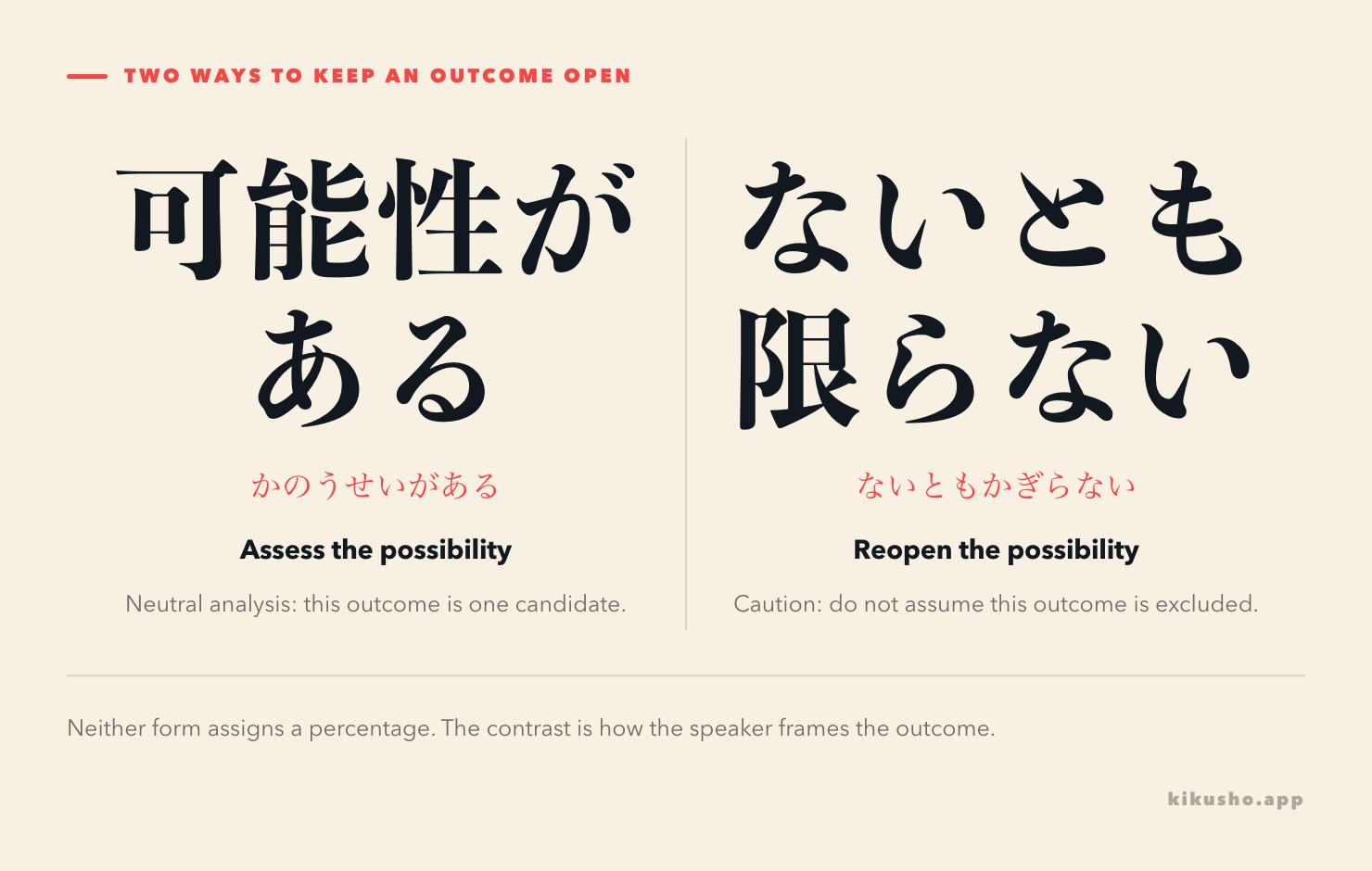
This is a difference in framing rather than a probability scale. Neither construction supplies a percentage. Context may make the outcome likely or remote; the grammar tells you how the speaker places that outcome in the discussion.
可能性がある names the possibility directly
可能性(かのうせい) is a noun meaning possibility or potential. A plain-form clause modifies it, and がある says that such a possibility exists.
システムの更新後、一部の設定が変わる可能性があります。
システムの こうしんご、いちぶの せっていが かわる かのうせいが あります。
After the system update, some settings may change.
The sentence reports an outcome without marking it as welcome or alarming. Evidence and surrounding vocabulary can make it a risk, but 可能性がある itself remains neutral.
The clause can be affirmative or negative and can refer to different times:
| Content before 可能性 | Example | Meaning |
|---|---|---|
| V dictionary form | 遅れる可能性がある | may be late |
| Vない form | 間に合わない可能性がある | may not make it in time |
| Vた form | 連絡を見落とした可能性がある | may have overlooked the message |
| N + の | 機械の故障の可能性がある | mechanical failure is possible |
The wording becomes more formal and analytical than an everyday かもしれない. It is common when the writer wants to label a scenario, compare causes or explain what the evidence permits.
ログを見ると、別の端末から接続された可能性がある。
ログを みると、べつの たんまつから せつぞくされた かのうせいが ある。
The log suggests that a connection may have been made from another device.
Here the log supports a retrospective possibility. The sentence need not warn anyone; it can simply be one hypothesis in an investigation.
The particle often changes to も when the writer adds one candidate among several:
原因は部品の劣化だが、設定ミスの可能性もある。
The cause is component deterioration, but a configuration error is also possible.
可能性もある does not create a new construction. The particle も adds the possibility to the set already under discussion.
ないとも限らない reopens what looks excluded
With a verb, start from the ない-form and add とも限らない:
見落とす → 見落とさない → 見落とさないとも限らない
The two negatives have different jobs. 見落とさない says “does not overlook.” 限らない denies that this negative proposition is guaranteed. The result is that overlooking remains possible.
専門家でも、重要な点を見落とさないとも限らない。
せんもんかでも、じゅうような てんを みおとさないとも かぎらない。
Even an expert might overlook an important point.
The surrounding でも establishes the assumption being challenged: expertise makes an oversight seem less expected, but it does not eliminate it.
Sanshusha's published correction sheet gives the detailed attachment as verb negative, い-adjective く, and な-adjective or noun じゃ, followed by ないとも限らない. That produces forms such as 安くないとも限らない, 安全じゃないとも限らない and 専門家じゃないとも限らない. In practice, verb examples are the clearest and most frequent place to learn the construction.
篠研's N1 teaching reference describes the construction as admitting a possibility that is small but still present. A linguistic study from Okayama University likewise analyzes とも限らない as a possibility expression whose event portion is typically negative. These independent descriptions support the double-negative reading rather than a word-for-word translation of the first ない.
A precaution often follows the reopened possibility
Because the form resists complacency, it frequently gives a reason to prepare, check or wait.
電車が遅れないとも限らないので、一本早い電車で行こう。
でんしゃが おくれないとも かぎらないので、いっぽん はやい でんしゃで いこう。
The train could be delayed, so let us take an earlier one.
データが消えないとも限らないから、先にバックアップを取ってください。
データが きえないとも かぎらないから、さきに バックアップを とってください。
The data could be lost, so please make a backup first.
The warning is often about an unwanted outcome, but adversity is a tendency of the situations in which speakers challenge an assumption, not a fixed lexical requirement. A welcome surprise can also be reopened:
最後まで交渉すれば、相手が条件を受け入れないとも限らない。
If we keep negotiating to the end, the other side might accept the terms.
The speaker treats acceptance as uncertain but refuses to declare it impossible.
Do not reverse the meaning at the inner negative
The most dangerous reading mistake is to stop at ない.
| Japanese | Actual conclusion |
|---|---|
| 事故が起きない。 | An accident will not occur. |
| 事故が起きる可能性がある。 | An accident may occur. |
| 事故が起きないとも限らない。 | An accident might still occur. |
| 事故が起きない可能性がある。 | It is possible that no accident will occur. |
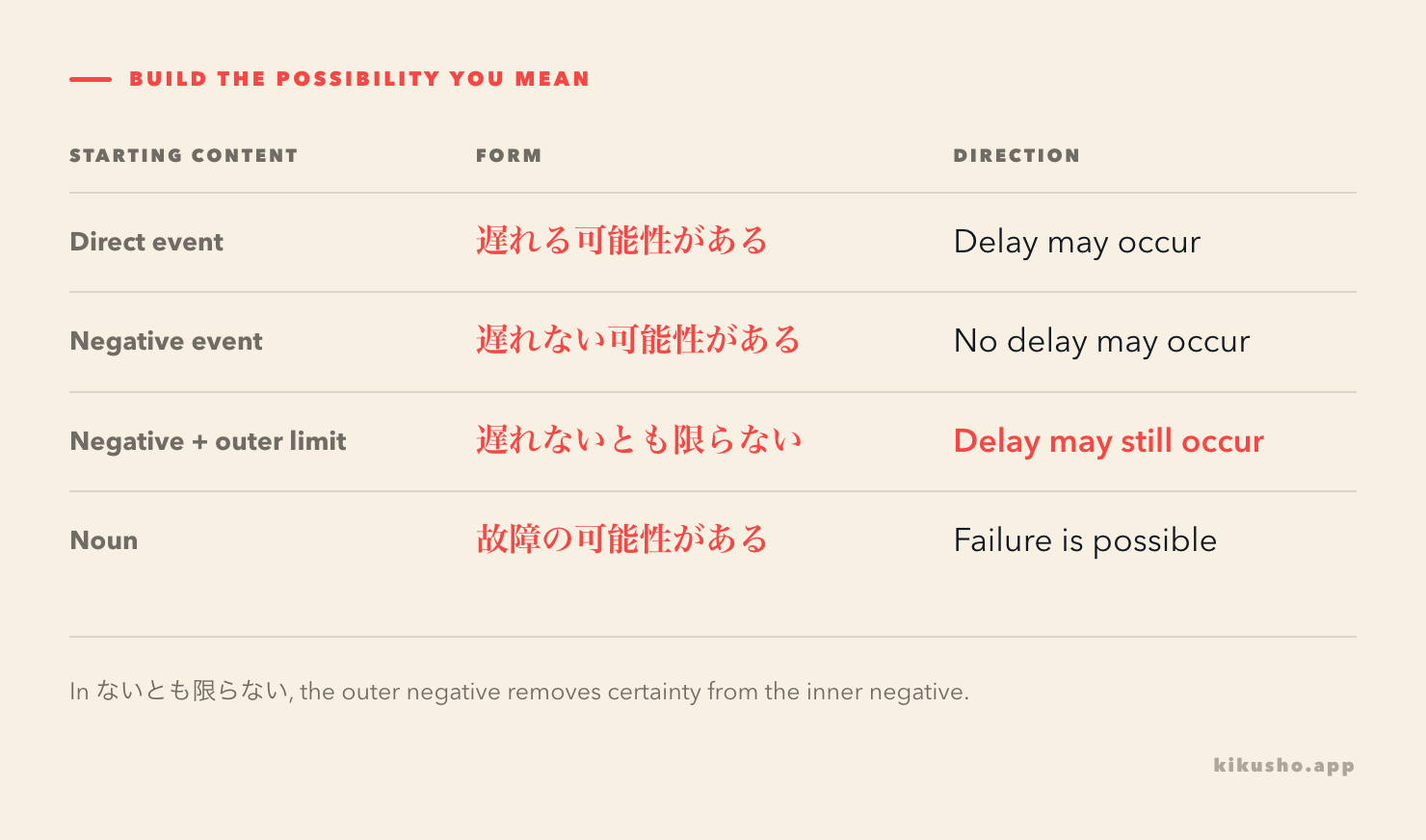
The last two sentences point in opposite directions. In 起きないとも限らない, the outer 限らない removes certainty from “will not occur,” so occurrence remains open. In 起きない可能性がある, the negative stays inside the scenario named by 可能性, so non-occurrence is the possibility.
This is why replacing either form mechanically can change the proposition. First decide which event you want to keep possible, then choose the construction.
Keep とは限らない separate
とは限らない normally rejects a general guarantee:
高価な製品が長持ちするとは限らない。
Expensive products do not necessarily last a long time.
It does not assert that expensive products fail. It leaves exceptions to the claim that they last. The lesson on に違いない and とは限らない develops that certainty contrast.
Now compare the target form:
高価な製品でも、すぐ故障しないとも限らない。
Even an expensive product might break down quickly.
The negative clause すぐ故障しない is what the speaker refuses to guarantee. The sentence therefore reopens breakdown as a concrete possibility. も in とも helps foreground an alternative that should not be excluded.
For a formal adverse risk, 恐れがある presents the outcome as a concern in notices and reports. For a guarded affirmative answer such as “it is not impossible for me to do it,” なくはない and なくもない qualify ability or willingness. Their repeated negatives resemble one another, but the sentence-level jobs differ.
Register and N1 placement
可能性がある is productive in careful speech, reporting and analytical prose. ないとも限らない is more marked: it sounds deliberate because the speaker builds a possibility through double negation. In casual conversation, かもしれない often expresses the same basic uncertainty with less rhetorical weight.
JLPT Sensei's lesson on ないとも限らない and its 可能性がある lesson list both at N1. The JLPT does not publish an exhaustive official grammar inventory, so treat that label as study guidance. The attachment and framing remain useful beyond any test classification.
When you save either form in Kikusho, keep the evidence or challenged assumption on the card. 遅れる可能性がある becomes clearer with the schedule or observation that supports it. 遅れないとも限らない becomes memorable with the precaution that follows.
Practice
Answer Questions 1–7 before opening the explanations.
Question 1
Choose the neutral report of a possible system change.
更新後、一部の設定が変わる____。
A. ないとも限らない
B. 可能性がある
C. とは限らない
D. なくはない
Question 2
Complete the warning: “Even an expert might make a mistake.”
専門家でも、間違いを____とも限らない。
A. する
B. し
C. しない
D. して
Question 3
Which sentence means “It is possible that the package will not arrive today”?
A. 荷物が今日届かない可能性がある。
B. 荷物が今日届かないとも限らない。
C. 荷物が今日届くとは限らない可能性がある。
D. 荷物が今日届く可能性は限らない。
Question 4
Arrange the fragments to make a precaution based on a reopened possibility.
- バックアップを取ろう
- データが
- 消えないとも限らないから
Question 5
Choose the form that connects the noun 故障 to 可能性がある.
調査の結果、機械__故障の可能性があると分かった。
A. が
B. を
C. の
D. に
Question 6
The first speaker rules out agreement. Select the reply that reopens it as a possible result of further negotiation.
甲:この条件では、先方は絶対に受け入れないよ。
乙:____
A. 受け入れる可能性がない。
B. 受け入れるとは限らない。
C. もう少し交渉すれば、受け入れないとも限らない。
D. 受け入れるに違いない。
Question 7
Explain why the following two sentences point in opposite directions.
問題が起きないとも限らない。
問題が起きない可能性がある。
Answers and explanations
Answer 1
Choose B. 可能性がある. The sentence directly labels changing settings as a possible outcome. Choice A would require the negative 変わらないとも限らない and would frame the point as an outcome that should not be dismissed.
Answer 2
Choose C. しない: 専門家でも、間違いをしないとも限らない. The construction starts from the negative proposition “an expert does not make a mistake,” then refuses to guarantee it. The result is that a mistake remains possible.
Answer 3
Choose A. In 届かない可能性がある, non-arrival is the scenario that may be true. Choice B denies the guarantee of non-arrival and therefore leaves arrival possible, which reverses the direction.
Answer 4
2 → 3 → 1: データが消えないとも限らないから、バックアップを取ろう。 The possibility of data loss is reopened first; から then makes it the reason for taking a backup.
Answer 5
Choose C. の: 機械の故障の可能性がある. The first の links the machine to its failure, while the second の makes 故障 modify 可能性.
Answer 6
Choose C. The first speaker has excluded acceptance. The reply uses the negative proposition 受け入れない plus とも限らない to say that acceptance cannot be ruled out, and it supplies continued negotiation as the condition. Choice B says that acceptance is not guaranteed, so it points toward possible rejection instead.
Answer 7
In 問題が起きないとも限らない, the outer 限らない removes certainty from “a problem will not occur,” so a problem may occur. In 問題が起きない可能性がある, 起きない directly describes the possible scenario, so it may be the case that no problem occurs.
Common questions
What does ないとも限らない mean?
It means that an outcome cannot be ruled out: “it might happen” or “there is no guarantee it will not happen.” The negative before とも限らない is part of a double negative, so 雨が降らないとも限らない leaves open the possibility that rain will fall.
What is the difference between ないとも限らない and 可能性がある?
ないとも限らない reopens an overlooked or supposedly unlikely possibility and often supports a warning or precaution. 可能性がある simply states that an outcome is possible and works naturally in neutral analysis, reports and explanations.
How does 可能性がある attach to a verb or noun?
A plain-form clause can modify 可能性, as in 遅れる可能性がある and 遅れた可能性がある. A noun normally takes の, as in 故障の可能性がある. The particle も often replaces が when the possibility is one option among several.
Is ないとも限らない the same as とは限らない?
They are related but their usual jobs differ. A positive proposition plus とは限らない rejects a guarantee: 高い物がいいとは限らない means expensive things are not necessarily good. A negative proposition plus とも限らない uses double negation to keep the positive event possible: 値上がりしないとも限らない means prices might rise.