On this page
A team can say 皆さんの応援なくしては、優勝できなかった, “Without your support, we could not have won.” It can describe the same dependency as 皆さんの応援あっての優勝です, “This victory was possible thanks to your support,” but the grammar points in opposite directions.
なくしては removes an indispensable condition and denies the result. あっての presents the condition as present, then makes the result a noun built upon it.
The direction decides the form
| Form | Direction of the claim | Required shape | Typical effect |
|---|---|---|---|
| A なくしては Bない | remove A, then block B | A is usually a noun; B is negative | insist that A cannot be dispensed with |
| A あっての B | affirm A, then characterize B | A and B are nouns | credit A as the foundation of B |
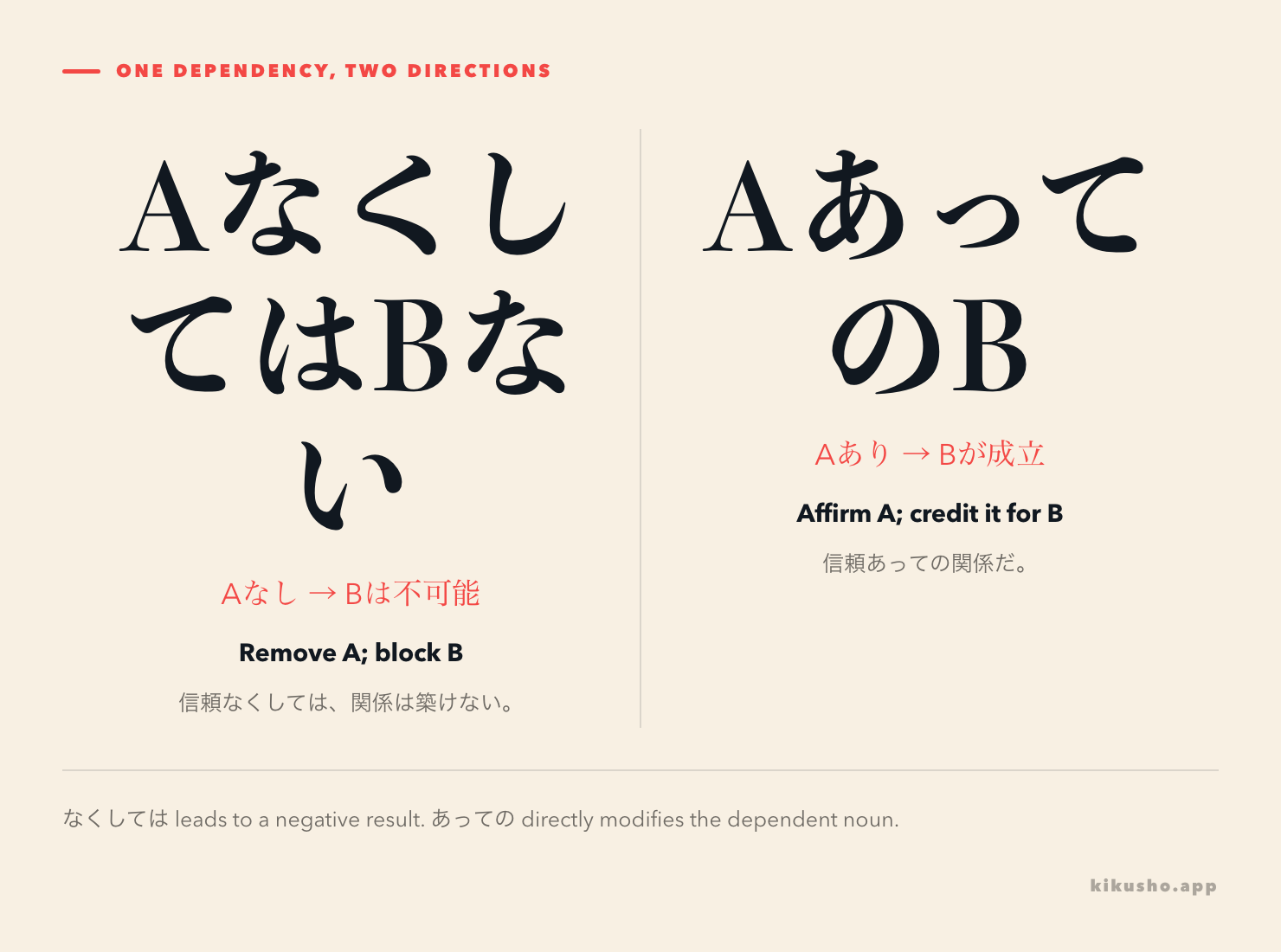
The two forms can describe the same real-world relationship, but they do not occupy the same slot. 応援なくしては優勝できなかった finishes as a sentence with a negative predicate. 応援あっての優勝 is a noun phrase; 優勝 must immediately follow の.
なくしては makes absence block the result
Put a noun before なくしては, then state what cannot exist, happen or be achieved without it.
相互の信頼なくしては、長期的な協力関係は築けない。
そうごの しんらい なくしては、ちょうきてきな きょうりょくかんけいは きずけない。
Without mutual trust, a long-term cooperative relationship cannot be built.
The indispensable element is 相互の信頼. The result ends in 築けない, so the sentence explicitly closes the route to cooperation when trust is absent.
Common negative conclusions include:
| Negative result | Example ending | Force |
|---|---|---|
| ~ない / ~られない | 成功は望めない | the result cannot be expected |
| あり得ない | 改善はあり得ない | the result is inconceivable |
| 不可能だ | 実現は不可能だ | the result is impossible |
| 成り立たない | 制度は成り立たない | the system cannot function |
現場の理解なくして、制度の改善はあり得ない。
げんばの りかい なくして、せいどの かいぜんは ありえない。
Without understanding conditions on the ground, improving the system is impossible.
Here は after なくして is omitted. 日本語NET records both なくしては and なくして, with no change to the core dependency. The particle makes the contrastive condition especially clear, but it is not obligatory.
A verb needs こと before なくしては
The productive routes are N + なくしては and V dictionary form + ことなくしては.
実際に試すことなくしては、この方法の価値は判断できない。
じっさいに ためすこと なくしては、この ほうほうの かちは はんだんできない。
Without trying it in practice, the value of this method cannot be judged.
The verb 試す cannot simply take the target ending as ×試すなくしては. こと turns the action into the indispensable element.
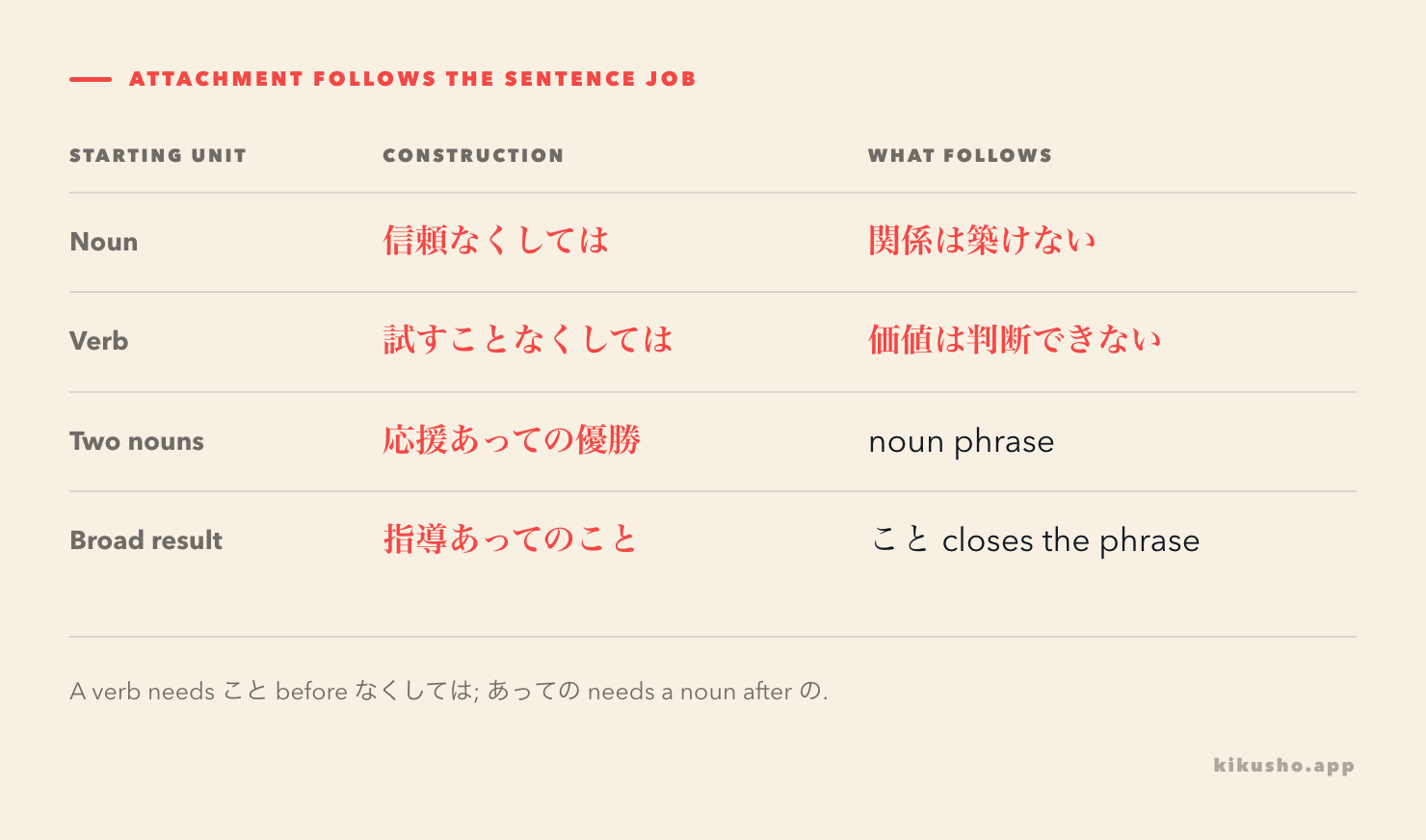
毎日のんびり日本語教師 identifies the same two attachments and describes the form as written language. A compact noun is often more idiomatic than a long nominalized action: 協力することなくしては is grammatical, while 協力なくしては delivers the same claim more cleanly when 協力 already names the needed act.
The construction sounds weightier than everyday AがなければBできない. It suits speeches, arguments, formal statements and maxim-like claims. Using it for a minor practical inconvenience can sound theatrical:
× このペンなくしては、メモが書けない。
このペンがなければ、メモが書けない。
The first sentence is grammatically interpretable, but it treats one pen as a grand indispensable foundation. Ordinary なければ fits the mundane situation unless the exaggeration is intentional.
あっての makes the foundation modify a noun
The core structure is N1 + あっての + N2. N1 exists first; N2 has its value, identity or success because of that foundation.
お客様あっての商売です。
おきゃくさま あっての しょうばいです。
A business exists because of its customers.
健康あっての仕事ですから、無理はしないでください。
けんこう あっての しごとですから、むりは しないでください。
Work depends on having your health, so please do not overdo it.
あっての does not merely list a cause. It ranks N1 as indispensable to how N2 is possible or meaningful. In お客様あっての商売, customers are not one cause among many; the speaker asks the listener to recognize that the business has no standing without them.
日本語NET's あっての lesson gives the relationship as “N2 is established because N1 exists” and confirms the two-noun attachment. MLC Japanese Language School adds a useful discourse tendency: the construction frequently expresses gratitude. This is why 支援, 協力, 指導, 応援 and お客様 are natural first nouns.
今回の受賞は、研究チーム全員の協力あっての成果です。
こんかいの じゅしょうは、けんきゅうチーム ぜんいんの きょうりょく あっての せいかです。
This award is an achievement made possible by the entire research team's cooperation.
Gratitude is frequent, not compulsory. 命あっての物種(いのちあってのものだね) is a fixed proverb-like expression: life is the foundation that makes every other undertaking possible. It supports caution rather than thanking someone.
こと and もの can hold the second noun slot
Because あっての must modify a noun, speakers often use こと or もの when the dependent result is broader than one concrete noun.
今の私があるのは、先生の厳しい指導あってのことです。
いまの わたしが あるのは、せんせいの きびしい しどう あっての ことです。
I am where I am now thanks to my teacher's rigorous guidance.
こと closes the noun phrase and lets the whole sentence credit the present situation to that guidance. Do not stop at ×指導あってのです. The の needs a noun to modify.
You may also see an overt が before あっての, especially when a fuller clause is being emphasized:
家族の励ましがあっての成功だ。
It is a success made possible by the encouragement of the family.
For production, NあってのN is the dependable core. Recognize NがあってのN in context rather than inserting が mechanically into every example.
Swapping the forms requires rebuilding the sentence
Start with one dependency:
十分な準備なくしては、この計画は実行できない。
Without adequate preparation, this plan cannot be carried out.
The sentence removes 十分な準備 and denies 実行できる. To use あっての, turn the result into a noun:
十分な準備あっての計画実行だ。
Carrying out the plan depends on adequate preparation.
This version is possible but dense. A more natural context might name a successful result:
十分な準備あっての成功だ。
The success was possible because of adequate preparation.
The grammar does not permit a word-for-word swap:
| Intended frame | Wrong replacement | Why it fails |
|---|---|---|
| 準備なくしては成功できない | × 準備あっての成功できない | の must modify a noun, not the predicate できない |
| 支援あっての成功だ | × 支援なくしては成功だ | なくしては calls for a blocked or negative result |
Choose the rhetorical move first. If you want to warn that B fails without A, use なくしては. If you want to credit A for the identity or achievement B, use あっての.
Nearby condition patterns make narrower claims
ないことには~ない also presents a necessary condition, but it starts from a negative predicate and often concerns information or a practical step:
実際に話してみないことには、相手の考えはわからない。
Unless you actually speak with the person, you cannot know what they think.
The ないことには lesson shows its productive verb, adjective and noun attachments. なくしては instead tends toward compact nouns and stronger formal claims about a foundation: 信頼なくしては関係は築けない.
Do not confuse ことなくしては with ことなく, “without doing.” In 休むことなく働いた, work continues while rest does not occur. In 休むことなくしては働き続けられない, taking rest is treated as indispensable to continuing work. The ことなく and omission lesson covers the first relationship.
Register and N1 placement
Both forms appear naturally in speeches, formal prose and statements that elevate a condition into a principle. あっての also works in direct expressions of thanks, while なくしては gives the later denial extra weight.
JLPT Sensei's なくしては page and its あっての page place both constructions at N1. Bunpro independently lists なくしては and あっての at N1. Since the exam authority provides no item-by-item grammar syllabus, N1 here is a source-backed study placement rather than a promised test boundary.
For a Kikusho card, preserve both sides of the dependency. Save 信頼なくしては、協力関係は築けない with the blocked result, or 皆の協力あっての成果 with both nouns. A bare card reading “indispensable” cannot train the syntax that separates the two forms.
Practice
Keep the answer panel closed until you have traced the indispensable element and the dependent result in all seven tasks.
Question 1
Complete the formal claim “Without trust, a partnership cannot be built.”
信頼なくしては、協力関係は____。
A. 築ける
B. 築けない
C. 築いての
D. 築くあっての
Question 2
Choose the expression that directly modifies 成功 and credits everyone's cooperation.
これは皆の協力____成功です。
A. なくしては
B. ないことには
C. あっての
D. あっては
Question 3
Turn 実際に試す into the condition of a sentence meaning “Without actually trying it, its value cannot be judged.”
____、その価値は判断できない。
Question 4
Which sentence is structurally complete?
A. お客様あってのです。
B. お客様あっての商売です。
C. お客様なくしては商売です。
D. お客様あって商売できないの。
Question 5
Arrange the fragments to form a statement of gratitude.
- と思います
- 今回の受賞は
- 研究チームの支えあっての成果だ
Question 6
Read the notice and choose the form that fits its formal negative conclusion.
利用者の同意____、個人情報を第三者に提供することはできません。
A. あっての
B. なくしては
C. が必要
D. ないことは
Question 7
Compare the direction of dependence in the pair below.
皆さんの応援なくしては、優勝できなかった。
皆さんの応援あっての優勝です。
Answers and explanations
Answer 1
The blocked-result form is B. 築けない. なくしては removes trust and calls for a result that cannot hold without it. The potential negative 築けない completes that dependency.
Answer 2
Choose C. あっての: 皆の協力あっての成功. 協力 is the indispensable foundation and 成功 is the noun characterized as depending on it.
Answer 3
Use 実際に試すことなくしては: 実際に試すことなくしては、その価値は判断できない。 A verb in dictionary form needs こと before なくしては. The negative 判断できない supplies the blocked result.
Answer 4
Choose B. あっての must modify a following noun, and 商売 fills that slot. A stops before the required noun. C uses なくしては without a negative result.
Answer 5
2 → 3 → 1: 今回の受賞は、研究チームの支えあっての成果だと思います。 The sentence names the award, then credits the team's support as the foundation of the achievement.
Answer 6
Choose B. なくしては. 利用者の同意 is a noun, and 提供することはできません is the negative result. The notice says that disclosure cannot occur without consent.
Answer 7
The first sentence imagines the supporters' encouragement absent and denies that victory could have happened. The second keeps that encouragement present and labels the victory as an achievement founded on it. The real-world dependency is similar, but the first emphasizes impossibility without A and the second gives A credit for B.
Common questions
What is the difference between なくしては and あっての?
NなくしてはBない says that without N, result B cannot hold. N1あってのN2 makes N1 the indispensable foundation of N2 and directly modifies the second noun. The first construction leads to a negative result; the second builds a noun phrase that often expresses recognition or gratitude.
Does なくしては need a negative ending?
The following clause normally blocks the result with ない, できない, あり得ない, 不可能だ or an equivalent negative expression. は may be omitted, but the indispensable-condition meaning remains.
What can come before なくしては?
A noun can attach directly, as in 信頼なくしては. To use a verb, nominalize its dictionary form with こと, as in 協力することなくしては. In many cases a noun such as 協力 or 改革 is more natural and compact.
How does あっての attach?
The core form is N1あってのN2, as in お客様あっての商売. N2 must follow の. こと and 成功 are frequent second nouns when the speaker credits an achievement to support, effort or guidance.