On this page
Use noun + が必要 when a thing is needed, and dictionary-form verb + 必要がある when an action is necessary. Compare パスポートが必要です, “A passport is necessary,” with 予約する必要があります, “It is necessary to make a reservation.”
The shared word is 必要(ひつよう), “need” or “necessity.” What comes before it determines the pattern: a noun marked by が names the needed item, while a plain verb modifies 必要 and names the necessary action.
First decide whether the need is a thing or an action
Ask one concrete question before choosing the grammar.
| What is needed? | Pattern | Example |
|---|---|---|
| a thing | N が 必要だ/です | パスポートが必要です。 |
| doing an action | V dictionary + 必要がある/あります | 予約する必要があります。 |
旅行にはパスポートが必要です。
りょこうには パスポートが ひつようです。
A passport is necessary for the trip.
旅行の前にホテルを予約する必要があります。
りょこうの まえに ホテルを よやくする ひつようが あります。
You need to reserve a hotel before the trip.
The first sentence names パスポート, a needed object. The second names 予約する, an action that needs to happen. English often uses “need” for both, so translating word by word can hide the Japanese structure.
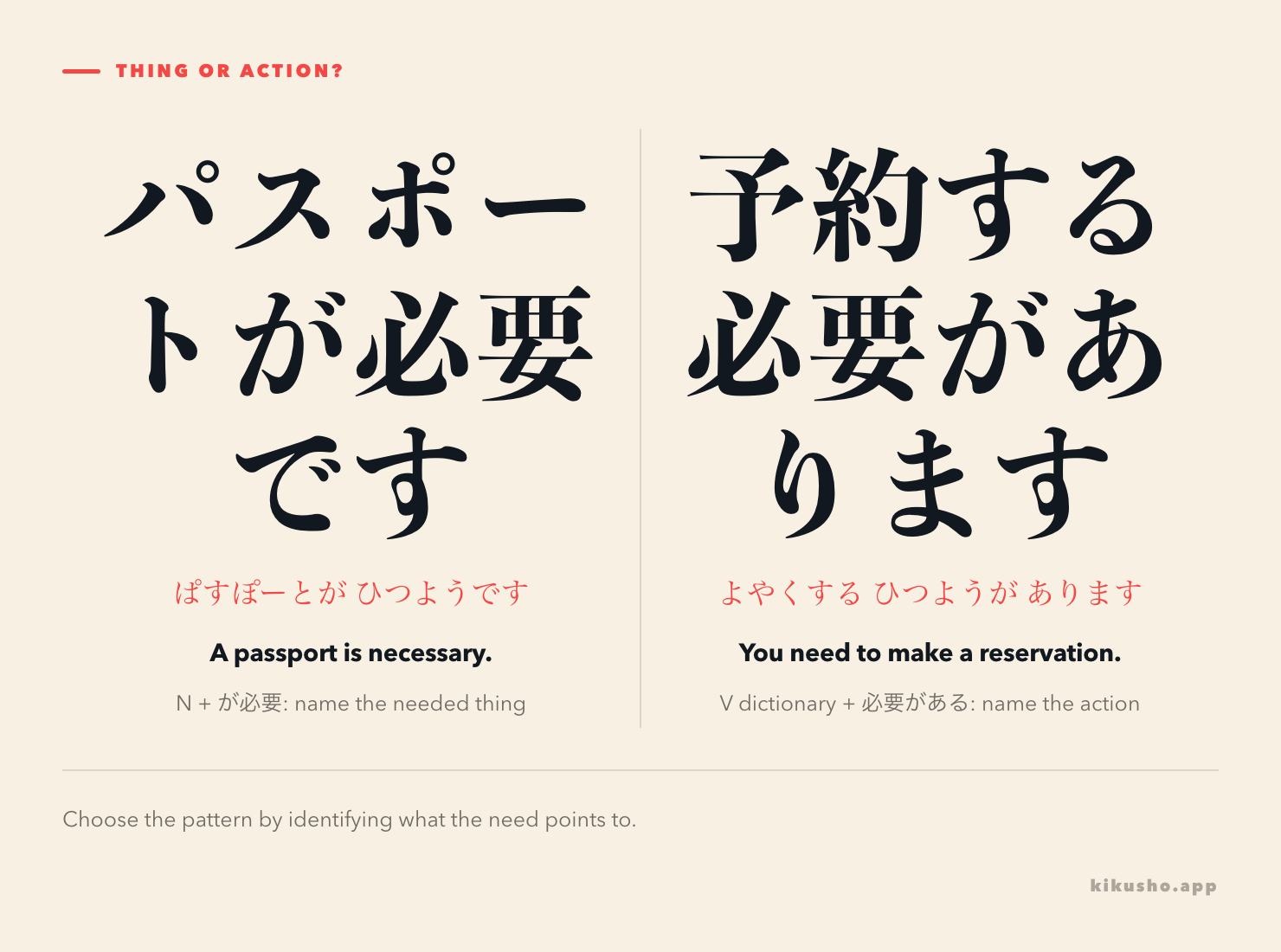
Nが必要 makes the needed thing the grammatical subject
In Nが必要, が marks the item judged necessary. The person, activity, or situation that needs it can appear as a topic with は or には.
私にはもっと時間が必要です。
わたしには もっと じかんが ひつようです。
I need more time.
この仕事には経験が必要です。
この しごとには けいけんが ひつようです。
Experience is necessary for this job.
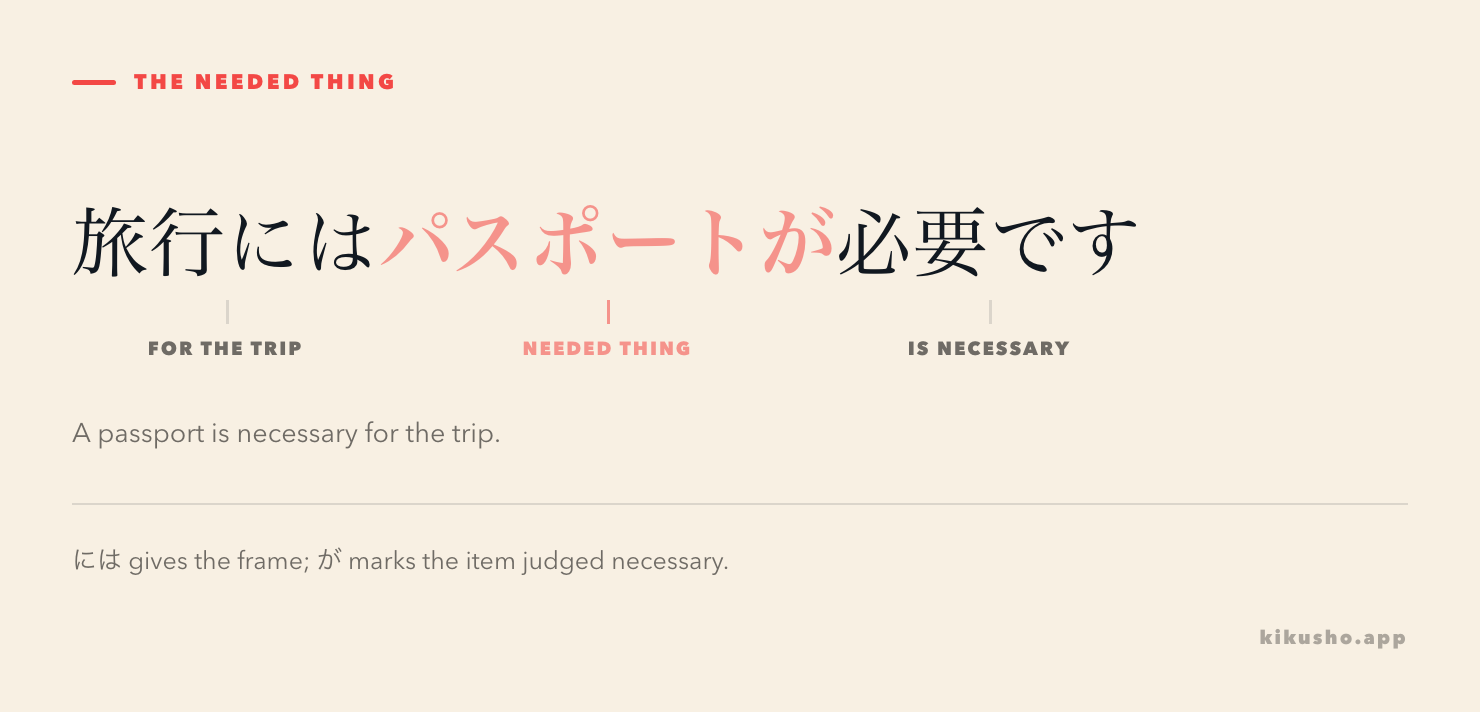
The English subject may be a person — “I need” — but Japanese usually describes the item as necessary for that person: 私には時間が必要です. Do not mark the item with を in this pattern. 時間を必要です is not the construction.
You may encounter 時間を必要とする, “to require time.” That is a separate, more formal transitive expression. At N4, keep the reliable contrast between 時間が必要です and 準備する必要があります.
必要 behaves as a な-adjectival noun. Its plain predicate is 必要だ, and its polite predicate is 必要です:
| Time and style | Example | Meaning |
|---|---|---|
| plain present | お金が必要だ | Money is necessary. |
| polite present | お金が必要です | Money is necessary. |
| plain past | お金が必要だった | Money was necessary. |
| polite past | お金が必要でした | Money was necessary. |
Vる必要がある makes the action modify “need”
Put the verb in its plain non-past form directly before 必要. This is the dictionary form, including 行く, 読む, 食べる, and する.
この書類を今日出す必要があります。
この しょるいを きょう だす ひつようが あります。
It is necessary to submit this document today.
駅で電車を乗り換える必要がある。
えきで でんしゃを のりかえる ひつようが ある。
It is necessary to change trains at the station.
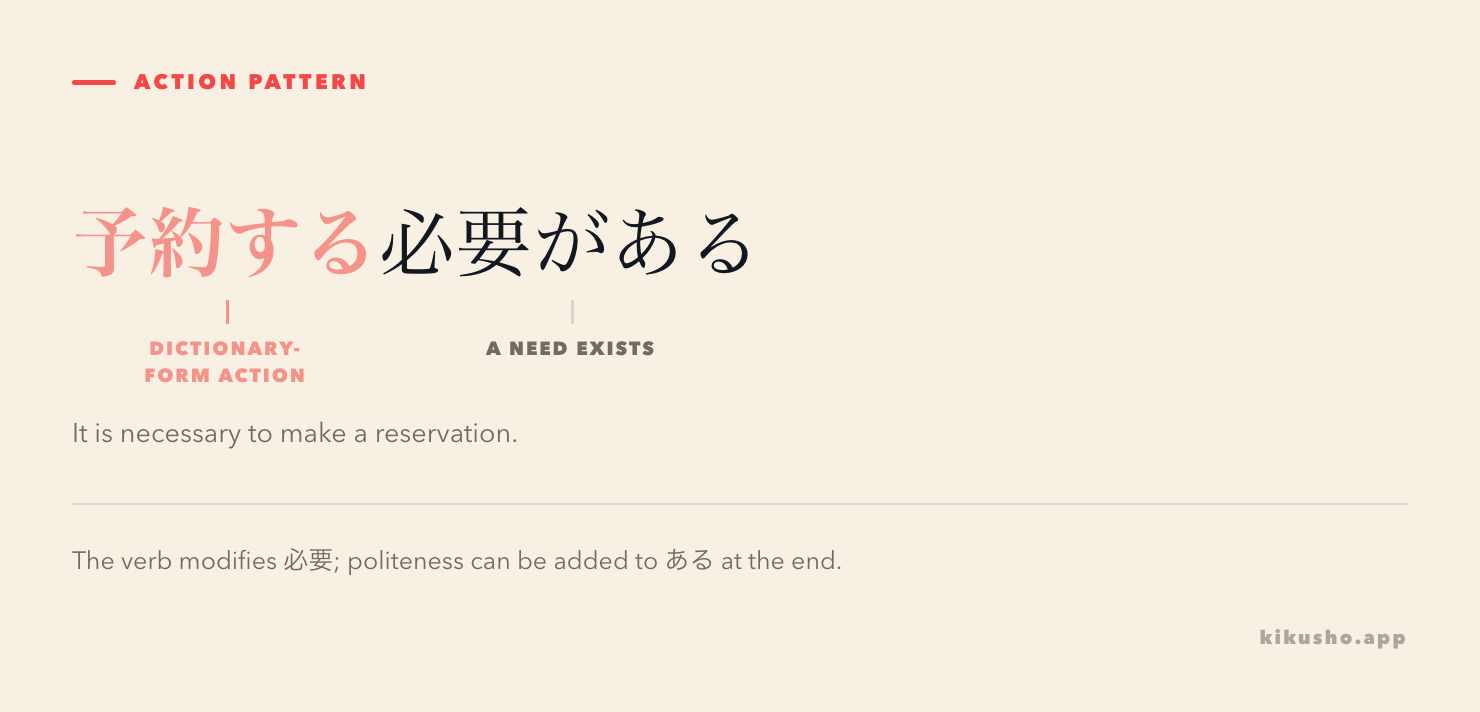
The structure becomes clearer if you read it literally: 予約する modifies the noun 必要, and 必要がある says that this need exists. The action is not made polite inside the phrase. Use 予約する必要があります, not 予約します必要があります.
Tense and politeness appear at the end:
| Form | Example | Meaning |
|---|---|---|
| 必要がある | 確認する必要がある | There is a need to check. |
| 必要があります | 確認する必要があります | It is necessary to check. |
| 必要があった | 確認する必要があった | It was necessary to check. |
| 必要がありました | 確認する必要がありました | It was necessary to check. |
Two bridge forms explain why the patterns look similar
A noun can also modify 必要 with の:
予約の必要があります。
よやくの ひつようが あります。
There is a need for a reservation.
This is grammatical, but it packages 予約 as “the need for a reservation.” When you simply want to identify a needed item, 予約が必要です is often more direct. When you mean that somebody must perform the action of reserving, 予約する必要があります makes the action explicit.
An action can also be turned into a こと phrase:
予約することが必要です。
Reserving is necessary.
This too is grammatical. In many ordinary situations, 予約する必要があります is shorter and more natural. The extra こと is useful only when the sentence specifically treats the action as a nominalized activity or contrasts it with another activity.
These bridges do not erase the main decision rule. Start with Nが必要 for a needed thing and Vる必要がある for a necessary action, then recognize の and こと when you meet them.
Negative necessity often changes が to は
To say that a thing is unnecessary, use Nは必要ない/ありません. To say that an action is unnecessary, use Vる必要はない/ありません.
予約は必要ありません。
よやくは ひつようありません。
A reservation is not necessary.
今日は予約する必要はありません。
きょうは よやくする ひつようは ありません。
There is no need to make a reservation today.
必要がない is also grammatical. は is frequent in clear “no need” statements because it presents or contrasts the supposed need, then denies it. It does not create a prohibition: 予約する必要はありません leaves reserving optional; 予約してはいけません says that reserving is forbidden.
The separate comparison of ことはない and 必要はない covers reassurance, advice, and negative necessity in more depth. The permission and prohibition lesson shows why “not required” and “not allowed” are different claims.
必要がある names a need; なければならない states an obligation
Vる必要がある and Vなければならない can describe the same real-world requirement, but they frame it differently.
この薬を毎日飲む必要があります。
この くすりを まいにち のむ ひつようが あります。
You need to take this medicine every day.
規則でヘルメットを着けなければなりません。
きそくで ヘルメットを つけなければ なりません。
Under the rules, you must wear a helmet.
必要がある presents the existence of a need. It works for practical requirements, recommendations, and conclusions based on circumstances. なければならない directly says that not doing the action will not do, so it readily expresses “must” or “have to.” Neither form has one fixed force in every conversation; a medical necessity may be serious, and a polite obligation can still sound considerate.
Use the grammar to match the message rather than memorizing “soft” and “strong” as absolute labels. The obligation comparison explains なければならない and its conversational contractions.
Common errors come from attaching the wrong unit
The two patterns are easier to correct when you identify the unit before 必要.
| Intended message | Incorrect | Correct |
|---|---|---|
| A ticket is necessary. | 切符を必要です。 | 切符が必要です。 |
| It is necessary to buy a ticket. | 切符を買います必要があります。 | 切符を買う必要があります。 |
| A passport was necessary. | パスポートが必要がありました。 | パスポートが必要でした。 |
| It was necessary to apply. | 申し込む必要でした。 | 申し込む必要がありました。 |
The third error mixes the two predicates. A noun need ends with 必要です/でした. An action need uses the full existence pattern 必要があります/ありました.
The N4 label is a study guide, not an official boundary
JLPT Sensei's が必要 page and its 必要がある page list both patterns at N4. Bunpro independently describes noun + が必要 and dictionary-form verb + 必要がある, while MIT OpenCourseWare's Tobira notes record V dictionary + 必要がある/ない.
Goo's dictionary entry gives 必要 its core sense of something needed or indispensable. These sources support the forms and meanings, but the JLPT does not publish a complete official grammar inventory. N4 therefore marks a practical study stage, not a promise about one exact test item.
Kikusho helps you preserve the reason behind a real example. Save the whole line containing 必要, then note whether the writer needed an object, an action, or compliance with a rule. That small distinction makes the pattern much easier to retrieve later.
Practice: locate the needed thing or action
All answers are grouped below Question 7 so you can complete the full set without seeing a solution early.
Question 1 — grammar choice
Choose the natural completion: 海外旅行にはパスポート__。
A. を必要があります
B. が必要です
C. が必要があります
D. を必要です
Question 2 — find the action pattern
Complete the sentence so it says “It is necessary to submit the form by Friday.”
金曜日までに申込書を__。
A. 出す必要があります
B. 出します必要です
C. 出すが必要です
D. 出した必要があります
Question 3 — sentence composition
Use この仕事, 日本語, and 必要です to write: “Japanese is necessary for this job.”
Question 4 — sentence composition
Use 出発する前に, 切符を買う, and 必要があります to write: “You need to buy a ticket before departing.”
Question 5 — particle choice
Complete both blanks: 私__もっと練習__必要です。
A. を・を
B. には・が
C. が・を
D. には・を
Question 6 — separate the two structures
Examine this entrance notice:
入館には予約が必要です。予約するとき、名前とメールアドレスを入力する必要があります。
Which phrase names a needed thing, and which phrase names a necessary action? Explain what が does in each construction.
Question 7 — text grammar
Read the two rules:
オンラインで参加する人は、会場に来る必要はありません。会場で作業する人は、安全のためヘルメットを着けなければなりません。
Which action is optional, and which action is obligatory? Why does the first sentence not prohibit coming to the venue?
Answers and explanations
Answer 1: B, パスポートが必要です. パスポート is the needed thing, so が marks it before the predicate 必要です. 必要があります belongs to the action pattern when a plain verb modifies 必要; it is not added after the noun pattern here.
Answer 2: A, 出す必要があります. The dictionary form 出す directly modifies 必要. Politeness appears in あります at the end. 出します is already polite and cannot modify 必要 in this construction; 出した is past form rather than the requested necessary future action.
Answer 3: この仕事には日本語が必要です。 この仕事には frames the context “for this job,” and 日本語が marks Japanese as the necessary thing.
Answer 4: 出発する前に、切符を買う必要があります。 The action 切符を買う remains in plain non-past form before 必要があります. 出発する also stays plain because it modifies 前.
Answer 5: B, 私にはもっと練習が必要です. 私には identifies the person for whom the need exists, while 練習が identifies the needed thing. The Japanese structure is literally closer to “For me, more practice is necessary.”
Answer 6: 予約が必要です names the needed thing, 予約, and が marks that noun as necessary. 入力する必要があります names the necessary action, entering the information. Here 入力する modifies the noun 必要, and the が inside 必要があります marks that need as something that exists.
Answer 7: Coming to the venue is optional for online participants because 来る必要はありません removes the requirement; it does not remove permission. Wearing a helmet is obligatory for people working at the venue because 着けなければなりません states that it must be done for safety. A prohibition on coming would require a form such as 来てはいけません.
Common questions
What is the difference between が必要 and 必要がある?
Nが必要 says that a thing is needed: パスポートが必要です, “A passport is necessary.” Dictionary-form verb + 必要がある says that doing an action is necessary: 予約する必要があります, “You need to make a reservation.”
Which verb form comes before 必要がある?
Use the plain non-past, usually called the dictionary form: 行く必要がある, 読む必要がある, and 予約する必要がある. Politeness and tense belong at the end, as in 予約する必要がありました.
What is the negative of 必要がある?
必要がない is grammatical, and 必要はない is especially common when stating that there is no need. Use Nは必要ありません for an unnecessary thing and Vる必要はありません for an unnecessary action.
Is 必要がある the same as なければならない?
They overlap, but they frame the message differently. 必要がある says that a need exists, while なければならない directly presents the action as something that must be done. Context decides how strong either sentence sounds.