On this page
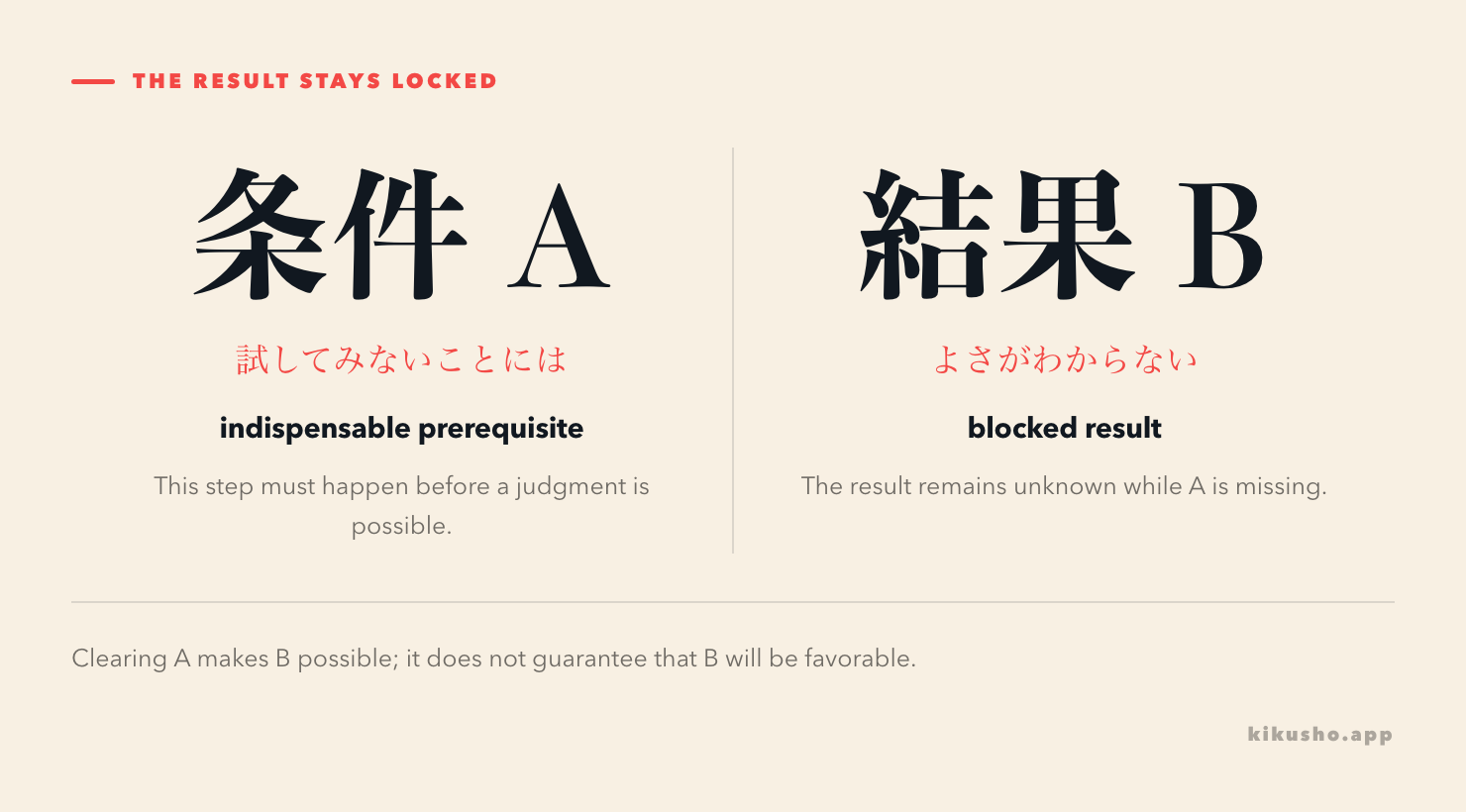
説明書を読まないことには、正しく設定できない means “Unless you read the manual, you cannot configure it correctly.” ~ないことには~ない marks the first event as an indispensable condition: until A happens or becomes true, B remains impossible, unknown, or undecidable.
Both halves are negative in form, but the practical message is positive: reading the manual is required for correct setup. The construction does not directly order someone to read. It explains why the desired result is blocked without that step.
This lesson covers inventory item g-cb031e908d46, ないことには~ない. JLPT Sensei and Bunpro place it at N2. That label is an editorial study placement; the JLPT does not publish an exhaustive grammar syllabus.
Read it as a locked prerequisite
The sentence has two jobs:
| Part | Function | Example |
|---|---|---|
| Aないことには | names the missing indispensable condition | 実際に使ってみないことには |
| Bない | names the result blocked by that absence | 便利かどうかわからない |
実際に使ってみないことには、便利かどうかわからない。
じっさいに つかってみないことには、べんりかどうか わからない。
Unless you actually try using it, you cannot know whether it is convenient.
The first clause does not say that trying guarantees a favorable verdict. Trying only makes a verdict possible. This is a necessary condition, not a sufficient one: A is required for B, but A alone may not produce B.
The Japan Foundation's grammar article on こと explains the relationship as “if that cannot be done, what follows cannot proceed,” with the first event functioning as the necessary condition. That logic also explains the frequent pairing with ~てみる. When knowledge depends on experience, やってみないことには、わからない says that speculation cannot replace the trial.
Build the first clause from a negative predicate
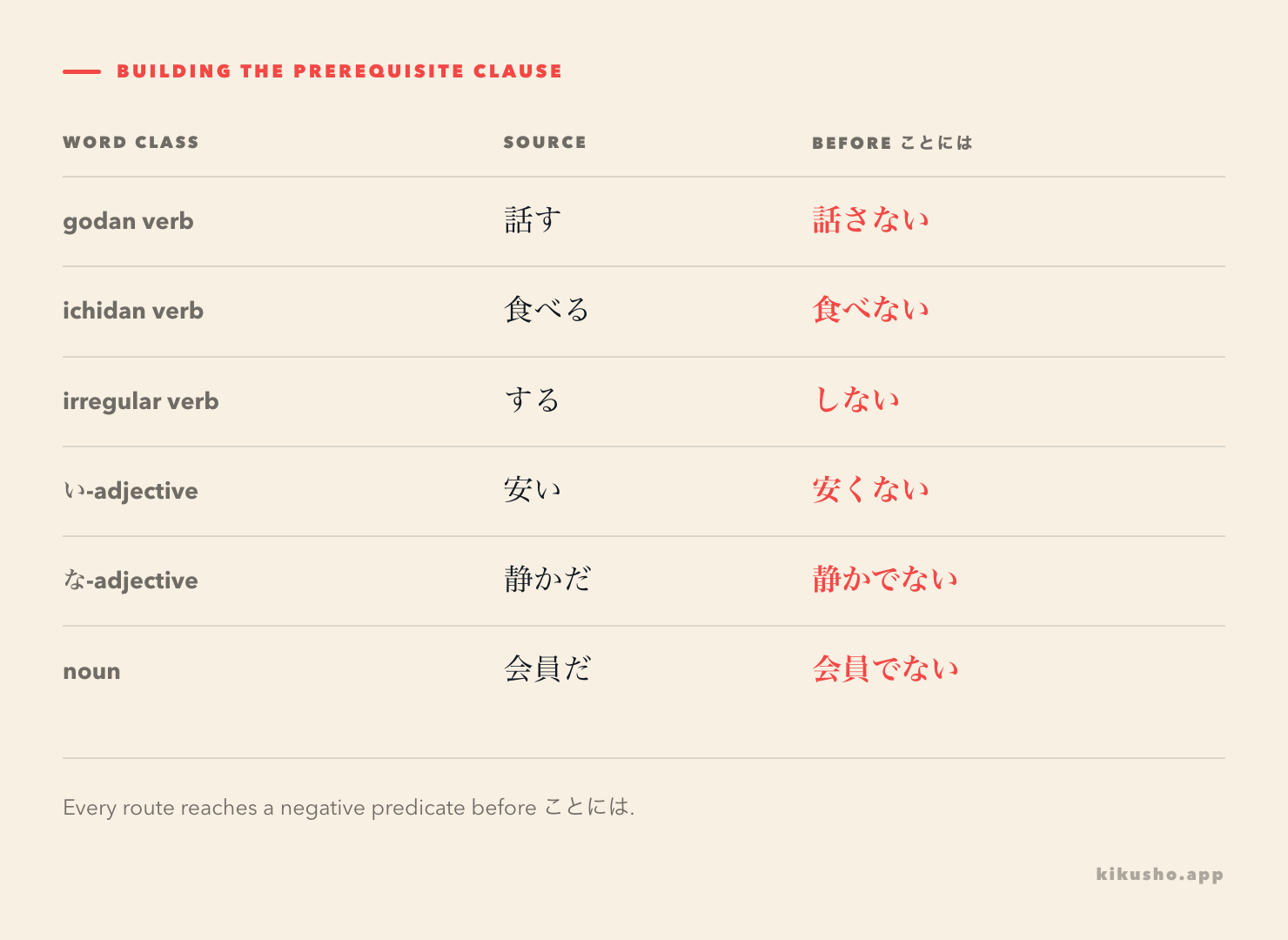
The material before ことには changes with its word class.
| Source | Negative before ことには | Complete first clause |
|---|---|---|
| 話す | 話さない | 話さないことには |
| 食べる | 食べない | 食べないことには |
| する | しない | しないことには |
| 安い | 安くない | 安くないことには |
| 静かだ | 静かでない | 静かでないことには |
| 会員だ | 会員でない | 会員でないことには |
本人と話さないことには、本当の理由はわからない。
ほんにんと はなさないことには、ほんとうの りゆうは わからない。
Unless we speak with the person directly, we cannot know the real reason.
値段がもう少し安くないことには、買う人は増えないだろう。
ねだんが もうすこし やすくないことには、かう ひとは ふえないだろう。
Unless the price is a little lower, the number of buyers probably will not increase.
会員でないことには、この資料を閲覧できない。
かいいんでないことには、この しりょうを えつらんできない。
Unless you are a member, you cannot view this material.
Tanosuke's N2 explanation records all four connections: verb ない, い-adjective くない, な-adjective でない, and noun でない. The verb pattern is the most frequent and productive. Adjective and noun examples are useful for recognition, but do not force them where a simpler conditional would sound more natural.
The second clause must block the result
The conclusion normally contains a negative expression. It often uses:
- わからない — cannot know
- できない/~られない — cannot do
- 決められない — cannot decide
- 始められない — cannot begin
- 難しい/無理だ — difficult or impossible in context
全員がそろわないことには、会議を始められない。
ぜんいんが そろわないことには、かいぎを はじめられない。
Unless everyone is present, we cannot start the meeting.
詳しい条件を確認しないことには、引き受けるかどうか決められない。
くわしい じょうけんを かくにんしないことには、ひきうけるかどうか きめられない。
Unless I check the detailed conditions, I cannot decide whether to accept.
An affirmative conclusion usually breaks the pattern's logic. ×試してみないことには、よさがわかる says “unless you try it, you understand its merits,” which reverses the intended dependency. Use わからない to keep the result blocked.
The negative need not end in the exact word ない. この問題が解決しないことには、先へ進むのは無理だ ends with 無理だ, yet it still says progress is impossible. The decisive test is semantic: does the second clause deny, block, or withhold B?
Why plain なければ is not always the same
An ordinary conditional can report what happens if a condition fails:
説明書を読まなければ、設定を間違えるかもしれない。
If you do not read the manual, you may configure it incorrectly.
ないことには~ない makes a narrower claim:
説明書を読まないことには、正しく設定できない。
Unless you read the manual, you cannot configure it correctly.
The second version singles out reading as indispensable to the result. It often carries the speaker's reluctance, caution, or insistence that an earlier step cannot be skipped. Tanosuke and Nihongo no Sato both note this necessary-condition force and the common sense that the missing condition is undesirable.
Do not confuse that dependency with direct obligation. 説明書を読まなければならない says “You must read the manual.” 説明書を読まないことには、設定できない says “Without reading it, setup cannot be done.” The obligation guide explains how なければならない turns a negative condition into a duty.
One particle separates it from ないことはない
These two strings look nearly identical, but they point in opposite directions.
| Form | Meaning | Example |
|---|---|---|
| ないことには~ない | unless A, B cannot happen | 食べないことには、味はわからない |
| ないことはない | it is not that A never happens; A is possible | 辛い物を食べないことはない |
辛い物を食べないことはない means “It is not that I never eat spicy food,” often implying that the speaker does so sometimes or with reservations. There is no indispensable-condition relationship. In 食べないことには、味はわからない, に belongs to the fixed conditional frame and a blocked result follows.
Spacing and intonation will not rescue an uncertain reading on the exam. Find the following clause. If it says that something remains impossible or unknown, ないことには~ない is likely. If the sentence stops after a double negative or continues with が/けど, the partial-affirmation pattern ないことはない is more likely.
Conversation may leave the blocked result unsaid
When the situation supplies the consequence, a speaker can trail off after ないことには:
まず本人に聞いてみないことには……。
まず ほんにんに きいてみないことには……。
Unless we ask the person first…
The unfinished line suggests “we cannot know,” “we cannot decide,” or another locally obvious limit. This resembles the way conversational sentence-final ないと can leave a bad result understood, but the structures remain different. ないと is a short negative condition and often implies practical obligation. ないことには emphasizes the missing prerequisite and is typically followed by an explicit negative result in careful writing.
The goal-frame Vるには is another useful neighbor. 合格するには、練習が必要だ asks what is needed for passing. 練習しないことには、合格できない states that no practice blocks passing. The には lesson develops that goal-to-requirement frame.
In Kikusho, save both halves of this construction. A card containing only ないことには = unless hides the dependency that makes the expression useful. Capture 条件を確認しないことには、決められない, then mark 確認 = prerequisite and 決定 = blocked result before saving it for offline review.
Practice: find the condition that unlocks the result
Complete the six tasks before revealing the answer panel.
Question 1
Which completion says “Unless we speak directly, we cannot know the truth”?
直接話さないことには、真実は( )。
- わかる
- わからない
- わかることはない
- わからなくてはならない
Question 2
Choose the correct attachment for the い-adjective 安い.
もう少し( )ことには、契約する会社は増えないだろう。
- 安い
- 安くて
- 安くない
- 安いでない
Question 3
Turn 確認する into the first half of ないことには~ない, then complete a sentence meaning “Unless I check the details, I cannot decide.”
Question 4
What is the difference between these two lines?
- A. この料理を食べないことには、味はわからない。
- B. この料理を食べないことはない。
Question 5
Select the sentence that presents everyone being present as indispensable before the meeting can start.
- 全員がそろわないことには、会議を始められない。
- 全員がそろわないことはない。
- 全員がそろわなければならないことはない。
- 全員がそろわないと聞いた。
Question 6
Choose the pair that completes the passage.
新しいシステムは、実際に( ① )、使いやすいかどうか判断できない。問題点が分からなければ、導入するかどうかも( ② )。
- ①使ってみないことには/②決められない
- ①使ってみないことはない/②決められる
- ①使ってみなくてはならない/②決めた
- ①使ってみないことには/②決める
First locate the trial that produces evidence, then check whether the final decision remains blocked.
Answers and explanations
Answer 1. The answer is 2, わからない. The negative result shows that direct conversation is necessary before the truth can be known. Choice 1 reverses the dependency, and choice 4 says that not knowing is obligatory.
Answer 2. Choice 3. An い-adjective keeps its negative くない form before ことには: 安い → 安くないことには. 安くて is a connective て-form, while 安いでない incorrectly applies the noun or な-adjective route.
Answer 3. 詳しいことを確認しないことには、決められない. 確認する → 確認しない gives the negative predicate before ことには. 決められない states the blocked result. 確認しないことには、決める would contradict the target relationship because its conclusion is affirmative.
Answer 4. A means “Unless I eat this dish, I cannot know its taste.” It establishes eating as the indispensable condition for knowing. B means “It is not that I never eat this dish,” a partial affirmation that allows occasional eating. には creates the condition-result frame; は creates the double-negative concession.
Answer 5. Choice 1. The meeting cannot start while the necessary attendance condition is unmet. Choice 2 says it is not the case that everyone never gathers. Choice 3 says that everyone is not required to gather, and choice 4 reports what someone heard.
Answer 6. Choice 1. 使ってみないことには makes an actual trial necessary before usability can be judged. 決められない then keeps the adoption decision blocked while the problems remain unknown. Choice 4 begins correctly but ends affirmatively, so it breaks the construction's logic.
For jl-335, OpenAI Codex carried out the AI review of the assigned pattern, attachments, examples, translations, restrictions and six original questions. No human or native-speaker review is asserted.
Common questions
What does ないことには~ない mean?
It means that unless the condition before ことには is fulfilled, the later result cannot happen or be established. The first condition is presented as indispensable.
Does the clause after ないことには have to be negative?
It normally carries a negative meaning, often with forms such as できない, わからない, 決められない, or 無理だ. In conversation, the negative result can be left unstated when context makes it obvious.
How do adjectives and nouns attach to ないことには?
Use い-adjectiveくない, な-adjectiveでない, or nounでない before ことには: 安くないことには, 静かでないことには, and 会員でないことには.
Is ないことには the same as ないことはない?
No. ないことには introduces an indispensable negative condition: unless X, Y cannot happen. ないことはない is a partial affirmation such as “it is not that I never do it” or “it is not impossible.”