On this page
Nならでは points to a feature or achievement that only N, or especially N, can provide. Aなら/はいざしらず、B sets A aside as a possible exception and then makes a contrasting judgment about B.
この細やかな接客は、老舗旅館ならではだ。
この こまやかな せっきゃくは、しにせりょかん ならではだ。
This attentive service is characteristic of a long-established inn.
初めてならいざしらず、三度目なのに同じ間違いをするのは困る。
はじめて なら いざしらず、さんどめ なのに おなじ まちがいを するのは こまる。
A first time might be understandable, but making the same mistake on the third attempt is a problem.
Both forms contain なら, but they move in different directions. ならでは stays with one source and identifies what distinguishes it. ならいざしらず dismisses one case from the present judgment so the speaker can focus on a different case.
Choose a defining quality or an exception
| Form | What A does | What comes next | Typical translation |
|---|---|---|---|
| Aならでは(のB) | supplies a distinctive source | a quality, product, skill or experience | unique to A; characteristic of A |
| Aならいざしらず、B | becomes a possible exception | a contrasting case that receives the main judgment | A may be one thing, but B… |
| Aはいざしらず、B | is bracketed as the topic | a contrasting case that receives the main judgment | as for A, I cannot say, but B… |
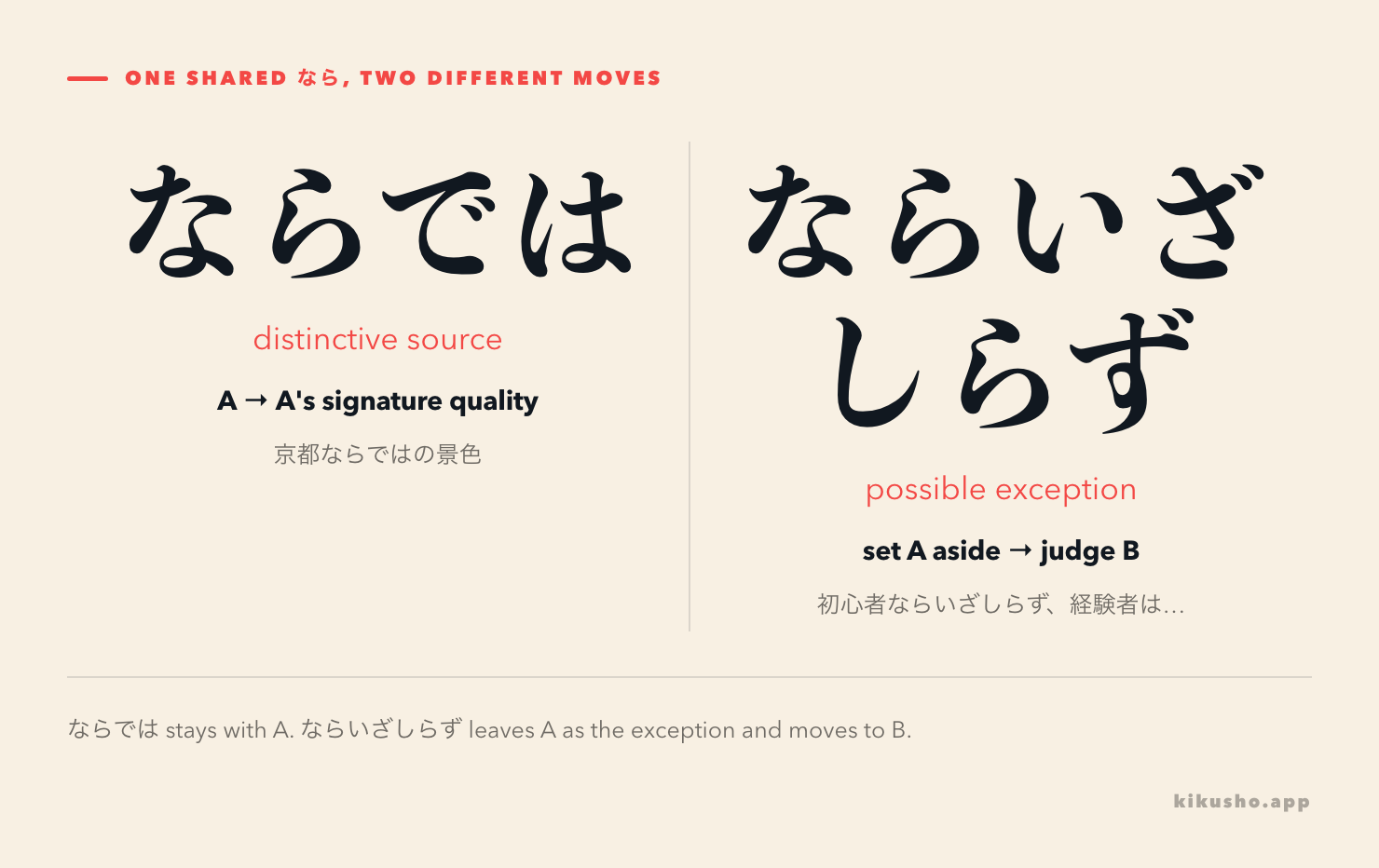
The easiest diagnostic is to ask whether the sentence remains inside A. 京都ならではの景色 describes scenery through Kyoto's distinctiveness. 京都ならいざしらず、東京では難しい leaves Kyoto as the exceptional case and asserts that something is difficult in Tokyo.
ならでは attributes something distinctive to a noun
The core attachment is noun + ならでは. It often takes の before another noun:
雪国ならではの暮らしの知恵が受け継がれている。
ゆきぐに ならではの くらしの ちえが うけつがれている。
Knowledge for daily life that is distinctive of snowy regions has been passed down.
The region is the source; the practical knowledge is the distinctive feature. ならでは implies more than a neutral association. 雪国の暮らしの知恵 means “knowledge for life in a snowy region.” 雪国ならではの暮らしの知恵 says that the conditions of a snowy region produced knowledge not normally found elsewhere.
People, roles and methods can also supply the source:
経験豊かな職人ならではの判断だった。
けいけん ゆたかな しょくにん ならではの はんだんだった。
It was the kind of judgment only an experienced craftsperson could make.
手作りならではの温かみがある。
てづくり ならではの あたたかみが ある。
It has the warmth characteristic of something handmade.
These examples often carry approval, admiration or promotional emphasis. Travel writing, product descriptions and reviews use the form because it singles out a reason that an experience is special. A negative property can be logically distinctive too, but learners should avoid using ならでは to stereotype a group or dress up an ordinary defect as praise.
ならでは can complete the predicate
The following noun may be understood from context. In that case ならでは can stand before だ/です:
この大胆な色使いは、彼女ならではだ。
この だいたんな いろづかいは、かのじょ ならではだ。
This bold use of color is uniquely hers.
The sentence still contains the same relationship as 彼女ならではの色使い. The distinctive quality is mentioned first, and 彼女ならではだ identifies its source.
Do not insert の before the copula: ×彼女ならではのだ is not the ordinary predicate form intended here. Use 彼女ならではだ, or provide a following noun: 彼女ならではの表現だ.
ならいざしらず establishes an exception
いざ知らず literally suggests “I do not know about that,” but the modern construction is not a request for information. The speaker withholds or suspends judgment about A, then makes the main claim about B.
子供ならいざしらず、大人が公共の場で騒ぐのは困る。
こども なら いざしらず、おとなが こうきょうの ばで さわぐのは こまる。
Children might be another matter, but adults making noise in public is a problem.
The speaker does not fully approve of noisy children. Children are simply easier to excuse than adults. The second case is less acceptable and carries the sentence's main judgment.
一度の遅刻ならいざしらず、毎週遅れる人にこの仕事は任せられない。
いちどの ちこく なら いざしらず、まいしゅう おくれる ひとに この しごとは まかせられない。
Being late once might be one thing, but this job cannot be entrusted to someone who is late every week.
The relationship frequently follows a scale: once versus every week, a child versus an adult, an inexpensive product versus a premium one, or the past versus the present. A falls inside a range the speaker may excuse; B falls outside it.
はいざしらず brackets a topic
With は, A is presented as a contrasted topic:
昔はいざしらず、今は海外でもすぐに連絡が取れる。
むかしは いざしらず、いまは かいがいでも すぐに れんらくが とれる。
The past may have been different, but now you can contact people abroad immediately.
専門家はいざしらず、初心者にはこの説明だけでは難しい。
せんもんかは いざしらず、しょしんしゃには この せつめいだけでは むずかしい。
Experts may be another matter, but this explanation alone is difficult for beginners.
なら makes A sound like a conditional case: “if it is A, perhaps.” は makes A the topic being set aside. In many noun examples the two are close, and both lead to a contrast. Do not assume that は creates a completely different grammar point.
The phrase sounds formal, literary or deliberately forceful. In an everyday complaint, ならまだしも is often more natural:
一日ならまだしも、一週間も返事を待てない。
One day would be one thing, but I cannot wait a whole week for a reply.
The ならまだしも lesson explains the everyday boundary between a tolerable A and a worse B. ならいざしらず can express the same broad architecture, but its “setting aside” language is more elevated and categorical.
A clause can attach directly or become one case with の
A noun attaches directly to both constructions. A verb, adjective or longer proposition before ならいざしらず appears in plain form. の can package that proposition as one case before なら and is especially useful when the clause is long.
| Input | Dependable attachment | Example |
|---|---|---|
| noun | N + なら/はいざしらず | 初心者ならいざしらず |
| verb clause | plain clause + (の)ならいざしらず | 一度忘れた(の)ならいざしらず |
| い-adjective clause | plain clause + (の)ならいざしらず | 少し高い(の)ならいざしらず |
| な-adjective clause | N/な-adjective + なら/なのならいざしらず | 不便(なの)ならいざしらず |
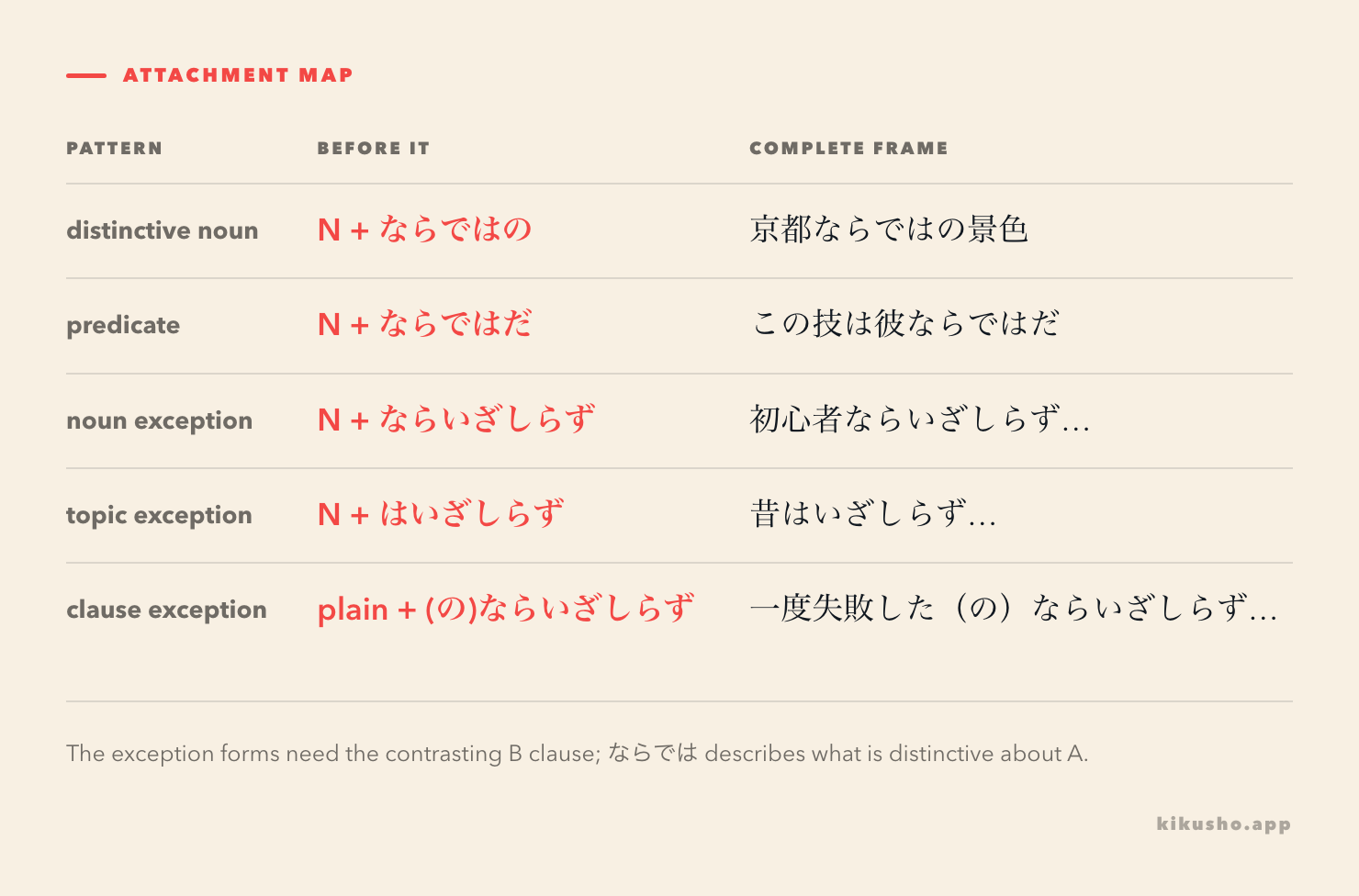
一度失敗したのならいざしらず、試しもしないで諦めるのは早い。
いちど しっぱいしたの なら いざしらず、ためしも しないで あきらめるのは はやい。
Having failed once might be another matter, but it is too soon to give up without even trying.
The first clause is treated as one imaginable excuse. The actual B case—giving up without trying—does not qualify for that excuse.
Reference examples use both direct plain-form attachment and のなら. The nominalized route makes a full proposition especially easy to read, but の is not compulsory: 日本語が話せないならいざしらず is also well formed.
The shared なら does not make the forms interchangeable
Compare two sentences about a chef:
この繊細な盛り付けは、一流の料理人ならではだ。
This delicate presentation is characteristic of a first-rate chef.
一流の料理人ならいざしらず、私に同じ盛り付けを求めるのは無理だ。
A first-rate chef may be another matter, but asking me for the same presentation is unreasonable.
The first sentence stays with the chef and credits the distinctive result to that expertise. The second exempts such a chef from the speaker's claim and then judges the demand placed on 私.
| Intended message | Correct form | Why |
|---|---|---|
| a quality belongs especially to Kyoto | 京都ならではの雰囲気 | Kyoto is the source of the quality |
| Kyoto may be possible, but Tokyo is not | 京都ならいざしらず、東京では難しい | Kyoto is the exceptional case |
| experts may understand, but beginners will not | 専門家はいざしらず、初心者には難しい | experts are bracketed before the main judgment |
はともかく also sets an issue aside, but often does so to change priorities rather than to create an exceptional comparison. The はもとより and はともかく lesson contrasts inclusion with that bracketing move. Use いざしらず when the A-versus-B contrast and the speaker's stronger judgment of B are central.
N1 placement and register
JLPT Sensei's ならでは page and 日本語NET independently give the noun attachment, uniqueness meaning and N1 placement. 日本語NET also shows the common NならではのN shape.
For the exception pattern, JLPT Sensei and 絵でわかる日本語 both place ならいざしらず/はいざしらず at N1 and support its “A may be one thing, but B” structure. Because the exam authority provides no item-by-item grammar catalogue, N1 here is a consistent estimate across independent teaching references rather than a guaranteed test boundary.
In Kikusho, save the relationship rather than an isolated gloss. A card for ならでは should retain both source and feature: 手作りならではの温かみ. A card for ならいざしらず needs both sides of the contrast: 一度ならいざしらず、毎週遅れるのは困る. Removing B also removes the judgment that gives the pattern its purpose.
Practice
Trace the source or the exception in all seven tasks, then open the explanation panel.
Question 1
Choose the form that presents hospitality as distinctive of a long-established inn.
この細やかな接客は、老舗旅館____。
A. ならいざしらず
B. ならではだ
C. はいざしらず
D. ならまだしもだ
Question 2
Complete the criticism: “A child might be another matter, but an adult should not behave that way.”
子供____、大人がそんな振る舞いをするべきではない。
A. ならでは
B. ならいざしらず
C. ならではの
D. にほかならず
Question 3
Which phrase means “scenery distinctive of Kyoto”?
A. 京都ならいざしらず景色
B. 京都ならでは景色
C. 京都ならではの景色
D. 京都はいざしらずの景色
Question 4
Arrange the chunks to say “The past may have been different, but now information can be found immediately.”
- 今は情報をすぐに調べられる
- 昔は
- いざしらず
- 、
Question 5
Choose the sentence that correctly packages a full clause as the possible exception.
A. 一度失敗したのならいざしらず、何も試さず諦めるのは早い。
B. 一度失敗したならでは、何も試さず諦めるのは早い。
C. 一度失敗したのならではの、何も試さず諦めるのは早い。
D. 一度失敗はいざしらずの、何も試さず諦めるのは早い。
Question 6
Rewrite the pair as one sentence with ならでは.
この温かみは手作りの品に特有だ。
Question 7
Complete both blanks with the form that matches each discourse move.
この大胆な発想は彼女( )。新人( )、経験者が基本的な確認を忘れるのは困る。
Answers and explanations
1.
B. ならではだ. The distinctive quality, この細やかな接客, appears first, and 老舗旅館ならではだ identifies its source. ならいざしらず would require a contrasting B case.
2.
B. ならいざしらず. Children form the possible exception; adults receive the main negative judgment. ならでは would describe a distinctive feature rather than establish an excusable benchmark.
3.
C. 京都ならではの景色. ならでは takes の when it modifies the following noun 景色. A bare 京都ならでは can finish a predicate, but not directly modify 景色 without の.
4.
2 → 3 → 4 → 1: 昔はいざしらず、今は情報をすぐに調べられる。 昔 is the topic placed outside the present claim, while 今 receives the assertion.
5.
A. 一度失敗したの packages the whole event as one case before ならいざしらず. The remaining options combine the distinctive-quality pattern with an exception structure or attach の in the wrong place.
6.
One natural answer is これは手作りならではの温かみだ。 You can also say この温かみは手作りならではだ. Both retain the source-feature relationship; the first uses ならではの attributively and the second uses ならではだ predicatively.
7.
彼女ならではだ / 新人ならいざしらず. The first clause credits the idea to her distinctive style. The second makes a novice the possible exception before criticizing an experienced person. The repeated なら does not give the two forms the same discourse job.
Common questions
What is the difference between ならでは and ならいざしらず?
Nならでは identifies a quality, experience or achievement as distinctive of N. AならいざしらずB sets A aside as a possible exception, then makes a contrasting judgment about B. The first describes what makes A special; the second separates A from the case the speaker really wants to judge.
How does ならでは attach to a noun?
Put the noun directly before ならでは. The most common attributive form is NならではのN, as in 京都ならではの景色. It can also end a predicate, as in この味はあの店ならではだ.
What can come before ならいざしらず?
A noun can attach directly, as in 初心者ならいざしらず. A verb, adjective or longer proposition appears in plain form and can be nominalized with の, as in 一度失敗した(の)ならいざしらず.
Are ならでは and ならいざしらず formal?
ならでは is common in careful speech, reviews, advertising and descriptive writing. ならいざしらず and はいざしらず sound more literary and forceful; everyday conversation often uses ならまだしも or はともかく instead.